

The camera with the longest advertised infrared range may still leave your Abu Dhabi site with footage that can’t answer the question that matters: who was there, and what happened? For businesses comparing night vision CCTV cameras for business Abu Dhabi, usable evidence depends on more than a range figure. Lighting, distance, mounting angle, movement, and the detail required all affect what appears in a recording.
It’s reasonable to expect a night camera to cover a dark loading bay, entrance, or car park, but the label alone can’t confirm it will perform well in your conditions. Infrared cameras typically produce monochrome images in darkness, while low-light colour cameras rely on ambient light and may not suit every unlit area. Reviewing footage at the distance and in the lighting you expect can help set realistic expectations.
This 2026 guide explains how to compare night performance, assess business risks, and plan camera positions around the evidence you need. It also outlines what to discuss during a professional site assessment, installation, and ongoing maintenance planning. The aim is a system specified for your premises, not simply a camera selected by its maximum range.
Key Takeaways
- Choose night vision CCTV cameras for business Abu Dhabi by matching their capabilities to the risks and scenes your site needs to monitor.
- Check resolution, lens coverage, low-light performance, and recording compatibility together before specifying a system.
- Use a structured site assessment to map entrances, perimeter approaches, loading areas, parking, and internal transition points.
- Include night-time testing in the coverage plan to identify gaps before the system is handed over.
- Assess how an installation and maintenance partner handles system testing, faults, configuration changes, and maintenance requests.
What Night Vision CCTV Cameras Can Capture at an Abu Dhabi Business After Dark
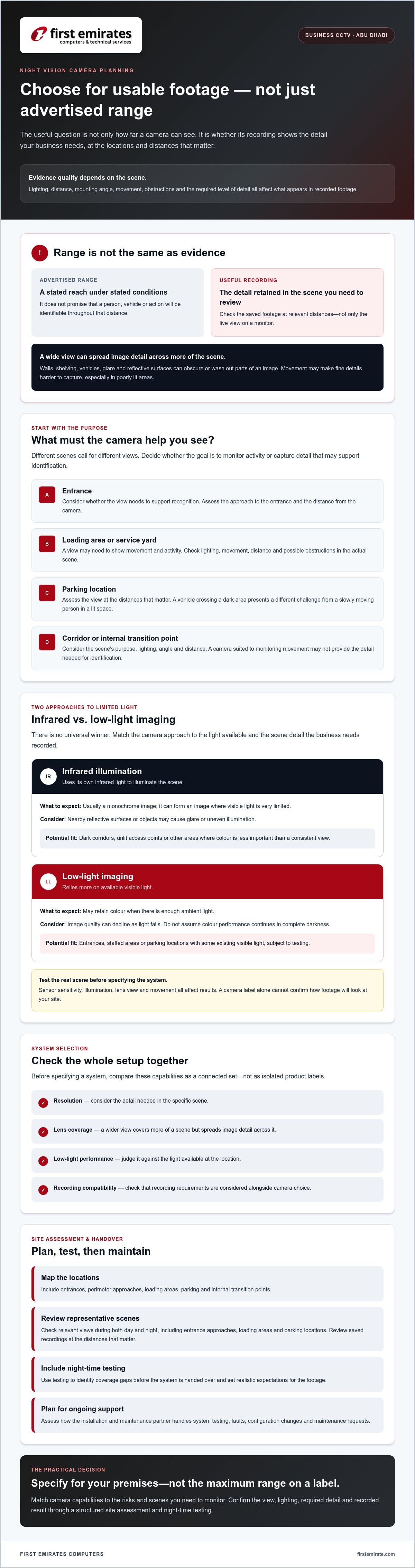
Night vision CCTV cameras for business Abu Dhabi sites are designed to record scenes when visible light is limited, but the label alone doesn’t tell you whether footage will show useful detail. Performance depends on the scene: distance from the camera, available light, movement, obstructions, and how the camera is positioned all affect what can be seen.
Night vision CCTV is imaging designed to record low-light or dark scenes, with evidence quality determined by the detail a camera can capture at the specific locations and distances that matter to a business. This distinction helps set a practical objective. A camera may be suitable for monitoring movement through a corridor, while identifying a person at an entrance or a vehicle in a parking area may require more detail and a different view.
Night vision can use active infrared illumination, which helps a camera form an image when visible light is scarce. The basic principles of night vision technology provide useful context, but business CCTV performance still needs to be assessed against the site and its recording requirements.
What does night vision mean for a business security camera?
Night vision describes a camera’s performance in low-light or dark conditions. It doesn’t guarantee that every feature will remain clear in live viewing or saved footage. An entrance may need a view that supports recognition, while a loading area may primarily need to show movement and activity. Corridors and parking locations present different distances, lighting conditions, and angles, so assess each scene according to its purpose.
Why does advertised night vision range not guarantee clear evidence?
An advertised range indicates reach under stated conditions, not a promise that a person, vehicle, or action will be identifiable throughout that distance. A wide field of view spreads image detail across more of the scene. Walls, shelving, vehicles, glare, and reflective surfaces can also obscure or wash out parts of an image. Movement may make fine details harder to capture, particularly in a poorly lit area.
Assess representative scenes before finalizing camera positions. Review views during both day and night, including the approach to an entrance, a loading area, and a parking location. Check what the recording retains at the distances relevant to your security needs, not only what appears on a live monitor. This helps distinguish broad activity monitoring from footage intended to support identification and informs a site-specific CCTV assessment.
Infrared vs Low-Light Cameras: How Business Night Vision Works
Infrared and low-light cameras handle limited illumination differently. Infrared (IR) cameras use their own infrared light to illuminate a scene, usually recording it in monochrome. Low-light cameras rely more on available visible light and may retain colour when that light is sufficient. For a plain-language overview of How night vision works, see HowStuffWorks. The practical choice depends on the site, not a universal ranking.
Choose a camera according to the light available at the location and the level of scene detail your business needs recorded. Sensor sensitivity, illumination, lens view, and movement all affect results. A slowly moving person in a lit reception area presents a different challenge from a vehicle crossing a dark service yard.
| Approach | Advantages | Limitations | Potentially suitable conditions |
|---|---|---|---|
| Infrared illumination | Can illuminate a scene where visible light is very limited, producing an image without relying on ordinary lighting. | Footage is generally monochrome; nearby reflective surfaces or objects can cause glare or uneven illumination. | Dark corridors, unlit access points, or other areas where colour is less important than a consistent view. |
| Low-light imaging | May retain colour detail when there is enough ambient light, which can help distinguish visible features in a scene. | Image quality can decline as light falls. Colour performance should not be assumed to continue in complete darkness. | Entrances, staffed areas, or parking locations with some existing visible light, subject to testing. |
When is infrared night vision suitable for business premises?
Infrared is worth considering where visible lighting is limited or unavailable and a dependable view matters more than colour. However, a camera looking through reflective glass may capture reflections rather than a clear exterior scene. Close walls, signs, or other surfaces can also reflect the camera’s infrared light back into the lens. Ask to review sample footage from comparable distances and angles before specifying the camera.
When can low-light or colour-at-night imaging be useful?
Low-light imaging may preserve colour information when there is ambient light, such as exterior lighting near an entrance. Colour can help distinguish a vehicle or clothing, but only if the proposed camera records adequate detail under the site’s actual conditions. In very dark locations, confirm whether the system needs another source of illumination or an infrared option instead.
For night vision CCTV cameras for business Abu Dhabi, assess each area against its lighting and recording purpose. A site assessment can connect those conditions to camera selection and installation planning. First Emirates Computers provides CCTV surveillance systems for businesses in Abu Dhabi.
How to Compare Night Vision CCTV Cameras for an Abu Dhabi Business
Start with the risk, not a camera specification. Identify which after-dark scenes need to be monitored and what the recording must help establish: movement through a service entrance, activity near stock, or vehicle access to a parking area. This purpose guides the choices that follow and helps prevent a wide view from being mistaken for sufficient detail.
Which camera specifications matter most after dark?
Compare resolution and lens coverage together. A higher resolution may capture more image detail, but the lens and field of view determine how that detail is distributed across the scene. A broad view can suit general monitoring, while a specific identification task may need a tighter view of a defined area. Ask to review recorded night footage from comparable distances and lighting, not just product demonstrations or live views.
Check that the proposed recorder or video management system can support the cameras and the intended recording settings. Confirm the image quality that will actually be saved, since recording configuration can affect the detail available for later review. Also verify each camera’s environmental ratings and operating limits for its intended position, including exposure to heat, dust, direct sun, or other site conditions. These are specifications to confirm for the selected equipment, not assume from the camera category.
How should businesses assess recording and system compatibility?
Ask the provider to explain how cameras will connect to recording equipment and the existing network infrastructure. Confirm network capacity for the planned camera count and recording settings, and establish who needs access to live views and recorded footage. Access should be assigned according to business roles and reviewed as those responsibilities change.
Storage and retrieval need equal attention. Agree on the required retention period for the project, how footage will be located and exported when needed, and which users are authorized to retrieve it. Applicable requirements can vary by project or sector, so confirm them with the relevant provider rather than assuming one retention setting suits every Abu Dhabi business. Include maintenance planning so faults, storage issues, or configuration changes can be addressed as part of the system’s ongoing reliability.
Use this checklist to compare proposed night vision CCTV cameras for business Abu Dhabi sites:
- Scene and purpose: What area is covered, and is the priority general monitoring or capturing specific detail?
- Image and recording: Do sample night recordings show the required detail, and can the recorder support the specified settings?
- Infrastructure and access: Are network capacity, storage, retrieval steps, and authorized users clearly defined?
- Site conditions: Are camera ratings and operating limits appropriate for the exact installation location?
A documented site assessment can connect these requirements to camera selection and installation, helping ensure the proposed system fits the premises rather than relying on specifications in isolation.
Plan Night Vision CCTV Coverage for an Abu Dhabi Business Site
Effective coverage starts with site conditions and business risks, not a camera count. An assessment should connect each location to its purpose, the expected lighting after dark, and the detail required from recorded footage. For night vision CCTV cameras for business Abu Dhabi premises, plan camera positions and installation together, then verify the result in actual nighttime conditions.
How should a business map night-time camera coverage?
Walk the site and mark entrances, perimeter approaches, loading areas, parking, critical assets, and internal transition points such as doorways between public and restricted areas. Record when these spaces are active and which hours need monitoring. Note existing lighting, likely blind spots, obstructions, glare, and where overlapping views may be needed to follow activity between areas.
Use a numbered assessment sequence:
- Map risks and priorities: Identify important assets, access routes, and the events the system needs to record.
- Inspect each location: Check lighting, glare, obstructions, dust exposure, heat exposure, and suitable mounting positions.
- Plan views and infrastructure: Confirm camera angles, coverage gaps, potential overlap, and practical cable routes.
- Verify requirements: Confirm project-specific approval and environmental requirements with the relevant parties before installation.
- Test and document: Review recorded footage after dark, make adjustments, and record limitations and handover details.
What should happen during night-time testing and commissioning?
Test recorded footage from each proposed camera position after dark, including the approaches and activity areas identified during the assessment. Review whether the view captures the intended scene at its actual distance, and check for glare, shadows, obstructions, or uneven illumination. A daytime check alone won’t show how lighting and camera performance interact at night.
Adjust focus, angle, illumination, and recording settings based on what the footage shows. Retest after changes. Before handover, document coverage limitations, authorized user access, and the procedure for reviewing or retrieving recordings. Site managers should know which areas are covered and where the system has constraints.
A structured assessment links site risks to camera placement, installation, and recorded results. First Emirates Computers provides CCTV surveillance systems in Abu Dhabi. Discuss CCTV coverage for your business site as part of planning a system suited to its operating conditions.
Choose a CCTV Installation and Maintenance Partner in Abu Dhabi
A night-time CCTV system depends on more than camera selection. The provider should connect the site assessment to coverage design, installation, testing, and handover, with clear responsibilities at each stage. For night vision CCTV cameras for business Abu Dhabi, ask how the proposed views address your business risks and how the provider will confirm recorded footage is usable after dark.
What should a business confirm before approving a CCTV proposal?
Request a camera-by-camera schedule that states each camera’s purpose, position, field of view, and recording method. The proposal should also clarify installation scope, network dependencies, commissioning tests, and what staff will be shown during handover. A written scope makes it easier to check that entrances, loading areas, parking, and other priority locations are accounted for.
Confirm any approval requirements that apply to your particular project with the relevant parties. Don’t assume one rule applies universally. You can also refer to this CCTV installation guide when preparing questions for a provider. Before approval, clarify who is responsible for confirming requirements and documenting the agreed system configuration.
How can ongoing maintenance support reliable night-time recording?
Maintenance planning helps keep a system aligned with its intended coverage over time. Ask whether checks include camera alignment, lens condition, recording status, and night-time image performance. Also clarify how faults are reported, how configuration changes are requested, and how service requests are managed. Confirm the maintenance scope and responsibilities in writing rather than relying on assumptions about what is included.
Discuss how authorized staff can retrieve footage and what steps they should follow if a recording is needed. A clear handover should cover user access, system operation, known coverage limitations, and the process for raising maintenance requests. For further guidance, see CCTV maintenance contract guidance.
First Emirates Computers is an Abu Dhabi-based provider of CCTV surveillance systems and offers annual maintenance contracts for clients across the UAE. Discuss your Abu Dhabi business CCTV requirements to explore site assessment, installation planning, and maintenance considerations for your premises.
Build a Night-Time CCTV Plan Around Your Site
Choosing night vision CCTV cameras for business Abu Dhabi premises starts with the evidence your team needs, not the maximum range on a specification sheet. Match camera type, lens coverage, recording quality, and storage to the site’s lighting and security priorities. Then confirm performance through night-time testing at the planned positions.
A clear proposal should connect assessment, camera placement, installation, commissioning, and handover. Agree on how footage is retrieved, who can access it, and how faults or maintenance requests will be handled. These practical steps help keep the system aligned with your site requirements after installation.
First Emirates Computers is an Abu Dhabi-based CCTV and biometric access control specialist with CCTV installation and ELV project capability. The company also provides annual maintenance contract services across the UAE. To discuss assessment, installation, or ongoing maintenance planning for your premises, discuss your business CCTV requirements with First Emirates Computers.
A well-specified system begins with a clear view of your risks and a plan that can be tested on site. With those foundations in place, you can move forward with greater confidence in your night-time coverage.
Frequently Asked Questions
Is infrared or colour night vision better for business CCTV?
Neither is universally better; the right choice depends on lighting, distance, and the detail your business needs to capture. Infrared can support imaging in very dark areas, while low-light colour imaging may retain colour when enough ambient light is available. Ask the installer to demonstrate recorded footage under conditions similar to your site. Check whether people, vehicles, or activity can be identified at the relevant distances, rather than judging image quality from a live view alone.
Can night vision CCTV cameras record clearly in complete darkness?
Some cameras use infrared illumination to capture images when visible light is absent, but clear footage isn’t guaranteed in every scene. Results depend on the camera, distance, scene layout, and reflective surfaces. Ask to review sample recordings from comparable conditions and arrange a test after dark at the proposed location. This helps establish whether the image provides the level of detail your business needs, rather than relying on an advertised range as a measure of identification quality.
How far can a business night vision CCTV camera see?
There isn’t one useful distance that applies to every camera and scene. The result depends on the lens, resolution, illumination, target size, obstructions, and the detail required. A camera may show activity at a distance without capturing enough detail to identify a person or vehicle. Ask the provider to demonstrate recorded footage at relevant site distances, then decide whether it supports general monitoring or the evidence needs of that location.
What should a business check when choosing night vision CCTV cameras in Abu Dhabi?
Start by defining the locations to monitor and the risks the system should address. Then compare low-light performance, lens coverage, recording compatibility, storage, network requirements, and environmental suitability for each camera position. Request a site assessment and review night-time footage under representative conditions. For night vision CCTV cameras for business Abu Dhabi, confirm any approval requirements that apply to your specific project with the relevant authority or project professional.
Do night vision CCTV cameras work through glass?
They may produce poor night footage through glass, particularly if infrared illumination reflects off the pane and creates glare or obscures the view. The result depends on camera placement, lighting, and the intended angle. Have the proposed position assessed on site and tested after dark. A suitable alternative may be to position the camera outside the glass or change the viewing angle, subject to the site layout and project requirements.
What happens if a business CCTV camera has night vision but footage is still unclear?
Check the focus, camera angle, lens coverage, lighting, reflections, obstructions, and recording settings. The camera may be operating normally while distance or scene conditions prevent it from capturing useful detail. Review saved footage at the recorder, identify what information the business needs to see, and ask the installer to adjust or reassess the position. Test the revised view under the same night-time conditions before considering the issue resolved.
How often should business night vision CCTV cameras be maintained?
Maintenance frequency depends on the site, equipment, operating conditions, and agreed service scope. Establish a process to check image clarity, camera alignment, recording status, and night performance. Ask the provider what inspections and support are included, how faults are reported, and how maintenance activity is documented. First Emirates Computers provides annual maintenance contracts for clients across the UAE; confirm the specific checks and responsibilities that would apply to your CCTV system.


