

With annual retail shrinkage draining $112 billion across the industry, simply mounting more cameras overhead won't protect your margins. Effective loss prevention demands precision-placed optics and disciplined system architecture, not just higher pixel counts. Deploying high definition CCTV for retail only delivers measurable value when your infrastructure captures actionable evidentiary detail at cash counters and aisles without choking network storage.
You already understand the frustration of reviewing checkout footage after suspected sweethearting or inventory discrepancies, only to encounter blurry playback that fails basic evidentiary standards. Between local network bandwidth limits and strict commercial retention mandates, maintaining an enterprise-grade multi-camera system can quickly become an operational headache.
In this guide, you'll discover how to design, deploy, and optimize a high-definition surveillance architecture that mitigates shrinkage, pairs cleanly with point-of-sale timestamps, and satisfies legal compliance standards. We examine the core camera hardware requirements, structured network cabling backbones, and long-term storage schedules necessary to maintain complete visibility across your commercial premises.
Key Takeaways
- Understand how calibrated high definition CCTV for retail aligns with international DORI standards to produce legally admissible forensic evidence.
- Learn strategic camera placement techniques that eliminate retail blind spots around high-risk zones, gondola aisles, and cash wraps.
- Discover the network infrastructure, certified structured cabling, and advanced video codecs required to stream multi-camera feeds without packet loss.
- Calculate compliant storage architecture to reliably meet statutory commercial video retention windows ranging from 31 to 90 days.
- Implement structured preventive maintenance and annual service routines to prevent silent recording failures and ensure continuous system uptime.
The Operational Value of High Definition CCTV for Retail Environments
Quantifiable loss prevention relies on verifiable visual proof. While traditional retail surveillance focused merely on general observation, modern high definition CCTV for retail functions as an exacting forensic tool. High-resolution network video creates an objective audit trail, capturing the minute details required to resolve civil disputes, substantiate insurance claims, and support criminal prosecutions without ambiguity.
Modern retail environments face systemic vulnerabilities across several distinct operational fronts:
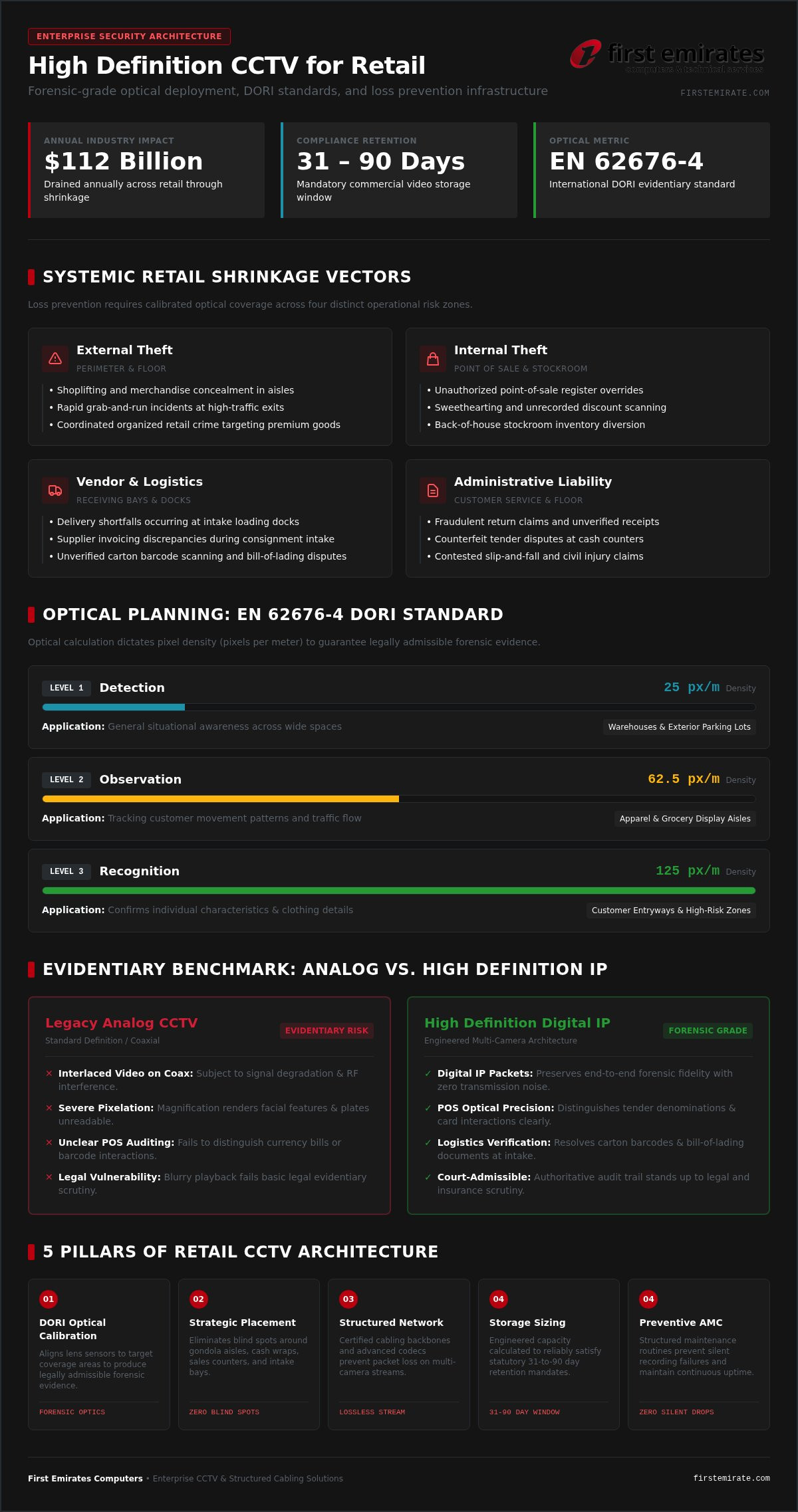
- External Theft: Shoplifting concealment, rapid grab-and-run incidents, and coordinated organized retail crime rings targeting premium inventory.
- Internal Theft: Unauthorized register overrides, unauthorized discounts, sweethearting at checkouts, and stockroom inventory diversion.
- Vendor and Logistics Discrepancies: Delivery shortfalls at loading docks and supplier invoicing errors during intake.
- Administrative Vulnerabilities: Fraudulent return claims, counterfeit tender disputes, and disputed slip-and-fall claims.
According to commercial standards established across the history of Closed-circuit television (CCTV), video fidelity determines whether an incident is legally actionable. Deploying an engineered high-definition IP camera network transforms visual monitoring from a passive deterrent into an active evidentiary safeguard.
Understanding Retail Shrinkage and Modern Loss Prevention
Shrinkage directly erodes gross margins. Countering sophisticated retail losses requires visual clarity at key operational handoffs. When receiving high-value consignments at back-of-house intake bays, HD cameras record bill-of-lading documents and carton barcodes clearly, ensuring supplier discrepancies are verified immediately. At customer touchpoints, low-profile dome cameras positioned over sales counters maintain continuous deterrence against opportunistic theft while recording interactions without creating an adversarial shopping atmosphere.
Why Legacy Analog Systems Fail Modern Commercial Evidentiary Tests
Standard-definition analog systems introduce significant evidentiary liability into modern commercial operations. Legacy analog systems distribute interlaced video over aging coaxial cabling, a transmission medium prone to signal degradation, radio frequency interference, and persistent frame loss. Magnifying an analog recording inevitably causes severe pixelation, rendering facial features unrecognizable and vehicle license plates unreadable.
Conversely, engineered digital high definition CCTV for retail preserves forensic details across every digital IP packet. When auditing point-of-sale transactions, high-resolution cameras provide the optical clarity necessary to distinguish currency denominations, verify payment card interactions, and track physical merchandise scans. High-fidelity recordings eliminate the speculation common to grainy standard-definition playback, establishing an authoritative record that readily withstands corporate investigations and legal scrutiny.
Technical Parameters: Selecting the Optimal Camera Resolution and Hardware
Selecting hardware for high definition CCTV for retail requires matching optical capabilities to specific operational objectives. Simply increasing camera megapixel counts without calculating the physical coverage area results in inflated storage costs without improving security. A methodical system design aligns resolution, sensor capability, and lens selection directly with the environmental demands of each retail zone.
Resolution Benchmarks: 1080p, 4K, and DORI Performance Standards
Optical planning should adhere to the international EN 62676-4 standard, which defines visual criteria via DORI thresholds (Detection, Observation, Recognition, and Identification):
- Detection (25 pixels/meter): Provides general situational awareness across broad warehouse spaces or wide exterior parking lots.
- Observation (62.5 pixels/meter): Tracks customer movement patterns through broad apparel or grocery display aisles.
- Recognition (125 pixels/meter): Confirms individual characteristics and clothing details to resolve contested customer disputes.
- Identification (250+ pixels/meter): Delivers forensic clarity at cash wraps and entrances, establishing facial details and numerical text for court-admissible evidence.
While 1080p sensors handle general aisle observation effectively, high-risk registers demand 4K resolution to maintain 250+ pixels per meter across cash drawers and card processing equipment.
Optical Features: WDR, Low-Light Sensors, and Variable Focal Lenses
Storefront architecture introduces difficult lighting conditions. Large glass facades create severe backlighting that renders subjects as dark silhouettes. True Wide Dynamic Range (WDR), rated at 120dB or higher, balances stark exterior sunlight against ambient showroom lighting to preserve clear facial features. Motorized varifocal lenses allow technicians to precisely calibrate focal lengths across variable drop-ceiling heights, while specialized low-light sensors maintain color fidelity during after-hours restocking routines without relying exclusively on harsh infrared projection.
Camera Form Factors: Dome, Turret, and Concealed Hardware
Physical casing determines both durability and image longevity. Vandal-resistant IK10 dome housings protect optical alignment against physical tampering in tight customer aisles. For open retail ceilings, turret configurations eliminate the internal infrared reflections and lens glare often caused by dust settling on glass domes. In back-office financial rooms, concealed pinhole cameras monitor cash counting stations discreetly without disrupting staff workflows. Retailers designing engineered CCTV surveillance systems can deploy these varied form factors methodically across enterprise footprints using unified hardware platforms like Hikvision, UNV, or Dahua.
Strategic Camera Placement and Coverage Across Key Store Zones
Effective store security depends on systematic layout planning rather than arbitrary camera placement. Tall gondola shelving, suspended promotional signage, and architectural columns regularly create visual obstruction corridors that opportunistic shoplifters exploit. Designing an effective architecture for high definition CCTV for retail requires mapping focal lengths to floor plans, ensuring compliance with commercial surveillance regulations across municipal frameworks such as Abu Dhabi and wider UAE retail guidelines.
Securing the Checkout Counter and Cash Wrap Stations
Cash wraps account for high financial volatility. Protecting these zones requires two dedicated camera angles per terminal:
- Overhead Point-of-Sale Monitoring: A top-down, narrow-angle camera captures hand movements, cash drawers, and scanning plates, intercepting sweethearting, pass-arounds, and improper manual drawer triggers.
- Transaction Data Integration: Point-of-sale text insertion software superimposes real-time receipt text directly over the video stream, synchronizing item barcodes and numeric totals with exact visual timestamps.
- Face-to-Face Overview: A chest-to-head angle verifies the physical interactions between customer and cashier, providing decisive evidence during billing or payment dispute claims.
Merchandise Aisles, High-Value Shelving, and Fitting Room Perimeters
Floor layouts demand tailored optical coverage. Linear display aisles benefit from narrow corridor-format lenses that align pixel density along the walking path without wasting coverage on adjacent shelf tops. For high-ticket items, automated cross-line analytics trigger local notifications if unauthorized personnel access locked display cases after hours. Surrounding fitting rooms, high-definition cameras must strictly monitor entry and exit vestibules to track item counts taken into stalls, maintaining stringent customer privacy standards while deterring fitting room concealment.
Stockrooms, Delivery Bays, and Emergency Exit Routes
Back-of-house operations present complex internal shrinkage risks. Loading docks require dedicated wide-angle surveillance to reconcile pallet unloads against paper manifests. Cameras positioned over waste compactors and cardboard balers prevent employees from discarding undamaged stock into disposal bins for later retrieval outside the store. Additionally, emergency fire doors require constant monitoring to stop unauthorized exits and illicit exterior merchandise handoffs. Collaborating with an experienced access control system company allows retail operators to unify door sensor alarms directly with high definition CCTV for retail, immediately pulling up live video feeds whenever a secure perimeter point opens.
Network Infrastructure, Bandwidth Optimization, and Storage Architecture
High-resolution video streams demand robust physical transmission backbones. Deploying high definition CCTV for retail without engineered network throughput leads to dropped frames, stream latency, and corrupted files during critical investigations. Maintaining broadcast stability requires isolating surveillance traffic from consumer point-of-sale systems while calculating exact bandwidth overheads.
Structured Cabling and PoE Switch Dimensioning
Physical transport serves as the foundation for multi-camera IP systems. Certified Category 6 copper runs ensure full gigabit bandwidth and reduce packet loss across runs approaching standard 90-meter limits. Managed Power over Ethernet (PoE) switches must provide adequate wattage headroom, ensuring that Class 3 and Class 4 motorized lenses or infrared illuminators don't drop off during nighttime power spikes. Retailers engaging qualified structured cabling companies in Abu Dhabi establish clean patch field terminations and isolated Virtual Local Area Networks (VLANs), preventing broadcast storms from disrupting daily retail transactions.
Bandwidth Compression: Managing H.264, H.265, and Smart Codecs
Managing concurrent high-resolution streams requires disciplined data compression:
- H.265 (HEVC) Deployment: Adopting H.265 cuts bitrates roughly in half compared to legacy H.264 profiles without compromising pixel clarity.
- Dynamic Smart Encoding: Scene-adaptive algorithms dynamically throttle bitrates during quiet, after-hours showroom periods, ramping to peak bitrates only when sensing physical motion.
- Dual-Stream Architecture: System setups allocate an efficient, low-bandwidth sub-stream for simultaneous multi-screen security desk monitoring, saving the native 4K main stream strictly for localized NVR write operations.
Storage Architecture and Commercial Regulatory Retention Standards
Calculating enterprise storage requirements involves multiplying individual camera bitrates against store operating schedules and required archive duration. Commercial regulations across the UAE and Abu Dhabi establish mandatory video retention windows, typically spanning 31 to 90 days depending on the specific retail license and premises classification. Meeting these compliance benchmarks requires resilient Network Video Recorders (NVRs) configured with enterprise-grade surveillance hard drives arranged in fault-tolerant RAID 5 or RAID 6 arrays. These arrays prevent total data loss if a single drive suffers mechanical failure.
If you need to engineer high-capacity network recording pipelines, consult with our systems team to explore customized CCTV surveillance systems tailored to your enterprise storage targets.
System Maintenance, Health Monitoring, and AMC Lifecycle Management
Security hardware requires persistent operational upkeep to deliver uninterrupted protection. A surveillance system that records corrupted footage or experiences dropped feeds leaves a store exposed during critical loss prevention investigations. Sustaining the performance of high definition CCTV for retail demands a disciplined schedule of physical servicing, hardware diagnostics, and network firmware administration.
Preventing Silent Hardware Failures and Data Loss
Recording failures often occur silently, going completely unnoticed until an incident forces management to retrieve historical footage. Routine preventative inspections protect video integrity through several core tasks:
- Drive Sector Diagnostics: Automated S.M.A.R.T. monitoring detects bad sectors and write errors across NVR disk arrays before mechanical storage crashes corrupt video databases.
- Optical Dome Restoration: Airborne dust and particulate matter settle quickly on optical covers. This buildup causes severe infrared wash, blinding night-vision sensors. Scheduled cleaning eliminates halo effects.
- Backup Power Capacity Testing: Uninterruptible power supply (UPS) batteries undergo scheduled load tests to verify continuous runtimes during commercial power fluctuations.
Firmware Upgrades, Network Security, and Cyber Hardening
Modern IP surveillance endpoints are active network devices that require rigorous cyber protections. Leaving retail surveillance hardware on unpatched firmware invites remote exploits and lateral network breaches that threaten sensitive corporate files. Proper security protocols mandate establishing complex administrative credentials, disabling exposed camera service ports, and running encrypted Transport Layer Security (TLS) connections across video management clients. In addition, security leads must routinely audit user access logs to ensure store employees don't export or view unauthorized camera footage.
Structuring Long-Term Value with Professional Maintenance Contracts
Commercial longevity depends on structured service level agreements (SLAs) that guarantee guaranteed response times for failed hardware. Partnering with certified providers for IT AMC services Abu Dhabi ensures your high definition CCTV for retail receives regular preventative maintenance alongside priority replacement for defective switches or cameras. Methodical engineering oversight keeps systems aligned with local UAE commercial surveillance regulations, ensuring flawless continuous uptime and audit readiness.
Building a Resilient Retail Surveillance Architecture
Protecting enterprise retail assets requires moving beyond standalone cameras toward an engineered technical ecosystem. Successfully deploying high definition CCTV for retail means calculating exact DORI pixel densities at cash points, provisioning certified structured cabling to eliminate dropped frames, and establishing RAID storage arrays that satisfy mandatory 31-to-90-day regulatory retention windows.
Sustainable loss prevention also demands systematic post-installation upkeep. Through disciplined annual maintenance contracts, commercial operators eliminate silent storage failures, maintain optical dome clarity, and keep IP devices hardened against network vulnerabilities before losses occur.
As a methodical systems integrator across Abu Dhabi and the UAE, First Emirates Computers delivers comprehensive ELV project implementation and certified structured cabling backbones. Our engineers specialize in deploying tier-one security platforms including Hikvision, UNV, Dahua, and Panasonic, supported by proactive maintenance agreements that ensure continuous uptime. Upgrade your retail surveillance with First Emirates Computers to secure your premises with dependable, fully compliant visual protection.
Frequently Asked Questions
What is the recommended camera resolution for monitoring retail point-of-sale counters?
Point-of-sale terminals require a minimum of 4K resolution or a tightly focused 4MP varifocal lens. According to international DORI benchmarks, cash handling requires an identification threshold of at least 250 pixels per meter. This optical density ensures operators can clearly verify currency denominations, observe payment card exchanges, and track manual barcode entries during loss prevention audits without distortion.
How much storage capacity is needed to retain 30 days of high definition retail video footage?
Storage requirements depend on recording frame rate, operating hours, and compression codecs. A standard 4MP camera recording continuously at 15 frames per second using H.265 compression requires approximately 1.5 to 2.5 terabytes of storage for a 30-day window. For larger multi-camera deployments, network video recorders utilize multi-bay RAID arrays to provide 20 to 60 terabytes of dependable, fault-tolerant capacity.
Can high definition CCTV cameras integrate directly with existing POS cash registers?
Yes, modern high definition CCTV for retail connects directly to electronic cash registers using specialized POS bridge modules or software interfaces. This integration synchronizes transactional data directly with the video stream, imprinting itemized receipts, cashier operator IDs, and transaction totals onto the recorded playback. Investigators can easily search for specific transaction events like voids, refunds, or no-sales across synchronized video archives.
What is the difference between H.264 and H.265 compression for commercial retail security?
The primary difference lies in compression efficiency and bandwidth consumption. While H.264 remains widely compatible, H.265 reduces stream bitrates and storage space by roughly 50% while preserving identical visual detail. In commercial retail deployments with dozens of high-resolution IP channels, H.265 prevents internal network congestion and substantially reduces hard drive storage hardware costs without degrading evidentiary image quality.
How do high definition retail security cameras handle harsh storefront glass glare?
High-definition cameras handle severe backlighting and showroom reflections using True Wide Dynamic Range (WDR) sensors rated at 120dB or higher. True WDR captures multiple exposures of the same scene simultaneously, blending overexposed exterior light from glass windows with darker interior retail displays. This dynamic balancing prevents subjects from appearing as dark silhouettes, ensuring clear facial identification even under bright midday sunlight.
Is an annual maintenance contract necessary for retail IP surveillance systems?
Yes, an annual maintenance contract is essential for preventing silent hardware degradation and ensuring ongoing operational uptime. Commercial contracts cover scheduled optical dome cleanings, camera focus recalibration, storage hard drive sector health diagnostics, and critical firmware security patching. For businesses operating high definition CCTV for retail, structured maintenance ensures systems remain continuously functional and fully compliant with local security inspection audits.
What regulatory standards govern commercial retail video surveillance retention in the UAE?
Commercial retail operations in the UAE must comply with strict municipal security frameworks, such as those overseen by SIRA in Dubai or the Monitoring and Control Centre in Abu Dhabi. Regulatory mandates typically require retail commercial properties to maintain continuous video retention windows ranging from 31 to 90 days, depending on specific commercial licenses, premises square footage, and property classifications.


