

A single bottleneck in your cabling can effectively cap the operational capacity of your entire enterprise. You likely recognize the frustration when high-definition security feeds lag or critical business applications stutter because of insufficient bandwidth. Professional fiber optic network installation isn't just about faster internet; it's about building a stable foundation for your entire ELV ecosystem. Many UAE businesses struggle with unreliable connectivity that compromises their security surveillance and daily data management.
We'll guide you through a systematic approach to high-speed fiber infrastructure that ensures long-term reliability. You'll discover the technical standards required for modern UAE commercial environments and how professional installation integrates seamlessly with existing CCTV and biometric systems. This article details the transition from legacy copper to future-proof glass. It covers everything from technical site surveys to the dedicated maintenance contracts that protect your technical investment for years to come. By prioritizing a methodical deployment, you can eliminate latency issues and ensure your infrastructure is ready for the next generation of digital demands.
Key Takeaways
- Understand why migrating to an optical backbone is essential for UAE businesses outgrowing the bandwidth limitations of traditional copper cabling.
- Learn to distinguish between Single-Mode and Multi-Mode fiber standards to ensure your infrastructure matches your facility's distance and data requirements.
- Discover the systematic phases of a professional fiber optic network installation, including technical site surveys and precise routing to maintain cable integrity.
- Explore how high-speed fiber integration eliminates latency for critical ELV systems, such as high-definition CCTV surveillance and biometric access control.
- Recognize the importance of proactive Annual Maintenance Contracts (AMC) in identifying fiber degradation and ensuring long-term network reliability.
The Strategic Importance of Fiber Optic Infrastructure
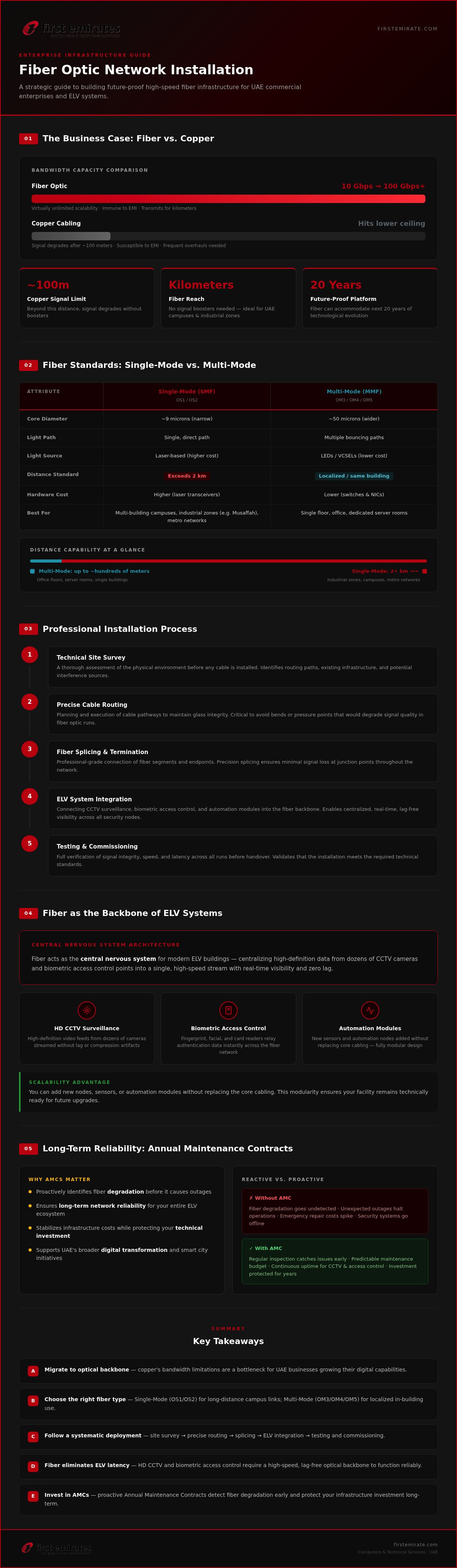
Fiber optic technology represents the most advanced method for data transmission available to commercial enterprises. By converting electrical signals into pulses of light, fiber optic cable technology allows for near-limitless data transmission speeds across vast distances. For Abu Dhabi businesses, this isn't just a technical upgrade. It's a strategic shift from traditional copper backbones to a medium that supports the UAE's broader digital transformation and smart city initiatives.
A professional fiber optic network installation ensures that a facility can handle the exponential growth of data without requiring frequent cabling overhauls. This long-term ROI is critical for local firms looking to stabilize their infrastructure costs while expanding their digital capabilities. When you invest in an optical backbone, you're essentially building a platform that can accommodate the next twenty years of technological evolution.
Fiber vs. Copper: The Business Case
Copper cabling, while standard for decades, faces physical limitations that fiber easily overcomes. The primary advantage lies in bandwidth capacity. Fiber supports speeds from 10Gbps to 100Gbps and beyond, while copper often hits a ceiling at much lower thresholds. This difference is vital for companies running data-heavy applications or cloud-integrated services.
Distance is another critical factor for UAE industrial zones and business parks. Copper signals degrade after approximately 100 meters. Fiber can transmit data for kilometers without signal boosters, making it essential for large UAE campuses and warehouses. Additionally, fiber offers immunity to electromagnetic interference (EMI). Because fiber is made of glass, it doesn't conduct electricity. This makes it immune to interference from heavy industrial machinery or high-voltage electrical panels, which are common in commercial environments.
The Backbone of Modern ELV Systems
Modern buildings rely on integrated Extra Low Voltage (ELV) projects to manage security and automation effectively. A high-quality fiber optic network installation acts as the central nervous system for these assets. It centralizes high-definition data from dozens of CCTV cameras and biometric access control points into a single, high-speed stream, ensuring that security teams have real-time visibility without lag.
This architecture provides unmatched scalability. You can add new nodes, sensors, or automation modules to your network without the need to replace the core cabling. This modularity is a hallmark of a methodical approach to infrastructure design. It ensures your facility remains technically ready for future upgrades, allowing for a steady, functional expansion of your business operations as your technical needs evolve.
Selecting Fiber Standards: Single-Mode vs. Multi-Mode
Selecting the correct standard is a pivotal decision during the planning phase of any fiber optic network installation. The choice between Single-Mode and Multi-Mode fiber dictates the range, speed, and overall hardware costs of your infrastructure. At a fundamental level, the difference lies in the core diameter and how light propagates through the glass. Single-Mode fiber (SMF) features a narrow core of approximately 9 microns, allowing light to travel in a single, direct path. Multi-Mode fiber (MMF) has a larger core, typically 50 microns, which permits multiple paths of light to bounce through the cable simultaneously.
Single-Mode Fiber (OS1/OS2) Applications
SMF is designed for high-performance, long-distance connectivity. It utilizes laser light sources to maintain signal integrity over many kilometers without the need for repeaters. This makes it the ideal choice for connecting multiple buildings within expansive industrial zones like Musaffah or for establishing metropolitan area networks across Abu Dhabi. SMF is the industry standard for transmission distances exceeding 2 kilometers. While the cable itself is often comparable in price to Multi-Mode, the laser-based transceivers required for SMF are generally more expensive, representing a higher initial investment for the sake of unlimited distance potential.
Multi-Mode Fiber (OM3/OM4/OM5) Benefits
MMF is the practical solution for localized environments, such as a single office floor or a dedicated server room. It relies on lower-cost light sources like LEDs or Vertical-Cavity Surface-Emitting Lasers (VCSELs). This significantly reduces the cost of the active hardware, such as network switches and interface cards. Modern standards like OM3 and OM4 are common for 10G and 40G Ethernet over shorter distances. For businesses looking toward the future, OM5 supports high-density 40G and 100G Ethernet using Shortwave Wavelength Division Multiplexing (SWDM).
Choosing between these standards requires a careful balance of your current facility layout and your five-year growth plan. Balancing transceiver costs with raw cable performance ensures you don't over-engineer simple office links or under-spec critical long-haul backbones. If you're unsure which standard fits your facility, reviewing your requirements with a specialist in structured cabling can prevent costly integration errors during deployment. By matching the fiber type to the specific application, you ensure a functional, cost-effective network that performs reliably under heavy data loads during your fiber optic network installation.
The Professional Installation Process in the UAE
Executing a professional fiber optic network installation in the UAE requires more than technical skill. It demands a deep understanding of local environmental stressors like extreme heat and fine desert dust. A methodical approach ensures the glass core remains protected from physical degradation and signal loss. Our process follows a disciplined sequence to guarantee that the final infrastructure is both durable and high-performing, reflecting the technical readiness required for modern business operations.
Phase 1: Engineering and Site Assessment
The process begins with a comprehensive engineering assessment. We conduct a physical walk-through to map existing infrastructure and identify potential obstacles like high-voltage lines or structural barriers. In regions like Abu Dhabi, securing permits for outside plant (OSP) work is a mandatory step for any underground trenching or aerial deployment. This phase determines whether the route requires reinforced conduits or specialized aerial supports. We evaluate route feasibility based on cable length limits to minimize the number of splices required across the entire run, ensuring maximum signal strength from the start.
Phase 2: Deployment and Physical Installation
During deployment, the focus shifts to physical protection and technical compliance. We utilize sub-ducts and heavy-duty protective conduits to shield cables from the harsh desert environment, where soil temperatures can fluctuate significantly. Technicians must adhere to strict tension limits and minimum bend radius requirements during the pulling process. Ignoring these standards leads to micro-bends that cause permanent signal attenuation. Every segment is labeled according to TIA/EIA standards to ensure long-term manageability. This organized approach allows for easier troubleshooting and future expansions without disrupting the existing core.
Phase 3: Termination and Quality Assurance
The final phase involves precision termination and rigorous quality assurance. We prioritize fusion splicing for backbone links because it uses an electric arc to weld fiber ends together, resulting in the lowest possible decibel (dB) loss. Mechanical termination may be used for specific patch panels, but fusion remains the gold standard for performance. Every strand undergoes testing with an Optical Time Domain Reflectometer (OTDR) and a Power Meter. We provide clients with detailed dB loss reports and "as-built" documentation to certify that the installation meets international performance benchmarks. This ensures a seamless handoff to the structured cabling services UAE team for final integration with your office network and security systems.
Integrating Fiber with Security and Automation
A professional fiber optic network installation serves as the high-capacity backbone for a facility's entire Extra Low Voltage (ELV) ecosystem. In modern UAE commercial environments, the integration of security and automation systems requires a level of bandwidth that legacy copper systems simply cannot sustain. By centralizing data transmission through an optical core, businesses ensure their security assets and automation modules function as a unified, responsive environment rather than a series of disconnected silos. This architecture eliminates the bottleneck often found in traditional structured cabling when handling multiple high-demand subsystems simultaneously.
High-Bandwidth Surveillance Networks
High-definition surveillance requires massive throughput. A single 4K stream is demanding; sixty of them can paralyze a standard copper network. Fiber provides the dedicated bandwidth needed for 4K and 8K IP camera streams without causing network congestion or frame drops. For facilities requiring SIRA-compliant CCTV installation Abu Dhabi, fiber ensures that footage reaches remote monitoring stations with zero loss in clarity. This reliability is non-negotiable for large-scale industrial sites or commercial towers where distances between cameras and the control room often exceed the 100-meter limit of Ethernet cables. Optical cabling maintains signal integrity over kilometers, allowing for high-frame-rate monitoring across expansive properties without the need for signal boosters or intermediate switches.
Unified Access Control and Automation
Real-time biometric authentication, such as facial recognition or iris scanning, relies on rapid data exchange between the peripheral reader and the central server. High latency can lead to significant delays at entry points, frustrating employees and visitors alike. By utilizing a fiber backbone, an access control system company can deploy solutions that process high-traffic biometric data instantly across multiple entry points. This speed is also critical for the integration of smart lighting and HVAC controls into the fiber network, where sensor data must be processed immediately to maintain energy efficiency and comfort.
Managing these systems through a centralized fiber architecture streamlines IT management and reduces the footprint of server room cabling. Instead of a chaotic web of disparate cabling types, technicians manage a disciplined, high-performance core that handles all building functions. This synergy ensures that every subsystem operates within a single, stable framework, providing the technical readiness necessary for future-proof operations. For businesses looking to upgrade their technical readiness, we provide comprehensive ELV projects that integrate these technologies from the ground up.
Ensuring Long-Term Reliability: Maintenance and AMCs
A professional fiber optic network installation is a significant technical investment that requires disciplined oversight to maintain its peak performance. While fiber is more durable than copper in terms of environmental interference, the glass cores are sensitive to physical stress and contamination. Neglecting the physical integrity of your optical links leads to gradual signal attenuation that can cripple your security feeds and data throughput. Establishing a systematic maintenance schedule is the only way to ensure that your infrastructure remains a reliable asset rather than a liability.
The distinction between proactive and reactive maintenance is critical for business continuity. Reactive maintenance occurs after a failure, such as a severed cable during nearby construction or a failed transceiver, often resulting in expensive emergency repairs and operational downtime. Proactive maintenance involves periodic testing of decibel (dB) loss to identify fiber degradation before it causes a system crash. This methodical approach allows for scheduled repairs, ensuring your network stays online during critical business hours.
The Benefits of a Dedicated IT AMC
An Annual Maintenance Contract (AMC) provides a structured framework for network health. It moves beyond simple troubleshooting to include regular inspections of patch panels, connectors, and cable pathways. Dust is a persistent challenge in the UAE; even microscopic particles on a connector can cause significant signal loss. Through comprehensive IT AMC services Abu Dhabi businesses can secure scheduled cleaning and testing of all optical interfaces. These contracts also cover firmware updates for active network components, ensuring your hardware remains compatible with evolving security protocols and software requirements.
Choosing a Local Expert in Abu Dhabi
Selecting a partner from among the established structured cabling companies in Abu Dhabi is essential for long-term stability. A local specialist understands the specific regulatory environment and environmental challenges unique to the region. First Emirates Computers has functioned as a dependable partner since 2011, providing the technical readiness needed to manage complex ELV environments. We offer a steady hand in a complex landscape, ensuring that your fiber optic network installation is backed by on-site support and rapid emergency restoration services.
Our commitment to quiet confidence and technical proficiency means we focus on the functional details that keep your business running. Whether it's re-splicing a damaged backbone link or optimizing a distribution frame, our team prioritizes precision. This systematic oversight provides peace of mind, knowing that your high-speed infrastructure is managed by experts who value stability and comprehensive coverage. By securing a dedicated maintenance partner, you protect your technical investment and ensure your facility remains ready for the data demands of tomorrow.
Securing Your Digital Foundation with Optical Infrastructure
Transitioning to a high-speed backbone is a fundamental requirement for any business aiming to scale its digital operations. You've seen how a systematic fiber optic network installation provides the necessary bandwidth for integrated ELV projects, from 4K surveillance to real-time biometric access control. By selecting the appropriate fiber standards and adhering to disciplined installation protocols, you eliminate the technical bottlenecks that disrupt daily productivity.
Reliability doesn't end at deployment. Proactive maintenance remains the only way to protect your infrastructure from the environmental challenges of the UAE. First Emirates Computers has been a dedicated partner for Abu Dhabi businesses since 2011, providing expert ELV and structured cabling solutions backed by comprehensive AMC support. Our methodical approach ensures your network remains stable, functional, and ready for future technical demands.
Request a Professional Site Survey for Your Fiber Optic Installation and take the first step toward a more resilient network. Investing in quality connectivity today ensures your business stays ahead of tomorrow's technical challenges.
Frequently Asked Questions
What is the primary difference between Single-mode and Multi-mode fiber?
Single-mode fiber is designed for long-distance data transmission, utilizing a narrow core that allows light to travel in a direct path for many kilometers. Multi-mode fiber features a larger core that supports multiple light paths, making it more cost-effective for localized office environments or data centers. While single-mode handles high-speed metropolitan links, multi-mode is the standard for short-range connectivity within a single facility where laser-based hardware is unnecessary.
How long does a typical fiber optic network installation take for an office?
The duration of a fiber optic network installation depends on the facility size and the complexity of the cable routing. A standard office deployment typically spans three to five business days, encompassing the initial site survey, physical cable pulling, and final termination. Larger industrial projects in Abu Dhabi may require additional time for underground trenching or securing municipal permits. We provide a detailed project timeline following the engineering assessment to ensure minimal disruption.
Can fiber optic cables be installed alongside existing electrical wiring?
Yes, fiber optic cables can safely be installed alongside electrical wiring because they use light instead of electricity to transmit data. Unlike copper cables, fiber is immune to electromagnetic interference (EMI) generated by high-voltage power lines or heavy machinery. This characteristic makes it ideal for industrial environments where signal integrity must be maintained near electrical panels. We still recommend using dedicated conduits to provide physical protection and ensure easier maintenance access.
What are the environmental factors in the UAE that affect fiber optic longevity?
Extreme heat, fine desert dust, and high humidity are the primary environmental factors affecting infrastructure in the UAE. Excessive heat can cause physical stress on cable jackets, while dust ingress into connectors leads to significant signal attenuation. Professional installations utilize heavy-duty sub-ducts and hermetically sealed enclosures to mitigate these risks. Regular cleaning and inspection are essential to prevent microscopic particles from degrading the glass core over time.
Is it necessary to upgrade my existing network switches for a fiber backbone?
You may not need to replace your entire network infrastructure, but you will likely need switches that support SFP or SFP+ ports for fiber connectivity. These ports accept transceivers that convert optical signals back into electrical data for your local network. We evaluate your existing IT hardware during the site survey to determine if simple module upgrades are sufficient or if high-capacity switches are required to leverage the full bandwidth of your new backbone.
How much does professional fiber optic installation cost in Abu Dhabi?
The cost of a professional fiber optic network installation varies based on the total cable length, the number of termination points, and the specific fiber standard selected. Other variables include the complexity of the routing and whether the project requires specialized trenching or aerial supports. We focus on providing a methodical evaluation of your facility's needs to ensure a cost-effective deployment. A detailed technical proposal is provided after the site survey to outline the necessary resources.
What is included in a fiber optic Annual Maintenance Contract (AMC)?
An Annual Maintenance Contract (AMC) includes scheduled inspections, connector cleaning, and decibel (dB) loss testing to ensure peak performance. It also provides for rapid emergency restoration in the event of cable damage and technical support for active components. Our contracts are designed to provide UAE businesses with steady, functional oversight of their infrastructure. This proactive approach identifies potential degradation early, preventing the costly downtime associated with sudden network failures.
How does fiber optic cabling improve CCTV camera performance?
Fiber optic cabling dramatically improves CCTV performance by providing the high bandwidth required for 4K and 8K IP camera streams. It eliminates the frame drops and latency issues often associated with copper cabling over long distances. Because fiber supports near-limitless data transmission, it allows security teams to monitor expansive properties with real-time clarity. This stable connection is vital for systems where consistent, high-definition footage must be transmitted to central recording servers without interruption.


