

How much of your annual IT budget is consumed by recurring license fees for hardware you already own? Many enterprise leaders in Dubai find themselves trapped in a cycle of high subscription costs from legacy vendors while managing fragmented systems that don't communicate. A professional UNIFI deployment offers a different path by consolidating networking, CCTV, and access control into a single, license-free ecosystem. You likely agree that managing separate platforms for security and WiFi is an inefficient use of technical resources, especially when high-density traffic demands a more cohesive approach.
This article demonstrates how the UniFi ecosystem integrates essential infrastructure into a unified management interface tailored for the UAE's specific regulatory environment. We'll examine how these solutions meet TDRA Type Approval and NESA Information Assurance standards while eliminating recurring software costs. You'll discover the technical requirements for a robust installation, from SIRA-compliant surveillance to structured cabling that supports the latest WiFi 7 standards. We provide a systematic overview of how a methodical approach to hardware integration creates a stable, high-performance network that provides comprehensive oversight without the burden of legacy licensing.
Key Takeaways
- Understand why the UNIFI ecosystem is replacing subscription-heavy legacy systems by offering a license-free model that consolidates networking, security, and access control.
- Learn how to leverage WiFi 7 technology and 10Gbps switching to support high-density traffic in modern UAE corporate environments.
- Explore the advantages of AI-driven CCTV surveillance with local storage to ensure compliance with UAE data privacy laws and NESA standards.
- Identify why professional structured cabling and specialized heat management are essential for maintaining hardware longevity in the Abu Dhabi climate.
- Discover how expert ELV project execution and professional installation prevent common configuration pitfalls and ensure long-term system stability.
What is UniFi? Rethinking IT Infrastructure for UAE Enterprises
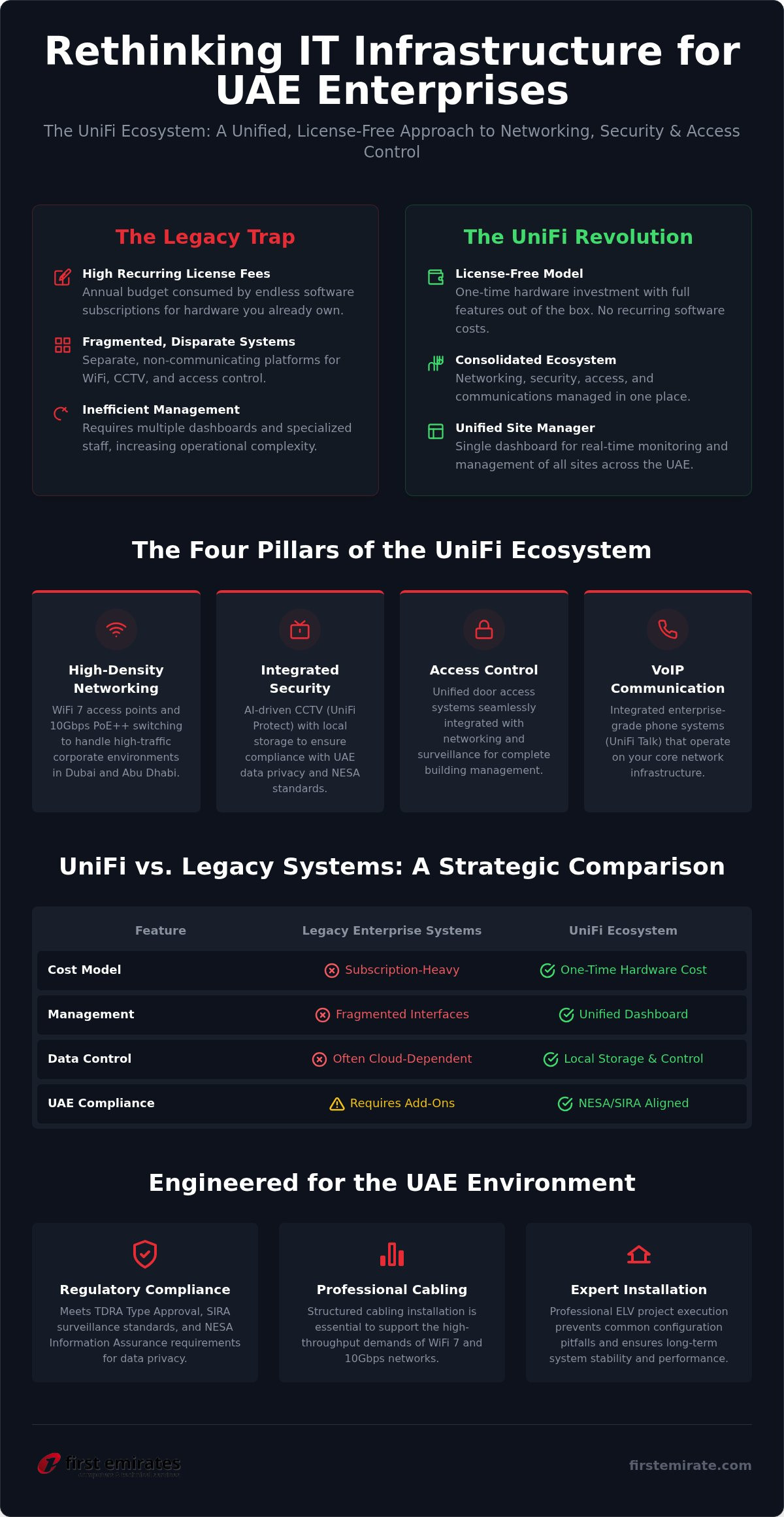
UniFi represents a significant departure from traditional IT infrastructure models. It's a unified ecosystem of networking, security, and access hardware managed via a single, intuitive interface. For enterprises in the UAE, this means consolidating disparate systems into a cohesive framework. Developed by Ubiquiti Inc., the platform serves as a centralized operating system for business technology that eliminates recurring software costs. Whether you're operating a boutique retail shop in Abu Dhabi or a massive industrial warehouse in Musaffah, the system scales predictably without the complexity often found in legacy enterprise solutions.
The primary driver for UAE businesses moving toward a UNIFI deployment is the "License-Free" revolution. Traditional networking vendors often lock organizations into subscription-heavy models, where access to basic features or security updates requires an ongoing financial commitment. This ecosystem disrupts that pattern by offering full feature sets out of the box. This shift allows IT managers to allocate budgets toward physical infrastructure and performance rather than administrative overhead.
The Core Philosophy: Hardware Ownership
The distinction between traditional licensing and the UniFi model centers on true hardware ownership. When you invest in this ecosystem, you aren't just renting a service; you're acquiring a permanent asset. This approach has a profound impact on the five-year Total Cost of Ownership (TCO). By removing monthly per-device fees, businesses can achieve a faster return on investment. Additionally, the system provides native cloud management capabilities through its own hardware controllers. This ensures that your technical team retains full control over the infrastructure without being penalized for growth or adding more access points.
Unified Management via the UniFi Site Manager
Efficiency in modern IT operations requires centralized oversight. The UniFi Site Manager allows administrators to manage multiple sites across Dubai and Abu Dhabi from a single, unified dashboard. This global visibility replaces the outdated practice of localized configuration, where technicians had to be physically present or use fragmented VPNs to adjust settings. This methodical approach to management ensures that your network remains stable and responsive to high-density traffic demands.
- Real-time monitoring: Immediate visibility into network health and security alerts.
- Standardized deployment: Apply consistent security policies across all branch offices from one location.
- Integrated support: Transition from reactive troubleshooting to proactive system management.
The Four Pillars of the UniFi Ecosystem in 2026
The strength of a UNIFI deployment lies in its four specialized yet interconnected pillars. These categories cover every aspect of modern enterprise networking, physical security, and communication. By 2026, the ecosystem has matured to include high-capacity WiFi 7 access points, 10Gbps switching fabric, and AI-driven surveillance. This integration allows UAE businesses to manage their entire infrastructure through a single software pane, providing a level of visibility that was previously reserved for much more expensive proprietary systems.
High-Density Networking and WiFi 7
Urban environments in Dubai and Abu Dhabi present unique challenges for wireless coverage. High-interference signals from neighboring high-rises can degrade network performance significantly. The latest WiFi 7 hardware addresses this by utilizing wider channels and advanced modulation to maintain stability in crowded RF environments. For a successful enterprise deployment, PoE++ switching is essential. It provides the high power budget required for these advanced access points while offering 10Gbps uplinks to prevent data bottlenecks. Administrators can also improve security by segmenting guest and corporate traffic using VLANs, ensuring that sensitive internal data remains isolated from public-facing connections.
Integrated Physical Security and Access Control
Physical security is no longer a separate silo. UniFi Protect replaces fragmented DVR and NVR systems with a unified AI-driven surveillance platform. It prioritizes data privacy by utilizing local storage on dedicated hardware, which aligns with NESA standards and UAE data protection laws. This localized approach eliminates the latency and security risks associated with third-party cloud storage. When paired with UniFi Access, businesses can integrate their access control system company logic directly into the network management layer. This creates a centralized, chronological log for both digital network access and physical door entry, allowing for rapid auditing during security reviews.
Beyond networking and security, the ecosystem includes UniFi Talk and Connect. These solutions provide integrated VoIP communication and digital signage for corporate offices. Having a single vendor for these services reduces technical friction and simplifies long-term maintenance. This methodical integration is what distinguishes the platform from fragmented legacy setups that require multiple management consoles. If you're planning a new facility or upgrading an existing site, consulting with a specialist for ELV project execution ensures these pillars are correctly aligned with your technical goals.
UniFi vs. Legacy Enterprise Systems: A Strategic Comparison
Legacy enterprise systems often require specialized command-line expertise, which can slow down deployment by weeks. In contrast, a UNIFI setup utilizes a graphical interface that simplifies configuration without sacrificing technical depth. This plug-and-play approach allows technical teams in the UAE to commission new sites rapidly. Beyond initial speed, the hardware continues to improve long after purchase. While legacy vendors often charge for every feature update, this ecosystem provides free firmware improvements that add functionality to your existing hardware. This ensures that your infrastructure remains current with evolving security standards without additional investment.
Design also plays a critical role in the UAE market. In luxury retail spaces in Dubai Mall or high-end offices in Al Maryah Island, bulky, industrial-looking networking gear can disrupt the carefully curated aesthetic. The sleek, minimalist design of these access points and cameras allows them to blend into sophisticated interiors. This aesthetic consideration is a significant factor for architects and interior designers who require technical readiness without compromising visual standards. It's a functional approach that respects the environment where the hardware is installed.
Cost Analysis: CAPEX vs. OPEX
The "License Trap" is a common pain point for IT directors across the Emirates. Legacy systems often involve lower initial hardware costs but high recurring OPEX that drains budgets annually. By shifting to a CAPEX-heavy model with zero licensing fees, businesses can achieve more predictable budgeting. This is especially beneficial for ELV project expansion. Adding more cameras or access points doesn't result in a proportional increase in software subscriptions, allowing for a more stable five-year financial plan. You're paying for the physical asset, not the right to use it.
Ease of Use for Local IT Teams
The learning curve for managing a UNIFI network is significantly shorter than that of proprietary command-line systems. This reduces the training burden for in-house staff in Abu Dhabi, allowing them to focus on high-value tasks rather than complex syntax. Mobile-first management tools enable technicians to troubleshoot issues on-the-go via dedicated smartphone apps. This is essential for managing multiple locations across the Emirates from a single mobile device. Automated backup and recovery features provide an additional layer of stability. If a controller fails, system settings can be restored to new hardware in minutes, ensuring that business operations resume with minimal disruption.
The transition from vendor-direct support to expert local partner support also changes the troubleshooting dynamic. Instead of waiting for global support tickets, businesses can rely on local specialists who understand the regional infrastructure and environmental challenges. This methodical approach to support ensures that your network remains a reliable asset rather than a source of technical friction.
Designing for the UAE: Structured Cabling and Compliance
A UNIFI network is only as capable as the physical infrastructure supporting it. In the UAE, environmental and regulatory factors dictate the success of any technical installation. High-performance WiFi 7 and 10Gbps switching require a foundation built on professional structured cabling services UAE to prevent data bottlenecks and power delivery failures. This methodical approach ensures that the ecosystem operates at its full enterprise potential, providing a stable platform for both networking and security.
Cabling Standards for 10G and Beyond
For 2026 deployments, Cat6a or Fiber optic backbones are the minimum requirement. These standards ensure the network can handle the massive throughput of modern access points and high-resolution cameras. Proper termination and rigorous testing are vital for PoE (Power over Ethernet) stability. Without precise termination, cameras and APs may suffer from intermittent power drops or reduced hardware lifespan. Engaging structured cabling companies in Abu Dhabi ensures that the backbone design meets these high-frequency requirements and supports future hardware upgrades.
Environmental resilience is equally critical for long-term stability. Abu Dhabi server rooms require dedicated rack cooling and ventilation systems to protect hardware from thermal stress. Heat is a primary cause of hardware failure in the region. For outdoor deployments, selecting IP-rated hardware is mandatory to withstand dust and extreme temperatures. Using the correct enclosures and shielded cabling protects the system's integrity against the harsh UAE climate.
Meeting Security Regulations in Abu Dhabi
Compliance with local security standards is a non-negotiable aspect of any surveillance project. UniFi Protect installations must be designed to meet specific storage retention requirements mandated by Abu Dhabi security laws. This often involves calculating disk space for 31 days or more of high-definition recording. Integrating these systems with SIRA-approved monitoring protocols ensures that the facility remains compliant and operational. Physical security of the core hardware, such as the UniFi Dream Machine or dedicated NVRs, should also be prioritized within a locked, climate-controlled rack to prevent unauthorized access.
For businesses seeking a compliant and high-performance infrastructure, consulting with a specialist for professional ELV design provides the necessary technical readiness to meet all regional standards.
Professional UniFi Installation and Maintenance in Abu Dhabi
While the accessibility of the UNIFI ecosystem is a primary advantage, enterprise-level deployment in the UAE requires a methodical approach to installation. Attempting a DIY setup for a corporate environment often leads to significant configuration pitfalls. Incorrect VLAN tagging, poorly planned PoE budgets, or inadequate channel width settings can result in frequent hardware failures and network instability. Professional integration ensures that these technical nuances are addressed before they impact business operations. First Emirates Computers acts as the essential bridge between specialized hardware and a functional, compliant business system.
First Emirates Computers has maintained a consistent presence in the Abu Dhabi technical services sector for 15 years, providing grounded expertise and reliable support since its founding in 2011. This longevity reflects a deep commitment to technical readiness and systematic project execution. By choosing a partner with extensive local experience, businesses avoid the risks associated with fragmented installations and ensure their infrastructure meets all regional standards.
The Installation Process: What to Expect
A professional installation begins with a comprehensive site survey and RF heat mapping. This data-driven step is critical for determining the optimal placement of access points to ensure uniform WiFi coverage, especially in buildings with dense concrete or glass partitions. Following the survey, the physical phase involves professional rack mounting and structured cable management. A clean, organized rack is not merely an aesthetic choice; it's vital for maintaining proper airflow and simplifying future troubleshooting. The process concludes with final configuration, where technicians establish secure VLANs and provide staff handover training to ensure your team can manage the system's daily functions with confidence.
Long-term Reliability via Annual Maintenance
Securing your technical investment requires more than just a successful initial setup. Long-term stability is achieved through structured IT AMC services Abu Dhabi. These maintenance contracts provide a proactive framework for system health, moving away from reactive "break-fix" cycles. In the specific environmental conditions of the UAE, regular physical maintenance is essential. Dust accumulation can cause thermal stress on switches and gateways, leading to premature hardware degradation. A dedicated maintenance team performs regular health checks and cleaning to mitigate these risks.
- Proactive Firmware Management: Timely application of security patches and firmware updates to protect against emerging threats.
- Hardware Health Checks: Systematic inspection of internal components and power supplies to identify potential failures before they occur.
- Priority Support: Access to emergency onsite visits and technical guidance to ensure business continuity during critical outages.
A methodical maintenance schedule ensures that your network remains a dependable asset. By prioritizing technical oversight and professional support, UAE businesses can focus on their core objectives while maintaining total confidence in their digital and physical security infrastructure.
Future-Proofing Your UAE Infrastructure with Integrated Solutions
Adopting a unified approach to networking and security is a strategic necessity for businesses seeking long-term operational efficiency. By transitioning to a license-free UNIFI ecosystem, organizations eliminate recurring subscription costs while gaining a centralized management platform for all IT assets. Success in the UAE's specific technical environment requires more than just high-performance hardware. It's a process that demands a foundation of professional structured cabling and a deep understanding of local regulatory requirements, such as SIRA-compliant surveillance protocols and TDRA type approvals.
First Emirates Computers has provided grounded technical expertise in Abu Dhabi since 2011. Our team specializes in methodical ELV project execution and comprehensive IT AMC support, ensuring your systems remain stable and responsive. We act as your dependable local partner to bridge the gap between advanced hardware and a fully compliant business system. Request a Professional UniFi Site Survey from First Emirates to begin your transition toward a more reliable and cost-effective infrastructure. We look forward to supporting your long-term technical readiness.
Frequently Asked Questions
Is UniFi suitable for large-scale enterprise environments in the UAE?
Yes, the ecosystem is highly suitable for large-scale enterprises when paired with professional ELV project execution. Modern hardware supports high-density traffic and 10Gbps backbones, making it ideal for industrial warehouses in Musaffah or corporate offices in Dubai. A methodical deployment ensures that the system scales predictably. By utilizing centralized management, IT teams can oversee hundreds of devices without the complexity or recurring costs often associated with legacy proprietary systems.
Do UniFi cameras comply with SIRA regulations in Abu Dhabi?
Compliance depends on the specific installation parameters and storage retention settings. First Emirates Computers specializes in SIRA-compliant CCTV systems, ensuring that Protect deployments meet local security standards. This includes configuring the hardware for mandatory recording retention and integrating it with approved monitoring protocols. It's essential to verify the current approval status of specific camera models in 2026 to ensure full regulatory adherence for your facility and maintain technical readiness.
Can I manage my Dubai and Abu Dhabi offices from a single UniFi controller?
You can manage multiple geographic locations through a single, unified interface. The UniFi Site Manager provides global visibility across sites in Dubai, Abu Dhabi, and beyond. This centralized approach allows your technical team to monitor network health, update firmware, and manage security policies from a central dashboard. It replaces the need for localized configuration at every branch, reducing the administrative burden and ensuring consistent security standards across your entire UAE infrastructure.
What is the benefit of a license-free model for my business budget?
The primary benefit is the elimination of the license trap that often drains IT budgets. Most legacy vendors charge annual subscription fees per device for software access and security updates. A UNIFI deployment operates on a one-time hardware purchase model with zero recurring software costs. This shift allows businesses to move their budget from operational expenses to capital investments, resulting in a lower five-year total cost of ownership while maintaining full feature access.
Does First Emirates provide Annual Maintenance Contracts for UniFi systems?
Yes, First Emirates Computers provides dedicated Annual Maintenance Contracts (AMC) for all integrated systems. These contracts ensure long-term reliability through proactive hardware health checks, security patching, and emergency onsite support. Given the environmental conditions in the UAE, regular maintenance is critical to protect your investment from dust and heat-related stress. Our Abu Dhabi-based support team has provided this methodical approach to system oversight since 2011, providing peace of mind for business owners.
What cabling is required to support UniFi WiFi 7 access points?
To achieve the full performance of WiFi 7 access points, we recommend a minimum of Cat6a structured cabling. This standard supports the 10Gbps speeds and higher power delivery (PoE++) required by modern hardware. For larger backbones or high-interference environments, fiber optic cabling may be necessary to prevent data bottlenecks. Professional termination and testing are vital; without them, you won't reach the high-density traffic throughput these advanced access points are designed to deliver in 2026.
How does UniFi handle the extreme summer temperatures in the UAE?
Hardware longevity in the UAE climate requires specialized installation practices. For outdoor areas, we utilize IP-rated hardware designed to withstand dust and extreme heat. Indoor core components must be housed in climate-controlled server racks with adequate ventilation. Proper rack cooling and airflow management are essential to prevent thermal stress. A professional installation includes environmental considerations that protect sensitive electronics from the regional temperature spikes experienced during the summer months, ensuring a steady, functional network.
Can I integrate my existing non-Ubiquiti cameras with the UniFi system?
UniFi Protect is a closed ecosystem designed for native hardware to ensure maximum security and performance. While you can't typically add non-Ubiquiti cameras directly to the Protect interface, we can design a hybrid ELV project that bridges different systems. For businesses seeking a truly unified management experience, we often recommend a phased migration to native hardware. This ensures that all AI-driven analytics and local storage features function seamlessly within the centralized UNIFI software environment without technical friction.


