

If a single lost keycard is all that stands between an unauthorized individual and your entire rack of enterprise servers, is your infrastructure truly secure? In a landscape where physical breaches can lead to catastrophic data loss, relying on credentials that are easily misplaced or duplicated represents a significant vulnerability. You likely recognize that traditional proximity cards and PIN codes often lack the accountability required for mission-critical IT environments, which is why implementing robust biometric security for server rooms has become a technical necessity for modern businesses.
This guide provides a methodical approach to securing your critical IT infrastructure using advanced access control integrated with your existing systems. You will learn how to establish a tamper-proof access log and ensure seamless integration with CCTV and ELV frameworks, all while maintaining compliance with local UAE security standards. We examine the technical requirements for hardware reliability in high-temperature environments and the importance of structured cabling for enterprise stability. This overview ensures your facility remains protected through a disciplined, systematic security strategy that prioritizes both precision and long-term operational readiness.
Key Takeaways
- Define the role of biometric security for server rooms as the definitive physical layer for protecting critical IT infrastructure against unauthorized entry.
- Identify how high-precision identification eliminates the risks of lost or stolen credentials while providing automated, time-stamped entry logs for audit compliance.
- Compare fingerprint and face recognition modalities to select the most reliable solution for high-usage and high-temperature server environments.
- Recognize the necessity of robust structured cabling and ELV integration to maintain system stability and seamless communication with existing security frameworks.
- Adhere to local UAE security standards and SIRA/MCC requirements through professional installation and methodical system design in Abu Dhabi.
The Role of Biometric Security in Modern Server Room Environments
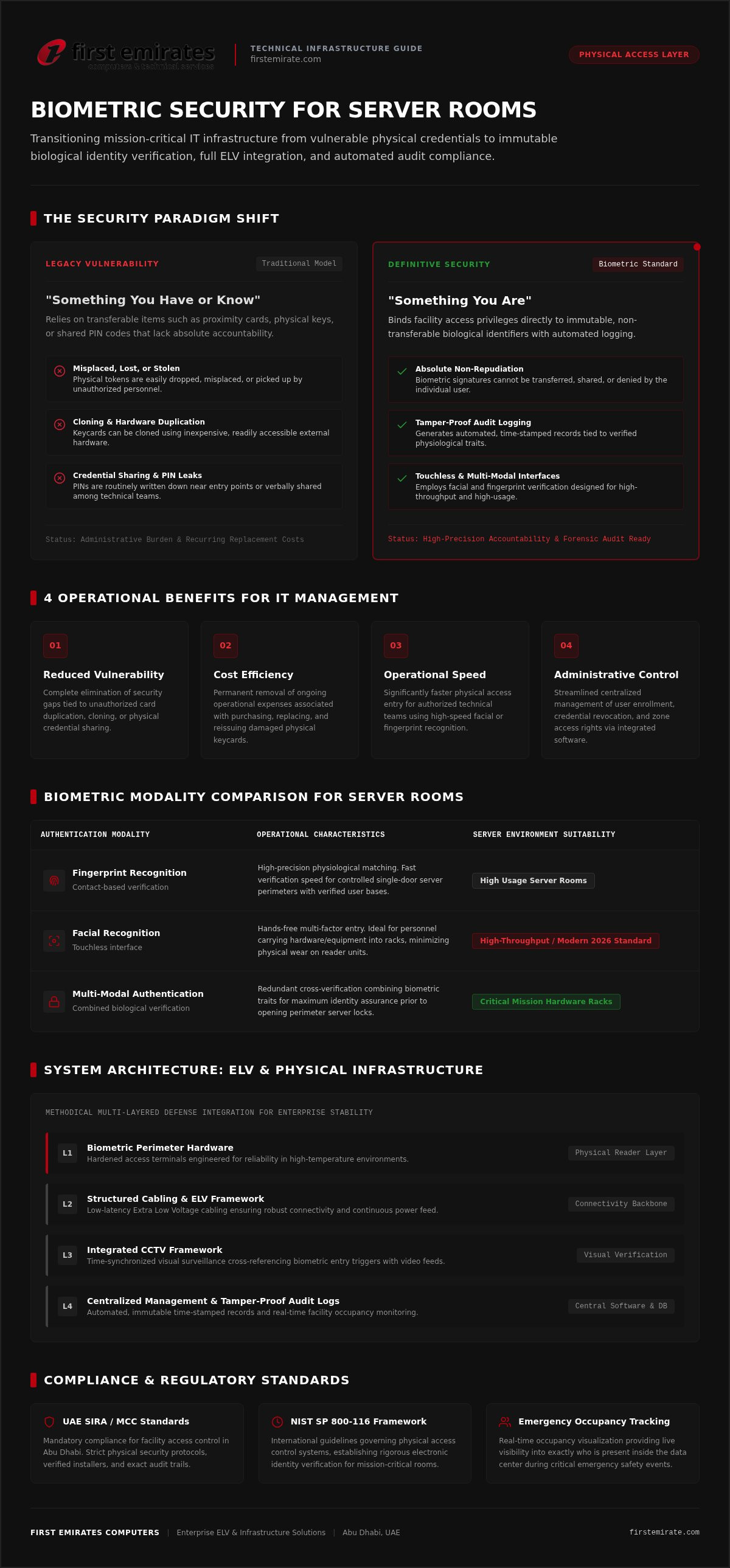
Establishing a secure perimeter for IT infrastructure requires a transition from legacy proximity systems to advanced identity verification. The implementation of biometric security for server rooms serves as a definitive physical barrier for enterprise assets. It moves the security protocol from "something you have," such as a plastic keycard, to "something you are," utilizing immutable biological data. This shift is essential for facilities housing critical hardware where the cost of a breach is extreme. Current 2026 trends indicate a strong preference for touchless interfaces and multi-modal authentication. These biometric authentication modalities ensure that access is granted based on verified physiological traits, significantly reducing the margin for error compared to manual entry systems.
Protecting Critical Data Infrastructure
Physical data breaches often occur when unauthorized individuals gain direct access to server racks. Hardware tampering or the illicit connection of external storage devices can bypass even the most sophisticated firewalls. Biometric systems mitigate these risks by providing absolute non-repudiation in access logs. Unlike a shared password, a biometric signature cannot be transferred or denied by the user. This level of accountability is vital for regulatory compliance in the UAE, where maintaining precise records of facility access is a standard requirement for SIRA-approved installations. It ensures that every entry event is tied to a specific, verifiable identity. This systematic approach to logging provides a reliable audit trail for forensic investigations if a security incident occurs.
The Limitations of Traditional Keycards and PINs
Legacy systems rely on credentials that are inherently insecure. Keycards are frequently lost, stolen, or cloned using inexpensive hardware. PIN codes are often shared among staff or written down near the entry point, creating a significant security gap. For IT departments in Abu Dhabi, managing a fleet of physical keys or cards is an administrative burden that distracts from core technical tasks. By 2026, security standards have moved toward unique biological identifiers because they don't require the user to carry a physical object or memorize a string of digits. This approach removes the risk of credential theft and streamlines the entry process for authorized personnel.
- Reduced Vulnerability: Elimination of risks related to card duplication or credential sharing.
- Cost Efficiency: Removal of ongoing expenses associated with replacing lost or damaged physical hardware.
- Operational Speed: Faster entry for authorized staff through high-speed facial or fingerprint recognition.
- Administrative Control: Centralized management of user enrollment and access rights through integrated software.
Choosing to implement biometric security for server rooms is a methodical decision that prioritizes long-term stability. It provides a scalable solution that integrates with existing Extra Low Voltage (ELV) projects, ensuring that your security infrastructure remains robust as your technical requirements grow.
Key Benefits of Biometric Access Control for IT Managers
IT managers face constant pressure to maintain infrastructure uptime and data integrity. Traditional security methods often fail because they rely on transferable items that can be shared or stolen. Implementing biometric security for server rooms effectively removes these vulnerabilities by grounding access rights in individual identity. This high-precision approach ensures that only authorized personnel can enter sensitive zones while providing a real-time view of facility occupancy. This visibility is critical for emergency response and safety protocols, allowing managers to know exactly who's inside the data center during an incident.
Audit Readiness and Compliance
Maintaining compliance with international and local standards requires meticulous record-keeping and accountability. Biometric systems automate this process by generating time-stamped entry logs that cannot be altered or falsified. These logs are essential for both internal reviews and external security audits. By following the NIST SP 800-116 guidelines for physical access control systems, IT managers can align their physical security with established high-assurance standards. This integration ensures that server room logs contribute to a comprehensive security posture, simplifying the reporting process for facility managers.
Operational Efficiency for IT Teams
Efficiency is a core requirement for modern technical operations. Biometric readers eliminate the logistical burden of managing physical keys or proximity cards. When an employee joins or leaves the organization, their access can be granted or revoked instantly through a centralized software interface. This capability is especially valuable for multi-site environments in Abu Dhabi where remote management is necessary. It also reduces downtime by preventing lockouts caused by lost or damaged credentials.
- Instant Enrollment: Quickly add new staff members to the system without waiting for card printing.
- Remote Revocation: Terminate access rights immediately from a central console during offboarding.
- Reduced Support Tickets: Lower the volume of requests related to lost keys or forgotten PIN codes.
- Multi-Site Sync: Synchronize user data across different server room locations for seamless entry.
Long-term cost management is another significant advantage of this technology. While the initial setup for biometric security for server rooms requires professional calibration, it removes the recurring costs of card replacement and printer maintenance. This steady, functional approach to security allows IT teams to focus on infrastructure rather than credential management. For those looking to upgrade their current setup, exploring professional biometric access control solutions can provide a clear path toward a more stable and cost-effective facility.
Selecting the Right Biometric Modality for Your Server Room
Selecting a specific biometric technology depends on the unique security requirements and environmental conditions of your facility. For many organizations in Abu Dhabi, fingerprint recognition remains the industry standard due to its established reliability and cost-effectiveness. It provides a balanced approach to security that integrates well with existing Extra Low Voltage (ELV) projects. Face recognition has gained traction for its touchless convenience and high-speed processing, which is particularly useful in high-traffic environments. For ultra-sensitive data centers, iris scanning offers a superior level of security, as the patterns are nearly impossible to replicate. Multi-modal systems, which combine two or more identifiers, provide the maximum level of assurance for critical IT assets.
Comparing Performance Metrics
Evaluating a system's effectiveness requires an understanding of two critical metrics: False Acceptance Rate (FAR) and False Rejection Rate (FRR). A high FAR poses a security risk by allowing unauthorized entry, while a high FRR causes operational delays for legitimate staff. When designing biometric security for server rooms, balancing these rates is essential to maintain both safety and efficiency. These systems must also be evaluated for their environmental durability, especially in server rooms where temperature and humidity are tightly controlled. Aligning your selection with CISA facility access control best practices ensures that your entry authorization protocols meet rigorous standards for mission-critical facilities.
Hardware Durability and Maintenance
Industrial-grade sensors are a requirement for server room environments. These devices must withstand frequent use without degrading in accuracy. High-quality readers incorporate anti-spoofing and liveness detection technology to prevent the use of high-resolution photos or synthetic models to bypass security. Regular maintenance is also a factor in long-term reliability. A disciplined maintenance schedule ensures that optical components remain clear and electronic components stay functional.
- Sensor Calibration: Periodic adjustments ensure the reader maintains its precision over years of operation.
- Anti-Spoofing: Advanced algorithms detect whether the biometric sample is from a living person rather than a replica.
- Environmental Protection: Housings should protect internal electronics from dust and static discharge common in IT environments.
- Cleaning Protocols: Simple maintenance routines prevent the buildup of oils or debris on optical sensors that could lead to false rejections.
A methodical selection process ensures that the biometric security for server rooms is not just a high-tech addition, but a functional component of your broader security infrastructure. By prioritizing hardware durability and precise performance metrics, facility managers can establish a stable environment that protects both data and hardware. This systematic approach establishes trust through technical readiness and steady, predictable performance.
Integrating Biometrics with ELV and IT Infrastructure
The effectiveness of biometric security for server rooms depends heavily on the physical infrastructure supporting the hardware. A biometric reader is only as reliable as the data and power pathways connecting it to the central management console. Integrating these advanced sensors requires a methodical approach to Extra Low Voltage (ELV) design, ensuring that every component from the reader to the server rack communicates without delay. This integration creates a cohesive security environment where physical entry points are as guarded as the digital network.
The Importance of Structured Cabling
Robust structured cabling services UAE are the foundation of any stable security system. High-quality Cat6 or fiber optic backbones are essential for transmitting complex biometric data templates across the network. Without a reliable cable plant, systems may suffer from network latency, which causes frustrating delays in door release or synchronization errors between multi-site facilities. Professional cable management is equally vital; it prevents accidental disconnections and protects the infrastructure from physical tampering. A disciplined installation ensures that all cabling is properly labeled and routed through secure conduits, mirroring the systematic nature of enterprise-grade IT environments.
Interfacing biometric readers with existing Door Access Control Systems allows for a unified response to security events. When a reader detects an unauthorized attempt, the system should trigger visual verification by linking the physical access alert with CCTV surveillance. This integration provides security teams with immediate visual context for every entry event. To maintain this protection during power fluctuations, the ELV design must incorporate integrated UPS redundancy. This ensures that the locks and readers remain functional even if the main power supply fails, a critical consideration for maintaining server room integrity in Abu Dhabi.
Unified Security Management
Centralizing security functions into a single dashboard provides a comprehensive view of facility safety. By aligning with the standards of a professional access control system company, IT managers can automate lock-down procedures during detected breaches. This unified management approach allows for the coordination of access control, CCTV, and alarms, creating a proactive security posture. It's a technical solution that offers peace of mind through complete oversight and technical readiness.
If you're ready to enhance your facility with a systematic integration of these technologies, our team provides expert ELV projects and maintenance tailored to your specific infrastructure needs.
Professional Installation and Maintenance in Abu Dhabi
The successful deployment of biometric security for server rooms requires more than just high-quality hardware. It demands a methodical installation process that begins with a comprehensive site survey. In Abu Dhabi, environmental factors such as ambient temperature and humidity can impact sensor sensitivity, making professional calibration a technical necessity. Local experts ensure that every reader is positioned and configured to maintain high accuracy while integrating seamlessly with the facility's existing Extra Low Voltage (ELV) architecture. This disciplined approach establishes a reliable foundation for your physical security, ensuring that the system performs as expected from day one.
Local Compliance and Standards
Navigating the regulatory landscape in the UAE is a critical step for any enterprise-grade security project. Businesses in Abu Dhabi must adhere to specific mandates set by the Monitoring and Control Centre (MCC) and the Security Industry Regulatory Agency (SIRA) where applicable. These regulations ensure that security installations meet national safety and monitoring standards. Working with a certified installer is essential to guarantee that your server room security meets both legal requirements and insurance prerequisites. A compliant system doesn't just protect data; it ensures that your facility is recognized as a secure environment by local authorities, providing long-term peace of mind for business owners.
The Value of Annual Maintenance Contracts (AMC)
Maintaining the integrity of a biometric system requires ongoing technical oversight. Over time, sensors can accumulate dust or oils that interfere with optical precision, and backup power systems need regular testing to ensure availability during outages. Establishing IT AMC services Abu Dhabi provides a structured framework for preventative maintenance. These contracts cover more than just physical cleaning; they include essential firmware updates that protect the system against emerging cybersecurity vulnerabilities. A systematic maintenance schedule minimizes the risk of hardware failure and ensures that your critical access points remain functional at all times.
- System Calibration: Regular adjustments to maintain low False Rejection Rates (FRR) in high-usage environments.
- Power Redundancy Testing: Methodical checks of UPS systems and battery backups to prevent lockouts during power failures.
- Firmware Management: Disciplined application of software patches to enhance system features and security.
- Technical Support: Access to professional assistance for rapid troubleshooting and hardware replacement.
A steady, functional approach to maintenance is what separates a temporary fix from a long-term security solution. By prioritizing professional installation and a comprehensive AMC, you ensure that your biometric security for server rooms remains a reliable asset. It's about building a partnership with a local specialist who understands the practical realities of technical service delivery in the UAE. This commitment to technical readiness ensures your infrastructure is always protected by a disciplined and authoritative security presence.
Establishing a Resilient Physical Security Foundation
Implementing biometric security for server rooms is a technical commitment to protecting your organization's most sensitive assets. By moving beyond legacy keycards, you eliminate the risk of credential theft and establish a transparent, automated audit trail. This methodical approach ensures that your physical entry protocols are as robust as your digital firewalls. Success in the UAE market requires more than just installing hardware; it requires a disciplined integration with ELV systems and a commitment to ongoing maintenance.
Professional calibration and regular firmware updates are essential for maintaining the high-precision identification that your facility demands. As expert ELV and security integrators since 2011, we provide the technical readiness needed for enterprise stability. We offer comprehensive IT AMC support for Abu Dhabi businesses to ensure your systems remain operational and compliant at all times. Secure your server room with First Emirates Computers professional biometric solutions. Taking these systematic steps today provides a stable and secure environment for your infrastructure for years to come.
Frequently Asked Questions
Is biometric security for server rooms better than keycards?
Biometrics are superior because they rely on biological traits that can't be lost, stolen, or shared. Keycards represent a vulnerability if misplaced or cloned. Biometric security for server rooms ensures that access is tied to a specific individual. This provides higher accountability and a tamper-proof audit trail that legacy card systems simply can't match in a high-security IT environment.
Can biometric systems be hacked or spoofed?
No system is entirely immune, but modern industrial-grade biometric readers use advanced liveness detection and anti-spoofing technology. These features detect whether the presented sample is a living person or a high-resolution image or replica. When integrated with a secure ELV network and professional installation, these systems are significantly more difficult to compromise than traditional PIN-based or card-based access controls used in older facilities.
What happens to the server room access if the power goes out?
Professional security designs include power redundancy to ensure continuous operation. Our ELV projects typically incorporate an Uninterruptible Power Supply (UPS) and battery backups that maintain the functionality of biometric readers and electronic locks during outages. In emergency scenarios, systems are configured to "fail-secure" or "fail-safe" based on specific local safety regulations and the facility's unique operational requirements in Abu Dhabi.
How many users can a biometric access control system handle?
Enterprise-grade biometric controllers are designed to manage thousands of unique templates. While entry-level devices might have smaller capacities, the systems we deploy for data centers easily handle the needs of large corporate teams. The management software allows for centralized enrollment and revocation. This ensures that user capacity remains scalable as your organization grows without degrading the speed of authentication or the precision of the identification process.
Are face recognition systems reliable in low-light server rooms?
Professional facial recognition readers use infrared sensors and built-in illumination to operate effectively in low-light environments. Server rooms often have dim lighting to save energy, but these advanced sensors don't rely solely on visible light. They map facial geometry using infrared light. This ensures consistent and fast identification regardless of the ambient lighting conditions within the rack area or the time of day.
What is the typical installation time for a server room biometric system?
A standard installation usually takes between two to five business days. This timeline depends on the complexity of the existing infrastructure and the number of entry points. The process includes the physical mounting of hardware, implementing structured cabling, and final software integration. We also prioritize the calibration phase to ensure the sensors are optimized for your specific environment, which is a critical step for long-term reliability.
Does a biometric system require a dedicated server for management?
Many systems can run on shared infrastructure, but we often recommend a dedicated management station for high-security environments. This approach ensures that the access control software has consistent resources and isn't affected by other network activities. A dedicated setup also simplifies compliance with local UAE security standards by isolating security data and logs from general corporate traffic, providing a cleaner audit trail for managers.
How often do biometric sensors need to be cleaned or maintained?
We recommend a professional maintenance check at least once per quarter. Regular cleaning of the optical or capacitive sensors prevents the buildup of oils and dust that can lead to false rejections. Under our Annual Maintenance Contracts, we perform systematic hardware inspections, firmware updates, and sensor recalibrations. This ensures that biometric security for server rooms remains accurate and functional throughout its entire operational lifecycle in Abu Dhabi.


