

Driven by AI, rack power densities are now pushing beyond 80 kW, yet many facilities still struggle with basic airflow blocked by disorganized cables. Efficiency starts at the physical layer. You've likely dealt with the frustration of a "spaghetti" closet where tracing a single patch lead takes hours or, worse, where restricted air distribution causes critical hardware to throttle. Implementing server room cabling solutions isn't just about aesthetics; it's a fundamental requirement for maintaining maximum uptime and meeting modern thermal demands in the UAE.
We understand that a disorganized network environment leads to increased latency and a higher Mean Time to Repair. This guide provides a methodical framework to help you master technical requirements and management strategies for 2026. You'll learn how to implement the latest ANSI/TIA-568.2-E standards, including mandatory DC Resistance Unbalance measurements, while ensuring your facility remains compliant with local fire safety and LSZH regulations for a scalable, high-speed network.
Key Takeaways
- Transition from outdated point-to-point designs to a hierarchical structured cabling architecture to enhance network reliability and simplify future expansions.
- Select the appropriate media, such as Cat8 copper or multi-mode fiber, to support data transmission speeds reaching 100GbE in high-density environments.
- Optimize thermal management and airflow within server racks through systematic cable organization and strategic hardware placement.
- Deploy standardized server room cabling solutions to minimize downtime and ensure full compliance with international documentation and labelling standards.
- Integrate structured cabling with ELV projects and biometric access control for a comprehensive approach to facility security and connectivity.
The Fundamentals of Structured Server Room Cabling Solutions
A structured cabling system is defined as a complete collective of cables and associated hardware that provides a comprehensive telecommunications infrastructure. This hierarchical architecture serves as the backbone for data transmission within modern facilities. Historically, many UAE enterprises relied on point-to-point cabling, where equipment is connected directly with individual patch cords. While this worked for smaller setups, it lacks the scalability required for the 2026 digital landscape. Today's high-density environments, driven by AI workloads and rack power densities exceeding 80 kW, demand a more disciplined approach to physical connectivity.
Disorganized physical infrastructure is a primary contributor to network latency. When cables are bundled haphazardly, they become susceptible to electromagnetic interference and signal crosstalk. This degradation forces retransmissions at the data link layer, slowing down the entire network. Beyond signal quality, poor organization leads to hardware failure. Excessive cable weight can strain ports, while "cable dams" prevent efficient heat dissipation from server exhausts. Implementing professional server room cabling solutions ensures that the physical layer supports high-performance hardware without creating these avoidable bottlenecks.
Standardized Architecture vs. Spaghetti Cabling
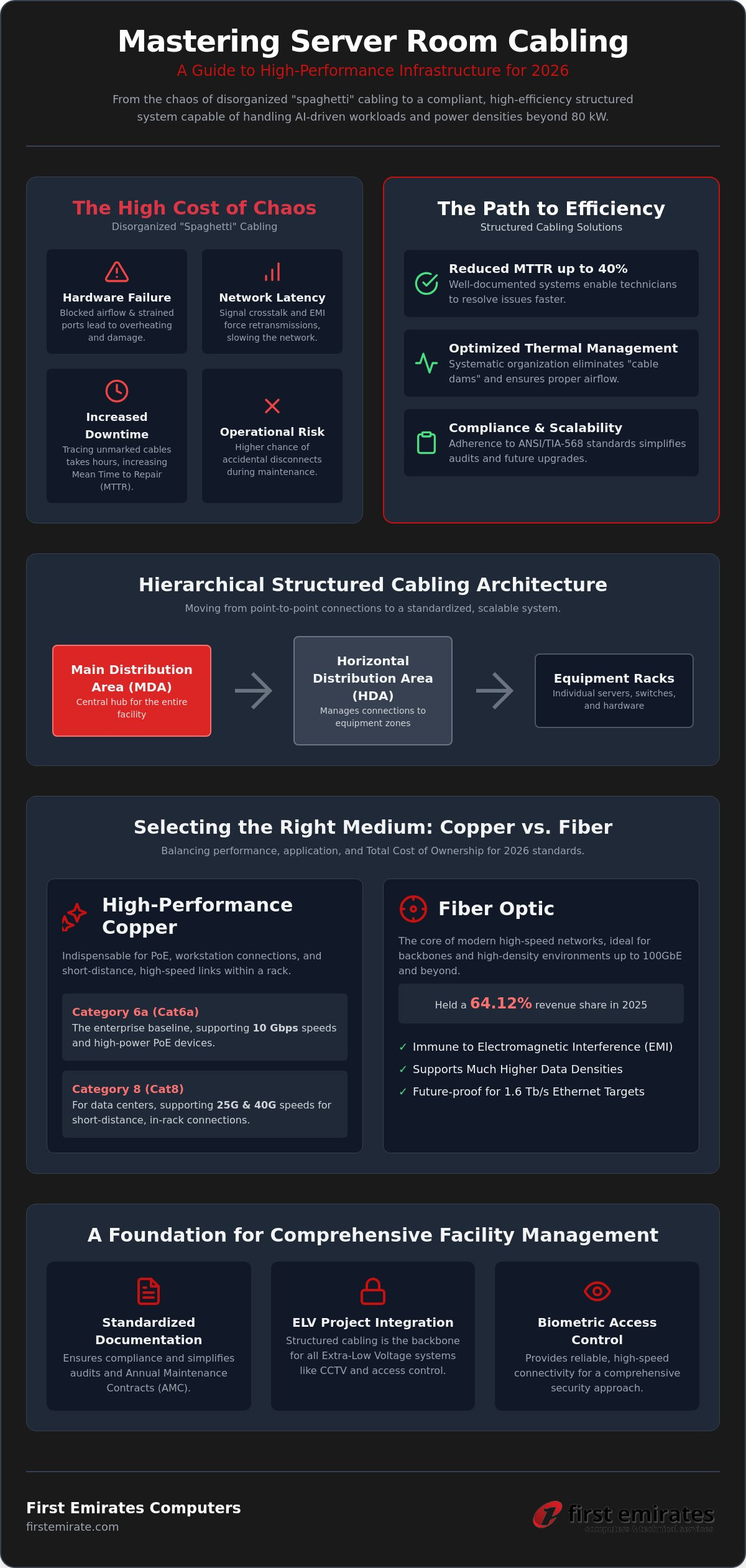
"Spaghetti" cabling creates significant operational risks. These unmanaged bundles trap heat, leading to localized hotspots that can trigger thermal shutdowns. They also increase the likelihood of accidental disconnects during routine maintenance. Professional server room cabling solutions utilize specific zones to manage traffic. The Main Distribution Area (MDA) acts as the central hub for the entire facility, while Horizontal Distribution Areas (HDA) manage the connections to individual equipment racks. Structured cabling is the standardized foundation of all ELV projects.
The Business Case for Professional Installation
Investing in professional installation provides a measurable return on investment. Industry professionals report that a well-documented structured system can reduce the Mean Time to Repair (MTTR) by up to 40% because technicians don't waste time tracing unmarked lines. This efficiency is vital for businesses managing Annual Maintenance Contracts (AMC). It ensures that audits are straightforward and hardware updates are executed without disrupting adjacent services. Adherence to international standards like TIA/EIA-568 ensures that your infrastructure supports multi-vendor environments and future hardware generations. This methodical approach minimizes the risk of downtime during critical business hours in Abu Dhabi and Dubai.
Selecting the Medium: Copper vs. Fiber Optic Standards in 2026
Choosing the right transmission medium is a critical decision in modern server room cabling solutions. By 2026, enterprise bandwidth requirements have scaled from traditional 1GbE to 100GbE architectures in the core. This shift necessitates a precise balance between copper and fiber. While fiber optic cabling held a 64.12% revenue share in 2025, copper remains indispensable for specific applications. A robust cable management strategy must account for the physical differences in these media to ensure long-term efficiency and airflow optimization.
Evaluating the Total Cost of Ownership (TCO) is essential for UAE businesses. While fiber infrastructure requires a higher initial investment in both material and transceiver hardware, its lifespan and bandwidth potential often outweigh these costs when compared to copper. Fiber is immune to electromagnetic interference and supports much higher data densities. Copper remains the practical choice for horizontal runs to workstations or PoE devices where 10 Gbps is sufficient. For those planning a new facility, consulting a specialist in structured cabling ensures the infrastructure meets both current needs and future 1.6 Tb/s Ethernet targets.
High-Performance Copper: Cat6a, Cat7, and Cat8
Category 6a is the current enterprise baseline, supporting 10 Gbps speeds and providing the necessary headroom for high-power PoE devices. For more demanding data center environments, Category 8 cabling is utilized for short-distance, high-speed connections within a rack, supporting 25G and 40G speeds. In environments with high electromagnetic interference, shielded twisted pair (STP) is preferred over unshielded (UTP) to maintain signal integrity. This is particularly important in industrial sectors where heavy machinery can disrupt data transmission.
Fiber Optic Infrastructure: Single-mode vs. Multi-mode
Fiber optics are the standard for backbone connectivity. Single-mode fiber is deployed for long-range links between floors or separate buildings. Conversely, multi-mode fiber, specifically OM4 and OM5, is the preferred choice for high-density server-to-switch patching. OM5 is particularly valuable in 2026 because it supports Shortwave Wavelength Division Multiplexing (SWDM), which increases capacity without adding more fiber strands. This laser-optimized fiber is critical for meeting the demands of AI-driven workloads that require massive data throughput.
Core Components of an Organized Server Room Environment
The physical layout of a server room dictates the long-term viability of your network. Selecting the right hardware components is just as critical as the media itself. Every rack, panel, and manager must align with recognized Data Center Structured Cabling Standards to ensure interoperability and ease of maintenance. In the UAE's high-temperature environment, these components also play a vital role in thermal regulation. High-performance server room cabling solutions rely on a systematic selection of cabinets that provide sufficient clearance for both data and power runs.
Server racks should be chosen based on equipment depth and the volume of cabling. While a 600mm wide rack is standard for many server deployments, an 800mm wide cabinet is often preferred for networking racks. This extra width provides dedicated vertical channels for cable management without obstructing the intake of cool air. Power Distribution Units (PDUs) are equally important. Utilizing vertical (0U) PDUs allows for power cable organization at the rear of the rack, preventing "power cord clutter" from blocking the hot-air exhaust of the servers. This methodical arrangement is a hallmark of professional server room cabling solutions.
Patch Panels and Termination Best Practices
Patch panels serve as the critical interface for all moves, adds, and changes (MAC). Angled patch panels are increasingly popular in high-density environments because they route cables directly into vertical managers, eliminating the need for horizontal management bars and saving valuable rack units. Modular keystone panels offer the most flexibility, allowing technicians to mix fiber and copper terminations within the same frame. Precise termination is the most important step during installation; poor punch-downs or improper crimping will inevitably lead to intermittent signal loss and packet drops that are difficult to diagnose later.
Cable Management Hardware
Maintaining the integrity of the physical medium requires specialized management hardware. Tools such as D-rings, brush panels, and finger ducts help route cables while preventing tangles. It's vital to respect the "Bend Radius" of every cable; exceeding these limits causes micro-fractures in fiber optics and attenuation in copper, leading to permanent performance degradation. For modern UAE data centers, there's a significant trend toward overhead cable trays. Unlike raised floor systems, overhead trays don't interfere with the distribution of cold air from the floor, making them a more energy-efficient choice for facilities with high rack power densities.
Operational Best Practices: Cooling, Labelling, and Documentation
Cabling is more than just a path for data; it's a critical component of the room's environmental control system. In the United Arab Emirates, where ambient temperatures frequently exceed 45°C, the cooling efficiency of a data center is paramount. Improperly managed server room cabling solutions often lead to "air dams." These are thick bundles of wire that physically obstruct the flow of cold air to server intakes or prevent the exhaust of hot air into the return plenum. Even the most advanced cooling units can't overcome the thermal barriers created by disorganized infrastructure.
Dust mitigation is another local priority. Over time, static-charged cable bundles attract fine desert dust, which acts as an insulator and can lead to hardware overheating. A methodical approach involves keeping cables in enclosed trays or using brush panels to seal entry points in racks. This discipline extends to documentation. Every link must be recorded in a living map of the infrastructure. If your current setup lacks this clarity, our team provides comprehensive Annual Maintenance Contracts to audit and organize your environment for peak performance.
Airflow Optimization in High-Density Racks
High-density racks require precision. When cables are routed without a plan, they often bunch up behind the server's exhaust fans. This restricted airflow forces fans to spin faster, increasing energy consumption and reducing the lifespan of the equipment. Using blanking panels is a simple yet effective way to maintain static pressure within the rack, ensuring air flows through the servers rather than around them. Additionally, separating power and data cables into different vertical managers reduces electromagnetic interference and prevents the thick power cords from burying the more delicate data lines.
Meticulous Labelling and Asset Tracking
Effective management relies on the "Golden Rule" of labelling: ANSI/TIA-606-B compliance. This standard requires a serialized system where both ends of every cable are clearly marked with a unique identifier. This practice drastically reduces troubleshooting time. Color-coding adds another layer of efficiency. For instance, using blue for data, yellow for CCTV, and red for critical uplinks allows technicians to identify services at a glance. Moving beyond basic Excel spreadsheets to automated infrastructure management tools ensures your documentation stays accurate as your network grows. This systematic approach to server room cabling solutions is what separates enterprise-grade facilities from amateur setups.
The First Emirates Advantage: Integrated ELV and Cabling Solutions
First Emirates Computers stands as a seasoned partner for Abu Dhabi's corporate sector, delivering comprehensive server room cabling solutions that prioritize reliability and technical readiness. Our team manages the entire lifecycle of ELV projects, ensuring every installation meets the stringent requirements of local authorities such as SIRA. This methodical approach to infrastructure design allows businesses to consolidate their technical needs under a single, dependable provider. By aligning physical connectivity with broader operational goals, we establish a foundation that supports both current hardware and future technological shifts.
The synergy between structured cabling and other essential services like Biometric Access Control is a core advantage of our integrated model. When a single contractor handles both IT and security infrastructure, the result is a unified, well-documented environment. This eliminates the common issue of "vendor friction," where different teams use conflicting labelling schemes or occupy rack space without coordination. Our disciplined installation process ensures that every cable, whether for a high-speed server uplink or a security gateway, follows the same rigorous standards for organization and thermal management.
Beyond Data: Cabling for Security and Automation
Modern server room cabling solutions must account for more than just data transmission. High-definition CCTV and IP surveillance systems place significant demands on the network backbone. We design infrastructure that provides the necessary bandwidth for real-time security monitoring while maintaining total signal integrity. Integrating biometric systems directly into the core structured cabling network allows for centralized management and easier troubleshooting. This holistic view of the server room ensures that security and automation components are never an afterthought but are instead built into the fabric of the facility.
Professional AMC and Support in the UAE
Long-term reliability is achieved through consistent oversight rather than a "set and forget" mentality. Our Annual Maintenance Contracts (AMC) are designed to protect your investment through regular infrastructure audits. These sessions involve testing cable integrity, verifying labelling accuracy, and ensuring that cooling paths remain unobstructed by new additions. We provide a steady hand in a complex technical landscape, offering rapid response for infrastructure changes and emergency troubleshooting. If your facility requires a transition to a more organized, high-performance state, Schedule a professional server room audit today. Our methodical problem-solving approach ensures that your facility remains a high-performance asset that supports your business growth for years to come.
Future-Proofing Your Enterprise Infrastructure
Building a resilient data environment requires a shift from reactive fixes to a methodical, standardized architecture. By prioritizing structured server room cabling solutions, your organization ensures that every rack is optimized for both high-speed data transmission and critical thermal management. This disciplined approach reduces the Mean Time to Repair and provides a clear roadmap for future 100GbE and AI-driven hardware expansions. Effective documentation and SIRA-compliant security integration are not just best practices; they're essential requirements for the modern UAE enterprise.
Since 2011, First Emirates Computers has served as a dependable partner for local businesses, providing expert ELV project management and comprehensive Annual Maintenance Contracts (AMC). Our team ensures that your infrastructure remains stable, secure, and fully compliant with international standards. To secure your facility's long-term performance, Consult with our Abu Dhabi Structured Cabling Experts today. We're ready to help you establish a clean, documented, and high-performance network that supports your business objectives for years to come.
Frequently Asked Questions
What is the difference between structured cabling and conventional cabling?
Structured cabling uses a standardized, hierarchical architecture to organize network infrastructure into manageable modules. Conventional or point-to-point cabling involves connecting devices directly with individual patch cords, which leads to disorganized wiring as the network scales. A structured approach simplifies troubleshooting and allows for seamless hardware upgrades without disrupting the entire system.
Which cable category is best for a server room in 2026?
Category 6A remains the baseline for most enterprise environments, supporting 10 Gbps speeds reliably. For high-density data centers requiring 25G or 40G speeds over short distances, Category 8 is the preferred choice. These server room cabling solutions ensure your facility is prepared for the increasing bandwidth demands of AI and high-performance computing workloads.
How does server room cabling affect cooling and energy efficiency?
Disorganized cables create physical barriers called "air dams" that block cold air from reaching server intakes. By implementing organized pathways and overhead trays, you allow the cooling system to operate at peak efficiency. This reduces the energy consumption of precision cooling units and prevents hardware from throttling due to localized hotspots in the rack.
Why is labelling so important in data center cabling solutions?
Meticulous labelling is essential for reducing the Mean Time to Repair (MTTR) during network outages. Following ANSI/TIA-606-B standards ensures that every link is identifiable at both ends of the run. This practice eliminates guesswork during maintenance and prevents accidental disconnects that can lead to costly business downtime during critical operations.
Can I mix fiber and copper cabling in the same server rack?
You can mix fiber and copper within the same rack by utilizing modular keystone patch panels. This flexibility is a hallmark of modern server room cabling solutions, where copper is often used for management ports and fiber handles high-speed data uplinks. It's important to route these runs through separate vertical managers to maintain accessibility and prevent cable strain.
What are the risks of exceeding the maximum bend radius for network cables?
Exceeding the maximum bend radius can cause permanent physical damage to the internal structure of the cable. In fiber optics, sharp bends lead to micro-fractures that result in significant signal loss or total link failure. For copper cabling, over-bending causes attenuation and crosstalk, which degrades overall network performance and data integrity over time.
How often should server room cabling be audited or maintained?
We recommend a comprehensive audit of your cabling infrastructure at least once a year. Regular maintenance is often managed through Annual Maintenance Contracts (AMC) to ensure labelling remains accurate and physical connections are secure. Audits should also be conducted after any major hardware refresh or significant "moves, adds, and changes" to maintain system documentation.
Does First Emirates Computers provide SIRA-compliant cabling for security systems?
First Emirates Computers provides fully SIRA-compliant cabling for security and infrastructure projects across the UAE. Our team ensures that all ELV installations, including CCTV and biometric access control, meet the specific regulatory standards required for commercial facilities. This integrated approach guarantees that your security systems are just as reliable as your primary data network.


