
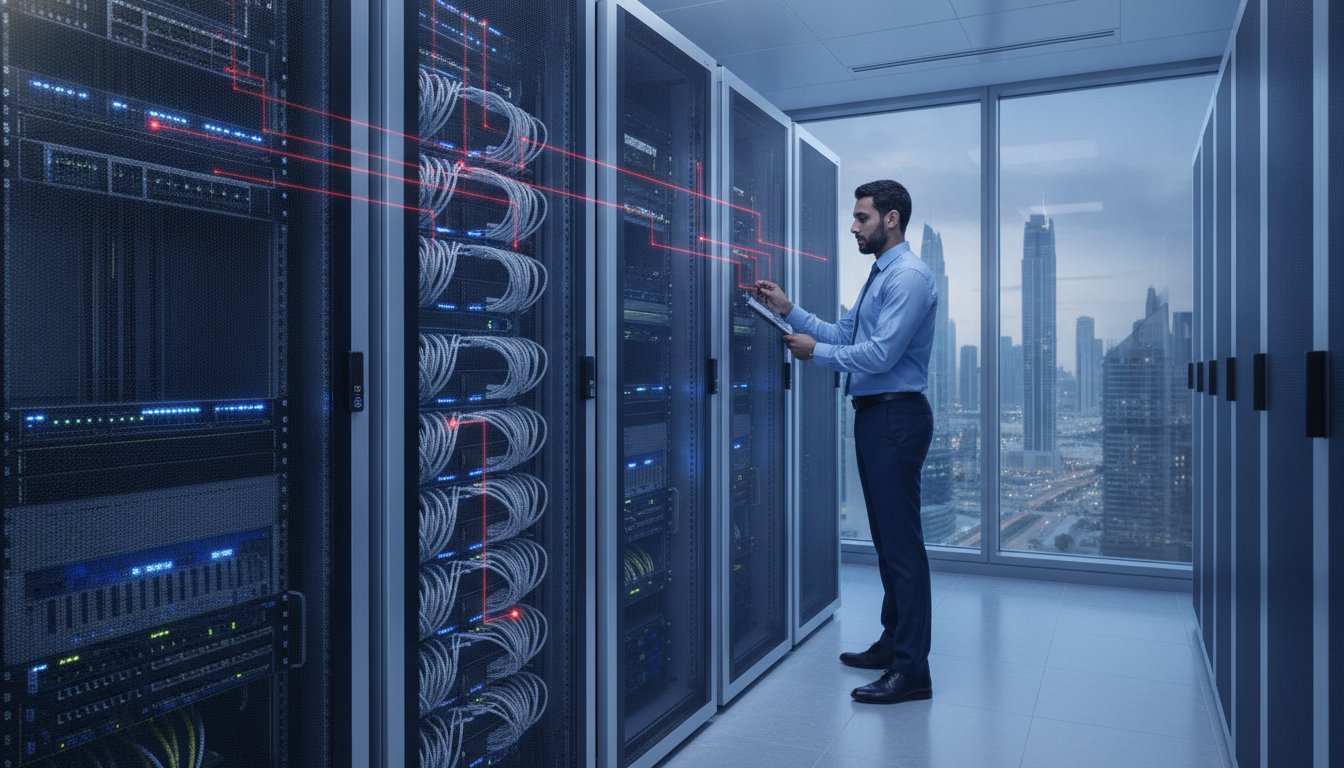
Last month, a Dubai-based IT manager discovered that a critical hardware upgrade was impossible because their server room had become an unlabelled "spaghetti" of tangled cables. You've likely felt similar frustrations when inconsistent data speeds or sudden network downtime disrupt your daily operations. It's a common pain point, but a reliable network shouldn't be a source of stress. Professional structured cabling services UAE businesses trust provide the methodical, capability-first architecture needed to eliminate these technical bottlenecks and ensure long-term stability.
We understand that a clean, certified cabling system is about more than just organization; it's about technical readiness and professional oversight. With the local wires and cables market projected to reach 4.48 billion AED by 2026, you need an infrastructure that's ready for 10G or 40G speeds while remaining fully compliant with SIRA regulations. This guide will walk you through the essential standards and systematic processes required to build a future-proof network. You'll learn how a disciplined approach to cabling integrates with CCTV and access control systems, providing a dependable environment that scales alongside your business requirements.
Key Takeaways
- Learn how transitioning from traditional point-to-point wiring to a standardized architecture provides the scalable foundation required for modern business growth.
- Identify the performance specifications of Cat6, Cat6a, and fiber optic cabling to ensure your infrastructure supports high-speed data and 10G/40G requirements.
- Discover how professional structured cabling services UAE specialists use logical labeling and methodical organization to reduce network downtime and simplify future office reconfigurations.
- Understand the disciplined implementation phases, including site surveys and CAD-based pathway planning, necessary for successful project delivery in Abu Dhabi and beyond.
- Explore the strategic benefits of a single-vendor approach when integrating your data infrastructure with critical ELV assets like CCTV surveillance and biometric access control.
What is Structured Cabling and Why is it Essential for UAE Businesses?
Structured cabling is the standardized architecture for a building or campus telecommunications infrastructure. It's best understood as the nervous system for all office technology, facilitating the steady transmission of data, voice, and video signals across an organization. Instead of a chaotic web of individual connections, this system uses a series of patch panels and trunks to create a predictable, manageable network environment. For a foundational overview of What is Structured Cabling?, one can look at its historical development and the way it organizes complex hardware interactions into a single, cohesive framework.
The transition from traditional point-to-point wiring to a structured approach is a critical step for any growing enterprise. Point-to-point setups, where each piece of hardware is directly linked to another, often result in congested cable trays and connections that are nearly impossible to trace. Professional structured cabling services UAE specialists replace this disorganized "spaghetti" wiring with a methodical system. This shift significantly reduces potential downtime. It allows for easier troubleshooting and ensures that adding a new workstation or server doesn't require a complete network overhaul.
UAE enterprises currently require high-density solutions to handle 2026 data loads. As digital transformation accelerates across the Emirates, bandwidth demands for AI processing, cloud integration, and 4K video conferencing are rising. A structured network provides the high-performance foundation required to support these modern applications. It ensures that the infrastructure remains scalable and ready for future technological shifts without requiring a full rip-and-replace of the existing wiring.
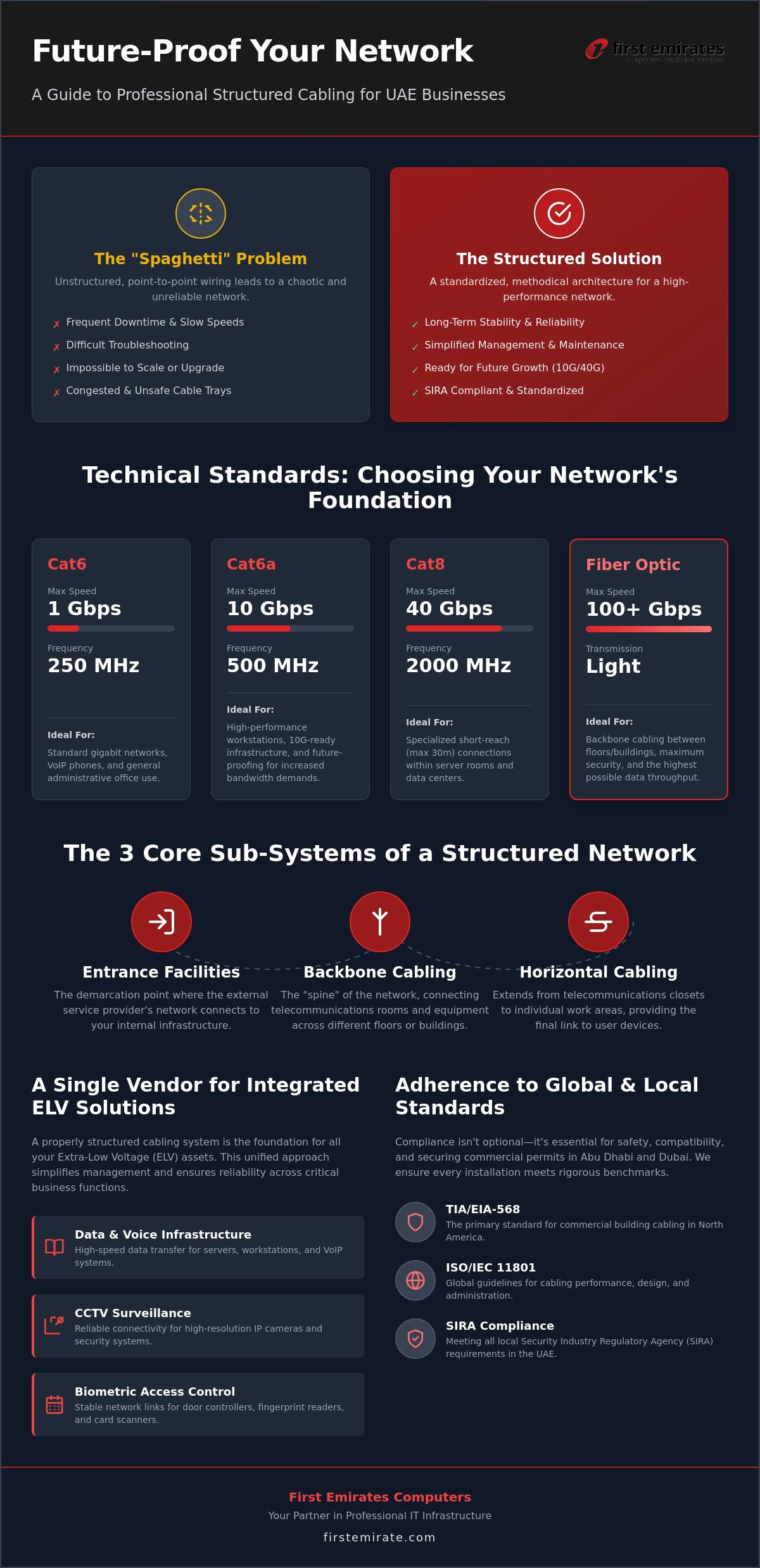
The Core Sub-systems of a Structured Network
- Entrance facilities: These mark the demarcation point where the external service provider's wiring ends and the customer's internal network begins.
- Backbone (vertical) cabling: This connects telecommunications rooms, equipment rooms, and entrance facilities, typically spanning different floors or sections of a building.
- Horizontal cabling: This extends from the telecommunications closet to individual work areas, providing the final link to user devices and workstations.
Regulatory Standards in the UAE
Adhering to international and local standards is a critical component of any technical installation. TIA/EIA-568 is the primary standard governing commercial building cabling for telecommunications products. In addition to this, ISO/IEC 11801 provides global guidelines for cabling performance and design. Compliance with these standards is essential for meeting Abu Dhabi building codes and securing necessary commercial permits. It ensures that your infrastructure is safe, efficient, and fully compatible with hardware from various global manufacturers. Proper documentation and testing are standard practice to verify that every cable link meets these rigorous performance benchmarks.
Technical Standards: Choosing Between Cat6, Cat6a, and Fiber Optic
Selecting the correct transmission medium is a technical decision that determines the operational ceiling of your business for the next decade. While Cat6 remains a common choice for standard gigabit networks, the shift toward 2026 infrastructure demands higher frequencies and faster data rates. Adhering to established Technical Standards ensures that your installation remains compatible with global hardware and local regulatory requirements. Professional structured cabling services UAE providers focus on matching these categories to specific business needs, from standard administrative offices to high-density data centers.
The technical roadmap for copper cabling has evolved significantly. Cat6 supports speeds up to 1 Gbps at 250 MHz. Cat6a doubles this frequency to 500 MHz, allowing for 10 Gbps speeds over the full 100-meter cable length. For specialized short-reach applications in server rooms, Cat8 offers up to 40 Gbps at 2000 MHz, though its 30-meter limit makes it unsuitable for general office distribution. Choosing the right category is essential for future-proofing, especially as 10GBASE-T becomes the baseline for modern corporate environments.
Copper Cabling: The Workhorse of the Office
The frequency advantage of Cat6a is its most significant asset. By operating at 500 MHz, it reduces alien crosstalk, which is vital for maintaining 10 Gbps speeds in dense cable bundles. In industrial zones across the UAE, shielded (STP) cabling is often necessary to protect data integrity from electromagnetic interference (EMI) generated by heavy machinery. Additionally, high-quality copper is the primary delivery method for Power over Ethernet (PoE). This technology is fundamental for powering CCTV surveillance systems and biometric readers without requiring separate electrical runs at every point.
Fiber Optic Solutions for High-Speed Backbones
Fiber optic cabling is the preferred choice for backbone connectivity and long-distance runs. Multimode fiber, specifically OM3 and OM4, provides high bandwidth over shorter distances, making it ideal for connecting telecommunications rooms within a single building. For expansive Abu Dhabi warehouse blocks or campus-wide networks, singlemode fiber is used to maintain signal integrity over several kilometers. Fiber's immunity to EMI and its ability to provide near-zero latency are critical for real-time server access and high-definition security monitoring. If you're designing a new facility, engaging an expert in structured cabling can help you balance copper and fiber for optimal performance.
The Business Value of Standardised Infrastructure
A standardized network architecture provides tangible operational advantages that extend far beyond simple connectivity. By implementing methodical organization and logical labeling, structured cabling services UAE experts create a system where every port and cable is identifiable. This clarity eliminates the guesswork usually associated with network troubleshooting. When a connection fails, technicians can locate and resolve the issue immediately, rather than tracing wires through disorganized cabling. This systematic approach directly translates to higher uptime and more consistent business continuity.
Efficiency in "Moves, Adds, and Changes" (MACs) is another primary driver of business value. As organizations grow or reorganize departments, the network must adapt without necessitating a complete re-cabling of the office. A structured system allows for seamless reconfigurations, where new workstations can be activated simply by patching into existing outlets. Professional rack management also improves aesthetics and airflow in server rooms. By organizing cables into disciplined pathways, you prevent the blocked ventilation that often leads to hardware overheating and premature failure.
ROI and Scalability for Growing UAE Companies
Investing in high-quality infrastructure is a long-term strategy, as a professionally installed system typically has a lifecycle of 10 to 15 years. This longevity ensures that your initial capital expenditure supports multiple generations of hardware upgrades. Modern systems are designed to handle high-bandwidth applications like 4K video conferencing and real-time cloud hosting without performance degradation. Industry professionals report that a methodical structured cabling layout can reduce IT troubleshooting time by up to 30%, allowing your technical staff to focus on strategic projects rather than routine maintenance.
Mitigating Risks in Server Room Environments
Risk management is central to technical readiness. In high-density data centers, unorganized cabling restricts airflow, causing heat buildup that can damage sensitive server components. Fire safety is equally critical; using plenum-rated cabling ensures compliance with local safety standards, as these materials emit less smoke and fewer toxins during a fire. We emphasize the delivery of detailed documentation and "As-Built" drawings at the end of every project. These records provide a precise map of the infrastructure, ensuring that future maintenance or expansions are handled with the same precision as the initial installation.
The Methodical Implementation Process for Abu Dhabi Projects
A successful network installation relies on a disciplined, multi-phase execution strategy. Professional structured cabling services UAE providers don't simply pull wires through walls; they follow a capability-first architecture that ensures every link is optimized for performance. This systematic journey begins with a deep dive into the physical environment and ends with a fully certified, documented infrastructure ready for immediate operation. By maintaining a steady, functional approach, we ensure that the technical foundation of your business remains stable and reliable.
Site Survey and Infrastructure Audit
The initial phase involves a thorough assessment of the building's physical constraints. We examine existing conduits and ceiling pathways in commercial towers to ensure there's sufficient capacity for new cable runs. In industrial zones like Musaffah, identifying potential sources of electromagnetic interference (EMF) is a priority. High-voltage machinery or power transformers can degrade data integrity if cables aren't properly routed or shielded. We also evaluate the power requirements for active network components to ensure the telecommunications room can support the planned hardware load.
Following the audit, our engineering team develops detailed CAD layouts. These drawings map out every pathway and outlet location, providing a blueprint for the design and engineering phase. This level of planning prevents errors during the construction process and ensures that the final installation aligns with the client's operational goals. Once the design is finalized, the team proceeds with professional cable pulling, termination, and labeling. Every connection is handled with precision to maintain the cable's integrity and signal quality.
Testing and Performance Certification
Rigorous testing is the only way to guarantee that an installation meets international standards. It's vital to distinguish between "verification" and "certification" testing. Verification simply checks if a signal can pass through the wire, whereas certification uses industry-standard tools like Fluke testers to measure complex parameters like near-end crosstalk and return loss. We provide detailed Fluke test reports for every link, serving as verifiable proof that your Cat6 or fiber infrastructure meets 2026 TIA/EIA standards. This level of technical readiness ensures your network is capable of supporting high-speed data without packet loss.
The final handover includes a comprehensive documentation package. This contains "As-Built" drawings and labeling charts that correspond to the physical tags on every cable and faceplate. This transparency allows your internal IT team to manage the network with confidence. If you're planning a new facility or upgrading an existing one, contact our team to discuss your structured cabling services UAE requirements and secure a methodical installation for your business.
Integrated ELV Solutions: Beyond Data Cabling
Structured cabling serves as the universal physical layer for all modern building systems. While many view it strictly as a utility for PCs and servers, professional structured cabling services UAE specialists provide the essential backbone for a wide range of Extra Low Voltage (ELV) applications. This integrated approach ensures that security, communication, and automation systems operate on a single, disciplined network fabric. By moving away from isolated "silos" of wiring, businesses can achieve a more reliable and manageable technical environment that scales with their operational needs.
Managing multiple contractors for cabling, security, and automation often leads to technical friction and accountability gaps. A single-vendor approach for ELV projects in Abu Dhabi ensures that the initial design phase accounts for every system's specific requirements simultaneously. This unified oversight results in cleaner rack management, reduced installation time, and more efficient troubleshooting throughout the infrastructure's lifecycle. It's a methodical strategy that prioritizes stability and comprehensive coverage over fragmented, short-term fixes.
Cabling for Advanced Security Systems
Modern security assets require more than just a basic connection; they demand a high-performance foundation. High-definition IP cameras rely on dedicated Power over Ethernet (PoE) cabling to receive both data and power through a single run. This reduces the need for additional electrical outlets at every camera location and ensures a cleaner installation. Similarly, integrating biometric readers into the central network fabric allows for real-time database synchronization and centralized management. If you're looking to enhance your facility's protection, a professional CCTV installation Abu Dhabi project begins with a certified cabling layout that guarantees zero packet loss and low latency for your security streams.
The First Emirates Advantage
First Emirates Computers has served as a steady, dependable partner for UAE businesses since 2011. We bring a decade of local experience to every project, offering a methodical, capability-first approach to complex ELV implementations. Our expertise extends beyond simple data runs to include sophisticated home and office automation systems that integrate lighting, climate control, and AV equipment into a cohesive network. We don't just complete an installation and walk away; we value long-term partnerships and technical readiness.
To ensure your infrastructure remains a constant, supportive presence in your daily operations, we offer comprehensive IT Annual Maintenance Contracts (AMC). These agreements provide regular health checks, cable testing, and proactive support to prevent downtime before it occurs. This commitment to long-term stability is what defines our persona as a methodical problem-solver in the complex local technical landscape. Enquire about our ELV and Structured Cabling services today to secure a reliable, all-encompassing resource for your business infrastructure.
Building a Resilient Technical Foundation
Establishing a methodical network architecture is a strategic investment that dictates your organization's operational stability for the next decade. By selecting high-performance standards like Cat6a or fiber optics and following a disciplined implementation process, you eliminate the risks associated with disorganized infrastructure. A capability-first approach ensures that your data network seamlessly supports critical ELV assets, including CCTV surveillance and biometric access control, while remaining ready for the bandwidth demands of 2026. This technical readiness is the key to minimizing downtime and maximizing long-term ROI.
Since 2011, we've focused on delivering reliable Abu Dhabi infrastructure projects with a commitment to technical precision. Our team provides comprehensive Fluke testing and certification for every installation, ensuring your system meets rigorous international standards. When you partner with us for structured cabling services UAE, you gain a dependable resource dedicated to your business's technical growth. If you're ready to transition from a fragmented setup to a professional, future-proof environment, Consult with our Structured Cabling Specialists in Abu Dhabi today. We look forward to helping you build a network that grows alongside your business requirements.
Frequently Asked Questions
What is the standard life expectancy of a structured cabling system?
A professionally installed structured cabling system typically has a life expectancy of 15 to 20 years. While the physical copper or fiber components are durable, the rapid evolution of network hardware often necessitates upgrades before the cable reaches its physical end-of-life. Adherence to international standards during the initial installation ensures that your infrastructure remains functional and compatible with multiple generations of hardware.
How much does structured cabling cost per drop in the UAE?
There are no fixed or regulated prices for cabling installations in the UAE because costs are determined by project-specific factors. The total investment is influenced by the number of points, the category of cable selected, and the complexity of the building's pathways. Business owners should request a detailed site survey to receive a precise quote in UAE Dirham (AED) that reflects their specific technical requirements and material choices.
Can I use Cat6 cabling for 10G internet speeds?
Cat6 cabling can support 10G speeds, but it's limited to shorter distances of approximately 37 to 55 meters depending on the surrounding electromagnetic environment. For consistent 10 Gbps performance over the full 100-meter industry standard, Cat6a is the required specification. Attempting to run 10G over longer Cat6 spans often results in signal degradation and packet loss due to alien crosstalk.
What is the difference between Cat6 and Cat6a cabling?
The primary difference lies in bandwidth frequency and transmission capabilities. Cat6 operates at 250 MHz and is optimized for 1 Gbps, while Cat6a operates at 500 MHz and supports 10 Gbps at full distance. Cat6a also features superior shielding and tighter twists to mitigate interference, making it the preferred choice for structured cabling services UAE projects that prioritize future-proofing and high-density data transmission.
Why is cable labelling and documentation so important?
Logical labeling and "As-Built" documentation are essential for reducing network downtime and simplifying future maintenance. Without a precise map of the infrastructure, IT teams spend excessive time tracing cables during troubleshooting or when performing "Moves, Adds, and Changes." Disciplined documentation ensures that every technical asset is identifiable, allowing for the rapid resolution of connectivity issues and efficient system reconfigurations.
Do I need a separate network for my CCTV and Access Control systems?
You don't necessarily need a physically separate network, as modern systems use Virtual Local Area Networks (VLANs) to isolate security traffic on a shared backbone. Integrated ELV solutions allow CCTV and access control systems to run on the same structured cabling architecture while maintaining high levels of data security. This unified approach reduces the total cost of ownership and simplifies the management of your building's technical systems.
What is Fluke testing and why is it necessary for my project?
Fluke testing is a rigorous certification process that uses industry-standard diagnostic tools to verify that every cable link meets specific performance benchmarks. It goes beyond basic connectivity checks by measuring signal loss, crosstalk, and resistance. This certification is necessary to guarantee that your structured cabling services UAE provider has delivered an infrastructure capable of supporting its rated speeds without errors or performance bottlenecks.
How does structured cabling support PoE (Power over Ethernet) devices?
Structured copper cabling uses its internal wire pairs to deliver both data and electrical power to compatible devices like IP cameras and wireless access points. This technology eliminates the need for separate electrical wiring at every device location, which significantly reduces installation complexity. It's vital to use high-quality, certified copper cables to safely manage the heat generated by PoE delivery, especially in high-density cable bundles.


