

Did you know that operating a non-compliant surveillance system in the capital can lead to fines ranging from AED 50,000 to AED 200,000? For many business owners, the primary challenge of CCTV installation Abu Dhabi isn't just picking a camera; it's ensuring every lens and server meets the strict 2026 ADMCC standards. You likely recognize that high-definition coverage is essential for protecting your assets, yet the technical complexity of integrating these systems into your existing IT network often creates more questions than answers.
We understand that you need a solution that's both reliable and fully compliant with Abu Dhabi Law No. 5 of 2011. This guide provides a methodical breakdown of the technical requirements, regulatory mandates, and installation best practices required for modern surveillance. You'll learn how to achieve 4K clarity, manage mandatory data retention periods, and implement structured maintenance to ensure your security infrastructure remains a dependable asset for years to come.
Key Takeaways
- Identify the critical regulatory differences between ADMCC and SIRA to ensure your surveillance system remains fully compliant with Abu Dhabi Police standards.
- Evaluate high-definition hardware options, including the technical advantages of IP cameras and thermal imaging systems built for the UAE environment.
- Learn how a systematic on-site audit and vulnerability assessment serve as the essential first steps for a professional CCTV installation Abu Dhabi project.
- Explore the integration of surveillance within a comprehensive ELV framework, combining structured cabling with biometric access control for unified security management.
- Understand the strategic importance of Annual Maintenance Contracts (AMC) in maintaining long-term system reliability and high-definition footage clarity.
Navigating Surveillance Regulations: SIRA and ADMCC Compliance in Abu Dhabi
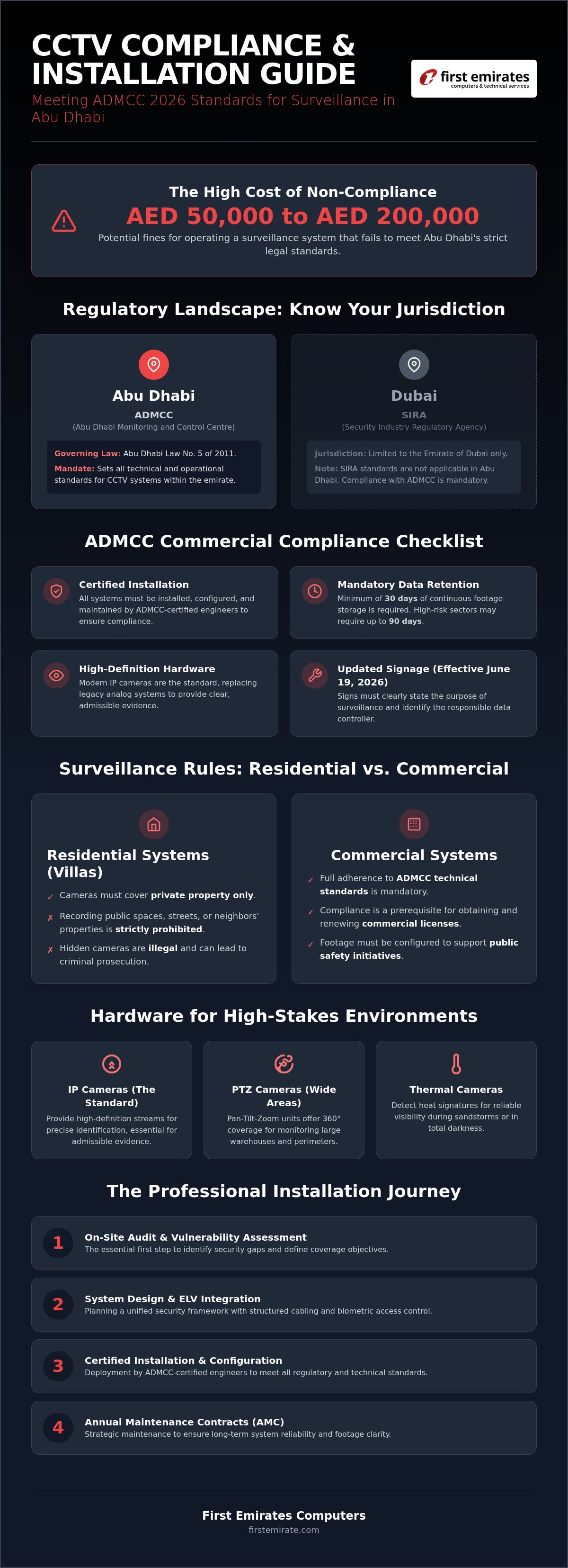
Effective security in the UAE capital requires a clear understanding of the local regulatory hierarchy. While many businesses are familiar with the Security Industry Regulatory Agency (SIRA), its jurisdiction is limited to Dubai. In Abu Dhabi, the primary governing body is the Abu Dhabi Monitoring and Control Centre (ADMCC). This agency establishes the technical and operational standards that every professional Closed-circuit television (CCTV) system must follow. Professional CCTV installation Abu Dhabi ensures that your hardware is not only functional but also legally sound. Aligning your infrastructure with Abu Dhabi Police standards isn't optional; it's a prerequisite for obtaining and renewing commercial licenses.
Failing to meet these requirements can lead to severe operational disruptions. For instance, operating a non-compliant system can result in fines ranging from AED 50,000 to AED 200,000. The legal framework established by Abu Dhabi Law No. 5 of 2011 dictates that specific sectors, such as banking and hospitality, must maintain hardware configurations that support public safety initiatives. Using a systematic approach to compliance protects your business from these penalties while ensuring that recorded footage is admissible if an incident occurs.
Understanding ADMCC Approval Requirements
Commercial entities in Abu Dhabi must adhere to the Video Surveillance Systems Standards. These regulations mandate that equipment must be installed by certified engineers who understand the nuances of the ADMCC certification process. A core requirement is the data retention policy, which typically demands at least 30 days of continuous footage. Some high-risk sectors may even require up to 90 days. As of June 19, 2026, signage requirements have also become more stringent. It's no longer enough to state that cameras are in use. Signs must now identify the data controller and the specific purpose of the surveillance to remain compliant.
Legal Framework for Residential CCTV
Residential security follows a different set of protocols governed largely by UAE Federal Decree-Law No. 45 of 2021 regarding data protection. While homeowners are encouraged to invest in CCTV installation Abu Dhabi for villa protection, they must strictly avoid recording public spaces or neighboring properties. Privacy laws are rigorous. The installation of hidden cameras is strictly prohibited and can lead to criminal prosecution. For residential systems, the focus is on protecting the perimeter without infringing on the privacy of the general public or adjacent residents. Professional installers ensure that camera angles are precisely calibrated to cover only the owner's private property.
Selecting High-Definition Hardware for Abu Dhabi Environments
Hardware selection determines the efficacy of your security ecosystem. For a professional CCTV installation Abu Dhabi, the transition from legacy analog systems to network IP cameras is now a standard requirement for 2026. While analog systems were once common, they lack the resolution and digital scalability required by current ADMCC regulations. Modern IP cameras provide high-definition streams that allow for precise identification of individuals and license plates, which is critical for providing admissible evidence to local authorities.
Industrial sites in areas like Musaffah often require specialized hardware such as Pan-Tilt-Zoom (PTZ) cameras. These units provide 360-degree coverage and powerful optical zoom, making them ideal for monitoring large warehouses or construction perimeters. In environments with high ambient temperatures, thermal imaging cameras offer an added layer of security. They detect heat signatures rather than relying on visible light, ensuring visibility during sandstorms or total darkness. This technical readiness is part of a broader initiative to bolster security compliance across the emirate's commercial sectors.
Data management is equally vital to your security strategy. Most local businesses utilize a Network Video Recorder (NVR) to manage high-definition streams locally while maintaining the mandatory 30-day retention period. Cloud-based storage is increasingly used as a redundant backup, protecting footage against physical theft or hardware failure. Selecting the right balance between local and off-site storage ensures your data remains secure and accessible at all times. If you're evaluating hardware for a new facility, reviewing our CCTV Surveillance Systems can help clarify which components align with your specific infrastructure needs.
Network IP Cameras: The Gold Standard for 2026
IP cameras are the primary choice for modern installations due to their superior 4K resolution and advanced digital zoom capabilities. Utilizing Power over Ethernet (PoE) technology simplifies the installation process by carrying both power and data over a single structured cable. This reduces the complexity of the deployment and allows for seamless remote monitoring via secure mobile applications, giving you real-time oversight of your premises from any location.
Specialised Surveillance for Harsh Climates
Abu Dhabi's climate presents unique challenges for electronic equipment. Outdoor units must feature dust-proof and heat-resistant housing, typically with an IP66 or IP67 rating to withstand extreme summer temperatures. For coastal properties, corrosion-resistant materials are necessary to prevent damage from salt-laden air. High-performance night vision and low-light sensors are standard requirements for CCTV installation Abu Dhabi projects, ensuring that image quality remains consistent regardless of environmental conditions.
Tailored Security Solutions: From Musaffah Warehouses to Corporate Offices
Every facility in the capital presents a unique set of vulnerabilities. A logistics hub in Musaffah requires a fundamentally different security architecture than a high-rise corporate office in the city center. Professional CCTV installation Abu Dhabi begins with a precise mapping of these specific operational risks. For industrial managers, the primary focus is often perimeter integrity and the protection of physical assets. In contrast, corporate leaders prioritize employee safety and the visual auditing of sensitive IT infrastructure. A methodical approach ensures that the hardware selected aligns perfectly with the site's daily operations.
Retail environments also benefit from specialized surveillance configurations. Beyond simple loss prevention, modern systems utilize AI-powered analytics to conduct customer traffic analysis. This data helps managers identify peak hours and optimize floor layouts based on buyer behavior. For enterprise-level organizations with multiple branches across the emirate, multi-site management software is essential. It allows security teams to centralize their oversight, ensuring that protocols remain consistent whether they're monitoring a storefront in Al Khalidiyah or a distribution center in the Industrial Area.
Industrial and Warehouse Security in Musaffah
Musaffah remains the industrial heart of the emirate, characterized by expansive warehouse compounds and high-traffic loading bays. Security in this sector demands robust perimeter protection using long-range thermal cameras and PTZ units. Integrating these cameras with Biometric Access Control systems allows facility managers to verify the identity of personnel entering high-value storage zones. This systematic integration ensures that every entry event is backed by high-definition visual evidence, creating a comprehensive audit trail for logistics operations.
Corporate and Multi-Tenant Office Surveillance
Office environments require a more discreet and professional approach to hardware placement. Cameras are typically positioned to monitor entry points, elevator lobbies, and reception areas without creating an intrusive atmosphere for staff or visitors. Protecting the server room is a critical component of any corporate ELV project. Surveillance in these areas provides a visual record of all individuals accessing core network hardware. For multi-tenant office blocks, centralized management platforms allow building security to monitor multiple floors and common areas from a single, unified control interface.
The Professional Installation Journey: A Systematic Approach
A successful security deployment relies on a disciplined execution strategy. For CCTV installation Abu Dhabi, this process begins long before the first camera is mounted. We follow a rigorous five-step methodology to ensure that every system is technically sound and fully compliant with local mandates. This structured approach moves from initial discovery to final regulatory approval, providing a transparent roadmap for business owners.
- On-site security audit: We evaluate your physical premises to identify vulnerabilities and environmental constraints.
- Custom system design: Based on the audit, we select hardware that matches your specific coverage requirements and budget.
- Structured cabling and mounting: Our engineers deploy the physical infrastructure, ensuring clean cable runs and secure hardware positioning.
- Configuration and testing: We calibrate the software, set up remote monitoring, and provide comprehensive staff training.
- Regulatory handover: The final stage involves verifying compliance with ADMCC standards and completing the necessary certification.
Adhering to this journey minimizes downtime and prevents the common pitfalls of sub-professional setups. If you're ready to begin your deployment, our team provides expert CCTV installation Abu Dhabi services tailored to your facility's unique footprint. By following these steps, we ensure that your system isn't just a collection of cameras, but a reliable security asset.
The Importance of a Site Audit
An exhaustive site audit is the foundation of a reliable surveillance system. We analyze your facility to identify critical blind spots where coverage might be obstructed by structural elements or poor lighting. This stage also includes assessing your existing network capacity. High-definition IP cameras require significant bandwidth, so we must ensure your IT infrastructure can handle the increased data load without compromising performance. Proper planning during the audit phase also ensures that camera angles align with privacy laws and ADMCC visibility requirements.
Structured Cabling: The Backbone of Surveillance
Reliable video transmission depends entirely on the quality of your underlying Structured Cabling. Poorly installed wiring often leads to signal dropouts and intermittent hardware failure, which can be disastrous during a security incident. We utilize high-grade Cat6 or fiber optic cables to future-proof your system, providing the high-speed data pathways needed for 4K streams. Neat cable management isn't just about aesthetics; it facilitates easier maintenance and protects the integrity of your network over the long term.
Integrated Infrastructure: ELV Projects and Maintenance Contracts
Extra Low Voltage (ELV) systems serve as the central nervous system of modern buildings. A professional CCTV installation Abu Dhabi project is most effective when it's treated as a core component of this broader ELV framework. By integrating surveillance with your data networks, telecommunications, and power management, you create a unified infrastructure that's easier to manage and scale. This systematic approach prevents the technical silos that often lead to network congestion or hardware conflicts in complex commercial environments.
First Emirates Computers serves as a dependable partner for businesses seeking this level of technical integration. We move beyond simple hardware sales to provide comprehensive oversight of your IT and security assets. Our methodical process ensures that your surveillance system isn't just an isolated tool, but a functional part of your building's operational strategy. This focus on integrated infrastructure provides the quiet confidence that your facility is protected by a stable, high-performance network designed for long-term reliability.
Maintenance is the final, yet most critical, stage of any security project. Shifting from a reactive "break-fix" mindset to a proactive strategy is essential for reducing long-term repair costs and avoiding system failure. In the UAE capital, maintaining a fully operational surveillance system is often a prerequisite for insurance compliance and commercial licensing. A disciplined maintenance schedule ensures that your security investment remains an asset rather than a liability.
Maximising Reliability with CCTV AMCs
An Annual Maintenance Contract (AMC) provides the structured support needed for system longevity. These contracts include scheduled lens cleaning and hardware health checks to ensure that image quality never degrades. Our engineers perform regular firmware updates to protect your cameras and recorders against emerging cybersecurity threats. Priority support for critical system failures is a standard feature of our Annual Maintenance Contracts, ensuring that any downtime is addressed with technical precision and minimal delay.
Beyond Cameras: Integrating Access Control and Automation
True security readiness involves linking your cameras with other ELV components. By integrating surveillance with Biometric Access Control, you create a comprehensive event log where every door entry is paired with a high-definition video clip. Smart automation features can be configured to trigger real-time alerts based on visual motion in restricted zones. This unified management of IT hardware and security assets allows for a more responsive and thorough approach to facility protection, ensuring that no incident goes unrecorded or unnoticed.
Strengthening Your Security Infrastructure for 2026 and Beyond
Transitioning from fragmented security to a unified ELV framework is the most effective way to protect your commercial interests in the capital. A successful CCTV installation Abu Dhabi requires more than just mounting hardware; it demands a deep understanding of ADMCC standards and the technical precision to integrate cameras into complex IT networks. By prioritizing high-definition IP technology and robust structured cabling, you ensure your surveillance system remains a functional asset rather than a technical liability.
First Emirates Computers has provided this level of methodical expertise since 2011. As specialists in comprehensive ELV projects and structured cabling, we deliver the technical readiness required for modern industrial and corporate environments. Our dedicated Annual Maintenance Contracts ensure that your system continues to perform at peak efficiency, providing long-term reliability and peace of mind. Secure your assets with First Emirates Computers-Request a professional site audit today to verify that your facility meets the highest standards of safety and compliance. We look forward to being your dependable partner in building a more secure and resilient business environment.
Frequently Asked Questions
Is it mandatory for all businesses in Abu Dhabi to have CCTV?
Yes, many commercial sectors are legally required to maintain an ADMCC-compliant surveillance system. This mandate applies to hotels, banks, shopping malls, hospitals, and most commercial buildings. Abu Dhabi Law No. 5 of 2011 establishes these requirements to support public safety. If your business falls into these categories, you must ensure your system meets all current technical and regulatory standards to maintain your operational license.
How long must CCTV footage be stored according to Abu Dhabi law?
Standard regulations require a minimum of 30 days of continuous footage retention for most commercial entities. However, certain high-risk sectors or specific facilities may be directed to maintain data for up to 90 days. It's essential to verify the specific retention period required for your industry. Professional systems must be configured with sufficient storage capacity to ensure that older data isn't overwritten before the legal limit is reached.
What is the difference between SIRA and ADMCC approval?
The primary difference lies in their geographic jurisdiction and specific technical mandates. SIRA is the regulatory body for the security industry in Dubai, while the Abu Dhabi Monitoring and Control Centre (ADMCC) is the overriding authority for the capital. Any CCTV installation Abu Dhabi project must strictly adhere to ADMCC standards. These standards often differ from Dubai’s requirements regarding hardware specifications, data retention, and reporting protocols.
Can I monitor my Abu Dhabi CCTV cameras remotely from another country?
Remote monitoring is technically feasible through secure IP networks and mobile applications. You can access your high-definition streams from anywhere in the world provided you have an active internet connection. However, it's vital to ensure that your remote access is secured with robust encryption to prevent unauthorized data breaches. You must also ensure that the collection and processing of this data remain compliant with UAE federal data protection laws.
What happens if my CCTV system is found to be non-compliant?
Non-compliance carries significant legal and financial risks for business owners. Operating a system that doesn't meet ADMCC standards can result in fines ranging from AED 50,000 to AED 200,000. In some cases, penalties may include imprisonment for up to two years. Additionally, the Abu Dhabi Police or other authorities may refuse to certify your facility, which could prevent the renewal of your commercial trade license or insurance policy.
How often should a professional CCTV system be serviced?
Professional systems should be serviced at least once every quarter to ensure consistent reliability. Regular maintenance includes cleaning camera lenses, checking hardware connections, and verifying the health of storage drives. It's also a critical time for engineers to apply firmware updates that protect your equipment from cybersecurity vulnerabilities. A disciplined maintenance schedule prevents minor technical issues from escalating into expensive system failures during a security incident.
Are wireless cameras suitable for commercial use in Abu Dhabi?
Wireless cameras are typically unsuitable for high-security commercial environments due to their vulnerability to signal interference and bandwidth limitations. Most professional installations in the capital utilize structured cabling, such as Cat6 or fiber optics, to ensure a stable data pathway. Wired connections provide the consistent high-speed transmission required for 4K video streams. They also eliminate the risk of signal dropouts that can occur in dense urban or industrial areas.
How much does a professional CCTV installation cost?
The total investment for a professional CCTV installation Abu Dhabi project is determined by several technical factors. These include the number of cameras required, the specific resolution of the hardware, and the complexity of the structured cabling infrastructure. Other variables, such as the total storage capacity for data retention and integration with biometric access control, also influence the final cost. We recommend a site audit to determine the precise requirements for your facility.


