

What if a camera proposal still leaves gaps in coverage, compliance, or ongoing support? Knowing how to choose a security system installer in Dubai means looking beyond equipment lists and headline specifications. The system should suit the property, its daily operations, and the applicable local requirements.
Camera resolution and features matter, but they do not show how the full project will be delivered. A clear scope should address surveillance priorities, access control where needed, cabling and infrastructure, installation coordination, and maintenance after handover.
This guide gives you a practical framework for assessing technical fit, Dubai compliance needs, project delivery, and long-term support. It explains how to compare proposals by coverage and scope, account for relevant authority requirements, and plan for reliability after installation. First Emirates Computers provides CCTV surveillance, biometric access control, structured cabling, ELV projects, and annual maintenance contracts across the UAE, connecting security systems with the infrastructure that supports them.
Key Takeaways
- Learn how to choose a security system installer in Dubai by starting with the property’s purpose, access patterns, operating hours, and priority areas.
- Compare technical scope across CCTV, biometric access control, ELV works, and structured cabling, while accounting for site-specific approval needs.
- Assess proposals by project stages, including design, cabling, configuration, testing, handover, and ongoing support, rather than equipment names or totals alone.
- Use consistent decision criteria to define your needs, assess the site, compare scopes, plan delivery, and review maintenance support.
- See how First Emirates Computers connects security systems and supporting infrastructure through its UAE-based capabilities and experience founded in 2011.
How to Choose a Security System Installer in Dubai: Start with the Site
Comparing security proposals is difficult when each describes a different scope. One may focus on camera models, while another includes access control, cabling, setup, and handover. Before weighing equipment or totals, define what the system needs to do at your property. This is the practical starting point for how to choose a security system installer in Dubai.
Site purpose, access patterns, operating hours, and risk areas all affect the design. A Dubai office may need clear views of reception and controlled access to staff-only areas. A retail premises may prioritise entrances, customer areas, and points where transactions take place. A villa may need attention to gates, entrances, and boundaries, while a warehouse may require coverage around loading areas, storage zones, and staff access routes. These settings have different operating needs, so one standard layout will not suit them all.
Start with a site assessment, because the property’s risks and routines determine what the system needs to cover. Physical security combines measures that protect people, property, and access; the Physical Security Overview provides useful background on this broader approach.
Which site risks should the installer assess first?
Map how people and goods move through the property. Mark entrances, loading areas, reception points, restricted zones, and places where walls, shelving, vehicles, or layout changes may create blind spots. Then identify who needs access to each area and which events staff may need to review later, such as an after-hours entry or a delivery discrepancy.
Separate immediate priorities from future requirements. A business may need better visibility at a staff entrance now, for example, while planning for additional access-controlled areas as operations expand. Recording both helps keep the initial scope focused without overlooking infrastructure or future expansion. Camera placement should also respect privacy boundaries and applicable requirements for the specific property.
What should a project brief include?
A useful brief gives the project team a consistent picture of the site and its operating needs. Include the property type, operating hours, regular users, visitor patterns, and priority areas. Note what the system should support, such as incident review, visitor management, or controlled entry. Clear objectives help distinguish essential functions from optional additions.
Document existing conditions as well. List current cameras, access-control equipment, network infrastructure, and known limitations, such as unreliable coverage or areas without cabling. Add planned layout or operational changes that could affect the design. A concise brief gives the technical assessment a practical basis and helps ensure proposals address the same requirements, making their scopes easier to compare.
Evaluate a Dubai Security Installer’s Technical Scope and Compliance Approach
A technically suitable proposal connects the equipment to the work required at the site. Compare the installer’s capabilities across CCTV, biometric access control, ELV works, and structured cabling. These elements often need coordinated planning: camera positions depend on coverage objectives, while access points and network infrastructure affect how the system can be installed and used.
A device list names what may be supplied; a complete technical scope explains how the system will be designed, integrated, tested, and documented. Use a comparison table to make differences visible. For each proposal, record the design scope, equipment categories, integration responsibilities, testing activities, handover documents, and exclusions. This helps reveal gaps that a camera brand or headline specification cannot show.
For general background on industry practices and education, consult the Security Industry Association (SIA). Industry guidance can inform questions about project quality, but it does not replace Dubai-specific regulatory requirements or approvals.
How should CCTV and access control work together?
CCTV and controlled entry serve different operational purposes. Cameras provide visual records of relevant areas, while access control governs who can enter selected spaces. A useful design aligns access points, camera views, and user roles. For example, if entry to a staff-only room is restricted, the plan should cover both user permissions and the relevant camera view, where surveillance is appropriate.
Biometric access control should reflect the property’s access policy and user needs, rather than being added by default. The scope should specify which doors require controlled entry, who will be assigned access, and how that arrangement supports daily operations.
How should Dubai compliance be handled in the project scope?
Applicable requirements depend on the property, system, and project scope. Identify the relevant Dubai authority requirements for the specific site, including any requirements that apply to CCTV or security-system work, and document how compliance responsibilities will be handled. Verify current information directly with the relevant authority; do not treat a vendor preference or product feature as a legal requirement.
Keep three categories distinct in the proposal: regulatory requirements, optional system features, and vendor recommendations. Request clear documentation of the compliance basis and project deliverables without assuming an installer holds a particular approval or certification. This is a practical part of how to choose a security system installer in Dubai, because compliance planning should be specific to the project, not implied by equipment selection.
- Design: planned coverage, access points, and system connections.
- Equipment: proposed categories and their stated roles.
- Integration: interfaces between CCTV, access control, and infrastructure.
- Verification: testing, handover records, and compliance documentation.
First Emirates Computers delivers CCTV, biometric access control, ELV implementation, and structured cabling. Reviewing these elements together helps clarify responsibilities from design through handover. Explore security and infrastructure project capabilities as you define the scope your site requires.
Compare Security Installer Proposals Beyond Camera Brands
Two proposals can name similar cameras and still describe very different projects. One may include site assessment, cabling, configuration, testing, and handover; another may price equipment while leaving those activities unclear. Compare equivalent scopes, not just headline equipment or proposal totals. That makes it easier to see what each project includes and who is responsible for each task.
Equipment brands can help identify the proposed hardware, but they do not show whether placement suits the site, how components will work together, or who is accountable for completing and testing the installation. A clear scope addresses these points and reduces handoff gaps. When design, cabling, configuration, and testing are assigned and documented, fewer tasks are left between separate workstreams.
What belongs in a like-for-like proposal comparison?
Build a side-by-side comparison using the same categories for each proposal. Record the stated coverage areas, system functions, and relevant equipment specifications, then note whether each project stage is included. Check that the scope covers the work from design through installation and testing, rather than treating hardware supply as the entire project. Consistent categories make differences easier to spot.
- Site assessment and design: identify the areas and functions covered.
- Cabling and configuration: note infrastructure work and system setup.
- Testing and handover: record functional checks, user training, and documentation.
- Assumptions and exclusions: capture work, materials, or responsibilities outside the stated scope.
Be precise about terms such as “testing” or “training.” The proposal should explain what will be checked and what handover information users will receive. If a requirement is not described, record it as an open point instead of assuming it is included. The aim is to compare the same deliverables, not infer them from a total or equipment list.
How can you assess support after installation?
Review maintenance as part of the system’s lifecycle. Note the proposed maintenance scope, planned system checks, and who is responsible for support. Clarify how the agreed service handles reported faults, updates, and changes to users or system configuration. Clear responsibilities help the property team understand what ongoing care covers and how support connects to the original installation.
For ongoing-care context, the CCTV maintenance contract guide explains how maintenance planning can support business continuity. Use it to identify the support activities that matter for your operations, then make sure the proposal describes them in practical terms.
A disciplined comparison is central to how to choose a security system installer in Dubai. Evaluate scope, inclusions, exclusions, testing, handover, and support together. This gives decision-makers a clearer basis for comparing complete delivery plans, rather than treating camera brands or proposal totals as measures of project suitability.
Use a Step-by-Step Process to Select a Dubai Security Installer
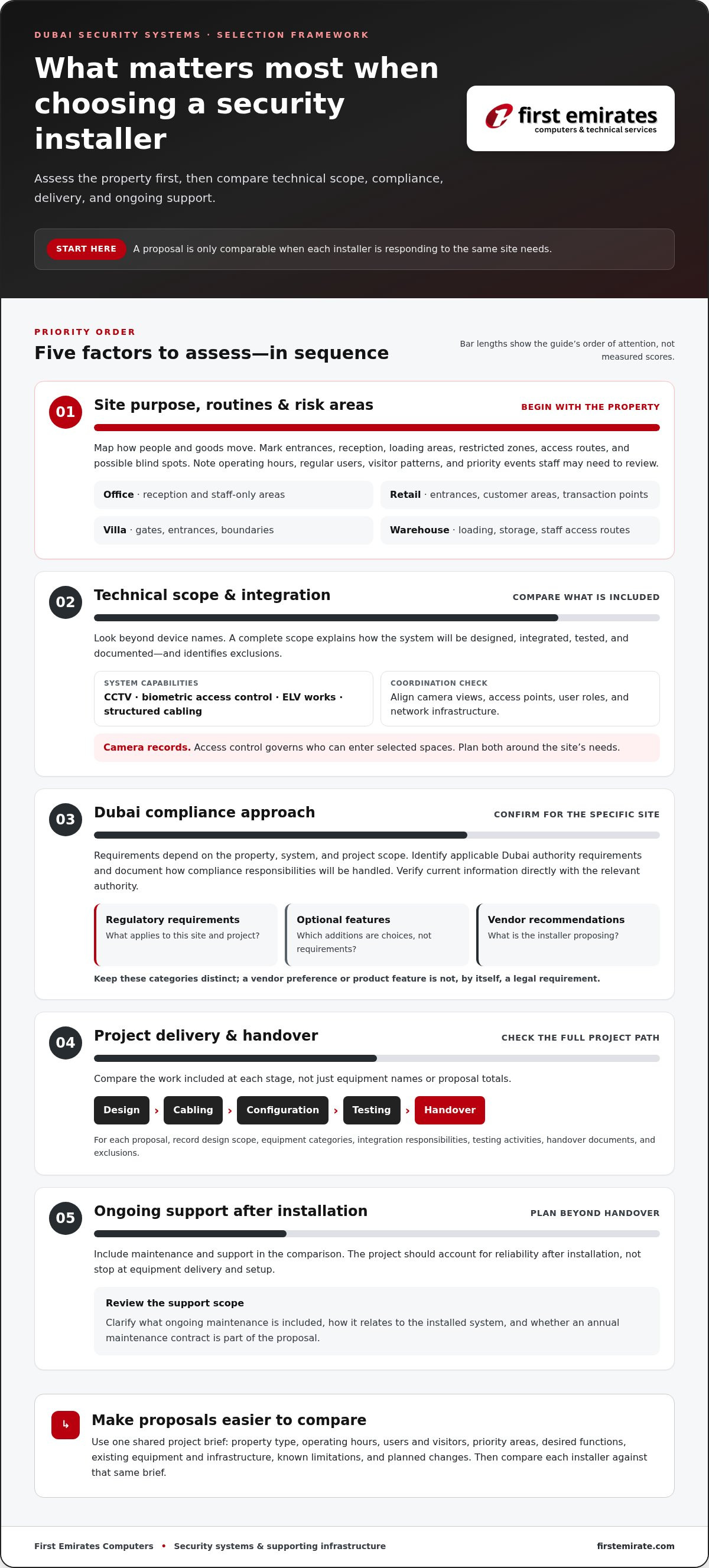
A consistent selection process turns site findings into a scope that can be delivered and supported. Before reviewing proposals, write down the criteria you will use: coverage priorities, access-control needs, infrastructure work, compliance responsibilities, testing, handover, and ongoing support. Apply the same criteria to each proposal so differences reflect the work being offered, not different assumptions.
- 1. Define the need. Write down the operational objectives, such as reviewing incidents, managing visitor entry, or restricting access to specific areas. Separate essential requirements from optional features, and note any future expansion plans.
- 2. Assess the site. Review priority areas, existing equipment, cabling routes, and potential coverage or access gaps. Record network dependencies and constraints that could affect system placement or operation.
- 3. Compare the scope. Check that proposals address comparable system functions, infrastructure, configuration, testing, handover, and exclusions. Clarify assumptions rather than treating an unspecified task as included.
- 4. Plan delivery. Set out responsibilities and implementation stages, including how surveillance, access control, and cabling will be coordinated when they form part of the project. Agree how system testing and handover will be documented.
- 5. Review support. Define who manages routine checks, fault reporting, updates, and system changes after handover. Consider how the maintenance arrangement supports operational continuity.
How do you move from site assessment to an agreed scope?
Translate site findings into objectives that can be checked against the design. If controlled entry to a restricted area is a priority, document the access point, intended user permissions, and any related surveillance objective. Then assign responsibilities for design, cabling, configuration, implementation, and testing. A written scope gives the project team a shared reference and makes handover expectations clear.
Include dependencies that could affect continuity, such as network capacity or the need to coordinate installation around normal site operations. If requirements may expand, record what could change and which parts of the design or infrastructure should account for it. This distinguishes planned provisions from work that would require a later scope change.
How should you plan for future maintenance and changes?
Decide how routine checks, fault reporting, updates, and changes to users or coverage will be managed. A change in site layout, staff roles, or access policy can affect the original design, so identify who will review those changes and document adjustments. For access-control evaluation, the access control system selection guide offers related considerations.
Use this framework to prepare a clear project brief and compare security scopes consistently. Explore coordinated security and infrastructure project support for CCTV, biometric access control, ELV works, and structured cabling.
How First Emirates Computers Supports Security Projects in Dubai
Security projects are easier to manage when system design and supporting infrastructure are considered together. First Emirates Computers is a locally owned UAE company founded in 2011, with services covering CCTV surveillance, biometric access control, ELV projects, structured cabling, and annual maintenance contracts. These capabilities support coordinated project planning, with the scope shaped around the property and its priorities.
For a Dubai office, that could mean planning surveillance and controlled entry alongside the cabling needed to support them. Another property may need CCTV and infrastructure work without biometric access control. The right combination depends on site conditions, operating requirements, and applicable project needs. A coordinated scope defines how each selected system fits into the wider installation while keeping unnecessary components out of the plan.
What capabilities can support a coordinated security project?
CCTV surveillance and biometric access-control installation address distinct security functions. Surveillance supports visual monitoring and review, while access control manages entry according to the site’s access policy. ELV implementation and structured cabling provide supporting technical infrastructure where the project calls for it. Bringing these requirements into one scope clarifies how equipment, cabling, and implementation activities relate, rather than treating each component as an isolated purchase.
Not every property needs every system. A project brief and site assessment should guide the design: which areas need surveillance, whether selected entry points require access control, and what infrastructure is needed. This keeps the solution focused on practical objectives and makes project responsibilities easier to define.
What is the next step for a Dubai security project?
Start by outlining the property type, operating requirements, security priorities, and existing infrastructure. Include current CCTV or access-control equipment, relevant network or cabling details, and known limitations. These details provide a useful basis for scoping and help shape an implementation plan around the site instead of a generic equipment list.
Project scoping can connect the required security functions with the work needed to implement and support them. Where ongoing care is a priority, an annual maintenance contract can be part of planning for system checks and longer-term reliability. The scope should make clear which systems are included and how maintenance fits the property’s operational requirements.
If you’re considering how to choose a security system installer in Dubai, a clear project brief is a practical starting point. Share your property type, priorities, and existing infrastructure to define a tailored scope for CCTV, biometric access control, ELV works, cabling, and ongoing care as required.
Discuss your security system requirements
Turn Your Security Priorities into a Clear Project
A security system should stay aligned with how a property is used, not simply reflect the equipment selected at installation. Treat the decision as the start of an operational plan: record the outcomes the system should support, assign an internal owner, and note what changes would prompt a review. This gives the property team a consistent reference as site use or priorities evolve.
If you’re considering how to choose a security system installer in Dubai, begin with a concise outline of your property, current infrastructure, and required outcomes. Use it to frame the project discussion and identify decisions to resolve before implementation, from system responsibilities to how the completed installation will fit daily operations.
First Emirates Computers brings together security, ELV, structured cabling, and maintenance capabilities for coordinated project planning. Discuss your security system requirements and take the next step toward a scope shaped around your property. A clear brief is a practical foundation for moving forward with confidence.
Frequently Asked Questions
How do I choose a security system installer in Dubai?
Choose an installer whose technical scope matches your property and the way your team operates. Before reviewing proposals, identify who will use the system, who will manage access permissions, and who needs to retrieve footage after an incident. Then compare project responsibilities, handover records, and ongoing support. This helps you assess whether the installation will work for daily operations, not just meet the initial equipment requirement.
Does a security system installer in Dubai need SIRA approval?
Dubai’s security-related installation work is subject to SIRA licensing requirements, according to the current regulatory information provided for this guide. The specific requirements can depend on the service and project scope, so verify current rules and any applicable authorization directly with SIRA before work begins. This general requirement should not be treated as evidence that a particular company holds a license or that a specific project has been approved.
What should a security system installation proposal include?
A proposal should identify the intended system functions, equipment categories, installation work, and responsibilities for configuration and testing. It should also specify handover items, such as user guidance, equipment records, and relevant system documentation. Check that exclusions and assumptions are written down. If building work or changes to existing network infrastructure are outside the scope, for example, the proposal should make that boundary clear before implementation is agreed.
Should I choose a CCTV installer that also provides access control?
Not necessarily. The decision depends on whether the property needs controlled entry as well as video surveillance. If both are required, coordinated planning can align access permissions with relevant camera coverage and clarify how the systems will be handed over. If access control is not part of the operational need, it may add unnecessary complexity. Consider the site’s entry policy, user roles, and security objectives before including it in the project.
How long does security system installation take in Dubai?
There is no single reliable duration for every Dubai project. The schedule depends on factors such as property size, installation access, the amount of cabling required, existing infrastructure, and the number of systems being implemented. Testing and handover are also part of the work. Base the project schedule on site conditions and the agreed scope, with dependencies and implementation stages made clear before work is planned.
Why does a security system need maintenance after installation?
Maintenance helps keep a system aligned with changing site conditions and operating needs. A camera view can become obstructed after a layout change, while staff turnover may require access permissions to be updated. Routine checks can also help identify faults affecting recording, connectivity, or system operation. An annual maintenance contract can define planned care and support responsibilities, giving the property team a clear basis for managing system reliability after handover.
Can an installer connect a security system to existing cabling and infrastructure?
Existing infrastructure may be reusable, but its condition and suitability require technical assessment. The project team can review cabling routes, network capacity, equipment connections, and known faults to determine whether the current setup supports the intended system. A site may have usable cable runs in some areas but need new structured cabling elsewhere. Documenting these findings helps define upgrade work and avoid relying on untested connections.


