

A dependable Ubiquiti network starts with a site plan, not a hardware list. For a Ubiquiti network installation Abu Dhabi businesses can rely on, begin by identifying how the property is used, where access is needed, and which devices require wired connections. Choosing equipment before answering those questions can leave coverage gaps, create unnecessary capacity, or lead to avoidable disruption.
Wireless access, wired devices, and network security need to work together while staff, residents, and daily operations continue. That calls for a process tailored to the building and its users, not a standard layout applied to every site.
This guide explains how to assess, design, install, and configure a business or property network. It also covers how structured cabling supports wired components and how ongoing maintenance can help sustain reliability after handover. You’ll learn what each stage involves, which decisions shape the coverage plan, and how to organize installation around the site’s operational needs in Abu Dhabi and across the UAE.
Key Takeaways
- A reliable Ubiquiti network installation Abu Dhabi project begins with site requirements and coverage priorities, not a preset equipment list.
- Building layout, walls, floors, user needs, and wired-device locations all shape the network design.
- Offices, retail sites, villas, and multi-tenant properties need different installation plans based on how people and devices use the network.
- Coordinating network deployment with structured cabling helps connect wireless coverage and wired equipment as one system.
- Plan for configuration updates and ongoing maintenance after handover to support reliability as operational needs change.
Ubiquiti Network Installation in Abu Dhabi: What the Project Covers
A Ubiquiti network installation is the planned deployment and configuration of network equipment for a specific site, including testing and handover. It involves more than purchasing devices. Suitable equipment may still deliver inconsistent coverage if placement, connections, and configuration aren’t considered together.
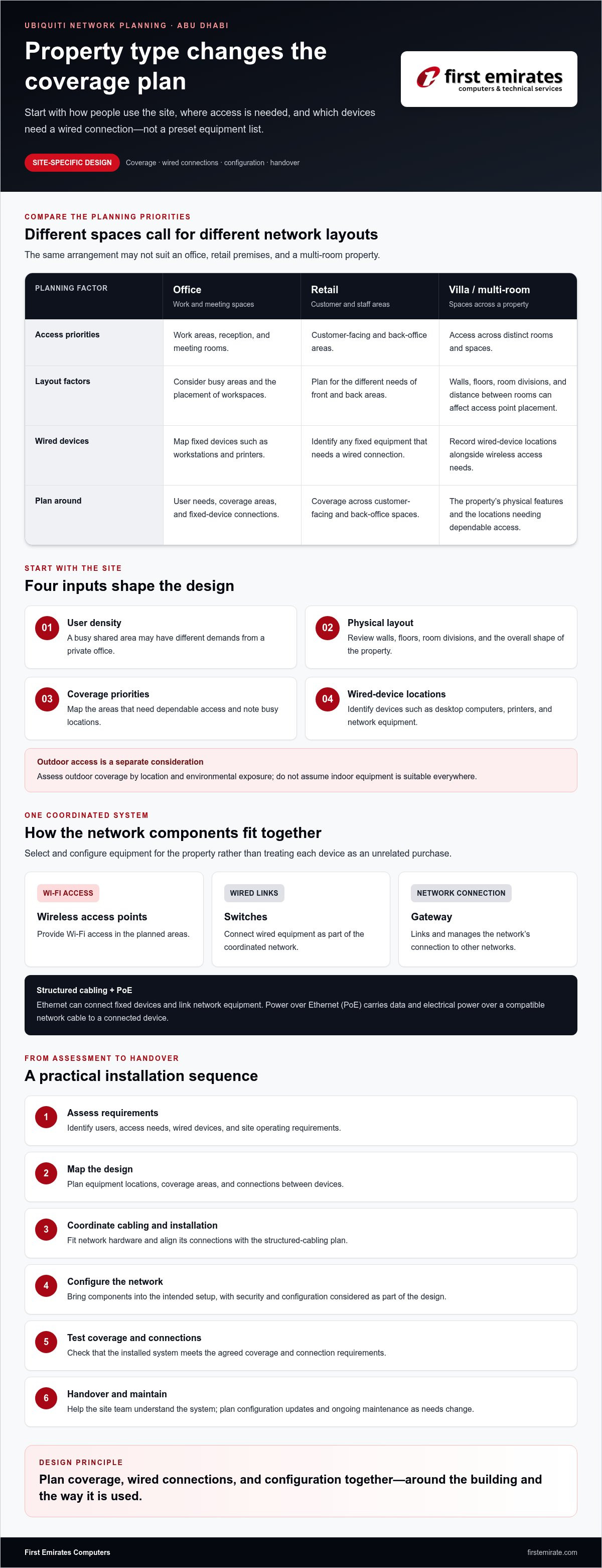
Ubiquiti Inc. produces networking equipment, while UniFi refers to its network ecosystem. In a coordinated design, wireless access points provide Wi-Fi access, switches connect wired equipment, and a gateway links and manages the network’s connection to other networks. Select and configure equipment for the property rather than treating each device as an unrelated purchase.
What does a Ubiquiti network installation include?
The project begins by identifying who uses the network, where access is needed, and which devices require wired connections. The design maps equipment locations and the connections between them. Installation may include fitting network hardware and coordinating its connections with structured cabling. Configuration brings the components into the intended setup. Testing checks that connections and coverage meet the agreed requirements, and handover helps the site team understand the deployed system.
The scope depends on the building layout and its operational needs. A site with several wired workstations, for example, has different connection requirements from one that relies mainly on wireless access. A useful plan records those differences before equipment is selected, rather than assuming the same arrangement suits every property.
Which Abu Dhabi sites may need a planned network deployment?
Every property combines users, spaces, and connected equipment differently. An office may need access across work areas and meeting rooms, alongside wired connections for fixed devices. A retail premises may need access in both customer-facing and back-office areas. In a villa or multi-room property, walls, floors, and the distance between rooms can influence access point placement and the coverage plan.
Assess user density, physical layout, and wired-device requirements. A busy shared area may have different demands from a private office, while a multi-storey layout may need a different placement approach from an open-plan space. Mapping these conditions helps shape a practical Ubiquiti network installation Abu Dhabi businesses and property owners can tailor to their site, without applying the same equipment list or layout everywhere.
How Ubiquiti Network Design Shapes Coverage and Reliability
Coverage planning starts with how people use each part of the site, not simply how many access points can be installed. Review the layout alongside user needs, busy areas, and locations for fixed devices such as desktop computers, printers, or network equipment. This helps identify where wireless access is a priority and where a wired connection may be more suitable.
Network reliability depends on design, configuration, and the environment in which the network operates. A device in an open area may serve nearby users differently from one placed behind walls or on another floor. For a Ubiquiti network installation Abu Dhabi property owners should account for these site conditions before finalizing equipment placement.
How is Wi-Fi coverage planned for an Abu Dhabi site?
Map the areas that need dependable access, then consider physical features that may affect signal coverage, including walls, floors, room divisions, and the overall shape of the property. An office may prioritize work areas, reception, and meeting rooms, while a shared property may need access across several distinct spaces. Assess outdoor coverage separately, taking the location and environmental exposure into account rather than assuming indoor equipment is suitable everywhere.
How do wired connections and PoE fit the design?
Ethernet cabling can connect fixed devices and link network equipment, creating a wired foundation alongside Wi-Fi. Power over Ethernet (PoE) allows a compatible network cable to carry both data and electrical power to a connected device. This can simplify placement where a separate power connection is inconvenient. The design should account for which devices need wired connections and how cable routes fit the property. Detailed cabling choices belong in the wider structured-cabling plan.
Wireless design also involves security and configuration, not just signal reach. The National Institute of Standards and Technology’s Guidelines for Securing Wireless Local Area Networks discuss WLAN security across its lifecycle, offering a reference for considering protection during deployment and ongoing oversight.
A site-specific assessment brings together coverage priorities, obstacles, wired-device locations, and operating requirements. For businesses planning network infrastructure alongside structured cabling services, coordinating the two helps align cable routes with the intended network layout.
Choosing a Ubiquiti Installation Plan for Your Abu Dhabi Property
A suitable network plan reflects what the property needs now and how its use may change. User numbers matter, but so do device types, busy areas, wired connections, and the physical route between network equipment and users. For a Ubiquiti network installation Abu Dhabi businesses can put into operation with minimal disruption, coordinate installation activity with the site’s operating schedule and access requirements.
Existing cabling is a useful starting point, not a guarantee that it will support the planned design. Assess its routes, condition, termination points, and suitability for the intended connections. Some existing runs may fit the plan; others may need adjustment or replacement. Reviewing this early helps define the project scope before deployment begins.
What should an office network plan account for?
Map work areas, meeting rooms, reception, shared spaces, and fixed devices such as printers or desktop computers. Identify which activities depend on stable connectivity and which areas can accommodate installation work at different times. If the business expects changes to its layout, staffing, or connected equipment, include those plans in the design so future adjustments can be considered without assuming a particular capacity.
How do villa, retail, and multi-floor requirements differ?
Room arrangement and access needs vary by property. A villa plan considers coverage across rooms and floors; a retail plan distinguishes customer-facing areas from staff-only spaces and fixed business devices. Multi-tenant properties may need attention to shared spaces and the way network access is organized for different users. Use the comparison below to identify the right questions before finalizing equipment and cabling decisions.
| Site type | Connectivity priorities | Design questions |
|---|---|---|
| Office | Work areas, meeting rooms, shared spaces, and wired devices | Which activities are business-critical? Where can installation work be coordinated around operations? |
| Retail premises | Customer-facing and staff-only areas, plus fixed equipment | Where do staff need access? Which devices need wired connections? |
| Villa | Coverage across rooms, floors, and relevant outdoor areas | How does the layout affect access between spaces? Which devices need a wired connection? |
| Multi-tenant property | Shared areas and connectivity needs across distinct spaces | Who uses each area, and how should access needs shape the design? |
These questions turn a general equipment requirement into a site-specific installation plan. Discuss a Ubiquiti network plan for your site with First Emirates Computers, whose structured cabling and ELV services support wider infrastructure planning in Abu Dhabi and across the UAE.
What Happens During Ubiquiti Network Installation in Abu Dhabi?
A well-managed installation follows a clear sequence, treating equipment, cabling, and site operations as parts of one project. For a Ubiquiti network installation Abu Dhabi businesses can plan with confidence, the process typically moves from requirements gathering to assessment, design, deployment, configuration, testing, and handover. The scope and timing depend on site conditions and the agreed design.
How are assessment and installation prepared?
Planning starts with the information needed to shape a practical design: the site layout, user requirements, connected devices, areas needing coverage, and operational constraints. Review existing cabling to understand whether it can support the planned connections or whether infrastructure changes are needed. This helps coordinate access points and other network hardware with structured cabling routes, connection points, and any required cabling work.
Organize installation activity around the property’s access arrangements and business operations. At an active office or retail site, identify work areas that must remain available and coordinate tasks to reduce unnecessary interference with normal activity. Clear planning gives the deployment team a defined sequence and helps site representatives understand what work is taking place.
What should configuration and handover cover?
After equipment is deployed and connected, configuration brings the network components into the intended setup. Testing checks the agreed operational requirements, including whether connected devices can access the network and whether planned coverage areas are served as intended. If a result differs from the design, review the relevant placement, connection, or configuration before handover.
Handover should give the responsible site team useful information about the installed network. This can include an outline of the equipment and connections, the network arrangement, and relevant configuration details needed for routine administration. Clear records help people understand the system after deployment and provide a reference when future changes are considered.
- Requirements: Confirm users, devices, coverage priorities, and operating constraints.
- Assessment and design: Review the layout and existing cabling, then define the deployment plan.
- Deployment and configuration: Install and connect the planned equipment, then apply the intended network settings.
- Testing and handover: Validate agreed connectivity and coverage needs, then provide site-specific handover information.
A methodical sequence aligns the finished network with the property’s requirements instead of treating deployment as a hardware installation alone. Plan a site-specific network installation around your layout, cabling, and operational needs.
Ubiquiti Network Support After Installation: A Practical Next Step
Network requirements change as teams, devices, and workspaces evolve. A new office layout, additional connected equipment, or a configuration adjustment can affect how the network operates. Planning support after a Ubiquiti network installation Abu Dhabi businesses can tailor to their site makes those changes part of the network’s ongoing lifecycle, rather than treating handover as the final step.
What network support may be needed after deployment?
Ongoing maintenance is separate from the original installation project. Installation delivers and tests the agreed design; support addresses operational needs that arise later. Depending on the site, this may include reviewing configuration, troubleshooting connectivity issues, and making changes as business requirements develop. An annual maintenance contract provides a structured support arrangement, with scope based on the business’s infrastructure needs.
Documentation is central to continuity. Keep an accurate record of network components, connections, configuration, and changes so the responsible team has a clear reference when investigating a fault or planning an adjustment. Without those records, troubleshooting may take more effort because the network’s layout and previous changes are less clear. Maintaining deployment records provides a useful basis for future support.
How can First Emirates Computers support the wider infrastructure?
Network performance depends on the infrastructure around the equipment as well as its configuration. Structured cabling supports physical connections between network components and wired devices, while ELV project implementation can form part of wider site infrastructure planning. Coordinating these elements helps keep network changes aligned with the property’s cabling and related systems.
First Emirates Computers provides annual maintenance contracts for ongoing support. The scope can be shaped around network and site requirements, since businesses do not all need the same maintenance arrangement. For a site with documented connections and a defined support path, the team has a clearer foundation for reviewing changes and addressing operational issues. Without a support plan, internal staff may have less guidance when configurations or requirements shift.
Include support in the network plan, not as an afterthought. Discuss your Abu Dhabi network installation requirements alongside your site’s infrastructure needs.
Build a Network That Fits Your Site
A reliable Ubiquiti network installation Abu Dhabi project is shaped by the property’s layout, users, and connected devices, not by equipment choices alone. A clear process links assessment and design with structured cabling, deployment, configuration, testing, and handover. Planning for support after installation also helps businesses manage configuration changes and evolving operational needs.
First Emirates Computers is based in Abu Dhabi and was established in 2011. Its structured cabling and ELV project capabilities support wider infrastructure, while annual maintenance contracts provide an ongoing technical support option.
Start with your site’s practical requirements, including coverage priorities, existing cabling, and how installation work can fit around operations. Discuss your Ubiquiti network installation requirements with First Emirates Computers and plan the infrastructure around your property.
Frequently Asked Questions
What does Ubiquiti network installation include?
Ubiquiti network installation typically includes requirements gathering, site assessment, network design, equipment deployment, configuration, testing, and handover. The design considers the property layout, coverage needs, connected devices, and how the network will be used. Testing checks the agreed connectivity requirements, while handover gives the responsible site team information about the installed setup. The final scope is tailored to the business or property.
Can Ubiquiti equipment be installed in an existing network?
Yes, Ubiquiti equipment can be incorporated into an existing network when the site assessment establishes how it fits the current infrastructure. The review should consider existing network equipment, cabling routes, connection points, and the intended design. For example, an office may retain suitable wired connections while adding wireless coverage in selected areas. Integration depends on compatibility and the requirements of the complete network.
How is Wi-Fi coverage planned for an office in Abu Dhabi?
Office Wi-Fi coverage is planned by mapping the areas that need access and identifying layout features that may affect signal reach. The assessment considers work areas, reception, meeting rooms, shared spaces, user needs, and locations of fixed devices. Walls, floors, and room divisions can influence equipment placement. For a Ubiquiti network installation Abu Dhabi businesses should assess the site rather than rely on a standard access point layout.
Does a Ubiquiti network installation include structured cabling?
Structured cabling can form part of a Ubiquiti network installation when the design requires wired connections for network equipment or fixed devices. The project review identifies whether existing cabling can support the intended setup or whether new routes or changes are needed. The cabling scope depends on the property and agreed design. Coordinating cabling with equipment placement aligns physical connections with network requirements.
How long does a Ubiquiti network installation take?
Installation time depends on site conditions and the agreed project scope, so there is no single duration for every property. The size and layout of the site, existing cabling, required infrastructure changes, access arrangements, and operational constraints can all affect the schedule. Straightforward equipment deployment differs from a project requiring extensive cabling work. Assessment and design establish the work involved before deployment is planned.
Can a Ubiquiti network support both wired and wireless devices?
Yes, a coordinated network design can support wireless users and devices alongside equipment connected by Ethernet. Wireless access points provide Wi-Fi connectivity, while wired connections can serve fixed devices such as desktop computers, printers, or other network equipment. The site plan identifies which devices need each connection type and how cabling links the relevant components. This helps the network serve different users and equipment across the property.
What support is useful after a Ubiquiti network is installed?
Useful post-installation support may include configuration reviews, troubleshooting, and changes as business requirements evolve. Accurate documentation of equipment, connections, and configuration gives the responsible team a practical reference when issues arise or adjustments are planned. Ongoing maintenance is distinct from the original installation and can be arranged through an annual maintenance contract. The support scope should reflect the site’s infrastructure and operational needs without assuming fixed response times or service levels.


