

Could a single overlooked camera angle or an insufficient storage buffer compromise your school's entire operating permit? With administrative fines for non-compliance now ranging from AED 5,000 to AED 100,000, the technical requirements for school security and surveillance solutions Dubai have never been more exacting. You likely recognize that managing a large-scale campus requires a delicate balance between high-grade protection and a welcoming learning environment. It's a complex task that demands technical precision and a thorough understanding of local regulations.
Achieving full compliance doesn't have to result in technical bottlenecks. This guide offers a professional roadmap to help you design, implement, and maintain a SIRA-compliant security ecosystem that functions with minimal oversight. We'll provide a systematic breakdown of the 21-point mandatory coverage specifications for the 2026 academic year, mandatory 31-day storage protocols, and the integration of biometric access control. By the end of this article, you'll have a clear framework for establishing a unified, reliable infrastructure that ensures student safety and regulatory peace of mind.
Key Takeaways
- Understand the 2026 SIRA regulatory framework, including the 21-zone coverage mandate and the 31-day minimum storage requirement for all educational facilities.
- Learn why modern school security and surveillance solutions Dubai require a transition to high-definition IP-based systems to meet specific identification and recognition standards.
- Discover the importance of a unified ELV project design, utilizing structured cabling as a backbone to ensure your security infrastructure scales with campus enrollment.
- Evaluate the role of biometric access control in securing sensitive areas while maintaining strict compliance with UAE federal data protection and child rights laws.
- Identify why a SIRA-registered Annual Maintenance Contract (AMC) is essential for passing annual audits and successfully renewing KHDA operating permits.
Navigating Dubai School Security Standards: Safety and Compliance in 2026
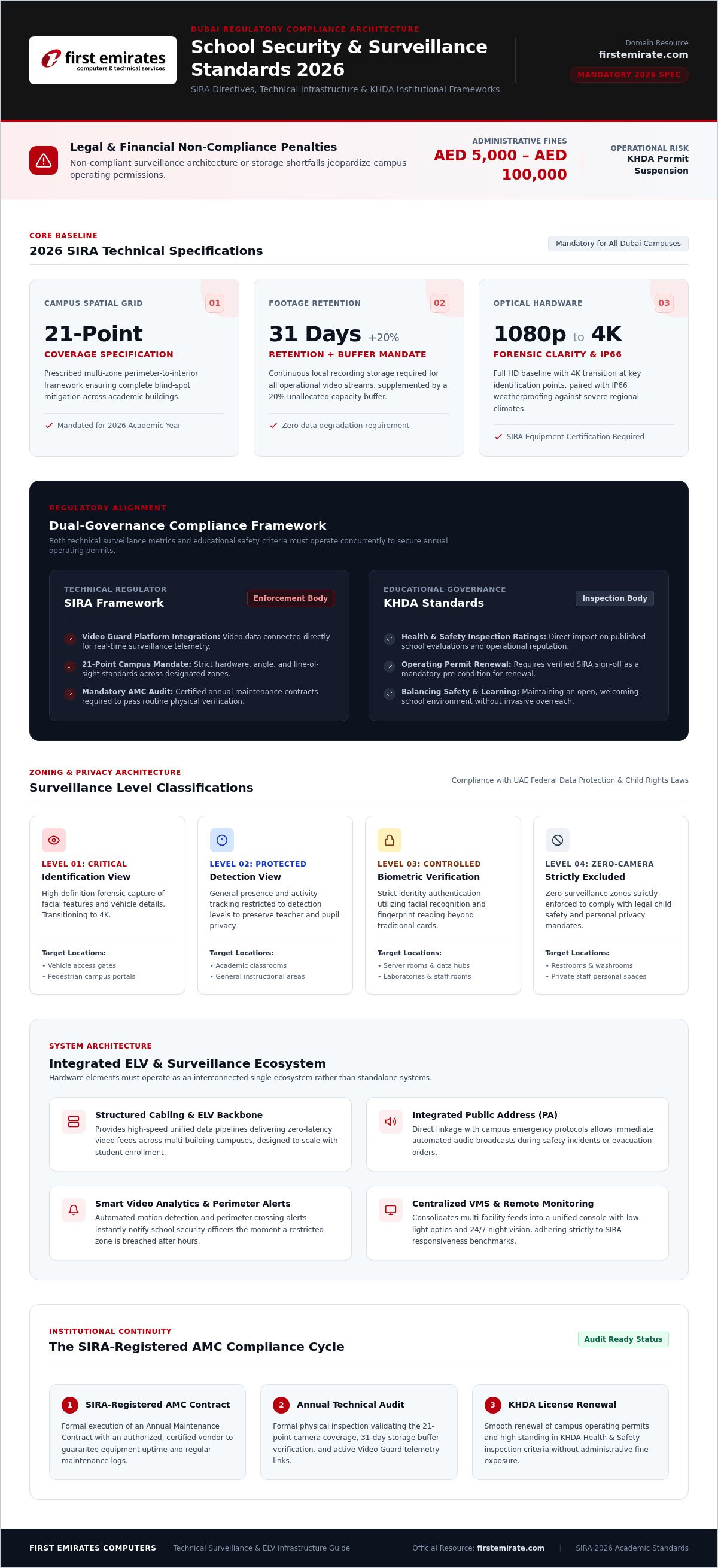
Dubai's educational sector operates under a rigorous dual-governance model where safety is both a pedagogical and a technical mandate. The Security Industry Regulatory Agency (SIRA) serves as the primary governing body for the design and implementation of electronic security measures. In 2026, the shift from standalone cameras to integrated school security and surveillance solutions Dubai has become a legal necessity. This evolution ensures that video data isn't just recorded but is actively integrated with the SIRA Video Guard platform for real-time telemetry. SIRA compliance represents the mandatory technical benchmark that ensures an educational institution's security infrastructure meets Dubai's rigorous legal and operational safety standards.
Essential Regulatory Requirements for School Surveillance
The updated 2026 SIRA directives mandate a 21-point coverage specification for all school campuses. This framework moves beyond simple perimeter monitoring to include specific "Detection View" requirements inside classrooms and "Identification View" at all main vehicle and pedestrian access gates. For any closed-circuit television (CCTV) systems to pass audit, they must adhere to specific data retention laws. Currently, schools must maintain a minimum of 31 continuous days of footage, supplemented by a mandatory 20% unallocated storage buffer. Using SIRA-approved hardware is non-negotiable; equipment must feature IP66 weatherproofing and minimum 1080p resolution to withstand Dubai's environmental conditions and ensure forensic clarity.
KHDA Safety Frameworks and Technical Security
While SIRA manages the technical specifications, the Knowledge and Human Development Authority (KHDA) evaluates safety through its broader inspection criteria. A robust infrastructure for school security and surveillance solutions Dubai directly supports the "Health and Safety" ratings that influence a school's reputation and permit status. Modern systems must balance this high-definition monitoring with strict privacy protocols. For instance, classroom cameras are restricted to detection levels to protect pupil-teacher privacy, while private areas like restrooms remain strictly excluded. Effective systems now incorporate remote monitoring capabilities for school security officers, allowing for immediate response to incidents without compromising the welcoming nature of the educational environment. This methodical approach ensures that every technical component contributes to a secure campus.
Core Components of Integrated School Surveillance Solutions
Modern campus security relies on a synergy of hardware and high-speed infrastructure. While 1080p resolution was once the baseline, the transition toward 4K campus-wide monitoring is now a technical necessity for forensic clarity at critical identification points. Implementing robust school security and surveillance solutions Dubai requires a methodical selection of hardware that functions as a single ecosystem. This integration extends beyond visual monitoring; it includes Public Address (PA) systems for emergency broadcasts and a backbone of structured cabling to ensure zero-latency video feeds across large, multi-building facilities.
Advanced CCTV Technology for Educational Campuses
Current surveillance technology utilizes smart analytics to transform passive recording into an active security tool. Systems now feature motion detection and perimeter crossing alerts that notify security personnel the moment someone enters a restricted zone after hours. High-performance night vision and low-light optics are essential for 24/7 protection, ensuring that image quality remains consistent regardless of ambient lighting. Centralized Video Management Systems (VMS) allow administrators to oversee multiple buildings from a single interface, adhering to the latest Dubai Security Industry Regulatory Agency (SIRA) standards for visibility and system responsiveness.
Biometric Access Control and Student Safety
Biometric access control adds a critical layer of verification that traditional ID cards cannot match. Facial recognition and fingerprint systems are increasingly deployed to secure staff rooms, laboratories, and server rooms where sensitive data is stored. These systems prevent unauthorized entry by eliminating the risk of lost or shared credentials. Many schools now integrate these biometric readers with student attendance tracking platforms. This provides real-time data on student movement and ensures that only authorized individuals can access specific campus zones. By securing laboratories and chemical storage areas with biometric locks, schools mitigate the risk of accidents or theft. This systematic approach to access management ensures that the school environment remains protected without creating unnecessary barriers to daily educational activities.
Reliability is the foundation of any technical installation. A professional design ensures that high-definition CCTV feeds and biometric data points remain operational during peak usage hours. By prioritizing a "capability-first" architecture, school boards can establish a security posture that is both comprehensive and easy to manage. This technical readiness is what defines a truly modern educational facility in Dubai's competitive landscape.
Evaluating Hardware: High-Definition CCTV and Biometric Options
Selecting hardware for educational environments requires a focus on long-term stability and technical compatibility. For modern school security and surveillance solutions Dubai, administrators typically choose between industry-leading brands such as Hikvision, Dahua, and UNV. Hikvision provides an extensive range of SIRA-compliant hardware suitable for diverse campus layouts. Dahua is often preferred for its advanced AI-driven perimeter protection, while UNV is recognized for its high-performance IP video technology and efficient storage compression. These brands offer the reliability needed to maintain a constant, supportive presence across the facility.
Prioritizing IP-based systems over legacy analog setups is critical for future-proofing. IP cameras offer superior resolution, reaching 4K Ultra HD, and utilize Power over Ethernet (PoE) to simplify the underlying infrastructure. While traditional analog systems are limited by physical cabling constraints, IP camera scalability allows for the seamless addition of hundreds of nodes across a distributed network backbone. This flexibility is essential for schools that plan to expand their facilities or increase camera density in the coming years.
Durability is a primary concern in the UAE. Cameras must be rated at least IP66 to ensure complete protection against fine sand dust and high-pressure water. Hardware must also be capable of operating in ambient temperatures exceeding 50°C without thermal throttling. Following the CISA K-12 School Security Guide, a layered approach to hardware selection ensures that every zone is monitored by the most appropriate technology. This methodical selection process builds a foundation of trust for parents and staff alike.
Selecting the Right Camera Form Factors
Camera choice doesn't just depend on the aesthetic; it's about the specific operational view required. Dome cameras are the standard for classrooms and hallways because their discreet profile isn't intimidating for students while remaining resistant to tampering. Bullet cameras are better suited for outdoor perimeters, providing visible deterrence and long-range infrared illumination for fence lines. For expansive areas like sports fields or parking lots, PTZ (Pan-Tilt-Zoom) cameras allow security teams to actively track movement and zoom in on specific incidents as they happen.
Backend Reliability: NVRs and Storage Solutions
The backend infrastructure must be as robust as the cameras themselves. Network Video Recorders (NVRs) should be sized not just for the mandatory 31-day storage, but ideally for 90-day retention to cover extended school holidays. Implementing RAID configurations, such as RAID 5 or RAID 6, is a technical necessity to prevent data loss if a hard drive fails. Additionally, every critical security node requires a dedicated Uninterruptible Power Supply (UPS). This ensures that the school security and surveillance solutions Dubai remain active during power fluctuations, maintaining the integrity of the campus safety record.
Planning Your Installation: From Structured Cabling to ELV Project Design
Success in deploying school security and surveillance solutions Dubai starts beneath the surface. While cameras are the visible face of security, they're entirely dependent on the physical layer of the network. We advocate for an infrastructure-first approach. This methodology ensures that your Extra-Low Voltage (ELV) systems aren't just functional today, but are capable of handling the increased data loads as school enrollment grows. A systematic design prevents the technical bottlenecks that often plague large campuses when new hardware is added to an aging backbone.
Structured Cabling for High-Bandwidth Surveillance
Choosing the correct medium is a fundamental technical decision. For most interior classroom and corridor runs, Cat6A cabling provides sufficient bandwidth for 4K streams. However, for large campuses where distances between the main server room and outlying buildings exceed 90 meters, fiber optic backbones are essential to prevent signal degradation. Professional Structured Cabling Services UAE account for these environmental realities. Heritage buildings often require specialized containment to preserve aesthetics, while new purpose-built campuses benefit from dedicated cable trays and IDF rooms. This preparation is vital for future-proofing your network for AI-driven security tools that require high-speed, low-latency connectivity.
The ELV Project Lifecycle for Schools
A methodical ELV project execution follows a disciplined lifecycle. It begins with a comprehensive site survey to identify blind spots and security vulnerabilities. Next, we move to the system design phase, where blueprints are developed specifically for SIRA approval. This step is critical; without accurate documentation, an institution risks failing its final inspection. Once the physical installation is complete, the focus shifts to testing and commissioning. We ensure every feed is stable and every sensor is calibrated before conducting staff training on the new security consoles. This hands-on approach ensures the system is ready for immediate operational use.
Managing these timelines is essential to prevent disruption to the academic calendar. Most major installations are scheduled during summer or winter breaks to ensure heavy drilling and cabling work don't interfere with student learning. A professional partner coordinates these phases with quiet confidence, ensuring the campus is fully operational before the first bell rings. If you're planning a campus upgrade or a new build, contact our team for a professional ELV project consultation to ensure your infrastructure meets every regulatory and operational requirement.
Ensuring Long-Term Safety with Annual Maintenance Contracts (AMC)
Security infrastructure is not a static installation; it is a dynamic system that requires consistent technical oversight to remain effective. For educational institutions, relying on reactive maintenance is a significant operational risk. A failure in your school security and surveillance solutions Dubai could lead to unrecorded incidents or, more critically, the failure of a SIRA audit. A professional Annual Maintenance Contract (AMC) ensures that every component, from the camera lens to the storage server, remains in peak condition. This systematic approach reduces the total cost of ownership by extending hardware life and preventing the need for emergency, high-cost repairs during the academic term.
Preventative vs. Reactive Security Maintenance
Preventative maintenance focuses on identifying potential failure points before they impact campus safety. This technical process includes a rigorous checklist designed to ensure system integrity. While some administrators may look for IT AMC Services Abu Dhabi for their regional offices, Dubai schools must ensure their contracts specifically meet SIRA’s mandatory maintenance standards. Key activities in a professional security AMC include:
- Scheduled Firmware Updates: Regularly updating camera and NVR software to patch vulnerabilities and protect the network against cybersecurity threats.
- Physical Hardware Calibration: Cleaning outdoor camera housings and lenses to remove dust and sand, ensuring that 4K clarity is not compromised by Dubai's environmental conditions.
- Storage and Power Audits: Testing the integrity of RAID arrays and verifying that UPS battery backups can sustain the system during power fluctuations.
- Connectivity Testing: Inspecting structured cabling and network switches to ensure zero-latency video transmission across the campus.
Partnering with First Emirates Computers for Dubai Schools
First Emirates Computers has been a methodical partner for the UAE’s educational sector since 2011. We understand that school boards require a steady hand to manage complex technical landscapes. Our approach to school security and surveillance solutions Dubai is rooted in grounded reliability and technical readiness. We provide dedicated support teams that understand the specific urgency of school environments, offering immediate troubleshooting to ensure continuous monitoring.
Our AMC packages are customizable, allowing school administrators to align their maintenance schedules with both their internal budgets and SIRA’s regulatory requirements. We don't just fix equipment; we provide a comprehensive oversight service that gives school boards peace of mind. By maintaining a disciplined maintenance rhythm, we ensure that your security ecosystem remains a supportive, constant presence that protects your students and staff throughout the year. This commitment to technical excellence is why schools trust us to manage their most critical safety infrastructure.
Securing the Future of Dubai's Educational Institutions
Designing an effective security ecosystem in 2026 requires more than just high-quality hardware; it demands a systematic integration of ELV components, structured cabling, and strict regulatory alignment. Throughout this guide, we've highlighted the importance of SIRA-approved systems and the critical role proactive maintenance plays in preserving campus safety. Implementing reliable school security and surveillance solutions Dubai ensures your facility remains a protected environment where students can thrive without technical interruptions.
First Emirates Computers has provided methodical ELV project execution across the UAE since 2011. Our technical proficiency with Hikvision, Dahua, and UNV systems allows us to design architectures that prioritize long-term stability. We offer comprehensive UAE-wide maintenance support to ensure your systems remain fully operational and compliant with the latest standards. It's about establishing a steady hand in a complex technical landscape.
Take the next step in establishing a robust safety framework for your campus. Contact First Emirates Computers for a SIRA-Compliant School Security Consultation to discuss your specific infrastructure requirements. We're ready to provide the technical readiness and peace of mind your institution deserves.
Frequently Asked Questions
What are the specific SIRA requirements for school CCTV in Dubai?
SIRA requires all school security and surveillance solutions Dubai to utilize high-definition cameras with a minimum 1080p resolution. The 2026 standards mandate coverage across 21 specific zones, including all entry points, corridors, and student play areas. Audio recording is strictly prohibited unless special permission is granted. Systems must also feature IP66 weatherproofing to ensure hardware remains operational despite Dubai's extreme heat and sand exposure throughout the academic year.
How long must a school in Dubai store its security camera footage?
Educational institutions must maintain a minimum of 31 continuous days of recorded footage according to current SIRA regulations. Additionally, storage hardware must include a 20% unallocated buffer beyond this baseline to ensure data integrity. To manage security during extended school holidays, we recommend configuring storage capacity for 60 to 90 days. This proactive approach ensures that administrators can review historical data even after a long term break concludes.
Can we integrate existing access control with a new surveillance system?
Integrating legacy access control with a modern surveillance ecosystem is possible through methodical ELV project design. We utilize unified Video Management Systems (VMS) to bridge existing hardware with new high-definition IP cameras. This creates a single point of oversight for school security officers. It's essential to verify that older hardware meets current encryption standards to maintain the overall security posture and ensure seamless communication between different technical nodes.
Is it better to install wired or wireless security cameras in a school?
Wired systems utilizing high-quality structured cabling are the only reliable option for large-scale campus environments. While wireless cameras might seem convenient, they often suffer from signal interference and bandwidth limitations that compromise 4K video feeds. SIRA standards prioritize the stability that physical cabling provides. A wired infrastructure ensures zero-latency monitoring and consistent power delivery through PoE, which is critical for maintaining a constant, supportive presence across the school.
What is included in a typical Annual Maintenance Contract (AMC) for school security?
A professional Annual Maintenance Contract (AMC) includes scheduled firmware updates, physical cleaning of camera lenses, and comprehensive testing of backup power systems. We also perform integrity checks on storage arrays and verify that all motion-triggered alerts are functioning correctly. This systematic oversight is a legal requirement for passing annual SIRA audits. It ensures that your security infrastructure remains technically ready and reduces the risk of expensive, reactive hardware replacements.
How does biometric access control improve student safety?
Biometric access control significantly improves safety by ensuring that only authorized personnel can enter sensitive zones like laboratories, server rooms, and staff offices. Unlike traditional RFID cards, biometric identifiers cannot be shared or lost. These systems also integrate with attendance tracking to provide real-time data on student locations. This technical precision helps prevent unauthorized visitors from accessing the campus, especially during high-traffic arrival and dismissal periods at the main gates.
What happens if our security system fails during school hours?
If a component fails, redundant storage configurations like RAID 5 or RAID 6 prevent the loss of critical video data. Dedicated UPS units ensure that cameras and recorders stay active during brief power anomalies. For schools with a certified AMC, our support teams provide immediate technical troubleshooting to restore full functionality. This methodical approach to hardware reliability ensures that your campus monitoring remains uninterrupted, even when individual technical nodes require professional attention.
How can we balance school security with student privacy laws in the UAE?
Balancing security with privacy requires a disciplined approach to camera placement and resolution. SIRA regulations mandate "Detection View" inside classrooms, which establishes activity without identifying individual students or teachers. Private areas such as restrooms and changing rooms are strictly excluded from all surveillance plans. By adhering to the UAE Federal Decree-Law on Personal Data Protection, schools can implement robust monitoring while respecting the privacy rights of every student and staff member.


