

How many times has a malfunctioning gate arm, stalled by the 45°C heat, compromised your facility's security protocol this week? For many property managers in Abu Dhabi and Dubai, a physical entry point becomes a liability when it fails to integrate with modern security software or buckles under the harsh local climate. It's frustrating to deal with unauthorized vehicle entry and the rising costs of manual security personnel when your GATE BARRIERS should be providing automated, reliable protection.
You recognize that effective property management requires more than just a moving arm; it demands a systematic approach to vehicle access. We'll show you how to select, integrate, and maintain a high-performance system that ensures accurate vehicle logging and streamlined traffic flow. Whether you're managing a commercial ELV project or a residential complex, this guide provides the technical clarity needed for a secure installation.
We will examine the latest SIRA-compliant ANPR technologies, explore integration with biometric access control, and outline the essential maintenance protocols that prevent heat-related system failures. By the end of this article, you'll have a professional framework for achieving a secure, automated entry point that reduces long-term operational costs and enhances site safety.
Key Takeaways
- Understand how integrating GATE BARRIERS with biometric access control and ANPR technology creates a seamless, contactless entry point for high-security UAE environments.
- Learn to calculate the required duty cycle and opening speeds to ensure your system handles peak traffic volumes without mechanical failure.
- Discover why professional structured cabling and ELV integration are critical for connecting physical barriers to centralized security management servers.
- Identify the specific maintenance protocols needed to protect sensitive mechanical components from the degradative effects of UAE heat and sand.
- Gain insights into selecting systems that align with local regulatory standards while reducing long-term manual security personnel costs.
What are Gate Barriers and Why are They Essential for UAE Security?
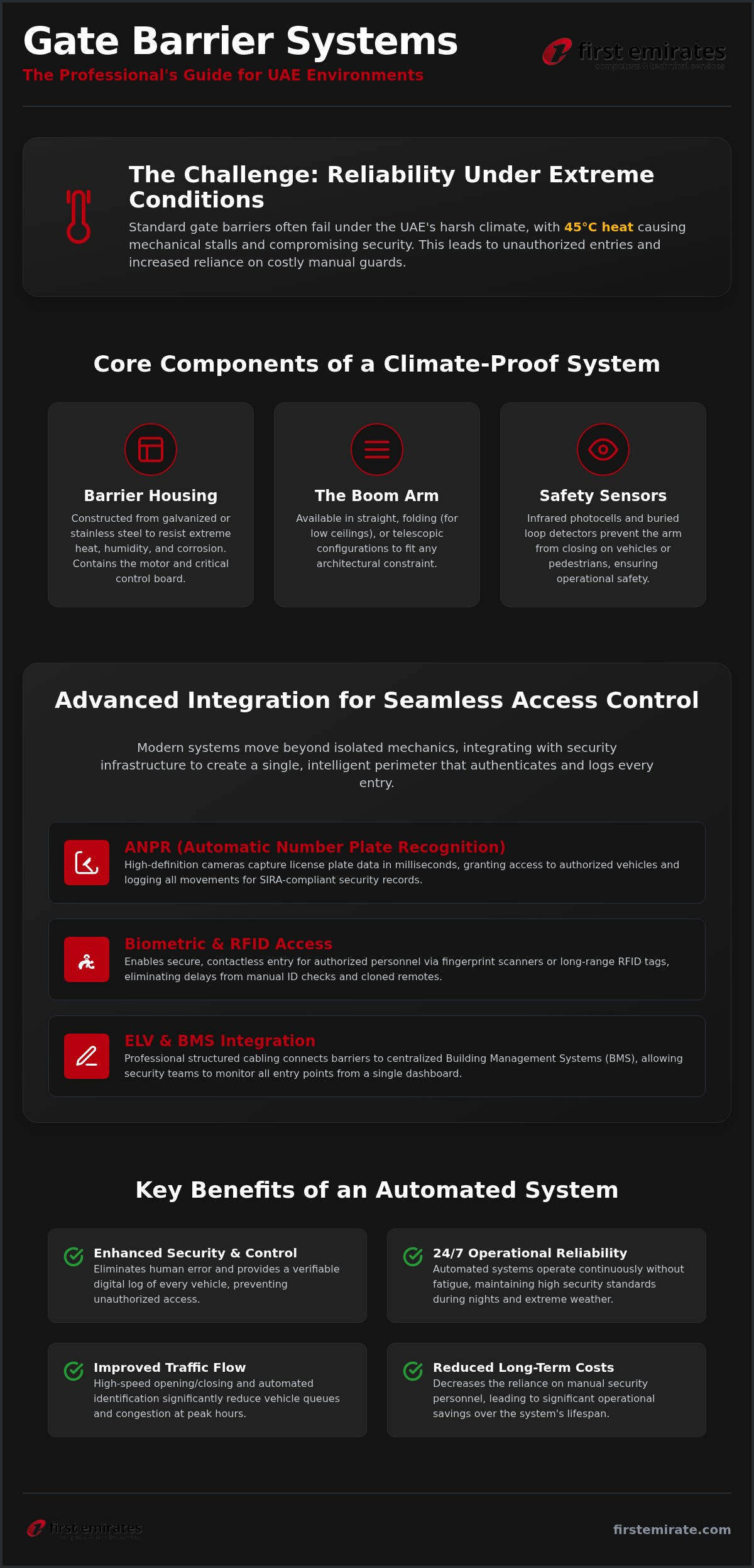
A gate barrier, often referred to as a boom barrier, is an automated vehicle access control system designed to manage the flow of traffic at entry and exit points. In the UAE, these systems represent a critical layer of infrastructure security for residential compounds, shopping malls, and industrial zones. While the primary function is physical restriction, modern GATE BARRIERS serve as sophisticated data collection nodes. They transition the responsibility of access management from manual security personnel to precise, automated hardware. This shift reduces human error. It also provides facility managers with a verifiable log of every vehicle movement on the property.
Core Components of a Modern Barrier System
A professional installation relies on several integrated mechanical and electronic parts to ensure stability and longevity. A systematic breakdown of these components includes:
- Barrier Housing: The cabinet contains the motor and control board. For UAE installations, these must be constructed from weather-resistant materials like galvanized steel or stainless steel to withstand high ambient temperatures and humidity.
- The Boom Arm: Depending on the architectural constraints, arms can be straight, folding, or telescopic. Folding arms are specifically useful for low-ceiling basements in urban developments.
- Safety Sensors: Loop detectors buried in the asphalt and infrared photocells prevent the arm from descending on a vehicle or pedestrian. This ensures operational safety and prevents damage to property.
Benefits of Automation in Vehicle Access
Automating your entry points provides a level of consistency that manual guarding can't match. Automated systems operate 24/7 without fatigue. They maintain a high standard of security throughout the night and during extreme weather conditions. This reliability is essential for high-traffic environments like Dubai's logistics hubs or Abu Dhabi's government districts.
The speed of entry and exit improves significantly when identification is handled by automated readers rather than manual ID checks. This efficiency reduces congestion at peak hours. The system generates detailed reporting for audit trails and security investigations. These records allow administrators to track specific license plates or RFID tags across multiple dates and times. Property owners gain a comprehensive overview of site utilization and potential security gaps by centralizing this data. This methodical approach to vehicle management reduces long-term operational costs while enhancing the overall security posture of the facility.
Advanced Integration: RFID, ANPR, and Biometric Controls
Standalone GATE BARRIERS operate as isolated mechanical tools. This creates a significant security gap for modern Abu Dhabi enterprises. Without digital identification, there's no way to verify if the vehicle entering belongs to an authorized user or an intruder using a cloned remote. Integrating these gates into a comprehensive physical access control system ensures that every entry event is authenticated and logged. Contactless entry is now the standard for high-traffic corporate environments. It eliminates the delays associated with manual ticketing or physical badges. This transition prioritizes both speed and security, allowing for a fluid movement of vehicles while maintaining a rigid digital perimeter.
A systematic integration allows barriers to interface directly with Building Management Systems (BMS). This connectivity enables centralized oversight. Security teams can monitor entry points alongside fire alarms and lighting systems from a single dashboard. Selecting the right hardware and software requires the technical proficiency of an experienced access control system company. They ensure that controllers are compatible with existing IT infrastructure and meet local regulatory standards. If you're looking to modernize your facility entrance, you can consult with our technical team for a tailored integration plan.
ANPR (Automatic Number Plate Recognition) Systems
High-definition cameras capture plate data in milliseconds. The system cross-references this information against a pre-approved whitelist. If a blacklisted vehicle appears, the software triggers an immediate alert to the security desk. These cameras are engineered to handle the unique environmental challenges of the UAE. They use specialized filters to manage intense sun glare during the day and high-contrast infrared for low-light conditions at night. SIRA-certified systems in Dubai can achieve over 99% recognition accuracy in real-world conditions. This precision provides a reliable audit trail for every vehicle that enters the premises.
RFID and Long-Range Readers
RFID technology provides a hands-free experience for corporate fleets and residential tenants. Passive tags are cost-effective for large-scale windshield mounting, while active tags offer extended range for industrial vehicles. These readers identify vehicles from several meters away, allowing the barrier to lift before the car even comes to a complete stop. For high-security zones, these readers can work in tandem with biometric access control systems UAE. This multi-factor approach ensures that both the vehicle and the driver are authorized before access is granted. Implementing these integrated solutions provides a robust, future-proof security perimeter for any professional facility.
Selecting the Right Barrier for UAE Conditions
Choosing GATE BARRIERS for a UAE property requires a methodical evaluation of technical specifications. It's not enough to select a model based on aesthetics or price alone. The environmental and operational demands of Abu Dhabi and Dubai require hardware that maintains performance under extreme thermal stress. A systematic approach to selection ensures the system doesn't become a maintenance burden within its first year of operation.
Opening speed must balance security with traffic throughput. In high-traffic zones like hospital emergency entrances or major mall parking lots, a slow arm leads to congestion and increased tailgating risks. Duty cycle is equally vital. A 100% duty cycle motor is essential for continuous operation in commercial hubs. Residential systems might only require an intermittent rating, which reduces initial capital expenditure without sacrificing the reliability needed for lower traffic volumes.
Environmental protection is non-negotiable in the Gulf region. You should specify an IP54 or higher rating to ensure internal electronics remain sealed against fine desert sand and high humidity. Heat-resistant lubricants and internal cooling fans are critical components that prevent the motor from seizing when ambient temperatures exceed 45°C. Additionally, safety features like pressure-sensitive auto-reverse mechanisms and dual-channel loop detectors protect your property from liability. These sensors ensure the arm doesn't descend if a vehicle stalls mid-entry or if a pedestrian enters the path unexpectedly.
Residential vs. Industrial Grade Barriers
Industrial environments, such as logistics centers, require high-speed motors and heavy-duty boom arms built for millions of cycles. These systems often integrate with broader warehouse security systems Musaffah to provide a unified defense layer for high-value assets. Residential barriers prioritize quiet operation and sleek designs that complement the property's architecture. While residential units focus on ease of use for tenants and visitors, industrial units are built for rugged, high-frequency use with minimal downtime.
Arm Length and Type Considerations
The physical environment dictates the arm configuration. Straight arms are the standard for open-air parking lots where vertical clearance isn't an issue. However, underground basements with restricted heights require articulated or folding arms. These arms bend at a 90-degree angle to clear low-hanging pipes or ceilings. For areas prone to pedestrian tailgating, fence-style arms provide a physical deterrent below the main boom. It's also wise to specify break-away arm features. This allows the arm to detach upon impact, protecting the expensive motor mechanism from catastrophic damage if a vehicle strikes the barrier.
The Technical Side: Installation and ELV Integration
Gate barrier installation is rarely a standalone task. It serves as a foundational component for ELV project contractors Abu Dhabi who specialize in building comprehensive security ecosystems. A methodical installation ensures that GATE BARRIERS communicate seamlessly with the centralized security management system. This connectivity relies heavily on structured cabling services UAE to bridge the gap between the physical entry point and the server room. Without robust data pathways, advanced features like real-time logging and remote management become impossible to maintain. Proper integration ensures that the barrier isn't just a mechanical arm but a smart node within your IT infrastructure.
The physical installation begins with precise civil works. A reinforced concrete foundation is necessary to anchor the barrier cabinet against wind loads and mechanical vibrations. Technicians must also perform loop detector cutting. This involves carving precise channels into the asphalt to house the induction loops that detect a vehicle's presence. These loops are critical for the safety and automation of the system, preventing the arm from closing on a vehicle mid-transit. A disciplined approach to these civil works prevents future shifting or misalignment of the hardware.
Reliable power is the final pillar of a technical installation. Fluctuations in the local grid can damage sensitive control boards. Therefore, a dedicated Uninterruptible Power Supply (UPS) is often integrated into the cabinet. This ensures that the barrier remains operational during power outages, maintaining the security perimeter of the property without interruption. For a professional evaluation of your site's infrastructure, you can request a technical site survey from our ELV specialists.
The Design and Implementation Phase
A thorough site survey is the first step in the implementation process. Engineers analyze vehicle approach angles and identify potential traffic bottlenecks. Effective cable management follows, where data and power lines are housed in weather-protected conduits to prevent environmental degradation from heat or moisture. Integrating the system with CCTV installation Abu Dhabi provides a visual verification layer. This allows security personnel to match license plate data with high-definition video footage for every entry and exit event.
Safety and Compliance Standards
Compliance with UAE safety regulations is mandatory for all automated moving equipment. This includes the installation of emergency manual release systems, which allow the arm to be raised by hand during a total system failure. Professional commissioning involves rigorous testing of all safety sensors and logic controllers. This disciplined approach ensures the system is safe for public use before it's handed over to the facility management team. A systematic testing phase minimizes the risk of operational accidents and ensures long-term reliability.
Maximizing ROI through Maintenance and AMC
The return on investment for any security installation is determined by its operational lifespan and day-to-day reliability. In the UAE, GATE BARRIERS face extreme environmental stress that can quickly degrade mechanical performance if left unmanaged. Fine desert sand infiltrates gearboxes, while ambient temperatures exceeding 45°C cause lubricants to thin and electronic components to overheat. Relying on reactive repairs is a costly strategy that leads to unpredictable downtime and security lapses. Instead, implementing proactive IT AMC services Abu Dhabi allows for a methodical approach to system health. Regular inspections identify component wear before it results in a total system failure.
First Emirates Computers acts as a technical partner for integrated barrier lifecycle management. This partnership covers both the physical hardware and the underlying software architecture. Beyond simple mechanical fixes, keeping access control databases secure and efficient requires consistent software updates. These updates patch security vulnerabilities and optimize the recognition speed of ANPR and biometric systems. By partnering with a specialist who understands the full ELV ecosystem, property managers ensure their GATE BARRIERS remain functional and secure for years, avoiding the high costs of premature replacement.
What a Comprehensive AMC for Gate Barriers Includes
A systematic maintenance schedule is essential for high-traffic environments where hardware is under constant load. A professional maintenance contract typically includes several critical technical tasks:
- Mechanical Calibration: Lubrication of internal gears and balancing the boom arm to reduce motor strain and prevent mechanical fatigue.
- Sensor Verification: Testing the sensitivity and alignment of loop detectors and infrared photocells to ensure operational safety.
- Hardware Cleaning: Removing dust, salt residue, and sand from ANPR camera lenses and RFID readers to maintain high recognition accuracy.
Reducing Downtime in Critical Access Points
A failed barrier at a hospital, government facility, or logistics hub is more than a technical glitch; it's a security breach and a source of immediate traffic congestion. The financial impact of such downtime often outweighs the cost of a yearly maintenance contract. AMC clients receive priority support and benefit from the local availability of critical spare parts in Abu Dhabi. This rapid response capability is a hallmark of professional maintenance teams who prioritize business continuity. Consistent care extends the lifespan of your security investment, ensuring that your entry points continue to provide a high level of service without the need for emergency, expensive repairs.
Strengthening Your Facility's Perimeter Security
Securing a UAE property requires a technical approach that combines robust hardware with intelligent software. You've learned that modern GATE BARRIERS are most effective when integrated into a broader ELV framework, utilizing ANPR and RFID for seamless traffic management. Selecting high-duty cycle equipment and committing to a structured maintenance plan are the most reliable ways to mitigate the impact of the local climate and ensure long-term system stability.
First Emirates Computers has provided Abu Dhabi with technical expertise and integrated security solutions since 2011. Our team specializes in comprehensive ELV projects and provides dedicated IT AMC support to keep your systems running efficiently. We prioritize technical readiness and methodical problem-solving to protect your investment. Contact First Emirates Computers for a professional Gate Barrier consultation and installation in Abu Dhabi to begin modernizing your site's access control. Establishing a secure, automated entry point provides the peace of mind needed for professional facility management.
Frequently Asked Questions
What is the average lifespan of a gate barrier in the UAE climate?
A high-quality barrier system typically lasts between 5 and 10 years in the UAE. This lifespan depends heavily on the frequency of use and the quality of the initial installation. The extreme summer heat and fine desert sand can accelerate mechanical wear on the motor and gears. Implementing a structured annual maintenance contract is the most effective way to protect the internal electronics and ensure the system achieves its maximum operational potential.
Can I integrate my existing staff ID cards with a new gate barrier system?
Integration with existing staff ID cards is a standard feature of modern access control solutions. Most systems support various identification technologies, including RFID and Mifare. Our technical team evaluates your current card frequency to ensure the new hardware communicates correctly with your database. This approach allows for a unified security perimeter where employees use a single credential for both building entry and vehicle access points across your facility.
Do gate barriers require a specific type of foundation or civil work?
Professional installation requires precise civil works to ensure long-term stability. A reinforced concrete foundation is necessary to anchor the cabinet against wind loads and mechanical vibrations. Additionally, technicians must perform loop detector cutting in the asphalt. These loops detect vehicle presence and are critical for preventing the arm from descending prematurely. A disciplined approach to these foundational works prevents the hardware from shifting or becoming misaligned over time.
What happens to the gate barrier during a power outage?
Most automated systems include an emergency manual release mechanism to ensure access during a total power failure. Technicians provide a dedicated key that allows security personnel to lift the boom arm by hand. For critical infrastructure, we recommend integrating a dedicated Uninterruptible Power Supply (UPS). This backup hardware ensures your GATE BARRIERS remain fully operational without human intervention, maintaining a secure and automated perimeter even during local grid interruptions.
Is ANPR better than RFID for residential community access?
ANPR provides a seamless, tag-free experience by identifying license plates, while RFID requires a physical tag in each vehicle. For residential communities, ANPR is often preferred for visitor management and resident convenience. However, RFID remains a highly reliable and cost-effective solution for high-volume corporate fleets. Many property managers choose a hybrid system to balance the speed of RFID with the comprehensive data logging capabilities of high-definition ANPR cameras.
Are there specific safety regulations for automated gates in Abu Dhabi?
Automated gate installations in Abu Dhabi must comply with specific safety and infrastructure regulations. These standards ensure that moving equipment doesn't pose a risk to pedestrians or vehicles. Systems featuring ANPR technology often require approval from local regulatory bodies to ensure they meet data privacy and recognition accuracy benchmarks. It's essential to work with an experienced ELV contractor who understands these local requirements to ensure your installation remains fully compliant and legally sound.
How often should a high-traffic commercial gate barrier be serviced?
High-traffic commercial GATE BARRIERS should undergo technical servicing at least once every three months. Quarterly inspections allow technicians to lubricate mechanical gears, check the balance of the boom arm, and calibrate safety sensors. This proactive frequency is necessary to address the stress of continuous operation and the build-up of sand and dust. Frequent professional care prevents minor alignment issues from developing into costly motor failures or complete system downtime.
Can I control my gate barrier remotely via a mobile app?
Modern barrier systems can be integrated with smart building management software to allow for remote operation via a mobile application. This functionality enables facility managers to monitor entry points and open gates from any location with an internet connection. It's particularly useful for managing deliveries or providing access to authorized visitors after hours. This level of control is typically achieved through professional ELV integration and secure structured cabling connected to your local network.


