

Can a security system truly survive a 50°C Abu Dhabi summer without a single power cable or a physical internet connection? For many project managers and estate owners, the high cost of trenching for remote security remains a primary barrier to effective oversight. You've likely experienced the frustration of cheap SOLAR CAMERAS failing during peak summer months, leaving your assets vulnerable when reliability matters most.
We understand that consistent performance is the only metric that matters for industrial sites and private estates. This article explains how industrial-grade solar technology provides a cable-free, maintenance-free solution that remains operational for at least 12 months. You'll learn how these systems utilize 4G and 5G connectivity to deliver stable 24/7 surveillance from isolated desert locations or construction outskirts.
We'll provide a methodical breakdown of the hardware required to meet SIRA and MCC standards, including IP66 weatherproof ratings and mandatory Full HD resolution. We also examine how professional ELV integration and structured maintenance contracts transform standalone units into a comprehensive, high-readiness security network.
Key Takeaways
- Identify the specific thermal resilience and IP67 ingress protection standards required for hardware to withstand the UAE's extreme temperatures and dust.
- Discover how industrial-grade SOLAR CAMERAS provide autonomous 4G/5G surveillance for remote construction projects and Musaffah warehouses without the need for trenching or cabling.
- Learn a methodical approach to conducting site surveys and load calculations to ensure consistent 24/7 performance across all seasons.
- Understand the critical role of Annual Maintenance Contracts in managing photovoltaic efficiency and battery health for long-term system stability.
Understanding Solar Cameras: The Autonomous Security Solution
Solar cameras function as completely autonomous surveillance units, combining high-definition video capture with local power generation and wireless data transmission. Unlike traditional CCTV that requires extensive groundwork, these systems operate independently of the local power grid. The UAE's geographic position provides optimal conditions for this technology, as the high levels of annual solar irradiance ensure that panels receive sufficient energy to maintain continuous operation throughout the year.
There's a distinct shift in the Abu Dhabi market from consumer-grade gadgets toward industrial-grade SOLAR CAMERAS. Professional systems are engineered to handle the specific stressors of a desert environment, such as extreme heat and fine particulate matter. The primary advantage for businesses lies in the elimination of structured cabling costs. Trenching through concrete or desert terrain for power lines is often the most expensive part of a security project. Solar solutions bypass this requirement, allowing for rapid deployment on remote construction sites or expansive private estates.
The Mechanics of Solar-Powered Surveillance
The reliability of these units depends on the efficiency of their photovoltaic systems. These panels convert Abu Dhabi's intense sunlight into DC power, which is then managed by a sophisticated charging controller. Energy storage is handled by high-capacity lithium-ion or LiFePO4 batteries, chosen for their ability to withstand deep discharge cycles and high ambient temperatures. A robust power management system is essential; it ensures the camera remains functional during sandstorms or the occasional cloudy day by intelligently regulating energy consumption based on remaining battery levels.
Connectivity Options: 4G, 5G, and Long-Range Wi-Fi
True autonomy requires more than just power; it requires a stable data link. Integrated 4G and 5G modules provide this independence, allowing SOLAR CAMERAS to stream high-definition footage without relying on local Wi-Fi networks. This is particularly useful for Musaffah industrial zones or new developments where fixed-line internet hasn't been established. These systems support remote monitoring through centralized control rooms or mobile applications, providing real-time oversight and instant alerts. By using efficient data transmission protocols, these cameras maintain clear video quality even in areas with variable signal strength.
Key Technical Specifications for the UAE Climate
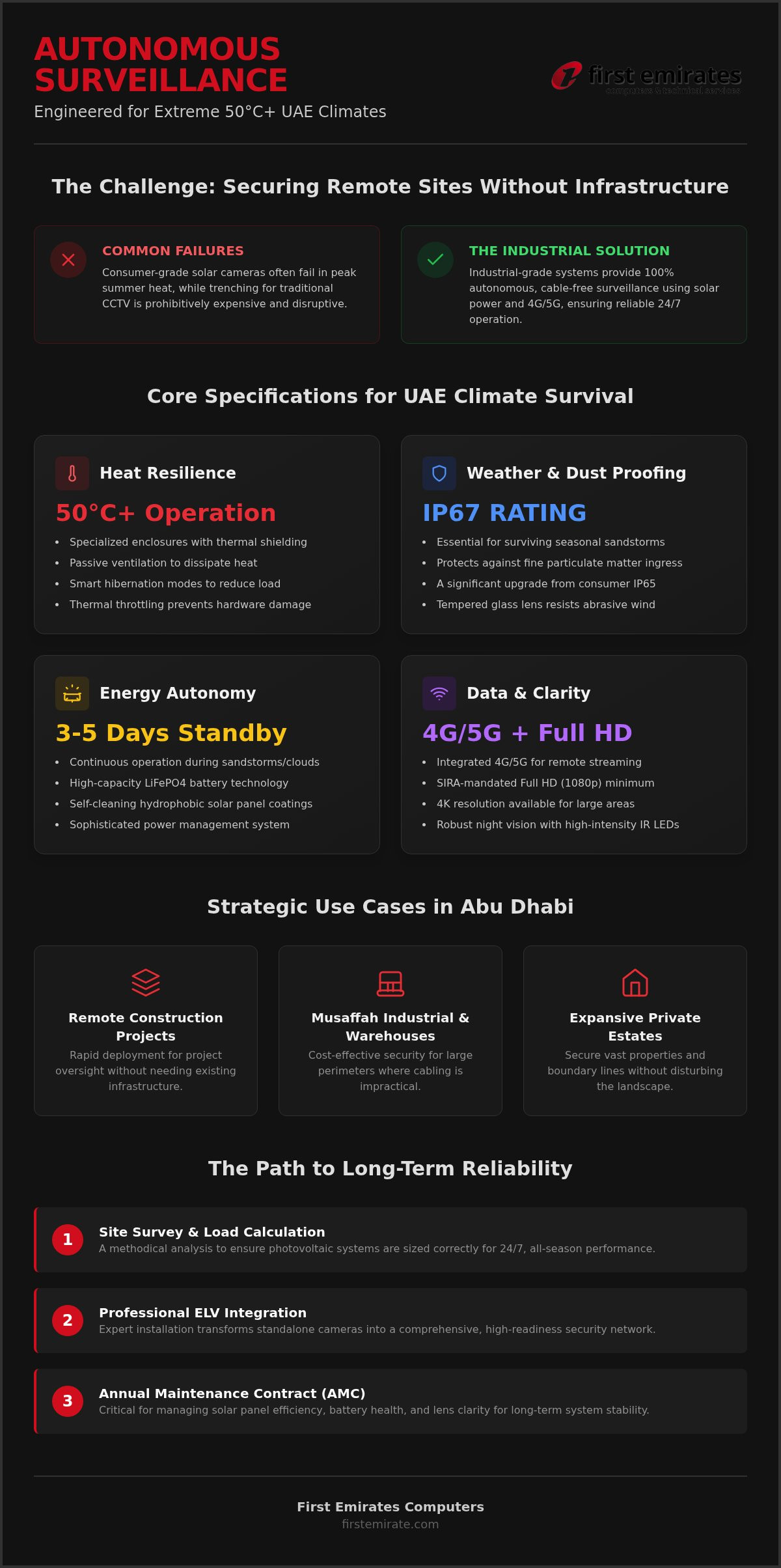
Deploying security hardware in the UAE requires a rigorous selection process based on environmental tolerance. Standard retail units often fail when ambient temperatures exceed 45°C. For industrial SOLAR CAMERAS, the Ingress Protection (IP) rating is a critical baseline. While IP65 is common in consumer electronics, IP67 is the practical minimum for desert environments to prevent the ingress of fine particulate matter during seasonal sandstorms. Energy autonomy is another vital metric; a professional system should provide at least three to five days of continuous operation without direct sunlight to account for heavy dust cover or rare overcast conditions.
Battery Technology and Heat Management
High-capacity lithium batteries face significant degradation when exposed to 50°C+ temperatures. Industrial designs utilize specialized enclosures with thermal shielding and passive ventilation to maintain battery health. Smart hibernation modes further preserve power by activating the camera only when sensors detect motion, which reduces internal heat generation. Thermal throttling in solar cameras is a protective mechanism where the system reduces processing power or disables non-essential features to prevent hardware damage from extreme ambient heat.
Dust and Sand Resistance
Sand accumulation on photovoltaic panels significantly reduces charging efficiency. High-end models often incorporate self-cleaning hydrophobic coatings that allow dust to slide off more easily. Lens durability is also a major concern; abrasive winds can pit standard plastic covers over time, making tempered glass essential for maintaining long-term clarity. Establishing a professional Annual Maintenance Contract ensures these technical components are regularly inspected and cleaned to maintain peak performance in harsh terrain.
Clarity remains non-negotiable for remote sites. SIRA regulations mandate a minimum resolution of Full HD (1080p) for all surveillance installations. Higher pixel densities, such as 4K, are preferred for expansive construction plots where identifying individuals at a distance is necessary. Night vision capabilities must be equally robust, utilizing high-intensity infrared LEDs or specialized low-light sensors to provide clear imagery in unlit desert outskirts where ambient light is non-existent.
Strategic Use Cases for Solar Cameras in Abu Dhabi
Abu Dhabi's diverse geography, ranging from high-density industrial zones to remote desert estates, presents unique security challenges. Traditional wired systems often prove impractical for large-scale sites where power infrastructure is absent or undergoing development. The deployment of industrial-grade SOLAR CAMERAS provides a reliable solution for these environments, ensuring technical readiness without the delays associated with civil works. From the manufacturing hubs in ICAD to the expansive farms in Liwa, these autonomous units serve as critical components of a comprehensive ELV strategy.
Construction and Industrial Site Surveillance
In Musaffah and other industrial districts, project managers utilize portable solar towers to maintain oversight during dynamic project phases. These units are easily repositioned as the site layout changes, providing 24/7 monitoring to prevent equipment theft and track progress through time-lapse capabilities. A primary concern for these sites is the impact of thermal extremes on hardware. Standard lithium batteries often fail when internal temperatures rise; however, industrial solar units incorporate active ventilation and heat-dissipating enclosures to prevent degradation. Ensuring your installation meets the standards of a SIRA approved CCTV company Abu Dhabi is mandatory for regulatory compliance on commercial plots. These systems maintain high-definition streams via 4G or 5G, providing a stable link to remote control rooms even in areas without fiber connectivity.
Residential and Private Estate Security
For private estates in Al Ain or Liwa, perimeter security is often hindered by the prohibitive cost of trenching through landscaped gardens or desert terrain. SOLAR CAMERAS allow for the immediate securing of boundary fences without intrusive cabling. These installations prioritize aesthetic integration, using compact panels and streamlined mounting hardware. Many property owners now seek unified systems that offer remote access and real-time alerts. This often involves integration with home automation companies Abu Dhabi to create a seamless security ecosystem. Beyond residential use, this technology is increasingly vital for infrastructure monitoring in the oil and gas outskirts, where utility lines must be protected across miles of unpopulated terrain. The systematic deployment of solar-powered surveillance ensures that even the most isolated assets remain under constant oversight.
Selection and Implementation: A Methodical Approach
A successful deployment of SOLAR CAMERAS requires a detailed site survey that accounts for both astronomical and telecommunications variables. Technicians must assess the solar path throughout the day to ensure panels aren't obstructed by building shadows or future construction phases. Simultaneously, cellular signal strength testing is mandatory to guarantee stable data transmission. In the UAE, network configuration often involves optimizing APN settings for local providers like Etisalat or Du to maintain a consistent handshake between the remote unit and the centralized monitoring station.
Calculating load requirements is a precise engineering task. High-resolution sensors, especially those meeting the SIRA-mandated 1080p minimum, demand significant power during peak recording periods. Installers must balance this consumption against the battery's ampere-hour rating and the panel's wattage. Mounting strategies vary by application; permanent sites often utilize reinforced steel poles with concrete foundations, while dynamic projects might employ mobile solar trailers that allow for rapid relocation as the site perimeter shifts.
Professional Installation vs. DIY
While consumer units are marketed for self-installation, industrial environments carry higher risks. Improper mounting in desert areas can lead to hardware failure during high-wind events or sandstorms. Security is another critical factor; professional CCTV installation Abu Dhabi includes the implementation of end-to-end encryption for all remote transmissions. This prevents unauthorized access to sensitive video feeds from isolated sites. Expert technicians also ensure that all hardware meets the PAL color standard and WDR requirements specified by local regulatory bodies.
Integrating Solar Cameras into Existing ELV Systems
Scaling a security network often requires merging autonomous units with fixed infrastructure. Bridge connections allow solar feeds to be centralized within a wired Network Video Recorder (NVR), providing a unified view of the entire facility. Experienced ELV project contractors Abu Dhabi can design these hybrid architectures to ensure seamless data flow between wireless solar units and structured cabling backbones. This integrated approach allows for multi-site management through a single dashboard, simplifying oversight for large-scale operations. To ensure your system architecture is optimized for your specific site conditions, you should consult with a specialist regarding your ELV project requirements.
Maintenance and Long-Term Reliability in the UAE
The long-term reliability of SOLAR CAMERAS in the UAE depends on a disciplined maintenance schedule that addresses the specific environmental stressors of the region. While these units are designed for autonomy, they are not immune to the cumulative effects of extreme heat and airborne particulates. Dust is the primary antagonist to photovoltaic efficiency; even a thin layer of fine sand can reduce energy absorption significantly during peak summer months. A systematic approach to hardware oversight ensures that remote installations continue to meet SIRA and MCC compliance standards throughout their operational life.
Technical readiness also requires consistent monitoring of the internal power ecosystem. This involves scheduled battery health checks to track discharge cycles and thermal performance. Because 50°C+ temperatures accelerate chemical degradation in lithium-based cells, proactive monitoring can identify failing components before they cause system downtime. Stability in data transmission is equally dependent on software; regular firmware updates for 4G and 5G modems are essential to maintain secure, high-bandwidth connections with local telecommunications providers. Utilizing professional IT AMC services Abu Dhabi allows businesses to delegate these technical tasks to specialists, ensuring constant oversight of critical solar assets.
The Solar Maintenance Checklist
Establishing a methodical cleaning protocol is the first step in preserving system efficiency. Panels should be cleaned using non-abrasive materials and distilled water to prevent mineral buildup on the glass surface. Beyond cleaning, technicians must inspect mounting hardware for structural integrity, particularly after shamals or heavy wind events that can loosen brackets or shift panel alignment. Verifying remote backup and storage redundancy is also a priority. This includes checking the health of local SD cards and ensuring that the synchronization between the camera and the centralized NVR remains uninterrupted.
Maximizing ROI through Annual Maintenance Contracts
Annual Maintenance Contracts (AMC) transform security from a reactive expense into a predictable operational cost. By shifting to a proactive model, businesses can reduce the risk of total system failure through scheduled hardware rotations and sensor calibrations. This level of oversight is particularly valuable when SOLAR CAMERAS are integrated with other security layers, such as those provided by a professional access control system company. A comprehensive AMC provides a clear cost-benefit advantage over ad-hoc repairs, especially for remote sites in Musaffah or Liwa where mobilization costs for emergency technicians are high. A steady, methodical maintenance plan ensures that your investment in autonomous security provides stable protection for years rather than months.
Securing Your Remote Assets with Autonomous Technology
Implementing industrial-grade SOLAR CAMERAS provides a stable, cable-free solution for remote UAE sites where power infrastructure is non-existent. We've examined how thermal resilience, IP67 ingress protection, and 24/7 connectivity via 4G or 5G networks create a robust security ecosystem. Success depends on a methodical approach to site surveys and ongoing maintenance to combat the persistent challenge of desert dust. By prioritizing hardware with high-capacity energy storage, you ensure operational continuity even during sandstorms or periods of low solar irradiance.
As a specialist in CCTV and ELV projects since 2011, First Emirates Computers delivers technical readiness through SIRA-approved expertise. Our Abu Dhabi-based support team ensures your surveillance system meets all local regulatory standards while providing long-term reliability through comprehensive Annual Maintenance Contracts. We handle the complexities of system scaling and technical oversight so you can focus on your core operations. Contact First Emirates Computers for Professional Solar CCTV Solutions and establish a dependable security presence for your project or estate today. We look forward to supporting your technical requirements with precision and expertise.
Frequently Asked Questions
Do solar cameras work at night in the UAE?
Solar cameras operate continuously at night by utilizing energy stored in internal lithium-ion or LiFePO4 batteries during daylight hours. These systems switch to infrared or low-light sensors when ambient light drops below a specific threshold. High-definition recording remains stable throughout the night, provided the battery capacity was correctly calculated during the initial site survey. This ensures that remote estates or construction sites in the UAE remain under constant surveillance without interruption.
Can solar cameras survive the 50°C summer heat in Abu Dhabi?
Industrial-grade units are specifically engineered to withstand the extreme 50°C summer temperatures common in Abu Dhabi. These systems utilize thermal shielding and passive cooling vents to protect sensitive internal electronics and battery cells. Standard retail models often fail under these conditions, but professional-grade equipment maintains operational stability. It's essential to select hardware with high thermal tolerance to prevent battery swelling or processor throttling during the peak heat of the day.
What happens to the camera if it is cloudy for several days?
Most professional systems include enough energy autonomy to function for three to five days without direct sunlight. High-capacity battery reserves are designed to bridge the gap during rare cloudy periods or heavy sandstorms that reduce photovoltaic efficiency. Smart energy management protocols can also reduce non-essential power consumption during these times. This redundancy is a standard feature in industrial installations to ensure that security coverage remains constant regardless of temporary weather fluctuations.
Do I need a special SIM card for a solar camera in the UAE?
A data-only SIM card from local providers like Etisalat or Du is necessary for remote connectivity. Industrial SOLAR CAMERAS often require M2M (Machine-to-Machine) SIMs that are optimized for consistent data throughput and extreme temperatures. These cards allow the unit to transmit high-definition video to a centralized control room or mobile application. It's important to verify that the chosen data plan provides sufficient monthly bandwidth for your specific resolution and recording frequency.
Are solar cameras SIRA approved for commercial use?
Yes, SOLAR CAMERAS are SIRA approved for commercial use as long as they meet the mandatory technical specifications for the UAE. These requirements include a minimum resolution of 1080p, PAL color standard compatibility, and a specific IP rating for outdoor durability. Commercial plots must have these systems installed by a licensed security company to ensure compliance. Failure to use approved hardware can result in significant fines during regulatory inspections of commercial properties.
How often do I need to clean the solar panels on my security cameras?
We recommend cleaning the panels every two to four weeks to maintain optimal charging efficiency. In high-dust areas like Musaffah or near active construction sites, more frequent cleaning might be required. Dust accumulation on the photovoltaic surface can reduce power generation by a significant margin. This task is typically included in a professional Annual Maintenance Contract to ensure that the system's energy balance remains stable throughout the year.
What is the typical range of a 4G solar camera in the desert?
The range of a 4G-enabled camera is determined by its proximity to the nearest telecommunications tower rather than a fixed distance from a base station. In the UAE's desert outskirts, signal strength can vary based on terrain and tower density. Technicians use high-gain antennas to improve reception in remote areas. A signal strength test is a mandatory part of our methodical site survey to ensure the camera can maintain a stable high-definition stream.
Can solar cameras be integrated with my existing wired CCTV system?
Solar-powered units can be integrated into existing wired CCTV systems through hybrid network configurations. We use wireless bridges or specialized NVR settings to consolidate solar feeds with your primary surveillance dashboard. This allows for unified multi-site management within a broader ELV project. Such integration provides the flexibility to extend security coverage to remote perimeters or temporary site zones without the need to modify your existing structured cabling infrastructure.


