

What if every network outlet appears live at handover, but the cabling still falls short of the performance your project requires? A basic continuity check can show that a link is connected, but it doesn’t necessarily prove that it meets a specified cabling category. For project teams comparing structured cabling testing and certification Abu Dhabi proposals, that distinction matters before faults reach users.
When a contractor says an installation has been tested, ask what the test covered. A useful certification process checks each installed link against the project’s stated requirements and provides traceable results for review, troubleshooting and handover. The scope depends on whether the links are copper or fibre, which standard applies and what acceptance criteria the project specifies.
This guide explains what testing can prove, how basic verification differs from certification, and which checks may apply to copper and fibre links. It also covers what to specify in a contractor’s scope and report so you can compare proposals and confirm the records you need at handover. For Abu Dhabi projects, First Emirates Computers provides structured cabling and ELV project implementation. Annual maintenance contracts are available as a separate service after installation. Confirm test capabilities and project requirements directly before appointing a provider.
Key Takeaways
- Distinguish installation checks, application qualification and standards-based certification before agreeing what “tested” means in a contractor’s scope.
- Match the test plan to the cabling medium, category, topology and intended application. Copper and fibre require different testing approaches.
- Review each report against link identifiers, specified limits and the tester’s result definitions. Clarify failures or marginal results before acceptance.
- Use a defined workflow from requirements review through testing and remediation, with the client, consultant and contractor confirming applicable standards and project requirements.
- When comparing structured cabling testing and certification Abu Dhabi providers, ask which tests, methods and handover records are included, and verify the provider’s capabilities.
What structured cabling testing and certification verifies in Abu Dhabi
Testing provides evidence about the condition and performance of installed links. At handover, it helps answer a practical question: does each link meet the performance limits specified for this installation? Certification records measured results against those limits. It is more than confirming that a cable is installed or that a device can connect. The required limits depend on the cable category, link type and approved project specification.
A useful overview of structured cabling explains how its components form an organised infrastructure. Testing checks whether the installed links perform as required. The records can support acceptance decisions, help locate faults and provide a baseline for troubleshooting or future network changes. Results are most useful when each test is tied to a clearly identified link and the relevant project requirement.
Certification, qualification, and verification: what is the difference?
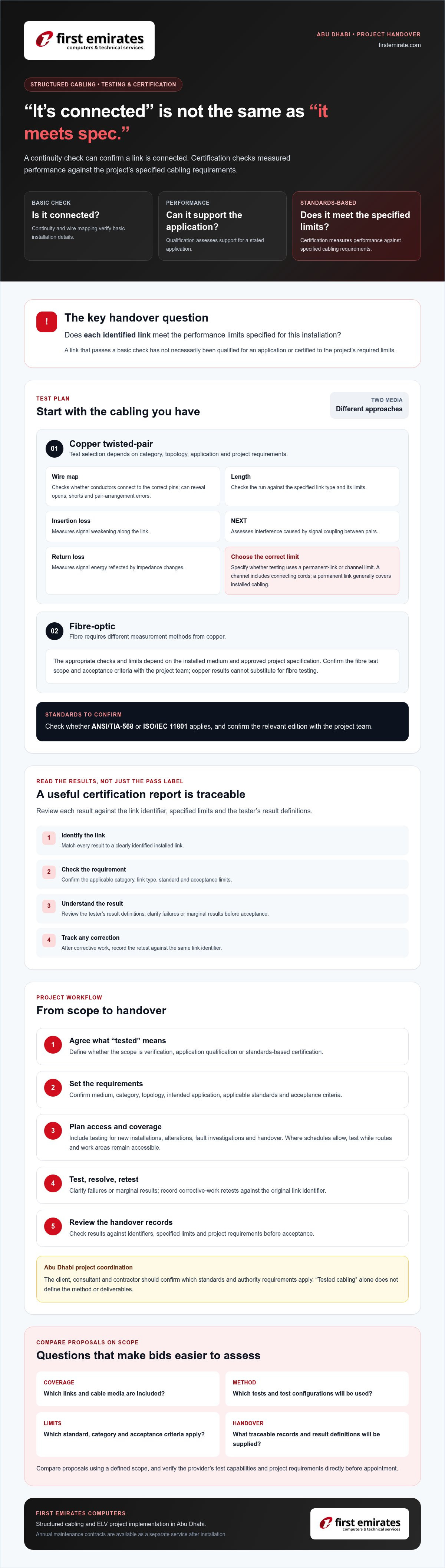
These terms describe different levels of assessment, so confirm which one a proposal includes. Verification checks basic installation details such as continuity and wire mapping. Qualification assesses whether a link can support a stated application. Certification measures the link’s performance against specified cabling requirements. A link that passes a basic check has not necessarily been qualified for an application or certified to the project’s required limits.
When should an Abu Dhabi project require testing?
Include testing in the scope for new installations, alterations, fault investigations and handover checks. Confirm the test type, coverage and acceptance criteria in the contract and consultant documentation before work starts. For Abu Dhabi projects, the client, consultant and contractor should also confirm which standards and authority requirements apply. The phrase “tested cabling” alone does not define the method or deliverables.
Where the schedule allows, plan testing while routes and work areas remain accessible. If a link fails, identifying the issue before ceilings or access routes are closed can make inspection and remediation more straightforward. After corrective work, record the retest against the same link identifier so reviewers can follow the issue through to resolution.
When assessing structured cabling testing and certification Abu Dhabi providers, specify the required scope instead of relying on broad claims. Ask what will be measured, which limits will be applied and what records will be supplied for acceptance. Those details give you a consistent basis for comparing proposals and reviewing the handover package.
Which copper and fibre tests demonstrate cabling performance?
Start the test plan with the installed medium and what the link must support. Copper twisted-pair and fibre-optic links require different measurement methods, so a result for one cannot substitute for testing the other. The cable category, link topology, intended application and approved project specification determine what to test and which limits to apply. Check whether ANSI/TIA-568 or ISO/IEC 11801 applies, and confirm the relevant edition with the project team.
Copper cabling tests: wire map, length, and transmission performance
A wire-map test checks whether conductors connect to the correct pins at each end. It can reveal open conductors, shorts and pair-arrangement errors that may prevent a link from working correctly. Length measurement checks the run against the specified link type and limits. Insertion loss measures how much signal weakens along the link, helping assess whether the received signal may be too weak for reliable communication.
Transmission measurements provide further detail. NEXT, or near-end crosstalk, assesses interference caused by signal coupling between pairs. Return loss measures signal energy reflected by impedance changes, which can affect transmission. Specify whether results must meet a permanent link or channel limit. A permanent link generally covers installed cabling, while a channel includes connecting cords. The test configuration and limit must match the project requirement.
Fibre-optic testing: continuity, loss, and end-to-end evidence
For fibre, confirm the test method before work begins. Where required by the project method statement, inspect and clean connector end faces before testing. Contamination can affect measurements and connection performance. An optical loss test measures the signal power lost across the link, providing end-to-end evidence against the specified acceptance criteria. Agree on the fibre type, connector interfaces, reference method and required results in advance.
An optical time-domain reflectometer (OTDR) trace serves a different purpose. It can show the location and characteristics of events along a fibre, such as a splice, connector or potential fault. This event analysis can help locate a problem, but it is not interchangeable with an end-to-end link-loss result. The project team should state whether an OTDR trace is required in addition to loss testing.
For UAE projects, check the project and authority requirements rather than assuming one test scope fits every site. The TDRA publishes UAE telecommunications regulations; confirm with the client and consultant which provisions and project specifications apply. For structured cabling testing and certification Abu Dhabi, ask providers to confirm their copper and fibre test capabilities and reporting scope. Teams planning installation can also review structured cabling services as part of project delivery discussions.
How to interpret a cabling certification report before accepting the work
A certification report is useful only if you can connect each result to a physical link and the requirement it was tested against. Match the report’s link identifier to the project’s outlet schedule, drawings or cable register. Then check that the stated test limit and link configuration match the approved specification. A “pass” against the wrong limit does not establish that a link meets the project requirement.
Read the tester’s definitions for pass, fail and any marginal or borderline status. Acceptance should follow the project criteria, not an informal interpretation of the label. If a result is close to a limit, ask the contractor or consultant how the report classifies it and whether further investigation or retesting is required.
A short review table can make exceptions easier to track. Record the link identifier, result status, test limit and required follow-up. For example, list a failed link for investigation and flag a marginal result for review against the project’s acceptance criteria. Use the complete report to support that summary. A cover sheet or overall statement that all links passed is not a substitute for link-level measurement records.
What information should a useful test report contain?
Check for a unique link ID, test date, operator, test limit and saved measurement results. Confirm that the cable type, link configuration and tested endpoints match the project records. Where the project requirements call for it, review the tester details and calibration status. Ask whether native electronic records are required, since they can support detailed review and future troubleshooting. Agree on the reporting format and required deliverables before testing begins.
What should happen when a link fails?
Keep the initial result. Before remedial work begins, record the failed link and the measurement that did not meet the specified limit. Depending on the result and installation, investigation may include checking terminations, bends, routing, physical damage and component compatibility. After correction, retest the link using the agreed method and limit, then retain both the original and final records. This creates a clear trail from fault identification to resolution.
For structured cabling testing and certification Abu Dhabi, treat the report as acceptance evidence, not just a closing document. Compare its identifiers with the installed cabling and project records, and resolve discrepancies before sign-off. Clear records also give future maintenance teams a baseline when investigating a fault or assessing a network change.
How Abu Dhabi project teams can scope testing and prepare handover
A clear testing scope prevents disagreements at handover about which links were tested, what limits applied and who must resolve exceptions. Abu Dhabi is the project location, not by itself evidence of a particular mandatory testing regime. Before installation and commissioning proceed, the client, consultant and contractor should confirm the standards, authority requirements and acceptance criteria applicable to the project.
Define the test scope before installation and commissioning
Record the cabling media, categories, link types, quantities and areas included in the work. Specify the test limits, required report format, any sampling rules, and who is responsible for reviewing results and accepting the work. Coordinate practical arrangements too, including access to equipment rooms, live networks, ceilings and occupied premises. These details help contractors plan testing without leaving gaps or disrupting other project activities.
A useful workflow is:
- Review requirements: Confirm project specifications, drawings, applicable standards and relevant authority requirements with the client and consultant.
- Set coverage: List the links and areas to be tested, along with the test limits and any agreed sampling method.
- Coordinate access: Agree how testing will fit around live services, restricted areas, ceiling closure and site occupancy.
- Test and document: Capture results against consistent link identifiers, then compare them with the agreed criteria.
- Remediate and retest: Record exceptions, arrange corrections and retain the retest evidence.
- Review and accept: Confirm that required records are complete and reviewed before closing the handover.
Build a traceable handover package
Organise test records so each result can be matched to floor plans, outlet schedules and equipment-room identifiers. Include approved drawings, change records, exceptions and evidence of remedial retesting. Confirm who receives, reviews and stores the final package, and whether electronic source records are needed as well as summary reports. This makes the handover more useful for future troubleshooting and network changes.
For support with contractor evaluation, see this structured cabling companies guide. Broader infrastructure context is also available through structured cabling services in the UAE.
For structured cabling testing and certification Abu Dhabi, compare providers by how clearly they define scope, reporting and coordination responsibilities. First Emirates Computers provides structured cabling and ELV project implementation in Abu Dhabi. Discuss structured cabling project requirements as part of planning implementation and handover.
Choosing structured cabling testing support in Abu Dhabi
A provider’s proposal should state what work is included and how completion will be documented. Compare the proposed test scope, method, reporting and alignment with the project specification instead of relying on a broad claim that cabling will be tested. Confirm which link types and media are covered, which limits will be used, and what records will be delivered. Verify the provider’s capabilities and deliverables before treating them as confirmed.
Questions to ask a testing or cabling contractor
Use these questions to compare proposals:
- Which copper and fibre link types, media and test limits are included?
- Can you provide an anonymised sample report, if available, and who owns the resulting test data?
- Who records failures, coordinates remedial work and retests links?
- Who reviews the results and is responsible for acceptance sign-off?
- What relevant project experience and credentials can you demonstrate for the proposed scope?
Also assess how the provider will coordinate with ELV installation teams, site personnel and the handover process. Clear responsibility for access, testing, exception tracking and record submission helps prevent gaps between cabling work and project acceptance. Don’t assume a contractor holds a particular credential or offers a specific test type. Ask for confirmation and supporting details.
From testing evidence to ongoing network support
Well-organised link records can help future teams identify the correct outlet or route when diagnosing a fault or planning moves, adds and changes. Keep the records aligned with project drawings and identifiers, and confirm where the final files will be stored and who can access them. First Emirates Computers provides structured cabling and ELV project implementation in Abu Dhabi. Confirm its specific copper and fibre testing capabilities, standards, equipment and reporting scope for your project.
Annual maintenance contracts are a separate offering and may be relevant when considering support after installation. Do not assume they include a particular cabling test package. For further information about ongoing support, see IT AMC services in Abu Dhabi.
Before discussing a project, prepare the cable media and link types, project specification, required test limits, site details and expected handover records. This gives a provider a practical basis to confirm its scope and capabilities. To discuss those requirements with First Emirates Computers, discuss your structured cabling requirements.
Make cabling acceptance clear from the start
Reliable handover depends on more than a basic connection check. Define the test scope against the project specification, choose tests that suit the copper or fibre links, and review results link by link against the correct limits. Clear identifiers, complete records and documented retests make acceptance easier to verify and give teams a useful reference for future changes or fault investigations.
For projects seeking structured cabling testing and certification Abu Dhabi, confirm the provider’s test methods, deliverables and capabilities before work begins. Annual maintenance contracts are also available as a separate service and may be relevant when planning support after installation. Confirm the specific project scope directly.
Before starting a discussion, gather your drawings, link schedule, applicable specifications and expected handover requirements. Discuss your structured cabling requirements with First Emirates Computers to plan a well-documented project handover.
Frequently Asked Questions
What is structured cabling certification?
Structured cabling certification is a set of measured results showing whether an installed link meets the performance limits specified for the project. The test scope depends on the cable medium, category, link configuration and applicable standard. Associate each result with a link identifier so the project team can compare it with plans and acceptance criteria. Certification records support handover and provide a reference for later troubleshooting or network changes.
What is the difference between cable testing and certification?
Cable testing is a broad term that can include basic checks, application qualification or standards-based certification. A continuity or wire-map check can confirm that conductors connect as expected, but it does not prove the link meets all required performance limits. Certification measures the link against a defined cabling requirement and records the results. Before accepting a contractor’s claim that cabling is “tested,” ask which method, test limit and deliverables are included.
Which tests are used to certify Cat6 cabling?
Cat6 certification typically assesses wire map, length and transmission performance against the project’s specified limit and link configuration. Measurements may include insertion loss, NEXT (near-end crosstalk) and return loss, which relate respectively to signal attenuation, interference between pairs and signal reflections. The required parameters depend on the applicable test limit and configuration. Confirm whether the scope is for a permanent link or channel, and check the approved specification rather than assuming the limits.
Does fibre-optic cabling need certification testing?
Yes, fibre links should be tested against the project’s defined requirements. End-to-end optical loss testing measures how much signal is lost across the link. An OTDR trace may also be requested to show events or help locate faults along the fibre, but it serves a different purpose from a link-loss measurement. Confirm the fibre type, connector interfaces, test method and acceptance criteria with the project team before testing begins.
How do I read a structured cabling test report?
Start by matching each result’s link identifier to the outlet schedule, drawings or cable register. Check that the cable type, link configuration and test limit match the project specification, then review the recorded measurements and the tester’s definitions of pass, fail or marginal results. Confirm any required tester and calibration details. A summary stating that all links passed is not enough on its own. Request link-level records and clarify exceptions before acceptance.
When should structured cabling be tested on a project?
Include testing for new installations, alterations, fault investigations and project handover. Define the scope and acceptance criteria before work begins, then coordinate access with the contractor and site team. Where the schedule allows, testing while ceilings and access routes remain open can make it easier to investigate and correct installation issues. Record failures before remedial work, then retain retest results so the handover documents show how exceptions were resolved.
Are specific structured cabling standards mandatory in Abu Dhabi?
Requirements depend on the project specification and applicable authority or telecommunications-provider conditions, so do not assume one test standard applies to every Abu Dhabi site. The project team should confirm which standard and edition govern the installation, along with any relevant building or service-provider requirements. For structured cabling testing and certification Abu Dhabi projects, agree on these requirements with the client, consultant and contractor before work starts, and record the accepted limits in the project documents.


