

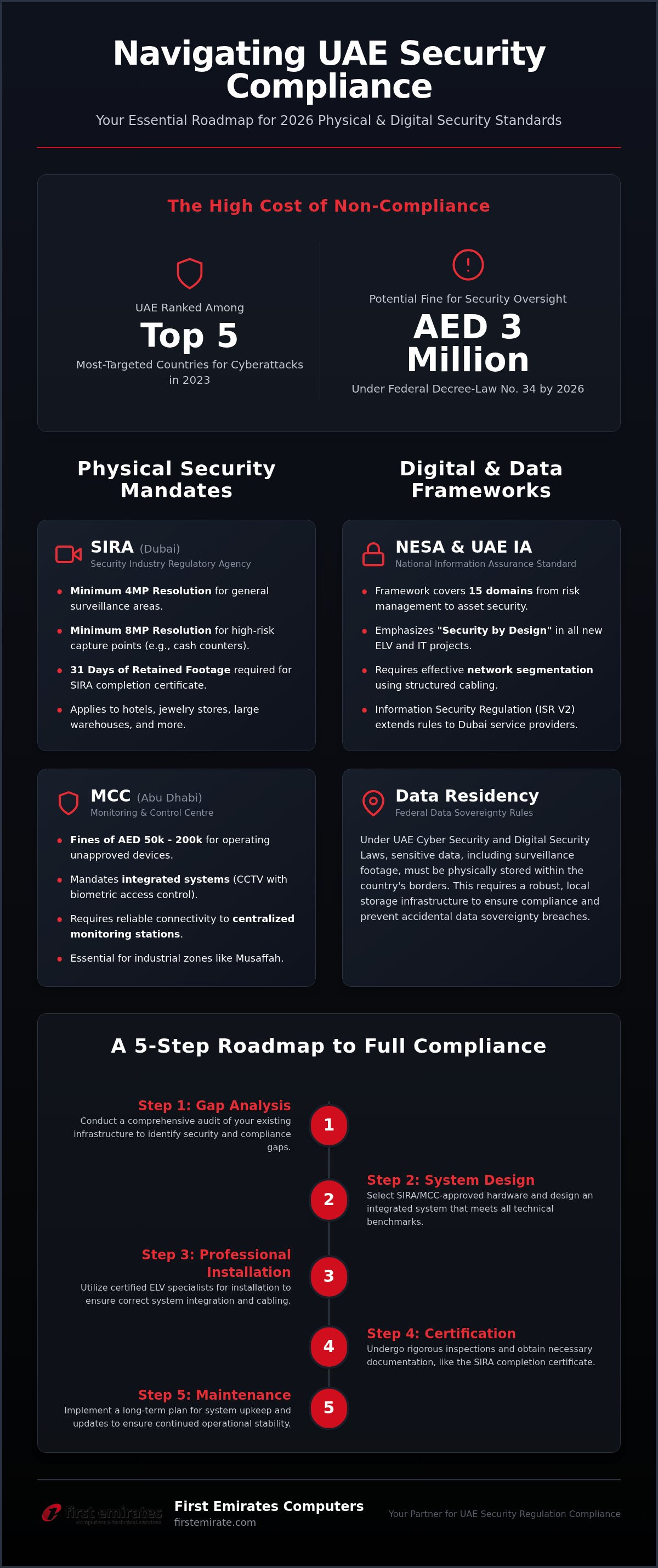
With the UAE ranked among the top five most-targeted countries for cyberattacks in 2023, the financial impact of a security oversight in 2026 can reach up to AED 3 million under Federal Decree-Law No. 34. You likely find the overlapping layers of federal mandates and emirate-specific rules, such as SIRA in Dubai and MCC in Abu Dhabi, both confusing and technically demanding. Achieving consistent UAE security regulation compliance isn't just about avoiding high non-compliance fines; it's about building a stable foundation for your daily operations through technical readiness and quiet confidence.
This guide provides a clear roadmap to help you master the complex landscape of mandatory security standards. We'll examine the 2026 updates for NESA information assurance, the latest 4MP and 8MP CCTV resolution requirements, and the specific documentation needed for MCC Abu Dhabi. By the end of this article, you'll have a systematic understanding of how to align your physical hardware and digital protocols with current laws. This ensures your infrastructure is fully compliant and managed by a dependable partner who understands the technical nuances of the region.
Key Takeaways
- Differentiate between federal mandates and emirate-specific requirements to ensure your business meets the standards of authorities like TDRA, DESC, and MCC.
- Identify the exact hardware specifications for CCTV and biometric systems required to satisfy SIRA and MCC Abu Dhabi technical standards.
- Navigate the updated UAE Information Assurance (IA) frameworks and ISR V2 to secure digital assets while maintaining strict data privacy.
- Follow a methodical five-step roadmap to achieve full UAE security regulation compliance, starting with a comprehensive gap analysis of your existing infrastructure.
- Learn how an established ELV specialist can streamline the installation and maintenance of compliant security systems for long-term operational stability.
Physical Security Standards: SIRA and MCC Abu Dhabi
Physical security in the Emirates is governed by specific regional authorities that mandate strict hardware and installation standards. Achieving the objectives outlined in the UAE's National Cyber Security Strategy involves integrating these physical measures with digital oversight. In Dubai, the Security Industry Regulatory Agency (SIRA) oversees all commercial surveillance, while the Monitoring and Control Centre (MCC) manages standards for Abu Dhabi infrastructure. These bodies ensure that every commercial entity maintains a baseline of technical readiness to protect both public and private interests.
SIRA Compliance for Commercial Entities
Dubai requires specific business activities, including hotels, jewelry stores, and large warehouses, to maintain SIRA-approved CCTV systems. As of 2026, SIRA has updated resolution requirements, mandating a minimum of 4MP for general surveillance and 8MP for high-risk capture areas. To obtain a SIRA completion certificate, businesses must undergo a rigorous inspection of their video storage, which typically requires 31 days of retained footage. Working with a SIRA approved CCTV company Abu Dhabi: Compliance Guide ensures that your hardware meets these precise technical benchmarks and follows the mandatory licensing age requirements for security personnel.
MCC Standards in Abu Dhabi
The Monitoring and Control Centre (MCC) provides a robust framework for Abu Dhabi's security landscape. For industrial zones like Musaffah, MCC standards require integrated systems that often combine surveillance with biometric access control. Operating monitoring devices without MCC approval is a serious offense that carries fines between AED 50,000 and AED 200,000. These regulations prioritize high-resolution imaging and reliable connectivity to centralized monitoring stations, making them essential for UAE security regulation compliance in the capital. It's a systematic approach that prevents unauthorized system access and ensures local law enforcement has access to clear data when needed.
Hardware specifications are not mere suggestions; they are legal requirements for UAE security regulation compliance. Beyond resolution, systems must maintain specific frame rates, usually 15 to 25 frames per second, to ensure clear forensic evidence. These standards ensure that every technical component, from the NVR storage capacity to the structured cabling, functions reliably under industrial conditions. Installations must be performed by certified contractors who understand the nuances of system integration and regional law. If you're planning an upgrade, consulting with a methodical specialist in CCTV Surveillance Systems can help you avoid the technical errors that lead to failed inspections or licensing delays.
Information Assurance and Data Privacy Frameworks
The UAE Information Assurance (IA) Regulation serves as the primary national standard for protecting information assets and critical infrastructure. For businesses operating in Dubai, the Information Security Regulation (ISR V2) extends these requirements specifically to contractors and service providers. A critical component of these frameworks is the concept of data residency. Under the UAE Cyber Security and Digital Security Laws, sensitive security data and surveillance footage must often remain within the country's borders. This legal necessity requires a robust local infrastructure where UAE security regulation compliance is maintained through both physical and digital oversight. Relying on local storage solutions ensures that your business doesn't inadvertently breach federal data sovereignty rules.
NESA Compliance Requirements
The National Electronic Security Authority (NESA) mandates a comprehensive framework consisting of 15 domains, ranging from risk management to asset security. For new ELV and IT projects, implementing a "Security by Design" approach is essential. This principle ensures that security isn't an afterthought but is integrated into the initial network architecture. High-quality structured cabling plays a vital role in this methodical setup. It allows for effective network segmentation, ensuring that critical security traffic, such as CCTV feeds, is isolated from general business data. This disciplined approach to cabling prevents lateral movement during a potential cyber incident, directly supporting NESA information assurance goals and overall UAE security regulation compliance.
Digital Data Protection in Surveillance
Digital protection goes beyond simple password management. It requires securing CCTV footage and biometric data against unauthorized access and evolving cyber threats. As biometric access control becomes a standard requirement in Abu Dhabi and Dubai, the handling of personal data must align with strict UAE privacy laws. Physical security for the hardware itself is equally important to prevent data tampering. We emphasize best practices for server room cabling and organization to protect the physical data assets that house your sensitive information. A disciplined cabling strategy reduces the risk of accidental disconnection or physical tampering, providing a steady foundation for your security network. By organizing your infrastructure systematically, you establish a professional environment that is easier to audit and maintain under current regulatory standards.
A 5-Step Compliance Checklist for UAE Businesses
Achieving full UAE security regulation compliance requires a disciplined, multi-stage approach. It isn't enough to simply install cameras; every component must be integrated into a system that meets specific legal benchmarks. Follow this methodical roadmap to ensure your business infrastructure remains ready for inspection.
- Step 1: Conduct a Gap Analysis. Evaluate your existing physical surveillance and digital information assurance protocols against SIRA, MCC, and NESA standards to identify any technical shortcomings.
- Step 2: Audit physical security hardware. Verify that your CCTV and biometric systems meet the 2026 requirements for resolution, frame rates, and tamper-proof mounting.
- Step 3: Review and upgrade infrastructure. Ensure your structured cabling and IT backbone can handle the increased bandwidth required for high-definition security data.
- Step 4: Establish a compliant Annual Maintenance Contract (AMC). Secure a formal agreement with a certified provider to maintain system integrity and provide the required maintenance logs.
- Step 5: Finalize documentation. Compile all technical specifications, site maps, and maintenance records to apply for your regulatory certification or renewal.
Auditing Your Current Security Assets
Checking your hardware involves more than a visual inspection. For 2026, cameras must meet a minimum of 4MP for general areas and 8MP for high-risk zones, such as facial capture points. You also need to verify that your NVR or DVR systems support the mandatory 31-day or 90-day storage rules, depending on your specific business activity. If your current setup falls short, you should consult an Access Control System Company: Choosing the Best in UAE to ensure your biometric and entry systems are equally compliant and integrated into your broader security network.
The Critical Role of the IT AMC
An Annual Maintenance Contract is frequently a legal prerequisite for receiving a security system completion certificate. Regulators require proof that your systems are being professionally managed and updated. A compliant contract should include documented routine checks, software updates, and detailed maintenance logs that can be presented during an audit. Without this steady oversight, your business risks failing inspections or facing delays in trade license renewals. Our IT AMC Services Abu Dhabi: Proactive Systems Care provide the technical readiness needed to keep your infrastructure aligned with evolving laws.
Securing a professional Annual Maintenance Contract is the most reliable way to ensure your hardware remains compliant year-round and protected against sudden technical failures.
Implementing Compliance with First Emirates Computers
First Emirates Computers operates as a methodical partner for businesses seeking to align with national standards. We provide a steady hand in a complex technical landscape. Our expertise covers the full spectrum of physical security, from CCTV Surveillance Systems to integrated Biometric Access Control. By focusing on technical proficiency, we ensure that your infrastructure meets the rigorous demands of UAE security regulation compliance. We've been a locally owned LLC since 2011, establishing a reputation for quiet confidence and technical readiness in the capital.
Our approach to system integration prioritizes longevity and stability. We design ELV projects and structured cabling solutions that serve as a reliable backbone for your security data. This systematic organization is crucial for maintaining NESA and ISR standards. Along with installation, we emphasize the importance of Annual Maintenance Contracts. These contracts are not just a service; they're a tool for ongoing compliance. We manage the routine checks and logs that prove your system is functional and secure during regulatory audits. This disciplined oversight ensures your business isn't caught off guard by sudden changes in enforcement or technical requirements.
Why Choose an Abu Dhabi Local Specialist?
Focusing on the capital requires specialized knowledge of regional authorities. We have a deep understanding of Musaffah industrial security requirements and Abu Dhabi's MCC standards. Since 2011, we've executed enterprise-level ELV projects that require precise technical execution. We don't rely on hyperbole. Instead, we offer grounded reliability and a professional cadence that mirrors the disciplined nature of the projects we manage. Our local presence allows us to be a constant, supportive resource for businesses navigating the specific documentation needs of the Abu Dhabi Monitoring and Control Centre.
Getting Started with a Compliance Audit
The first step toward UAE security regulation compliance is a thorough evaluation of your existing assets. Our team assesses your hardware against the 2026 resolution and storage updates. We guide you through the transition from legacy analog systems to modern, IP-based compliant solutions. This process includes a detailed review of your network infrastructure to ensure it supports high-definition capture and secure data residency. We provide clear guidance rather than flashy marketing, ensuring you understand the scope of your professional responsibility. To begin this methodical transition, Contact First Emirates Computers for a professional security audit and ensure your business is fully prepared for current and future mandates.
Securing Your Operational Future in the UAE
Achieving UAE security regulation compliance is a continuous process of technical alignment and disciplined maintenance. You've seen how the integration of high-resolution CCTV hardware with robust NESA information assurance frameworks protects both your physical assets and digital sovereignty. Maintaining these standards requires a methodical approach to structured cabling and a commitment to certified annual maintenance. By following a structured five-step checklist, you eliminate the confusion between federal and emirate-level rules while protecting your business from high non-compliance fines.
Since 2011, we've served the region as a steady hand for complex ELV projects. As a SIRA Approved Contractor and a specialist in MCC Abu Dhabi standards, we provide the technical readiness your business needs to stay operational. Our team focuses on grounded reliability, ensuring that every biometric installation and surveillance upgrade meets the exact requirements of local regulators. This systematic oversight provides you with the peace of mind to focus on your core business goals.
Secure your business with a SIRA-compliant security system from First Emirates Computers.
Taking these steps today ensures your infrastructure remains a reliable asset for years to come.
Frequently Asked Questions
What is the difference between SIRA and MCC in the UAE?
SIRA governs security standards in Dubai, while the Monitoring and Control Centre (MCC) manages surveillance in Abu Dhabi. Each authority has its own set of hardware approvals and installation protocols. SIRA focuses on commercial security licensing for Dubai businesses, whereas MCC regulates infrastructure in the capital. Navigating these regional differences is essential for UAE security regulation compliance, as hardware approved in one emirate might not meet the specific technical requirements of another.
Is it mandatory for all businesses in Abu Dhabi to have CCTV?
Mandatory CCTV requirements in Abu Dhabi depend on your specific business activity as defined by the MCC. High-risk sectors, such as financial institutions, hotels, and industrial warehouses in Musaffah, must install approved surveillance systems. While small commercial offices might have different rules, most entities require a security clearance for trade license renewal. Operating without approved monitoring devices is an offense punishable by fines ranging from AED 50,000 to AED 200,000 under current laws.
How long must I store CCTV footage to remain compliant in Dubai?
Most commercial businesses in Dubai are required to store CCTV footage for at least 31 days. However, certain sectors or high-risk facilities must maintain recordings for up to 90 days. You must use SIRA-approved storage devices that can handle the 2026 resolution standards of 4MP or 8MP. Keeping these logs accessible is vital for government audits. Failing to provide footage during an inspection can lead to penalties and complications with your operational permits.
Can any IT company install a SIRA-approved security system?
No, only companies holding a valid SIRA license are permitted to install or maintain security systems in Dubai. These contractors are audited for technical proficiency and adherence to federal safety laws. Hiring an uncertified IT firm for security installations is illegal and will result in your system being rejected during the mandatory SIRA inspection. It's a disciplined requirement that ensures all security infrastructure in the emirate meets a consistent, professional standard of technical readiness.
What are the NESA compliance requirements for private companies?
NESA standards, specifically Version 2 from September 2025, are mandatory for government bodies and critical infrastructure operators. Private companies must comply if they handle sensitive government data or provide essential services to these sectors. The framework involves 15 domains, including network security and incident management. Implementing these controls often requires specialized structured cabling and IT hardware that supports secure data segmentation, ensuring your business aligns with the UAE's broader national cybersecurity strategy.
Why do I need an Annual Maintenance Contract (AMC) for my security system?
An Annual Maintenance Contract is often a mandatory prerequisite for trade license renewals and security certifications. It provides documented proof that your CCTV and access control systems are professionally managed and functional. A compliant AMC covers routine hardware checks, software updates, and the maintenance of required system logs. This methodical oversight is a critical part of UAE security regulation compliance, ensuring that your technical infrastructure remains reliable and ready for any unannounced government inspections.
Are biometric attendance systems legal under UAE security regulations?
Biometric systems are legal but must align with the UAE’s personal data protection laws, such as Federal Decree-Law No. 45. You must ensure that biometric data is encrypted and stored according to data residency requirements, meaning it stays within the UAE. In Abu Dhabi, MCC standards often require biometric access control for high-security zones. Using a methodical approach to installation ensures that your biometric systems provide security without breaching the privacy rights of your employees.
What happens if my business fails a security inspection by DESC or SIRA?
Failing an inspection by SIRA or DESC leads to a rectification order, where you must fix technical gaps within a set period. Common failures include using non-compliant camera resolutions or having insufficient storage capacity. If you don't address these issues, your business faces fines and potential blacklisting. For serious violations of the cybercrime law, penalties can reach AED 3 million. Conducting a proactive audit of your ELV and IT systems helps you avoid these severe consequences.


