

Your CCTV system may be recording, yet outdated cameras, limited storage or unreliable cabling can leave important gaps. A security system audit UAE businesses can use to assess readiness should check more than whether equipment powers on. It should establish whether devices perform reliably, systems communicate as intended and the installation aligns with the requirements that apply in its emirate.
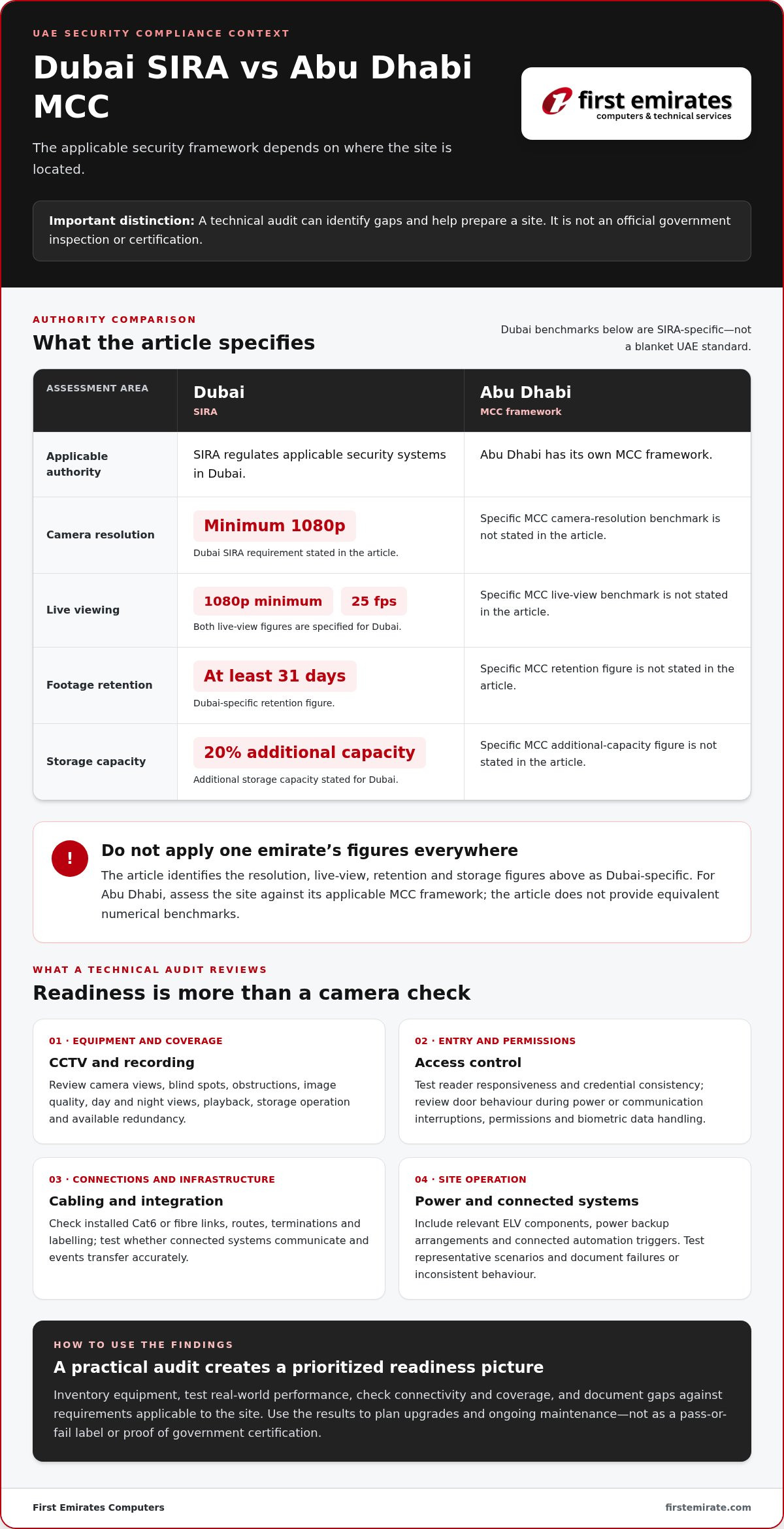
Concerns about SIRA or MCC compliance, ageing CCTV and disconnected security systems are understandable. The relevant authority depends on location: SIRA regulates applicable systems in Dubai, while Abu Dhabi has its own MCC framework. A technical audit can identify issues and help prepare a site, but it is not an official government inspection or certification.
This guide explains how to review CCTV performance, access control, structured cabling, storage and system integration. You’ll learn how to identify upgrade priorities, improve reliability and reduce downtime, then use the findings to plan compliance readiness and maintenance. First Emirates Computers provides CCTV, biometric access control and ELV solutions, bringing these connected parts of a site’s security infrastructure into one practical review.
Key Takeaways
- A security system audit UAE review brings physical equipment, IT infrastructure and applicable regulatory requirements into one assessment.
- Check CCTV coverage and biometric access control performance for issues that affect day-to-day reliability.
- The applicable compliance framework depends on whether the site is in Dubai or Abu Dhabi.
- A structured audit, from site survey and asset inventory through technical testing, gives a clearer picture of system readiness.
- Turn audit findings into prioritized upgrade and maintenance plans to support reliable operations over time.
Understanding the Security System Audit in the UAE Context
A security system audit is a methodical evaluation of physical security equipment, supporting IT infrastructure, system integration and applicable regulatory requirements. Unlike an information-systems review focused mainly on data integrity, it checks whether cameras, access control, recorders and connecting cabling work together in practice. Physical security depends on coordinated layers of protection, so a software-only assessment can miss faults at the site level.
A routine maintenance visit usually addresses known faults and scheduled servicing. A comprehensive security system audit UAE assessment takes a wider view: it inventories equipment, tests performance, checks coverage and connectivity, and documents gaps against relevant compliance requirements. It supports readiness, but it is not government approval or certification. The findings can also help organizations respond to risk controls, insurer documentation requests and applicable authority requirements.
The Evolution of UAE Security Regulations
Security systems have moved beyond standalone cameras toward integrated environments connecting surveillance, access control and building infrastructure. In 2026, this makes both the physical installation and its digital connections important to assess. In Dubai, SIRA requirements include a minimum camera resolution of 1080p, live viewing at a minimum 1080p and 25 frames per second, at least 31 days of footage retention, and 20% additional storage capacity. These figures are Dubai-specific, not a blanket UAE standard. Biometric and AI-enabled tools can add capabilities, but their suitability depends on site needs and configuration. They should not be assumed to be mandatory.
Who Needs a Security Audit Most?
Audits are particularly useful where security failures could disrupt operations, expose valuable assets or create compliance concerns. Sites that may benefit include:
- Critical infrastructure and warehouses: Facilities in Musaffah and other industrial zones can assess camera coverage, recording continuity, access points and cabling resilience. Specific requirements depend on the site and applicable authority.
- Corporate offices: Organizations can check whether biometric access control responds reliably, permissions are managed appropriately and entry points are covered.
- Residential towers and mixed-use developments: Owners and operators can review surveillance and access systems against the rules that apply to their location. SIRA is Dubai’s authority; Abu Dhabi has a separate MCC framework.
The goal is a clear, prioritized view of weaknesses and readiness, not simply a pass-or-fail label. This baseline helps organizations plan upgrades and ongoing maintenance with fewer surprises.
The Scope of a Professional Security and ELV Audit
A professional security system audit UAE assessment should examine more than software settings or network records. It checks the devices, their connections and how the complete system performs in daily use. A camera may be operating but fail to capture a doorway clearly. A biometric reader may respond correctly but not pass access events to another connected system. Reviewing the whole setup helps reveal these less obvious gaps.
CCTV and Surveillance Integrity
Map camera views against entrances, perimeters and other areas requiring coverage, then identify blind spots, obstructions and image-quality issues. Test day and night views, recording playback, storage operation and available redundancy. Inspect outdoor camera housings and mounting points for wear, moisture ingress or other environmental damage in UAE conditions. For Dubai sites, include applicable SIRA requirements in the compliance review. The Security Industry Regulatory Agency (SIRA) provides information about the authority’s role. An access control system selection guide can also help clarify how surveillance and entry systems work together.
Access Control and Biometric Reliability
Test reader responsiveness at different entry points and check that approved credentials work consistently. Review how doors behave during power or communication interruptions, and document whether the configured response suits the site’s safety and security requirements. Where biometric access is used, examine database integrity and access permissions. Biometric information is personal data, so its collection and handling should be considered in light of applicable UAE data protection obligations. If access control connects to time-attendance software, verify that events transfer accurately and can be reconciled with relevant records.
Structured Cabling: The Invisible Backbone
Physical infrastructure can undermine otherwise capable equipment. Testing installed Cat6 or fibre links helps identify connection faults or signal degradation that may affect camera feeds and communication between devices. Review cable routes, terminations and labelling, as well as server-room organization, so faults can be traced and maintenance work carried out efficiently. This hands-on assessment distinguishes an infrastructure review from a software-only check. Explore this structured cabling guide for Abu Dhabi for additional context.
Include relevant ELV components, power backup arrangements and connected home or office automation triggers in the review. Test representative scenarios, such as whether an authorized access event activates its intended automation response, and record failures or inconsistent behaviour. Reviewing CCTV, biometric access control and structured cabling together gives teams a practical basis for prioritizing corrective work. First Emirates Computers provides CCTV and structured cabling solutions as part of its infrastructure services. Learn more about its CCTV and structured cabling expertise.
Compliance Standards: SIRA, MCC, and UAE Regulations
Compliance depends on where a site operates and which requirements apply to its activity. SIRA governs relevant security systems in Dubai, while Abu Dhabi has a separate framework overseen by the Monitoring and Control Centre (MCC). A security system audit UAE review should begin by identifying the site’s emirate and applicable authority, then comparing the installation and records with current requirements. The Security Industry Regulatory Agency (SIRA) is the official source for Dubai’s security-sector guidance.
SIRA CCTV Standards in Dubai
As of September 2026, the SIRA standards provided for this guide specify a minimum camera resolution of 1080p, with live viewing at 1080p and at least 25 frames per second. Recorders must retain footage for at least 31 days and include 20% additional storage capacity. The technical framework also specifies a minimum 48dB signal-to-noise ratio for cameras and an IP66 weatherproof rating for outdoor cameras.
During a readiness review, test recorded footage and live views, verify retention and available capacity, and check whether cameras provide useful coverage of entrances and exits. These figures apply to Dubai, not universally across the UAE. Do not assume one storage period applies to every business type. Confirm the current rules relevant to the site. Compare hardware and installer documentation with applicable SIRA requirements rather than relying on a generic claim of certification.
Abu Dhabi MCC and Industrial Compliance
In Abu Dhabi, Law No. 5 of 2011 established the MCC framework for CCTV and other surveillance systems. Operating a covered surveillance system without MCC approval can result in imprisonment and fines ranging from AED 50,000 to AED 200,000. Approval status and supporting technical records are therefore important readiness checks for sites in Musaffah, ICAD and other industrial areas. Do not assume specific hardware or remote-monitoring conditions for a warehouse; these depend on the applicable MCC requirements.
Retail, hospitality and industrial operators should document camera coverage, equipment details, recording performance, access permissions and system changes. Check practical coverage of public-facing areas, entrances and exits, but do not present general camera-placement advice as a statutory rule unless the relevant authority specifies it.
A technical partner can help prepare the system and organize evidence for an official review, but this work is not a government inspection, approval or certification. First Emirates Computers provides technical readiness assessments covering CCTV, biometric access control and ELV infrastructure. A structured pre-audit review helps identify gaps to address before an authority inspection, but it cannot guarantee the inspection outcome.
The 5-Step Security Audit Methodology
A repeatable process makes an audit easier to document and act on. A security system audit UAE should assess physical assets and infrastructure alongside system performance and applicable compliance requirements, rather than relying on software checks alone. These five steps create a traceable path from site conditions to corrective priorities.
- Physical site survey and asset inventory. A physical asset inventory is a documented record of security equipment and its location. Locate each camera, sensor, recorder and access controller, then compare the installed equipment with available records. Note missing, unlabelled or outdated assets, and inspect devices, mounts and enclosures for tampering, wear or environmental damage.
- Technical performance testing and stress analysis. Test live views, recordings, access events and system communication under normal operating conditions. Where approved and safe, coordinate a controlled power-failure test to observe UPS response and any installed backup generator. Assess network performance under the expected surveillance load to identify bottlenecks, and test biometric readers for consistent recognition using authorized test credentials.
- Vulnerability and gap analysis. Compare observed performance with operational needs. Record issues such as camera blind spots, intermittent feeds, delayed reader response, weak cable connections or unclear access permissions. Separate urgent risks from improvement opportunities, and document the evidence behind each finding so teams can investigate and prioritize work.
- Regulatory compliance verification. Match system documentation and test results against the requirements that apply to the site’s emirate and business activity. Review relevant approval records, equipment details, footage retention settings and maintenance history. Keep regulatory findings distinct from general technical recommendations. An audit can support readiness, but it does not replace an authority’s inspection or approval.
- Final report and strategic recommendations. Present findings in a usable format, linking each issue to its location, operational effect and recommended next action. Group recommendations by priority, such as immediate repair, planned upgrade or ongoing monitoring. This gives management a basis for budgeting, assigning responsibility and tracking closure instead of treating the report as a one-time checklist.
Plan testing around site operations. Document test conditions and results, and avoid interrupting live security functions without appropriate coordination. The final report can also inform a maintenance schedule or an Annual Maintenance Contract, helping preserve system performance after corrective work is complete.
For a structured review of CCTV, biometric access control and connected infrastructure, arrange a security system readiness assessment with First Emirates Computers.
Post-Audit Strategy: Maintenance and Long-Term Reliability
An audit creates value when its findings lead to tracked corrective work. Turn the report into an upgrade roadmap that identifies each issue, its operational impact, the action required, its priority and a responsible owner. This keeps urgent security gaps distinct from optional performance improvements and gives management a practical basis for scheduling work.
Implementing Audit Recommendations
Address failures affecting essential coverage, recording or access control before lower-priority enhancements. If equipment replacement can be phased, sequence it around operational needs and available budgets rather than replacing every component at once. Plan future installations for maintainability and scalable infrastructure. Structured cabling, clear documentation and adaptable system capacity can support later changes. “Future-proofing” should mean preparing for change, not assuming what standards will require between 2027 and 2030.
Regular reviews and preventive maintenance can help limit avoidable faults, emergency repairs and service interruptions, supporting better control of the system’s total cost of ownership over time. The aim is not to promise a fixed saving, but to make equipment condition, repair priorities and replacement decisions visible before small issues become larger operational problems.
From Audit Findings to Ongoing Maintenance
A one-time review provides a useful baseline. An Annual Maintenance Contract (AMC) provides a framework for continuing to monitor and maintain security infrastructure. Planned servicing keeps CCTV, biometric access control and connected ELV components under review, while maintenance records help track recurring faults and confirm whether completed recommendations remain effective. An AMC can follow naturally from audit findings, with its scope aligned to the site’s equipment and identified priorities.
For organizations considering broader business continuity and maintenance planning, see IT AMC services in Abu Dhabi.
Methodical Technical Support
Based in Abu Dhabi, First Emirates Computers provides CCTV, biometric access control, ELV projects and structured cabling services. Bringing these areas together helps connect device-level findings with the cabling and infrastructure that support system performance. The process is practical: document the condition, prioritize the work and maintain the systems after upgrades are complete.
A security system audit UAE organizations can act on should start an ongoing reliability plan, not become a report to file away.
Make Your Security Infrastructure Ready for What’s Next
A reliable security system depends on more than functioning cameras. It needs connected hardware, dependable cabling and access controls, along with a clear understanding of the requirements that apply to the site. A structured security system audit UAE businesses can act on helps reveal performance and compliance-readiness gaps, then turns the findings into prioritized upgrades and ongoing maintenance.
First Emirates Computers provides technical assessments of CCTV, biometric access control and ELV infrastructure through a methodical five-step audit process. The Abu Dhabi-based team reviews physical security systems and their connections to help organizations build a practical path toward greater reliability. An audit supports preparation for an authority review; it does not replace official inspection or approval.
Get a clearer view of your system’s condition and priorities. Schedule a security system audit with First Emirates Computers today.
With a defined roadmap and consistent maintenance, you can move forward with greater confidence in your security operations.
Frequently Asked Questions
What is the difference between a security audit and a security inspection?
A security audit is a broad, documented assessment of equipment, infrastructure, performance and applicable compliance requirements. A security inspection usually checks conditions at a particular time, such as whether cameras are working or access points are secured. An audit may trace a camera fault to cabling or recording issues, then recommend corrective work. A technical audit supports readiness; it does not replace an official authority inspection or approval.
How often should a business in the UAE conduct a security system audit?
There is no single audit frequency that applies to every UAE business. Set a review schedule based on site risk, operating needs, applicable authority requirements and equipment condition. Reassess after significant system changes, recurring faults, security incidents or changes to the site layout. An Annual Maintenance Contract can support routine upkeep, while periodic audits provide a broader view of system performance and outstanding compliance-readiness gaps.
Are security audits mandatory for all businesses in Abu Dhabi?
No, a technical security audit is not automatically mandatory for every business in Abu Dhabi. Certain establishments must follow applicable surveillance rules, and covered CCTV systems require MCC approval. Abu Dhabi’s Law No. 5 of 2011 established the Monitoring and Control Centre framework. Requirements depend on the premises and activity, so identify the rules that apply to your site. A technical readiness assessment documents system condition but is not MCC approval.
Can a security system audit help reduce my insurance premiums in the UAE?
A security audit may help you document equipment condition, identify weaknesses and demonstrate risk-management steps to an insurer, but it cannot guarantee lower premiums. Insurance decisions depend on the insurer, policy terms and information reviewed. Keep the audit report, maintenance records and evidence of completed corrective work together. If your insurer requests specific documents or controls, use those requirements to guide the review rather than assuming an audit alone will change your premium.
What happens if our existing CCTV system fails a SIRA or MCC audit?
A failed official review may require corrective action, depending on the authority’s findings and applicable rules. Identify each documented gap, such as recording, coverage or equipment issues, then prioritize repairs or upgrades and retain evidence of completed work. A technical assessment can help prepare for a follow-up review, but it does not guarantee approval. In Abu Dhabi, operating a covered surveillance system without MCC approval can carry serious legal penalties.
How long does a typical security system audit take for an office or warehouse?
There is no fixed duration for every office or warehouse audit. The time required depends on site size, the number and type of devices, system complexity, available documentation and access to relevant areas. A small office review may differ considerably from an industrial site with extensive CCTV, access control and cabling. Before work begins, define the audit scope and arrange access to equipment, records and technical areas to support an efficient assessment.
What documents are required to prepare for a security system audit?
Gather the records available for your site, including CCTV and access-control equipment lists, camera layouts, system diagrams, installation or change records, maintenance logs and relevant approval documents. Include recording and retention settings, access permissions, and details of connected cabling or automation where applicable. These materials help compare documented systems with what is physically installed. Missing records need not stop a technical review, but note the gaps so they can be addressed in the audit findings.


