

What if the issue isn’t a missed alarm, but the missing context around it? For UAE property teams, the benefits of integrated security systems UAE sites can gain become clear when CCTV footage, access control events and alerts work together instead of sitting in separate workflows. Operators can see more of what’s happening, coordinate a response with better context and manage security through a more connected process.
It’s reasonable to question whether integration justifies the additional planning. The answer depends on how your site operates: a property with separate devices and teams may benefit from a shared workflow, while the design must still reflect its layout, risks and day-to-day requirements. Integration is valuable when it improves operational visibility and control, not simply because more devices are connected.
This guide explains the practical gains, compares integrated and separate systems against real site needs, and outlines what to plan for implementation, maintenance and UAE requirements. It also considers how CCTV, biometric access control and supporting ELV infrastructure can be coordinated as part of a security project, with ongoing maintenance supporting system reliability after installation.
Key Takeaways
- The benefits of integrated security systems UAE properties may gain depend on whether CCTV, access control and alerts support a coordinated operational workflow.
- Linking access events with relevant camera footage can give operators clearer context and reduce manual switching between separate interfaces.
- Compare integrated and separate systems against your site’s security needs, daily workflows, expansion plans and maintenance responsibilities.
- A practical implementation plan starts with site risks and workflows, then considers infrastructure, system integration and operational testing.
- CCTV, biometric access control, ELV infrastructure and structured cabling can be planned together, with ongoing maintenance supporting system reliability.
What Are Integrated Security Systems, and Why Do UAE Sites Use Them?
A site can have cameras, biometric readers and alarms yet still leave operators piecing events together across separate screens and procedures. Integration addresses that operational gap. It connects security functions so information from one system can inform how another is monitored or used, according to the design and equipment selected for the property.
An integrated security system coordinates devices, information and response procedures so staff can manage related security events as one workflow. A shared network alone doesn’t make separate devices an integrated system. The practical difference is whether an event, such as an access alert, can be reviewed alongside relevant camera footage and acted on through agreed procedures.
Typical components include CCTV, biometric access control, alarms and supporting ELV infrastructure, including structured cabling. Integration can mean devices exchange event information, but it can also include shared monitoring arrangements, user permissions and defined responsibilities. These are separate design decisions: connecting devices doesn’t automatically create consistent permissions or a clear response process.
Which security components can work together?
Consider an access alert at a restricted entrance. If the systems are designed to share relevant information, an operator may be able to review nearby camera footage and follow the site’s response procedure without searching through unrelated recordings. The exact functions depend on equipment compatibility and system design. For context, Internet Security Systems (ISS) relates to cybersecurity, a separate area from the physical-site systems discussed here.
Where can integrated security add value in the UAE?
Operational needs differ by property. A commercial premises may need to coordinate staff access, visitor movement and camera coverage. A residential property may prioritise controlled entry and visibility around shared or external areas. A facility with several entrances may need a consistent way to review events across those points while keeping response responsibilities clear.
For organisations managing more than one site, coordinated procedures can help teams review events consistently without assuming every location needs identical devices or permissions. Start with the site’s layout, users, entry points and operating routines. Those factors help determine whether integration will simplify oversight or add complexity without enough operational value. This is central to assessing the benefits of integrated security systems UAE properties may gain.
UAE projects also need to account for local requirements. Security approvals and technical requirements can differ by emirate, so a design for Dubai may not meet the same requirements as one for Abu Dhabi. Privacy obligations also matter when systems capture identifiable footage or access records. Before implementation, establish which rules apply to the property and how recorded information will be managed.
How Integrated CCTV, Access Control and Alarms Improve Response
An integrated workflow helps staff move from an alert to a considered response with less manual searching. For example, a door alarm may indicate that an access point has been forced or left open. If the system design connects that event with nearby CCTV, an authorised operator can review relevant footage, check the site’s response procedure and decide what action is appropriate.
Shared event context helps operators make more informed decisions by bringing relevant alerts and footage together for review. It doesn’t guarantee a particular response time or determine what happened. The value is in giving staff useful information in a consistent sequence, rather than requiring them to search several systems without knowing which records relate to the alert.
How does CCTV integration add context to access events?
Where system capabilities allow, a door event can be matched with footage from a relevant camera and time period. Staff can then follow a defined review process: confirm the event details, assess the available footage, record their findings and escalate in line with site procedures. This supports an orderly handover between security staff and managers. It doesn’t promise automatic identification or remove the need for human judgement.
Alarms can also contribute to the sequence. An alarm event may prompt an operator to review a nearby camera view and check access records, if those functions are configured to work together. The practical benefit depends on the quality of the event information, the equipment’s compatibility and the clarity of the response plan. Automation can present information or support a defined procedure, but trained personnel must assess the circumstances and choose the appropriate action.
How can centralised oversight support UAE operations?
For a business with multiple relevant locations, centralised oversight can give authorised operators a shared view of system status and events, subject to the design and permissions in place. It can help teams apply consistent review practices while allowing local staff to handle site-specific responsibilities. In UAE properties, shape this approach around each site’s operational needs and applicable local requirements.
Technology alone doesn’t establish accountability. Each property benefits from clear roles: who reviews an alert, who can access footage, when a matter is escalated and how the outcome is recorded. Event records can support follow-up by showing what information was reviewed and what action staff took. For UAE operations, account for the requirements that apply to the site and emirate when setting access permissions and handling security records.
These operational details are part of assessing the benefits of integrated security systems UAE organisations may realise. First Emirates Computers’ security solutions include CCTV surveillance and biometric access control, with ELV implementation and structured cabling supporting project infrastructure.
Integrated vs Separate Security Systems: Which Approach Fits Your Site?
The right setup depends on how your property operates, not on how many devices it contains. Separate CCTV, access control and alarm systems can be practical for a straightforward site with limited entry points and clear, independent responsibilities. Integration becomes more useful when staff need to coordinate information or actions across systems. Weigh the benefits of integrated security systems UAE properties can realise against project scope, compatibility and staff readiness.
| Decision area | Separate systems | Integrated systems |
|---|---|---|
| Visibility | Operators review each system independently. | Related information may be brought together for a more connected view. |
| Workflows | Staff may need to move between interfaces and processes. | Configured event links can support shared review and response procedures. |
| Administration | Permissions and records may be managed system by system. | Coordination can make shared roles clearer, but requires deliberate configuration. |
| Expansion | Systems can be updated independently, subject to their capabilities. | New connections need to work with the existing design and equipment. |
| Maintenance ownership | Responsibilities may sit with different system owners or teams. | Clear responsibility is needed for connected components and their interfaces. |
What are the practical trade-offs of integration?
Consolidated oversight can make related events easier to review, but achieving it requires planning. The project must define which systems exchange information, how permissions are assigned and how staff use the resulting workflow. Broader integration can also create dependencies: a change or fault in one part may affect a connected function. Clear ownership, documentation and maintenance arrangements help teams manage those dependencies. Integration isn’t automatically necessary or superior for every property.
Decision rule: integrate when multiple security workflows need to coordinate; keep systems separate when their tasks are simple and independent. For example, a small site with one controlled entrance and a straightforward camera review process may not gain enough operational value from extensive connections. A larger premises with several entry points and teams responsible for different events may benefit more from shared procedures.
When is a phased approach suitable?
A phased approach can prioritise the entry points or workflows with the clearest operational need, then extend connections as requirements develop. Before sequencing work, review existing equipment, structured cabling, system compatibility and the staff who will operate the setup. This helps distinguish infrastructure that can support the next phase from components that may need a different role in the design. For component-level considerations, consult the access control system selection guide.
For each phase, document the intended workflow, responsible staff, required permissions and maintenance ownership. Test the connected functions as a complete process, not just as individual devices, and make sure operators understand how to use the information provided. This keeps the design tied to site operations and gives decision-makers a practical basis for expanding, adjusting or limiting integration.
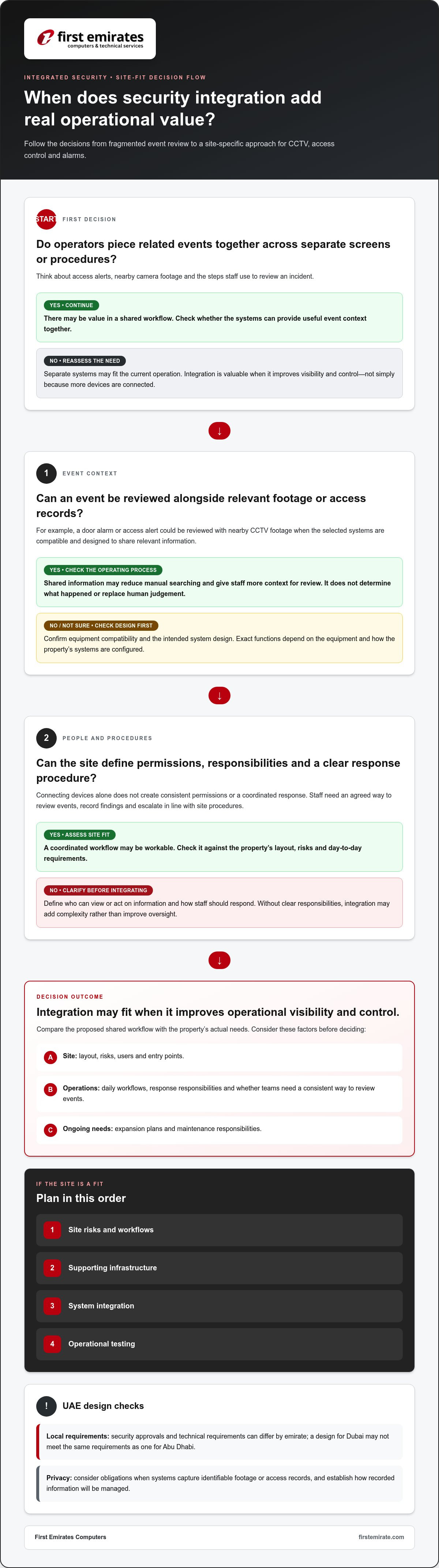
Planning an Integrated Security System for a UAE Property
A workable design starts with site operations, then connects those needs to equipment, infrastructure and responsibilities. For UAE properties, planning should also account for the building’s conditions, the relevant emirate’s requirements and the people who will operate and maintain the system. This sequence helps decision-makers assess the benefits of integrated security systems UAE sites may gain without treating every project as identical.
What should a site assessment cover?
Record the physical layout and how people use it before defining system connections. Map entrances, restricted areas, visitor routes, user groups and operating hours. Note existing CCTV, access control, alarms and infrastructure that may be reused. Include outdoor exposure and other site conditions that could affect equipment placement and cabling routes.
Use the assessment to clarify what the system needs to support: which events should be reviewed together, who needs access to information, and where monitoring takes place. Identify network, cabling and power requirements for the intended configuration, along with practical constraints such as active business operations during installation. Assign responsibilities across property management, IT, security staff and facilities teams so decisions and handovers have clear owners.
Approval and privacy questions belong in the project plan, not as an afterthought. Requirements can differ by emirate: Dubai’s security regulator is SIRA, while Abu Dhabi’s is ADMCC. Establish which authority requirements apply to the property and verify current approval, recording and data-handling obligations before finalising the design.
How should the project be sequenced?
Use five steps to turn the assessment into an implementation plan:
- Assess risks: Identify priority areas, likely security events and existing coverage gaps.
- Map workflows: Define who reviews each type of event, what information they need and how escalation works.
- Review infrastructure: Check existing structured cabling, network paths, power and monitoring arrangements against the intended setup.
- Plan integration: Specify which functions need to exchange information, how permissions are managed and who owns each connected component.
- Test operation: Validate the configured functions and response procedures, then document results and provide staff handover.
Structured cabling and ELV planning affect more than device connectivity. They help determine equipment locations, routes between system components and how future changes can be accommodated. Reviewing infrastructure early can reveal constraints before installation work is scheduled. First Emirates Computers coordinates CCTV, biometric access control, ELV implementation and structured cabling as part of UAE security projects. Read more about integrated security project support.
How can installation and maintenance support reliability?
Plan for configuration, functional testing, staff handover and clear documentation, including system layout and operational procedures. After installation, scheduled support can help maintain system availability and address faults through an agreed maintenance arrangement. An ongoing support plan should also define who reports issues and how changes to connected components are documented.
How First Emirates Computers Supports Integrated Security Projects
Choosing an integrated security approach is only one part of the decision. The project also needs to align equipment, supporting infrastructure and ongoing upkeep with the property’s operating requirements. First Emirates Computers is an Abu Dhabi-based provider serving UAE clients, with capabilities across CCTV surveillance, biometric access control, ELV project implementation, structured cabling and annual maintenance contracts.
What capabilities can support a coordinated project?
CCTV surveillance and biometric access control address different security functions. CCTV provides video coverage, while biometric access control manages authorised entry. A coordinated project considers how these functions relate to the site’s security objectives, where equipment needs to be placed and how staff will use the systems. The exact connections between devices depend on project design and selected equipment.
ELV implementation and structured cabling support the wider technical environment in which security devices operate. Cabling routes and infrastructure planning influence where components can be installed and how they connect. Addressing these requirements alongside the security design can help align device locations and project scope with the property layout, rather than treating each installation as an isolated task.
First Emirates Computers plans CCTV, biometric access control and supporting infrastructure around the project’s scope, property conditions and operational requirements. A commercial site, residential property and facility with multiple entry points can have different priorities. The appropriate design should reflect the intended workflows and the responsibilities of the people who will operate the systems.
Why plan for support beyond installation?
Installation is not the end of system ownership. Configuration, operational checks and clear handover documentation help establish how components are intended to function and how staff should use them. Over time, equipment and site requirements can change. Ongoing technical support gives the property a structured way to address upkeep and faults as part of its system management.
First Emirates Computers offers annual maintenance contracts for ongoing technical support. Maintenance planning provides a framework for technical upkeep without assuming a particular response time or outcome. For an integrated setup, document which systems are connected, who is responsible for them and how changes should be managed.
The benefits of integrated security systems UAE properties can achieve depend on the fit between the design and the site’s real operating needs. First Emirates Computers brings CCTV surveillance, biometric access control, ELV implementation, structured cabling and ongoing maintenance support together within UAE projects.
Discuss an integrated security system for your UAE property and outline the requirements your project needs to address.
Set a Clear Direction for Your Security Project
Define what better security operations should look like at your property. Identify the decisions staff need to make, the information they need to make them, and who will be responsible for each stage of the system’s operation. That clarity helps keep the project focused on practical outcomes rather than connections that add complexity without addressing a real need.
The benefits of integrated security systems UAE properties can achieve depend on aligning system design with site priorities and day-to-day responsibilities. A considered plan can also make future changes easier to evaluate, whether your needs call for a targeted improvement or a broader coordinated setup.
First Emirates Computers supports UAE security projects with CCTV, biometric access control, ELV implementation, structured cabling and annual maintenance contracts. Discuss an integrated security system for your UAE property and take the next step with a plan shaped around how your site operates.
Start with a clear operational objective, then build the project around the needs of your property and the people who use it.
Frequently Asked Questions
What is an integrated security system?
An integrated security system connects compatible security components so they can support coordinated monitoring and operations. For example, a property team might review an access event alongside relevant CCTV footage rather than treating each record separately. Integration can also involve shared permissions or agreed procedures, depending on the design. Devices simply sharing a network doesn’t necessarily mean their information or workflows are coordinated.
What are the main benefits of integrated security systems for UAE businesses?
For UAE businesses, the benefits of integrated security systems can include clearer operational oversight, more useful context for reviewing events and less manual movement between separate interfaces. A coordinated setup may also help teams apply consistent procedures across relevant areas of a property. These outcomes depend on the site’s design, equipment and staff processes. Integration supports decision-making, but it can’t guarantee that incidents will be prevented or resolved.
Can existing CCTV and access control systems be integrated?
Existing CCTV and access control systems may be integrated if their functions and equipment can work together within the planned design. The project scope may depend on system capabilities, connection methods, available infrastructure and the information the site needs to share. A practical assessment should establish which components can be connected and whether upgrades or configuration changes are needed. Not every existing function will necessarily be compatible.
Are integrated security systems suitable for small businesses?
They can be suitable for a small business if coordination solves a real operational need. A compact office with one entrance and straightforward monitoring may be adequately served by separately managed systems. A small premises with restricted rooms, several staff groups or frequent visitor access may benefit from linking selected functions. Base the decision on entry points, operating procedures and who is responsible for reviewing security events.
How does an integrated security system help during an incident?
It can give authorised staff relevant information from connected systems to assess an event within the site’s response procedures. For instance, an operator may compare an alert with associated records before deciding whether to notify a manager or escalate the matter. Staff should document their review and follow assigned responsibilities. Automation can organise or present information, but people must interpret the situation and make operational decisions.
Do integrated security systems need ongoing maintenance?
Yes. Initial installation establishes the system, while ongoing maintenance addresses upkeep as equipment is used and site needs change. A maintenance plan can include checking system functions, reviewing configuration and addressing faults that affect connected components. It should also define who is responsible for reporting issues and keeping relevant documentation current. First Emirates Computers provides annual maintenance contracts for ongoing technical support to UAE clients.
What UAE requirements apply to CCTV and access control integration?
Requirements depend on the property’s emirate, use and system scope, so there isn’t one blanket rule for every UAE installation. Dubai and Abu Dhabi have distinct security authorities, and requirements may differ between them. Before implementation, verify the current approvals and technical rules that apply to the specific site. Also review relevant privacy and information-handling obligations for recorded footage and access records, using current official guidance.


