

A biometric reader is only as reliable as the structured cabling and IT backbone that supports it. For enterprises in the capital, biometric access control integration Abu Dhabi is no longer just about installing hardware. It's a complex ELV project that demands strict adherence to UAE Federal Decree-Law No. 45 of 2021 and evolving local security standards. You're likely facing the pressure of the March 2026 CBUAE mandates for multi-factor authentication or the technical friction of syncing new scanners with legacy payroll software.
We understand that navigating specific ADMC requirements while avoiding system downtime is a significant technical challenge for any facility manager. This guide provides a methodical roadmap to achieving a zero-breach environment and automated attendance reporting through disciplined system integration. We'll examine the technical standards for 2026, the transition to touchless AI-powered systems, and how to maintain a unified security dashboard that simplifies your daily operations. By treating security as a core component of your IT infrastructure, you can ensure both regulatory compliance and long-term operational stability for your Abu Dhabi business.
Key Takeaways
- Learn why high-bandwidth structured cabling and Power over Ethernet (PoE) are the foundational requirements for a stable biometric security system.
- Understand the step-by-step methodology for biometric access control integration Abu Dhabi, from initial site surveys to comprehensive ELV mapping.
- Discover how to ensure 2026 regulatory compliance while transitioning your facility to advanced touchless authentication methods.
- Identify the critical criteria for selecting a local technical partner capable of providing rapid maintenance and dedicated Annual Maintenance Contracts (AMC).
- Explore strategies for future-proofing your security infrastructure to allow for seamless user scaling without requiring major hardware overhauls.
The Shift to Biometric Access Control Integration in Abu Dhabi
The landscape of corporate security in the capital has reached a technical turning point. 2026 marks a decisive shift toward touchless infrastructure as businesses move away from legacy hardware that no longer meets modern safety or efficiency standards. Biometric access control integration Abu Dhabi involves the systematic linking of physical scanning hardware to a centralized IT database for real-time identity verification. This process transforms a standalone lock into an intelligent node within a broader network, ensuring that every entry point is monitored and managed through a single interface.
Traditional RFID cards and PIN codes are increasingly viewed as liabilities in professional environments. These methods are susceptible to "buddy punching," where employees clock in for one another, and the constant risk of lost or stolen credentials. By prioritizing biometric access control integration Abu Dhabi, companies eliminate these vulnerabilities and create a non-transferable link between the individual and the facility. The economic benefits are clear. Automated data collection reduces the administrative burden on HR departments, as time and attendance records flow directly into management software without manual intervention. This reduction in administrative overhead allows staff to focus on core business functions rather than auditing access logs.
Modern Modalities: Beyond the Fingerprint
While fingerprint scanning remains common, the market is moving toward more sophisticated access control systems that offer higher precision and touchless interaction. Facial recognition has become the preferred standard for high-traffic Abu Dhabi office lobbies because it allows for rapid, "walk-through" authentication without physical contact. For high-security zones, such as data centers or research labs, iris and palm-vein scanning provide a near-zero false acceptance rate. Many enterprises now deploy multi-factor biometrics, combining facial recognition with mobile credentials to meet strict MCC-compliant security protocols and ensure the highest levels of identity assurance.
The Role of AI and Edge Computing in 2026
The latest generation of biometric hardware utilizes on-device processing to handle complex algorithms locally. This shift to edge computing ensures faster entry speeds and significantly reduces the load on central servers. These systems often retain legacy features from the post-pandemic era, such as thermal scanning and mask detection, which are now integrated into broader health and safety workflows. It's a methodical approach that prioritizes both speed and system resilience. Edge Biometrics represents the future of low-latency access control by performing identity verification at the point of entry rather than relying on distant cloud processing.
Infrastructure Requirements: ELV and Structured Cabling
A successful biometric access control integration Abu Dhabi depends entirely on the underlying physical layer. You cannot run advanced, AI-driven facial recognition on outdated wiring without experiencing significant verification lag. Biometric data packets are dense and require high-bandwidth, dedicated structured cabling to ensure authentication occurs in milliseconds. This is a technical reality that many businesses overlook during the hardware procurement phase. A methodical approach to the network foundation prevents the friction of slow entry times and system timeouts.
Power over Ethernet (PoE) has transitioned from a convenience to a critical requirement for system uptime. By delivering both data and power through a single cable, PoE simplifies the installation of scanners at remote entry points or parking gate barriers. It also improves reliability. When your scanners are powered via PoE switches, the entire security network can be supported by a centralized Uninterruptible Power Supply (UPS). This ensures that your facility remains secure even during local power fluctuations or outages, maintaining a constant defensive posture.
In industrial areas like Musaffah, the challenge is often electromagnetic interference (EMI). Heavy machinery and large power distribution units can corrupt data signals if the cabling isn't properly shielded. We utilize shielded twisted pair (STP) cabling and disciplined cable management techniques to prevent signal crosstalk. This methodical approach to the physical layer is what separates a professional installation from a setup that fails under environmental stress. Proper grounding and organized trunking are essential for maintaining the long-term health of your security hardware.
Cat6 and Fiber Optic Foundations
Cat6 remains the baseline standard for data transmission within a single facility. It provides the necessary throughput for high-resolution biometric templates and real-time database synchronization. For multi-building campuses or large-scale commercial developments in areas like Al Reem or Yas Island, fiber optic backbones are essential. They allow for long-distance data transfer without signal degradation. If you're planning a new facility, consulting with specialists in structured cabling services UAE ensures your foundation is ready for 2026 security standards.
The ELV Integration Layer
Biometrics shouldn't operate in a vacuum. A methodical integration involves connecting readers to the broader ELV ecosystem. This includes life safety systems where doors must automatically unlock during fire alarms to ensure safe egress. We also integrate these systems with physical barriers like turnstiles and gate barriers to create a unified perimeter. All these components should feed into a central Security Operations Centre (SOC). This provides your team with a single pane of glass for monitoring every entry event. For those overseeing complex sites, partnering with experts in ELV projects ensures that these disparate systems work as a cohesive unit.
Selecting the Right Integration Partner in Abu Dhabi
Choosing a partner for biometric access control integration Abu Dhabi requires a shift in perspective. You aren't simply purchasing sensors; you're commissioning a complex IT and ELV project that must function without fail for years. A methodical partner evaluates your existing network architecture before recommending a single piece of hardware. This "capability-first" approach ensures that the chosen devices are compatible with your server environment and structured cabling. Simple hardware resellers often lack the technical depth to troubleshoot integration friction between the reader and the backend database, leading to system lag or authentication errors.
A local Abu Dhabi presence is a functional necessity rather than a convenience. When a biometric reader at a main entry point malfunctions, the security of the entire facility is compromised. We prioritize a disciplined support model that emphasizes technical readiness and rapid response. Annual Maintenance Contracts (AMC) are non-negotiable for biometric systems. These sensors require periodic calibration and firmware updates to maintain high accuracy and protect against new spoofing techniques. A dedicated AMC ensures that your security posture remains stable and that any hardware failures are addressed through a systematic replacement process.
Regulatory Compliance: ADMC and SIRA
Navigating the regulatory landscape in the capital involves meeting project-specific standards often dictated by the Abu Dhabi Monitoring and Control Centre (ADMC). These requirements differ significantly between commercial high-rises and residential complexes. While Dubai utilizes SIRA standards, Abu Dhabi's framework is frequently tied to the specific authority overseeing the facility's safety. Ensuring your contractor is an experienced SIRA approved CCTV company Abu Dhabi specialist provides the peace of mind that your installation meets the highest national security benchmarks. This compliance is essential for obtaining necessary building permits and operational clearances.
Software and API Integration
The true value of biometric integration lies in the data. Modern systems use robust APIs to link access logs directly to HRMS platforms like SAP or Oracle. This automation eliminates manual entry for payroll and provides real-time visibility into staff movements. When considering system architecture, you must weigh the benefits of cloud-based management against on-premise solutions. Given the strict data sovereignty rules in UAE Federal Decree-Law No. 45 of 2021, many Abu Dhabi enterprises prefer on-premise or locally hosted private clouds. This ensures that sensitive biometric templates remain within the country's borders, fulfilling your legal obligations while maintaining operational efficiency.
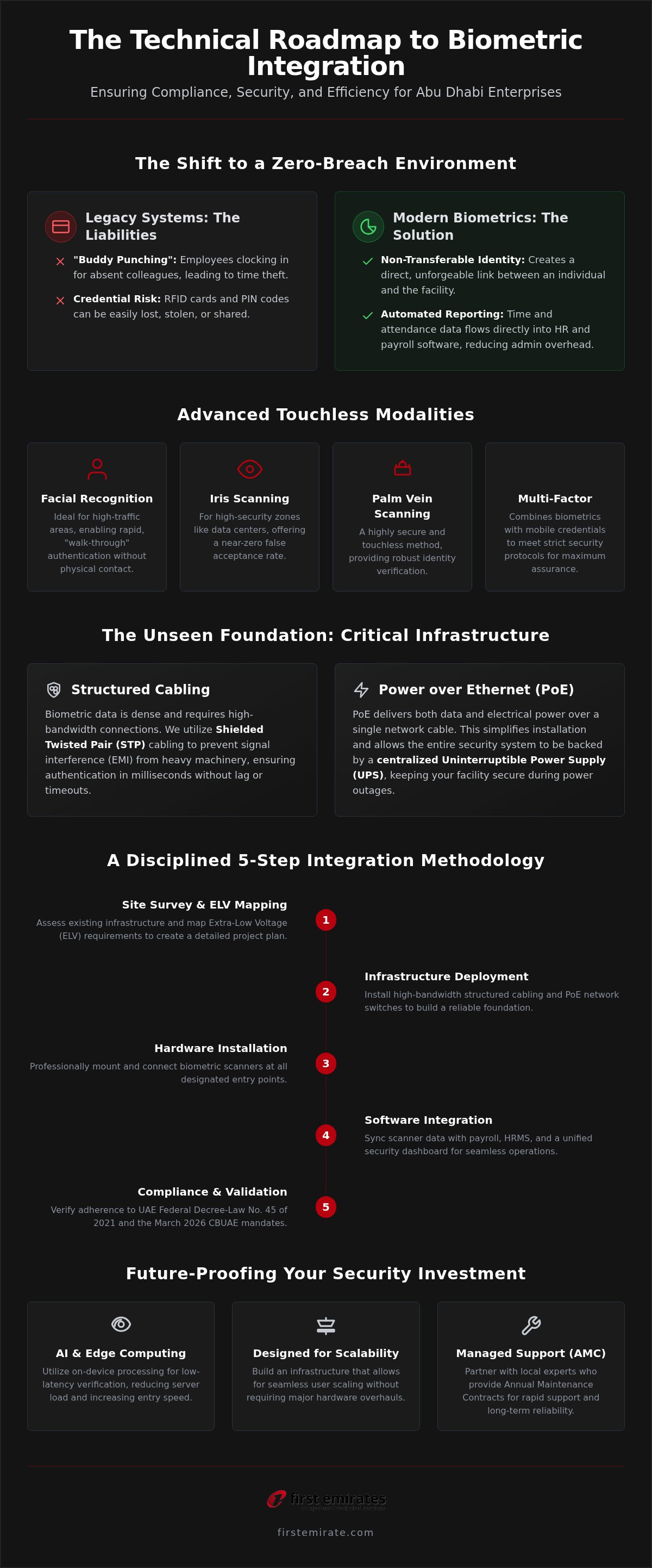
The Step-by-Step Biometric Integration Process
Success in biometric access control integration Abu Dhabi isn't accidental. It's the result of a disciplined, five-phase deployment model that prioritizes technical readiness over rapid, uncoordinated installation. This methodical approach ensures that the final system isn't just functional but also fully compliant with local security mandates. By following a structured timeline, we eliminate the common friction points that lead to system downtime or data synchronization errors.
- Phase 1: A comprehensive site survey and security risk assessment to identify physical and technical constraints.
- Phase 2: System architecture design, which includes detailed ELV and network mapping to support high-bandwidth data.
- Phase 3: Hardware procurement and pre-installation configuration conducted in a controlled environment to minimize on-site troubleshooting.
- Phase 4: Physical installation and structured cabling implementation, adhering to the standards discussed in previous chapters.
- Phase 5: User enrolment, system stress-testing, and a final compliance audit to meet ADMC and SIRA requirements.
Site Survey and Requirement Gathering
Evaluating a facility requires more than just counting doors. We identify potential "bottleneck" entry points in high-occupancy buildings where slow authentication could disrupt the flow of staff and visitors. During this phase, we scrutinize lighting conditions to ensure facial recognition accuracy remains high regardless of the time of day. Technical experts also calculate power backup (UPS) requirements. This ensures fail-safe operation during any electrical interruptions, maintaining a constant security posture for your enterprise.
Configuration and User Enrolment
Enrolling users is a sensitive process that must adhere to UAE Federal Decree-Law No. 45 of 2021 regarding data protection. We establish strict data privacy protocols for biometric template storage, ensuring that sensitive information is encrypted and isolated from the main network. For organizations managing multiple facilities, we set up multi-site synchronization for Abu Dhabi and Dubai branches. This allows a single enrolment to grant access across all authorized locations. Finally, we provide thorough training for your on-site staff on system management and automated reporting. A system is only effective if your team knows how to interpret the data it generates.
Unlike many regional providers who focus solely on hardware, we include a formal documentation and audit phase. This is critical for meeting the specific nuances of ADMC regulations, which require detailed system diagrams and proof of compliance for final operational approval. If you're ready to secure your facility with a methodical deployment, explore our full range of biometric access control solutions tailored for the Abu Dhabi market.
Maximising ROI: Maintenance and Future-Proofing
The long-term value of a biometric access control integration Abu Dhabi project is measured by its sustained reliability and its ability to adapt to organizational growth. A high-quality installation is an asset that requires a methodical management strategy to prevent technical debt. ROI isn't solely achieved at the moment of activation; it's built through consistent system uptime and the avoidance of costly hardware replacements. By treating your security infrastructure as a living component of your facility, you ensure that your initial investment continues to provide a zero-breach environment for years to come.
Scaling your system shouldn't require a complete infrastructure overhaul. A disciplined integration approach utilizes modular architecture, allowing you to add new doors, turnstiles, or users as your business expands. This scalability is particularly vital for the rapidly developing commercial sectors in Al Maryah Island and the Abu Dhabi Global Market (ADGM). To close the security loop entirely, we recommend linking your access data with your surveillance network. Integrating these scanners with professional CCTV installation Abu Dhabi protocols ensures that every biometric event is backed by high-definition visual evidence, providing a comprehensive audit trail for your security team.
The Value of Proactive AMC Services
Biometric sensors are precision instruments that are susceptible to environmental factors like dust and humidity, which are prevalent in the UAE. Without regular calibration, sensor accuracy can degrade, leading to increased false rejection rates and employee frustration. Our Annual Maintenance Contracts (AMC) provide a structured schedule of quarterly hardware cleaning and critical firmware updates to prevent system lag. These proactive IT AMC services Abu Dhabi include priority support for mission-critical entry points, ensuring that technical specialists are available to maintain your facility's operational continuity. A methodical maintenance plan is the most effective way to extend the lifespan of your security hardware.
Preparing for 2027 and Beyond
The next phase of security evolution involves moving toward mobile-first credentials and decentralised identity management. We're already seeing a shift toward using smartphones as biometric keys, where the phone's native facial or fingerprint recognition authenticates the user before granting access via Bluetooth or NFC. For high-security environments, blockchain-secured identity management is emerging as a solution for zero-trust architectures. We anticipate a transition where security hardware evolves from being perceived as "gatekeepers" to facilitating a "seamless flow" within smart Abu Dhabi buildings. First Emirates Computers remains your steady partner in this evolving landscape, providing the technical proficiency needed to navigate these advancements with quiet confidence and technical readiness.
Securing Your Enterprise Future in Abu Dhabi
The transition to touchless security is a technical necessity for businesses seeking to maintain compliance and operational efficiency in 2026. This guide has detailed why successful biometric access control integration Abu Dhabi relies on a disciplined approach to structured cabling and ELV architecture. By prioritizing a capability-first model over simple hardware procurement, you ensure your facility remains both secure and scalable as your organization grows. Maintaining this posture requires a steady partner who understands the local regulatory landscape and the critical role of proactive maintenance.
First Emirates Computers has provided professional technical support in the capital since 2011. Our team specializes in SIRA and ADMC compliant systems, delivering methodical ELV project management that minimizes downtime. We focus on building stable, long-term security foundations that allow your team to focus on their core objectives with complete peace of mind. Request a methodical site survey for your biometric integration from First Emirates Computers today to begin your infrastructure upgrade. We're ready to help you navigate the complexities of modern security with technical proficiency and reliable local support.
Frequently Asked Questions
Is biometric access control mandatory for businesses in Abu Dhabi?
Biometric access control isn't a blanket legal requirement for every small business, but it's mandated for specific high-security sectors and financial institutions. The Central Bank of the UAE (CBUAE) has set a March 31, 2026 deadline for financial institutions to replace OTPs with biometric verification. Additionally, government-linked entities and critical infrastructure sites must adhere to strict security protocols that often necessitate these advanced systems for identity assurance.
How does facial recognition work with UAE traditional dress (Kandura/Abaya)?
Modern facial recognition algorithms are highly effective when used with traditional UAE dress, such as the Kandura and Abaya. These systems focus on mapping specific facial geometry and nodal points rather than clothing or headwear like the Ghutra or Shayla. This ensures that biometric access control integration Abu Dhabi remains efficient and accurate for all employees while respecting local cultural norms and attire requirements in a professional environment.
What happens to the access control system during a power failure?
During a power failure, a professionally installed system relies on a centralized Uninterruptible Power Supply (UPS) to maintain operation. The hardware is configured as either "fail-safe," meaning doors unlock for emergency egress, or "fail-secure," where doors remain locked to protect assets. These settings are determined during the initial ELV design phase to ensure full compliance with Abu Dhabi Civil Defence fire safety regulations and building codes.
Can biometric systems be integrated with my existing payroll software?
Yes, biometric systems are designed to integrate seamlessly with HRMS and payroll platforms like SAP, Oracle, or Microsoft Dynamics. This is achieved through secure APIs that transfer real-time access logs directly into your attendance database. Automating this process eliminates manual entry errors and provides HR departments with precise data for payroll processing. It's a methodical way to improve administrative efficiency while maintaining a secure facility perimeter.
What is the difference between SIRA and ADMC approval for security systems?
SIRA (Security Industry Regulatory Agency) is the regulatory body for Dubai, whereas the Abu Dhabi Monitoring and Control Centre (ADMC) oversees security standards in the capital. While both agencies aim to ensure public safety, their specific technical requirements and certification processes differ. For a project in the capital, you must ensure your integrator is familiar with ADMC's project-specific standards to obtain the necessary operational approvals and building permits.
How long does it take to install a biometric system for a 50-person office?
A standard installation for a 50-person office typically requires five to ten business days to complete. This timeline includes the initial site survey, the installation of structured cabling, and the physical mounting of readers. The final phase involves user enrolment and system stress-testing to ensure zero authentication lag. Larger multi-site deployments or complex ELV integrations may require a more extended schedule depending on the existing IT infrastructure and building layout.
Are biometric templates stored as actual images of fingerprints or faces?
Biometric templates are never stored as raw images of faces or fingerprints. Instead, the system converts physical traits into an encrypted mathematical hash or "template" during the enrolment process. This method ensures that the original image cannot be reconstructed if the database is compromised. It's a critical security feature that helps businesses comply with UAE Federal Decree-Law No. 45 of 2021 regarding the protection of sensitive personal data.
Is an Annual Maintenance Contract (AMC) required by Abu Dhabi law?
An Annual Maintenance Contract (AMC) is often a regulatory requirement for facilities overseen by the ADMC or those requiring specific commercial security licenses. Even when not explicitly mandated by law, an AMC is essential for maintaining the calibration of sensitive biometric sensors. Regular maintenance ensures that your system remains compliant with national security standards and protects your long-term investment by preventing hardware failures or software vulnerabilities from compromising your security posture.


