

Did you know that cargo theft incidents have surged by 57% over the last three years? For operators in Abu Dhabi's industrial heart, implementing robust warehouse security systems Musaffah requires more than just standard cameras. It's a constant challenge to balance full coverage of high-bay racking with the harsh reality of fine industrial dust and HVAC-induced false alarms. You're likely already feeling the pressure of meeting the latest ADMCC v2.0 and SIRA v4.0 standards to ensure your trade license remains in good standing.
We understand that a security failure is more than a technical glitch; it's a direct threat to your inventory and your regulatory compliance. This guide provides a methodical roadmap to mastering industrial security in 2026. You'll learn how to design systems that eliminate blind spots, automate entry logging, and ensure your surveillance hardware survives the Musaffah climate. We will examine everything from IP66-rated equipment selection to the 30-day retention requirements mandated by Abu Dhabi authorities, giving you the technical readiness needed to protect your facility.
Key Takeaways
- Understand why industrial-grade sensors are essential to mitigate false alarms caused by thermal turbulence and environmental dust in large-scale facilities.
- Identify the technical specifications required for high-definition surveillance to ensure comprehensive coverage of high-bay racking and loading zones.
- Navigate the 2026 regulatory landscape, focusing on ADMCC and SIRA mandates for data retention and certified system integration.
- Evaluate the transition to biometric access control and active IR beams for enhanced perimeter security and automated staff logging.
- Master the implementation of warehouse security systems Musaffah through a capability-first approach that emphasizes structured cabling and long-term maintenance.
Why Standard Security Technology Fails in Musaffah Warehouses
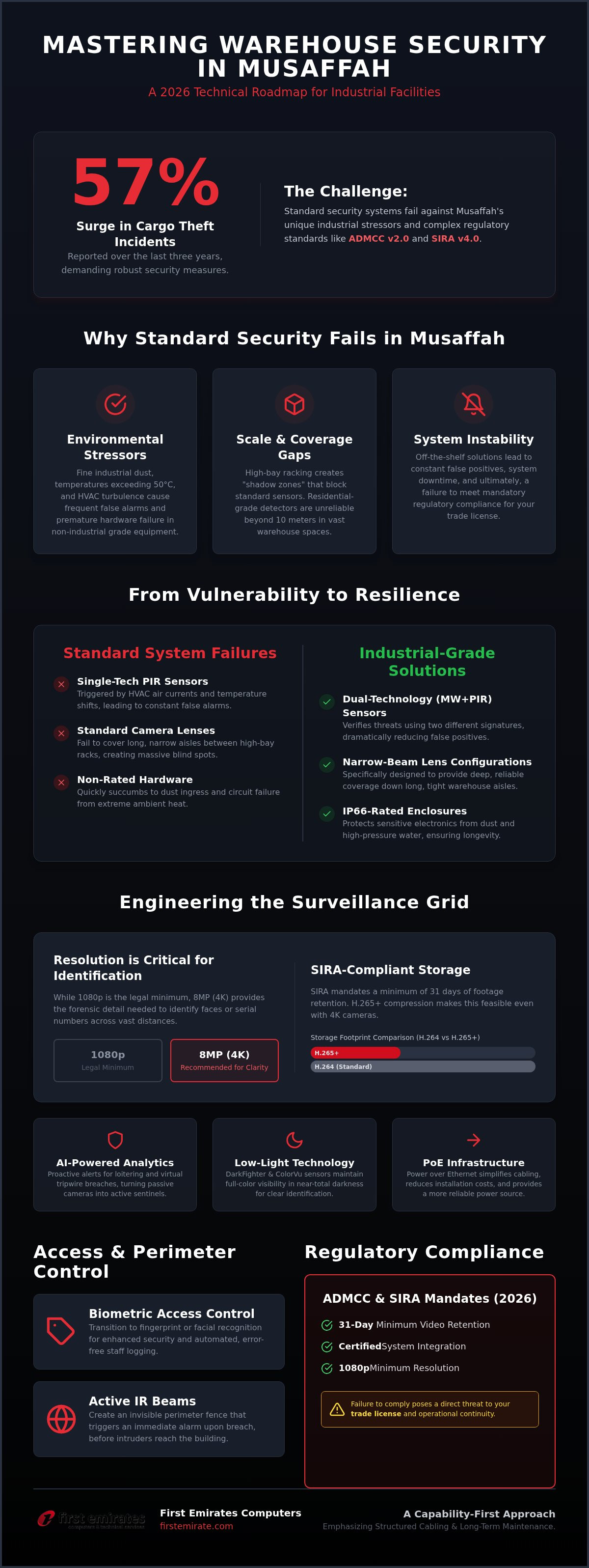
Implementing effective warehouse security systems Musaffah requires a departure from standard commercial logic. Typical off-the-shelf solutions often fail because they lack the technical readiness to handle Musaffah's unique industrial variables. A successful installation isn't just about mounting cameras; it's a systematic integration of high-definition surveillance, biometric access control, and proactive environmental monitoring. This holistic approach aligns with core Physical Security Principles, ensuring that every layer of the facility is protected against both external intrusion and internal inventory shrinkage. Relying on equipment designed for low-traffic retail environments in a high-density logistics hub is a recipe for system failure and regulatory non-compliance.
Scale and Detection Shadow Zones
Standard residential-grade motion sensors typically lose reliability beyond a 10-meter range. In a Musaffah warehouse, where ceilings often exceed 12 meters, these sensors create massive gaps in coverage. High-bay racking systems introduce a "Shadow Effect," where the physical structure of the shelves blocks the line of sight for standard PIR (Passive Infrared) detectors. To counter this, engineers must deploy sensors with specific narrow-beam lens configurations designed for long, tight aisles. We prioritize dual-technology sensors that combine Microwave and PIR detection for the following reasons:
- Verified Detection: Movement must be confirmed by two different physical signatures before triggering an alarm.
- Stability: It significantly reduces false alarms in environments with high airflow or shifting temperatures.
- Extended Reach: Dual-tech units are engineered to maintain high sensitivity across vast, open floor areas.
Environmental Stressors in Musaffah Industrial Zones
Musaffah's climate presents a significant hurdle for sensitive electronics. Standard PIR detectors are often rendered useless by thermal turbulence. This occurs when high-velocity HVAC air currents create rapid temperature shifts that the sensor misinterprets as human movement. Beyond internal air currents, outdoor perimeter cameras must withstand temperatures that frequently exceed 50°C. Without industrial-grade cooling or high-thermal-tolerance components, standard hardware will experience premature circuit failure. Industrial hardening is the process of protecting electronics from Musaffah's ambient dust. Utilizing NEMA-rated or IP66-rated enclosures is a non-negotiable requirement for hardware longevity in Sanaya areas. These protective measures ensure that the warehouse security systems Musaffah operators rely on remain functional despite constant exposure to abrasive sand and extreme heat. By addressing these environmental stressors at the design phase, you avoid the recurring costs of replacing damaged sensors and the operational downtime caused by frequent false positives.
Engineering the Surveillance Grid: High-Definition CCTV and IP Cameras
Designing effective warehouse security systems Musaffah requires a precise balance between high-resolution imagery and storage management. While 1080p is the legal minimum, 8MP (4K) cameras provide the pixel density necessary to identify faces or serial numbers across a vast warehouse floor. This clarity is vital when investigating inventory shrinkage or operational accidents. However, higher resolution demands significant storage bandwidth. To maintain compliance with SIRA regulations, which require a minimum of 31 days of footage, we utilize H.265+ compression. This technology reduces the storage footprint without sacrificing the forensic detail needed for official investigations.
Modern surveillance has moved beyond passive recording to include AI-powered analytics. Features like virtual tripwires and loitering alerts transform the system into a proactive security tool. Instead of reviewing footage after an event, the system notifies security personnel the moment someone enters a restricted zone. In unlit yard spaces, we deploy DarkFighter or ColorVu technology. These sensors maintain full-color visibility in near-total darkness, ensuring that perimeter breaches are captured with enough contrast for positive identification.
IP Camera Installation and Infrastructure
The backbone of any reliable surveillance grid is its physical infrastructure. We utilize Power over Ethernet (PoE) to streamline deployments across massive warehouse layouts. This approach simplifies the installation process by delivering power and data through a single Cat6 cable. For a deeper analysis of the networking requirements, our technical guide on IP camera installation Abu Dhabi outlines the necessary hardware standards. To prevent data loss, we configure NVRs with RAID arrays, ensuring that footage remains secure even in the event of a hard drive failure.
Monitoring Loading Docks and High-Traffic Areas
Loading docks represent the highest-risk zones for logistics theft. We deploy License Plate Recognition (LPR) cameras at entry gates to automatically log every vehicle entering the premises. These cameras must feature High Wide Dynamic Range (WDR) to handle the extreme glare often found at roller shutter doors. If your current hardware produces "washed out" images during peak daylight hours, it's likely time for a CCTV system upgrade Abu Dhabi. Integrating these specialized cameras ensures that your facility maintains a clear record of all cargo movements. For a professional consultation on your next project, our team provides comprehensive CCTV Surveillance Systems design and implementation.
Access Control and Perimeter Security for Musaffah Logistics Hubs
Modern logistics hubs in Musaffah are moving away from traditional physical keys in favor of integrated electronic systems. This shift is essential for maintaining high security standards in a 24/7 industrial environment. By implementing advanced warehouse security systems Musaffah operators can ensure that only authorized personnel enter sensitive zones while creating a permanent digital record of all movements. Managing personnel entry through turnstiles and high-speed gates at staff zones prevents unauthorized tailgating and ensures that the facility's occupancy is always accounted for during emergencies.
Audit trails generated by these systems serve a dual purpose. They provide critical forensic data for incident investigations and streamline administrative tasks like time-and-attendance tracking. When an anomaly occurs, security managers can correlate access logs with surveillance footage to identify individuals involved. This methodical approach to data management aligns with the latest ADMCC standards for industrial monitoring. It transforms access control from a simple locking mechanism into a comprehensive management tool.
Biometric and Face Recognition Solutions
In industrial settings where workers often handle heavy equipment or wear protective gear, face recognition technology offers a significant advantage over fingerprint scanners or RFID cards. It provides a completely hands-free experience, reducing friction at entry points and preventing the common issue of lost or shared access cards. Selecting an experienced access control system company is vital for ensuring that these biometric readers integrate seamlessly with your existing IT infrastructure. These systems also simplify visitor management by allowing contractors and delivery drivers to be issued temporary, time-bound digital credentials that expire automatically after their task is complete.
Perimeter Defense and Alarm Integration
Securing the external boundary of a Musaffah compound requires specialized hardware that can distinguish between a human intruder and environmental noise. While fence-mounted vibration sensors are effective for detecting climbing, long-range Active IR beams are often the preferred choice for the straight compound walls found in the Sanaya industrial zones. Dual-tech perimeter beams utilize both infrared and microwave detection to ensure that blowing debris or sand does not trigger a false alarm. For night shifts, we recommend integrating these beams with silent alarms and remote mobile notifications. This allows security teams to respond to a breach without alerting the intruder, increasing the likelihood of a successful intervention and protecting your assets before a theft occurs.
Navigating Regulatory Compliance: SIRA and ADMCC Standards
Navigating the regulatory framework for warehouse security systems Musaffah requires strict adherence to both local and national standards. In Abu Dhabi, the Monitoring and Control Centre (ADMCC) dictates the technical and operational requirements for surveillance systems. Partnering with an Abu Dhabi police approved CCTV company is a mandatory prerequisite for any commercial facility. These authorized partners ensure that your installation meets the necessary legal thresholds for trade license issuance and renewal. Without this official partnership, your security system cannot be certified for legal operation.
Data retention laws are particularly rigid for industrial sites in the UAE. To satisfy ADMCC mandates, you must maintain at least 30 days of continuous footage, though many industrial clients opt for the 31-day SIRA benchmark to ensure universal compliance across multiple emirates. Official security inspections are methodical and thorough. Inspectors review the system's technical readiness, the physical placement of cameras, and the integrity of the recorded data. Obtaining a SIRA or MCC passing certificate is the final, essential validation of your facility's security posture.
SIRA Approval and Installation Standards
In 2026, cameras must meet specific technical benchmarks to pass a SIRA inspection. This includes a minimum resolution of 1080p and a live streaming frame rate of 25 FPS per camera. A physical Security Logbook must be maintained on-site, documenting all maintenance activities, system faults, and technician visits. Inspectors also examine the physical infrastructure of the system. Structured cabling must follow precise color-coding and labeling protocols to facilitate easy auditing and troubleshooting. Failure to label a single patch panel correctly can result in a failed inspection and costly delays in certification.
ADMCC Compliance for Industrial Zones
Warehouses located in ICAD I and ICAD II face even more stringent oversight under the ADMCC v2.0 manual. These zones often require direct integration with central monitoring stations or an Alarm Receiving Center (ARC). This integration allows for real-time alerts to be transmitted to authorities during a security breach. The consequences of non-compliance are severe and immediate. Fines for adhering to ADMCC regulations incorrectly start at AED 5,000. More importantly, a lack of compliance can lead to the suspension of your trade license, halting your logistics operations entirely. To ensure your facility meets every requirement, we provide specialized Annual Maintenance Contracts that include pre-audit system checks and continuous compliance monitoring.
Implementation and Long-Term Maintenance Strategy
A successful deployment of warehouse security systems Musaffah relies on a "Capability-First" architectural approach. Instead of focusing solely on hardware specifications, we prioritize the underlying infrastructure that supports these devices. Structured cabling serves as the essential backbone of any reliable security network. Without a professionally designed cabling system, even the most advanced 4K cameras will suffer from signal degradation and packet loss. We ensure that every installation is documented and organized to facilitate rapid troubleshooting and future system expansions.
Long-term reliability is not an accidental outcome; it's the result of disciplined maintenance. First Emirates Computers has served the Musaffah industrial sector since 2011, providing the technical readiness required for complex ELV projects. We recognize that a security system is only effective if it remains operational 24/7. This level of uptime requires a proactive partnership that goes beyond the initial installation phase. By integrating surveillance, access control, and network infrastructure into a single managed ecosystem, we provide business owners with a stable and scalable security posture.
ELV and Structured Cabling Integration
In large-scale warehouse environments, standard copper cabling often reaches its distance limitations. We utilize fiber optic backbones to link remote camera clusters to the central server room, ensuring zero latency for high-bandwidth 8MP video streams. Organized server racks and dedicated UPS (Uninterruptible Power Supply) backups are critical components of this hub. These systems protect your security data during power fluctuations and ensure the system remains online during outages. Our designs focus on future-proofing, allowing your infrastructure to support 2026 technology upgrades without requiring a complete recabling of the facility.
The Role of Annual Maintenance Contracts (AMC)
Musaffah's industrial environment is notoriously harsh on sensitive electronics. Fine dust ingress can quickly coat camera lenses and clog the cooling fans of NVRs, leading to blurred footage and hardware overheating. A comprehensive IT AMC services Abu Dhabi plan is essential for mitigating these risks. Our preventative maintenance schedules include regular lens cleaning, sensor recalibration, and critical firmware updates to patch security vulnerabilities. In a high-stakes logistics environment, guaranteed response times are vital. We provide 2-hour on-site support for Musaffah businesses to ensure that any system faults are addressed before they impact your facility's security. Secure your warehouse with First Emirates Computers and benefit from a methodical approach to industrial protection.
Securing Your Industrial Assets in 2026
Protecting a large-scale facility in Musaffah requires a shift from basic surveillance to a comprehensive ELV architectural approach. This guide has detailed how high-definition IP cameras, biometric access control, and structured cabling form a unified defense against inventory loss and regulatory risks. Maintaining warehouse security systems Musaffah operators can trust involves more than just hardware; it requires strict adherence to SIRA and ADMCC standards to ensure business continuity and license compliance.
First Emirates Computers has provided methodical ELV project execution and SIRA-compliant solutions since 2011. It's our deep understanding of the local industrial landscape that ensures your security infrastructure remains resilient against environmental dust and extreme heat. By combining technical proficiency with dedicated AMC support and rapid on-site response, we provide the stability your logistics operations demand. Take the first step toward a fully integrated security posture by contacting our team for a detailed assessment of your facility.
Request a Professional Warehouse Security Survey in Musaffah
Frequently Asked Questions
What are the mandatory CCTV requirements for warehouses in Musaffah?
Mandatory requirements include a minimum camera resolution of 1080p (Full HD) and a frame rate of at least 20 FPS. Systems must be installed by an approved provider and utilize UAE-channel hardware from authorized brands like Hikvision, UNV, or Dahua. These standards ensure your warehouse security systems Musaffah remain compliant with local monitoring center regulations for trade license renewal.
How do I prevent false alarms in a large industrial warehouse?
Deploying dual-technology sensors that combine Passive Infrared (PIR) and Microwave detection is the most effective method. These sensors require two different physical triggers before an alarm is raised, which filters out movements caused by HVAC air currents or shifting temperatures. AI-based video analytics can also be configured to distinguish between human movement and blowing debris or small animals.
Can I integrate my existing access control with a new CCTV system?
Integration is possible if both systems utilize open standards like ONVIF or Wiegand interfaces. This allows your security team to link a specific biometric access event directly to a corresponding video clip for immediate verification. We recommend a methodical review of your existing ELV infrastructure to ensure the software platforms are compatible before you proceed with a full system upgrade.
What is the difference between SIRA and ADMCC approval?
SIRA (Security Industry Regulatory Agency) is the Dubai-based authority that sets rigorous standards often adopted as a benchmark across the UAE. ADMCC (Abu Dhabi Monitoring & Control Centre) is the specific regulatory body for the Abu Dhabi emirate, including Musaffah. While their technical requirements for resolution and storage are similar, the permit processes and inspection portals remain distinct for each emirate.
How often should warehouse security systems be maintained in Abu Dhabi?
You should schedule maintenance at least four times per year under a formal Annual Maintenance Contract. Regular quarterly checks are necessary to clean lenses of industrial dust and verify that recording drives are functioning correctly. In the harsh Sanaya climate, neglecting these visits often leads to premature hardware failure and potential fines during official police inspections.
What is the best type of camera for a high-bay racking environment?
High-resolution IP cameras equipped with varifocal lenses are ideal for high-bay environments. These allow technicians to adjust the focal length to cover long, narrow aisles without losing forensic detail at a distance. For areas with extreme lighting contrasts, such as loading docks, cameras must feature Wide Dynamic Range (WDR) to prevent images from being washed out by sunlight.
Is face recognition better than RFID for warehouse staff?
Face recognition is superior for industrial environments because it provides a hands-free experience for workers carrying cargo or equipment. It eliminates the operational risk of lost RFID cards and prevents unauthorized card sharing among staff. While it requires a more robust network backbone, the long-term gains in security and audit accuracy are significant for large logistics hubs.
How long must warehouse security footage be stored in Abu Dhabi?
Video recordings must be kept for a minimum of 30 days to meet ADMCC v2.0 standards. Some high-security facilities or specific commercial activities may require 90 days, but the standard for most warehouses in Musaffah remains one month. It's vital to calculate your storage capacity correctly to ensure that the oldest footage isn't overwritten before this mandatory period ends.


