

Did you know that property owners in the UAE can reduce their energy consumption by up to 43% simply by unifying two of their most critical building systems? With the May 30, 2026, deadline for federal climate compliance now in effect, managing a building's environmental footprint is no longer a matter of preference; it's a core operational requirement. Many facility managers struggle with fragmented setups where smart lighting and climate control operate in silos, leading to inefficient cooling cycles and high maintenance overhead.
You're likely aware of the challenges posed by rising utility bills and the technical complexity of systems that don't communicate. This professional guide demonstrates how integrating these technologies into a single, structured ELV infrastructure can lower operational costs and simplify your management workflow while ensuring your property meets the latest Dubai building safety standards. We'll examine the technical architecture of centralized environmental systems and the systematic maintenance protocols required to sustain long-term reliability in the UAE's demanding climate.
Key Takeaways
- Understand why transitioning from standalone devices to unified ELV ecosystems is essential for achieving professional-grade automation and system reliability.
- Learn how integrated smart lighting and climate control utilizes wired backbones like KNX and BACnet to outperform standard wireless solutions in large-scale UAE properties.
- Identify the specific sensor types, including CO2 and occupancy monitors, required to build an autonomous, human-centric environment that adapts to real-time conditions.
- Discover the critical role of structured cabling and comprehensive ELV blueprints in establishing a stable "nervous system" for your building’s data flow.
- Explore how systematic Annual Maintenance Contracts (AMC) protect sensitive hardware from the UAE’s environmental challenges, such as extreme heat and dust ingress.
The Evolution of Smart Lighting and Climate Control in 2026
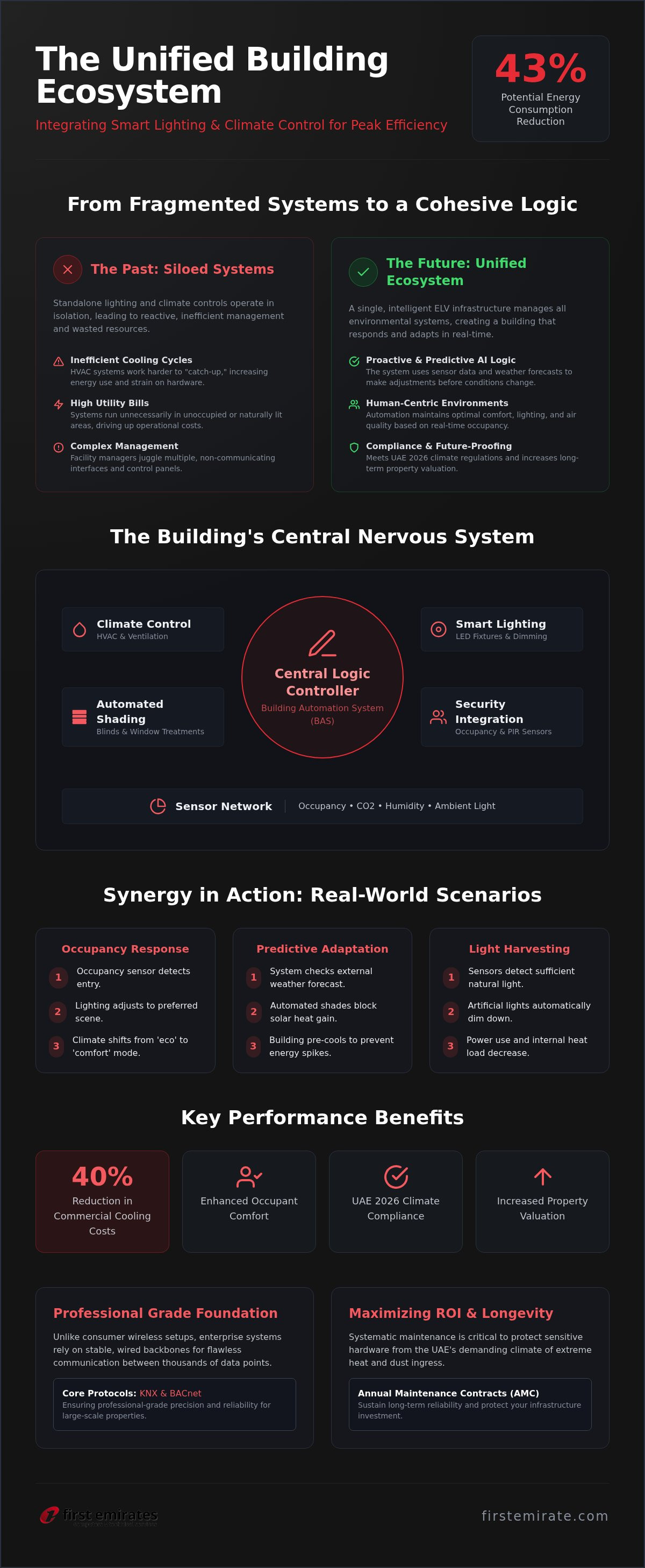
In 2026, the definition of a high-performance property has fundamentally changed. It's no longer sufficient to manage AC and illumination as separate utilities. True smart lighting and climate control integration represents the convergence of these two pillars into a single, cohesive logic controller. This evolution moves the industry away from fragmented, consumer-grade gadgets toward professional-grade ELV (Extra Low Voltage) ecosystems that prioritize stability and long-term performance. By centralizing these functions, property managers can move beyond basic scheduling to a system that understands the building's immediate needs.
Today's systems utilize predictive AI to cross-reference real-time occupancy data with external UAE weather patterns. If a heatwave is forecast in Abu Dhabi, the system proactively adjusts thermal set-points and manages window treatments before the interior temperature rises. This prevents the "catch-up" cooling cycles that typically waste energy and strain HVAC hardware. This level of technical readiness ensures that buildings remain compliant with the latest federal climate legislation while providing a superior environment for occupants.
From Standalone Devices to Unified Ecosystems
The transition to professional Building Automation Systems (BAS) marks a departure from the "Smart Home" era of the early 2020s. Modern enterprise automation relies on a centralized brain that manages thousands of data points simultaneously. When lighting and HVAC communicate, the building operates as a single entity. For instance, occupancy sensors don't just trigger lights; they signal the climate system to transition from "eco-mode" to "comfort-mode" before an occupant reaches their desk. Centralized controllers eliminate the latency and system conflicts often found in DIY setups, ensuring that the hardware responds with professional-grade precision and reliability.
Driving Energy Efficiency in the UAE Climate
The UAE's environment presents a unique "cooling challenge" that requires more than just powerful compressors. Integrated smart lighting and climate control systems coordinate automated shading with AC output to block solar heat gain before it enters the space. By utilizing natural light harvesting, sensors detect when the intense Abu Dhabi sun provides sufficient illumination, automatically dimming artificial lights to save power and reduce internal heat load. Industry data suggests that this level of coordination can achieve up to a 40% reduction in commercial building cooling costs. This isn't just a sustainability goal; it's a calculated financial strategy to maximize ROI and increase asset value.
- Enhanced occupant comfort through stable thermal and visual environments.
- Direct reduction in operational overhead via energy-efficient logic.
- Compliance with 2026 UAE federal climate regulations and safety standards.
- Increased property valuation through future-proofed technical infrastructure.
The Technical Synergy: Sensors, AI, and Control Logic
The operational success of smart lighting and climate control depends entirely on the precision of the data harvested from the environment. Modern systems no longer rely on simple timers. Instead, they utilize a sophisticated network of sensors that monitor occupancy, humidity, CO2 levels, and ambient light in real time. This data feeds into a central logic controller that balances comfort with energy conservation. By integrating these systems with existing security infrastructure, property managers can repurpose PIR sensors from CCTV or access control systems to trigger specific lighting scenes or air conditioning adjustments when a room is entered. This cross-system communication ensures that no energy is wasted on unoccupied spaces.
AI-enhanced logic represents the next step in this technical evolution. These systems learn occupant preferences over time, identifying patterns in how specific zones are used throughout the day. By analyzing historical data, the controller can make predictive adjustments before any discomfort occurs. For instance, if a conference room typically reaches capacity at 10:00 AM, the system can pre-cool the space and adjust the light temperature to improve focus. Research into Smart Technology for Energy Savings indicates that these autonomous adjustments are key to maintaining peak efficiency without manual intervention. If you're planning a new facility, a professional ELV project consultation can help define these logic requirements early in the design phase.
Critical Sensors for Climate and Light Management
True thermal comfort involves more than just monitoring temperature. Multi-sensor arrays now measure air velocity and humidity to calculate the "perceived" temperature, allowing the HVAC system to adjust more accurately. CO2 monitoring has also become a standard requirement for indoor air quality, triggering fresh air intake only when necessary. On the illumination side, intelligent light engines respond to real-time lux levels. These engines dim or brighten artificial lights in smooth, imperceptible increments to maintain a consistent brightness level as natural daylight shifts throughout the afternoon.
Wired vs. Wireless Infrastructure
While consumer-grade wireless products are popular for small retrofits, professional environments require the stability of a wired backbone. In the UAE, the prevalence of high-density concrete and steel in construction can significantly degrade Zigbee or Wi-Fi signals, leading to system latency or dropped connections. Hardwired ELV standards like KNX and BACnet provide a "nervous system" that's immune to such interference. Establishing this infrastructure requires expert structured cabling services UAE to ensure data flows reliably between every sensor and controller. This methodical approach to cabling ensures that the system remains functional for decades, avoiding the reliability issues common with fragmented wireless setups.
- KNX/BACnet: Industry-standard wired protocols offering maximum reliability and interoperability.
- Wi-Fi/Zigbee: Suitable for minor additions but prone to signal interference in large villas or offices.
- Structured Cabling: The physical foundation required to support high-bandwidth automation data.
- Redundancy: Wired systems allow for fail-safes that keep core functions running even if a single node fails.
Selecting the Right System for UAE Properties
Choosing the correct infrastructure for a UAE property requires a methodical evaluation of three primary factors: scalability, interoperability, and the availability of local technical support. In the context of Abu Dhabi’s rapid development, a system that cannot expand alongside your facility is a long-term liability. Interoperability is equally critical; your smart lighting and climate control must communicate seamlessly with existing building management systems to avoid the fragmentation discussed in previous sections. For older structures in Abu Dhabi, retrofitting presents unique challenges, particularly regarding thick masonry walls that impede wireless signals. Professional installers often overcome this by integrating hybrid ELV solutions that utilize existing conduits for new control wiring.
Budgeting for these systems should focus on the Total Cost of Ownership (TCO) rather than just the initial hardware purchase. While professional-grade controllers and sensors involve a higher upfront investment, the long-term savings from reduced energy consumption and lower maintenance costs provide a clear ROI. A well-designed system minimizes wear on HVAC compressors and lighting ballasts by preventing unnecessary operation, effectively extending the lifespan of your building's core assets. This approach ensures that the technical infrastructure remains a supportive presence rather than a source of recurring technical debt.
Residential Automation: Luxury and Comfort
High-end residential projects in the UAE prioritize occupant experience and ease of use. For luxury villas, the ability to create preset "scenes" for various times of day ensures the environment remains comfortable without manual adjustment. Property owners who travel frequently benefit from remote management interfaces that allow them to monitor their home’s status from anywhere in the world. Integrating an intercom system installation UAE with your lighting and climate controls provides a unified interface for security and environmental management, simplifying the user experience and enhancing overall property security.
Commercial Automation: Efficiency and Compliance
Commercial installations focus heavily on operational efficiency and regulatory compliance. Large-scale office blocks and warehouses face significant HVAC loads that require precise management to remain cost-effective. These systems must align with UAE green building standards, such as the Al Sa'fat rating system in Dubai or similar mandates in Abu Dhabi. Centralized dashboards allow facility managers to monitor energy usage across multiple floors or sites in real-time. This visibility is essential for identifying anomalies and ensuring the building operates within its designed efficiency parameters while meeting federal climate reporting requirements.
- Scalability: The ability to add new zones or devices without replacing the central controller.
- Local Support: Access to specialized technicians who understand the UAE's specific environmental challenges.
- Protocol Standards: Preference for open standards that allow different brands to work together.
- Compliance: Alignment with local building safety laws and energy efficiency mandates.
Professional Installation: The Role of ELV and Cabling
The physical installation of an integrated system is the most critical phase of any technical project. It begins with the creation of a comprehensive ELV (Extra Low Voltage) blueprint, which serves as the master architectural document for all automation. This phase defines how smart lighting and climate control will interact with other essential services, such as fire alarms and security. For example, by linking data from a professional access control system company, the building can trigger specific climate presets the moment an authorized employee enters a secure zone. This level of synchronization ensures that the environment is ready for use without manual intervention or energy waste.
Testing and commissioning follow the physical installation to validate that all energy-saving algorithms function as intended. This process involves rigorous stress-testing of user interfaces and sensor responses under various load conditions. A methodical approach to commissioning ensures that the theoretical energy savings discussed in earlier sections translate into real-world utility reductions. If you're ready to begin your infrastructure upgrade, you can request a professional ELV project consultation to evaluate your site requirements.
Why Structured Cabling is Non-Negotiable
Relying on basic electrical wiring for data-heavy automation is a common mistake that leads to system instability. Structured cabling acts as the "nervous system" of the building, ensuring that high-speed data flows between sensors and controllers without interruption. To future-proof a property, it's essential that structured cabling companies in Abu Dhabi utilize Cat6 or Fiber Optic standards. These materials provide the bandwidth necessary for 2026 automation requirements and significantly reduce electromagnetic interference from high-voltage power lines. This physical layer stability is what separates professional-grade automation from unreliable consumer setups.
The ELV Project Lifecycle
A disciplined project lifecycle ensures that every technical requirement is met from inception to handover. This process includes several distinct phases:
- Requirement Gathering: A detailed site survey to identify local environmental factors and architectural constraints.
- Hardware Procurement: Selecting industry-standard or SIRA-compliant components that offer long-term durability.
- Technical Installation: Executing the cabling and hardware mounting according to the ELV blueprint.
- Handover and Training: Providing property staff with the knowledge needed to manage the centralized dashboard effectively.
By following this structured approach, property owners can ensure that their smart lighting and climate control systems are installed with the precision required for long-term operational success. This methodical delivery ensures that the technical readiness of the property is maintained from the first day of operation.
Maximising ROI with Maintenance and Support
The longevity of your investment depends on systematic oversight. While the initial installation sets the stage for efficiency, the UAE's environmental conditions demand a rigorous maintenance schedule to prevent performance degradation. High levels of airborne dust can settle on sensitive optical sensors, while extreme heat puts constant stress on control logic processors. Establishing an Annual Maintenance Contract (AMC) ensures that your smart lighting and climate control infrastructure continues to operate at peak performance, protecting the energy savings targets established during the design phase. Without this methodical upkeep, even the most advanced systems can lose their calibration, leading to increased operational costs over time.
Professional IT AMC services Abu Dhabi provide a layer of remote monitoring that detects hardware anomalies before they impact occupant comfort. This proactive approach allows technicians to identify failing components or network bottlenecks without needing an on-site visit for every minor adjustment. It's a methodical way to ensure business continuity and maintain the professional-grade reliability required for corporate environments. By catching issues early, property managers avoid the high costs associated with emergency repairs and system downtime.
The Importance of Preventive Maintenance
Accuracy is the foundation of automation. Over time, CO2 and temperature sensors may experience "drift," leading to incorrect readings that force the HVAC system to work harder than necessary. Regular calibration is essential to maintain the system's environmental intelligence. Additionally, firmware updates are required to patch security vulnerabilities in IoT-connected devices and improve control logic. A physical inspection of structured cabling and server room racks ensures that the nervous system of the building remains organized and free from physical wear or heat-induced damage. This preventive approach is far more cost-effective than reactive troubleshooting.
Choosing a Local Expert in Abu Dhabi
Selecting a partner with deep roots in the local infrastructure is vital for long-term stability. First Emirates Computers has provided expert ELV project implementation since 2011, offering the technical readiness needed to manage complex integrated systems. A local specialist provides the peace of mind that quick on-site support is available for critical climate control failures. By integrating security, IT, and home automation into a single service contract, we provide a unified point of responsibility. This systematic approach simplifies facility management and ensures that every technical task is handled with the precision your property deserves.
- Systematic Oversight: Regularly scheduled inspections of all hardware and software components.
- Methodical Problem-Solving: Identifying root causes of system drift rather than just treating symptoms.
- Technical Readiness: Keeping a local inventory of critical spare parts for immediate replacement.
- Comprehensive Coverage: Managing the synergy between IT infrastructure, security, and environmental controls.
Securing Operational Excellence for Your UAE Property
Establishing a unified environment through smart lighting and climate control is a strategic investment in technical readiness. The transition from fragmented gadgets to a professional ELV ecosystem ensures that your property remains compliant with 2026 federal climate laws while maximizing energy efficiency. Success in these complex projects relies on the physical stability of structured cabling and the precision of AI-driven control logic. By centralizing these functions, you create a building that proactively manages its own footprint and enhances occupant comfort.
Since 2011, First Emirates Computers has served as a steady partner for complex technical projects in Abu Dhabi. We specialize in SIRA-compliant security and comprehensive ELV integration, backed by methodical IT AMC support across the UAE. This expertise ensures that your automated systems remain a supportive presence rather than a source of technical debt. Our methodical approach to system delivery and maintenance provides the peace of mind that your infrastructure is built to last.
Consult with our ELV Experts for your Smart Integration Project to begin your transition toward a more efficient and future-proofed facility. Your property's technical evolution starts with a partner committed to precision and long-term reliability.
Frequently Asked Questions
What are the primary benefits of integrating lighting and climate control?
Integration allows these two critical systems to share a single network of sensors and logic, leading to synchronized environmental management. When smart lighting and climate control work together, the building can automatically adjust thermal settings based on the heat load generated by artificial lights or solar gain from open shades. This unified approach eliminates the inefficiency of fragmented systems that often operate at cross-purposes.
Can smart lighting and climate control really reduce my DEWA or ADDC bills?
Yes, property owners can achieve energy savings of up to 43% by utilizing automated load shedding and natural light harvesting. By ensuring that AC units only cool occupied zones and that lights dim when natural sunlight is sufficient, the system directly lowers monthly consumption. These savings are measurable and provide a clear ROI while helping buildings meet the 2026 UAE federal climate compliance requirements.
Is it possible to install these systems in an older building in Abu Dhabi?
Retrofitting is entirely possible in older structures by utilizing existing conduits for new control wiring or implementing hybrid ELV solutions. Professional installers focus on establishing a stable wired backbone to bypass the signal interference caused by thick masonry and concrete common in Abu Dhabi. This methodical approach ensures that even established properties benefit from modern automation without requiring a full reconstruction.
How does smart climate control improve indoor air quality?
Smart systems utilize CO2 and humidity sensors to manage ventilation rates based on real-time occupancy and air pollutant levels. Rather than circulating air on a fixed timer, the system triggers fresh air intake precisely when sensors detect a drop in quality. This ensures a healthy environment for occupants while preventing the energy waste associated with over-ventilating unoccupied spaces.
Do I need a separate app for lighting and AC control?
No, a professionally integrated system consolidates all environmental functions into a single, centralized dashboard. This removes the frustration of managing multiple, disconnected applications that don't communicate with each other. A unified interface provides a "single pane of glass" view, allowing property managers to oversee illumination, temperature, and air quality from one intuitive platform.
What is the role of an ELV contractor in smart home automation?
An ELV contractor designs and installs the extra-low voltage infrastructure that acts as the building's nervous system. They are responsible for the structured cabling, sensor integration, and system commissioning required to make different hardware components work as a cohesive unit. Their expertise ensures that the underlying data network is stable enough to support high-performance automation and security systems.
How much maintenance does an integrated automation system require?
Integrated systems require systematic oversight through an Annual Maintenance Contract (AMC) to ensure continued accuracy and reliability. In the UAE's harsh climate, sensors must be cleaned of dust and recalibrated periodically to prevent "sensor drift." Regular maintenance also includes firmware updates to protect against security vulnerabilities and physical inspections of the server room hardware to prevent heat-related failures.
Can I integrate my existing CCTV system with smart lighting?
Yes, motion data from CCTV surveillance systems can be used to trigger specific lighting scenes and climate presets. This synergy allows the building to respond to movement by illuminating paths or pre-cooling rooms as someone approaches. Using security sensors to drive automation logic reduces the need for redundant hardware and enhances both the safety and efficiency of the property.


