

Treating your surveillance contract as an emergency repair policy is one of the costliest operational mistakes a facility manager can make in the UAE. Under regional enforcement frameworks like Dubai's SIRA and Abu Dhabi's ADMCC, a structured CCTV AMC for commercial buildings serves as an active compliance shield and uptime safeguard, not just a reactive troubleshooting service when hardware fails.
You likely know the frustration of discovering an unrecorded blind spot only after a security incident occurs, or the stress of facing severe administrative fines when degraded hardware fails a municipal audit. Unclear service agreements and delayed technician response times only compound these operational risks, leaving your premises vulnerable.
In this guide, you'll discover how a structured CCTV AMC protects commercial facilities, guarantees statutory regulatory compliance, and eliminates costly surveillance downtime. We'll examine mandatory UAE quarterly inspection standards, legal retention benchmarks, and the essential engineering protocols required to ensure reliable, uninterrupted coverage across your property.
Key Takeaways
- Understand how a proactive CCTV AMC for commercial buildings prevents silent hardware failures and maintains continuous perimeter visibility.
- Compare comprehensive and non-comprehensive service agreements to choose the right balance between predictable operating budgets and component risk.
- Review statutory UAE surveillance mandates to ensure full alignment with regulatory audit schedules and storage retention requirements.
- Implement a systematic engineering checklist covering optical focus, thermal protection, storage verification, and power supply readiness.
- Identify the essential qualifications, service level commitments, and ELV capabilities required when choosing a long-term maintenance provider.
Understanding CCTV AMC: Core Purpose and Business Value
Surveillance infrastructure is rarely a set-it-and-forget-it asset. For commercial properties across the UAE, relying on security hardware without routine engineering oversight creates substantial operational risks. A structured CCTV AMC for commercial buildings establishes a disciplined maintenance regime, ensuring continuous video recording, routine hardware diagnostics, and prompt technical support before small faults become critical perimeter failures.
Without scheduled intervention, systems suffer silent breakdowns. Network switches drop packets, storage sectors fail, and camera lenses gather layers of desert dust. These malfunctions often go unnoticed until security personnel attempt to retrieve footage after a break-in, slip-and-fall claim, or property dispute. Routine preventive care extends the operating life of high-definition cameras, network video recorders (NVRs), and server racks, directly protecting your original capital expenditure.
Regular maintenance delivers tangible operational advantages for facility managers:
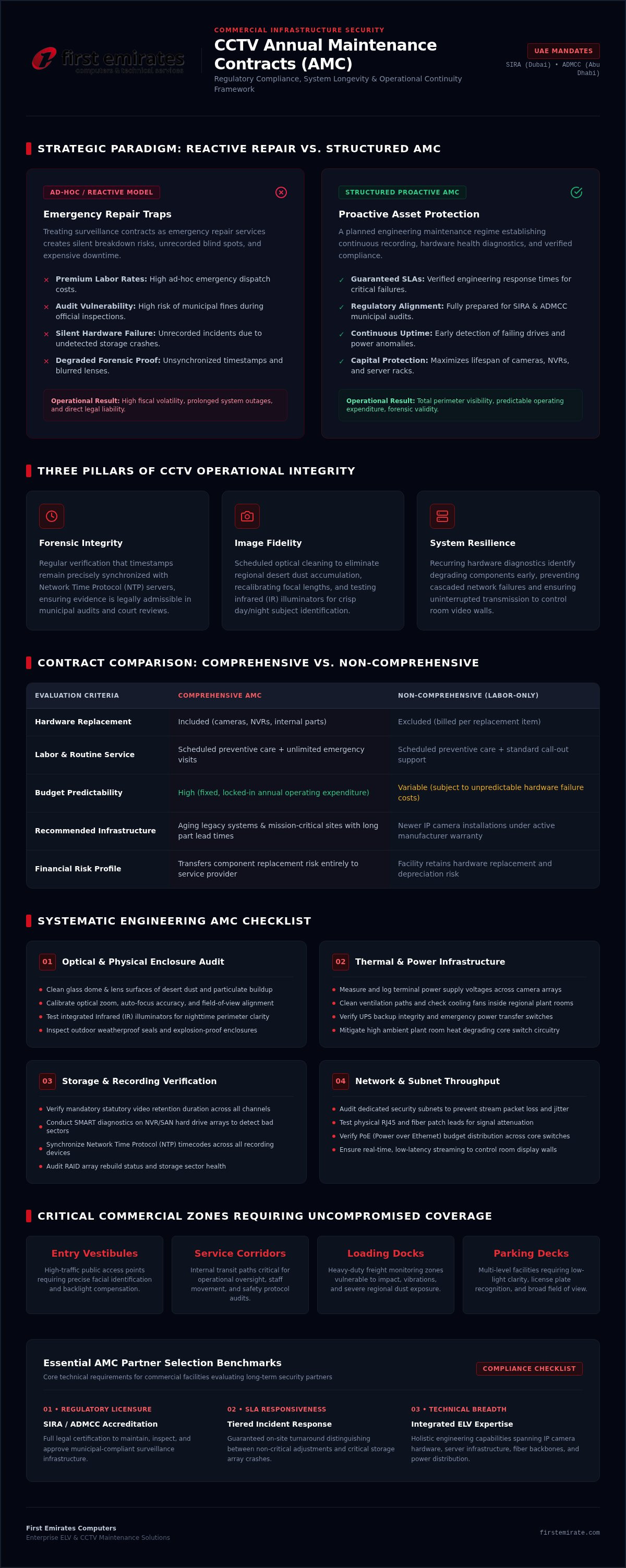
- Forensic Integrity: Routine checks ensure timestamps stay synchronised with Network Time Protocol servers, keeping footage legally admissible in municipal audits and legal reviews.
- Image Fidelity: Technicians continually clean optics, recalibrate focus, and test infrared illuminators to preserve clear identification capabilities day and night.
- System Resilience: Recurring diagnostics identify degrading components early, preventing cascaded failures across interconnected security platforms.
The High Cost of Reactive Security Maintenance
Ad-hoc repairs cost far more than managed care. Relying on emergency service calls forces properties to pay premium labor rates while enduring prolonged system downtime. If a hard drive bank crashes unmonitored, an incident occurring during that window leaves the property fully exposed to liability claims and police scrutiny. A structured contract eliminates unexpected call-out expenses while guaranteeing verified engineering resources on site.
Operational Continuity in High-Traffic Commercial Properties
Commercial facilities, such as corporate towers, retail spaces, and mixed-use developments, face relentless operational demands. High-traffic environments require uncompromised surveillance across entry vestibules, service corridors, loading docks, and multi-level parking decks. Implementing a methodical CCTV AMC for commercial buildings keeps these vital zones protected.
Technicians inspect physical cabling, measure power supply voltages, and clean ventilation paths on core switches to mitigate the intense ambient heat common in regional plant rooms. Routine bandwidth audits across dedicated security subnets verify that high-resolution data streams route efficiently without packet loss, keeping control room video walls active and responsive.
Comprehensive vs. Non-Comprehensive CCTV AMC: Contract Scopes
Selecting the right service model directly impacts your operational budgeting and risk exposure. When establishing a CCTV AMC for commercial buildings, property managers must evaluate whether a labor-only agreement or an all-inclusive hardware contract best matches their building's profile. Deciding between these two paths requires balancing infrastructure age, internal technical resources, and capital risk tolerance.
Every commercial facility carries unique operational demands. To choose the appropriate coverage level, consider these core technical criteria:
- System Age: Modern IP installations under active manufacturer warranty often thrive on labor-only contracts, whereas aging legacy infrastructure benefits from comprehensive part coverage.
- Component Availability: Facilities using specialized equipment, like explosion-proof perimeter cameras or high-capacity storage arrays, face long lead times if replacement units aren't managed proactively.
- Budget Predictability: Comprehensive terms lock down annual spending, insulating finance teams from unpredictable hardware failures.
- Response Service Levels: Both tiers must establish clear service level agreements (SLAs), distinguishing between non-critical camera repositioning and critical storage failures.
Comprehensive Maintenance Agreements Explained
A comprehensive agreement functions as full-coverage operational insurance. It wraps scheduled preventive servicing, unlimited emergency troubleshooting, and replacement hardware into a single annual fee. When an outdoor camera sensor burns out under summer temperatures or a core PoE switch fails, the maintenance team replaces the faulty unit without generating separate equipment procurement orders. This structure provides property directors with steady, predictable balance sheets while cutting down administrative approval delays during emergency outages.
Non-Comprehensive and Preventive-Only Coverage
Non-comprehensive contracts focus strictly on professional engineering labor. The service provider handles all routine quarterly cleanings, optical realignments, firmware updates, and diagnostic health checks. However, if a hard drive crashes or an optical lens degrades, the building operator pays for the new hardware separately. This setup works well for newly commissioned properties where base components carry active original equipment manufacturer warranties.
Clear contractual boundaries prevent disputes. The contract document should define which consumables are covered, such as RJ45 connectors, patch cords, or desiccant packs, and outline lead times for sourcing major components. For property managers auditing their current infrastructure or setting up new agreements, partnering with an experienced provider for an annual maintenance contract ensures your facility's service agreement matches its precise physical and operational requirements.
UAE Regulatory Compliance and Municipal Surveillance Mandates
Surveillance compliance in the UAE is closely monitored and strictly enforced by municipal authorities. Operating a commercial facility in Dubai requires adherence to the Security Industry Regulatory Agency (SIRA), while properties in Abu Dhabi operate under standards established by the Abu Dhabi Monitoring and Control Centre (ADMCC). Maintaining a certified CCTV AMC for commercial buildings is a statutory obligation across these jurisdictions. Failure to satisfy local surveillance mandates puts commercial trade license renewals at risk and exposes building owners to administrative fines ranging from AED 10,000 to AED 500,000 under Dubai Law No. 12 of 2016.
To avoid audit failure during municipal inspections, maintenance contracts must focus on three core compliance areas:
- Inspection Cadence: SIRA regulations enforce a mandatory schedule of at least four quarterly preventive maintenance visits per calendar year by an approved security systems contractor.
- Optical Benchmarks: Field cameras must meet mandated resolution thresholds, such as 4MP clarity across corridors and 8MP (4K) imaging at main building entrances and cashier counters.
- Hardware Durability: External enclosures require minimum IP66 ingress ratings and verified thermal tolerance to operate reliably in ambient heat reaching 50°C.
Statutory Video Retention and Storage Requirements
Surveillance systems must maintain at least 31 consecutive days of uncorrupted footage for general commercial facilities, with extended requirements of 90 to 180 days for financial entities. Storage arrays must include a 20% overhead margin beyond base calculations to prevent premature file overwrites. Quarterly AMC diagnostics review hard drive SMART status to detect bad disk sectors early, confirming continuous recording at 10 to 15 frames per second without frame drops.
Official Compliance Audits and Maintenance Logbooks
Facility managers must present physical or digital logbooks signed by certified technicians during government security inspections. Authorised service engineers audit camera positioning to verify fields of view stay free of structural obstructions. They also test uninterruptible power supply (UPS) batteries under load, ensuring the system can sustain recording operations for 30 to 60 minutes during sudden grid power interruptions.
Step-by-Step CCTV Maintenance Checklist for Facility Managers
A dependable CCTV AMC for commercial buildings requires a structured engineering procedure rather than a casual visual scan. Commercial properties operate in harsh environmental conditions where airborne dust, extreme summer temperatures, and electrical fluctuations constantly challenge delicate electronics. A four-step preventive maintenance checklist guarantees that both edge devices and central recording equipment remain fully functional throughout the year.
Executing these maintenance stages systematically prevents hardware bottlenecks:
- Phase 1: Field Device Servicing: Clean camera glass housings, inspect weather-sealed conduit fittings, and test mechanical pan-tilt-zoom drive assemblies.
- Phase 2: Optical Realignment: Calibrate varifocal lenses, adjust iris apertures, and re-verify signal-to-noise ratios across entryways and vehicle checkpoints.
- Phase 3: Network and Transmission Diagnostics: Audit PoE switch power budgets, log packet drops across security VLANs, and measure structured data throughput.
- Phase 4: Core Storage and Software Hardening: Verify RAID array parity, apply OEM firmware patches, and purge fragmented database indices.
Camera Hardware and Optical Integrity Checks
Technicians remove fine sand particles from external glass domes using anti-static, non-abrasive optical solutions. Heavy dust buildup diffuses infrared illumination, creating blurred night vision footage. Service teams test auto-focus tracking, replace worn desiccant pouches inside external housings, and tighten mounting hardware on high-mast cameras to prevent wind-induced vibration drift.
Server, Storage, and VMS Software Optimization
Storage integrity forms the core of regulatory compliance. Engineers check hard drive controller logs, temperature thresholds, and SMART counters across NVR arrays to flag bad sectors before total drive failure. Video Management Software (VMS) databases receive targeted indexing cleanups to prevent query slowdowns during incident investigations. System engineers also apply manufacturer-certified security patches, closing open communication ports to harden edge cameras against network vulnerabilities.
Infrastructure, Power, and Cabling Verification
Surveillance hardware depends on stable network delivery and clean power. Technicians test uninterruptible power supply batteries under load to confirm emergency cutover runtimes. They also scan horizontal copper links for physical degradation, attenuation, and ground faults. If your property needs comprehensive horizontal link testing, consult verified structured cabling companies in Abu Dhabi to validate enterprise data transmission lines. To protect your property with a structured engineering plan, schedule a comprehensive CCTV system audit with our certified technical team today.
Selecting the Right CCTV AMC Partner in the UAE
Selecting an engineering partner requires looking past baseline price quotations. A resilient CCTV AMC for commercial buildings demands deep cross-discipline proficiency across low-current systems, verified regulatory standing, and documented field responsiveness. Commercial facilities are complex ecosystems; your service provider must possess both the field personnel and technical bench strength to manage physical hardware alongside network routing.
Key criteria procurement teams should verify during contractor evaluations include:
- Multi-System Competency: Demonstrated ability to troubleshoot integrated ELV networks, bridging surveillance, access controllers, and physical server infrastructure.
- Transparent Logging: Implementation of digital ticketing platforms that provide real-time status updates and auditable preventive maintenance reports for compliance officers.
- Hardware Buffer Inventory: Guaranteed availability of operational loaner units to restore visual monitoring during off-site equipment repairs.
Crucial Service Level Agreement (SLA) Metrics
Contract performance hinges on explicit SLA language. Agreements should establish tiered response windows: immediate acknowledgment with rapid emergency dispatch for total recorder failures, contrasted with scheduled turnarounds for non-critical single-camera adjustments. Clear contracts define component replacement timelines and loaner unit provisioning, preventing facility security directors from waiting weeks for back-ordered parts during active outages.
The Advantage of Unified ELV and IT Maintenance
Surveillance does not operate in isolation. Modern IP camera networks share structured cabling, core switches, and power distribution with adjacent security platforms. Consolidating vendor management by selecting an experienced access control system company allows properties to synchronize door event telemetry with video recording logs without vendor friction.
Similarly, aligning low-current hardware with dedicated IT AMC services Abu Dhabi guarantees full stack continuity across enterprise endpoints, switches, and backup storage arrays. Established in the UAE since 2011, First Emirates Computers delivers this unified engineering methodology, supporting mission-critical security hardware through dependable, structured service contracts tailored to regional facility standards.
Ensure Complete Surveillance Reliability and Compliance
Moving from emergency troubleshooting to an organized engineering strategy is essential for protecting your property. A dependable CCTV AMC for commercial buildings does more than resolve unexpected hardware faults; it safeguards statutory video retention, satisfies mandatory municipal audit schedules, and provides total visibility across your operational budget.
Reliable perimeter defense requires an experienced engineering partner with proven multi-system capability. Serving UAE enterprises since 2011, First Emirates Computers combines low-current expertise, structured network management, and dedicated maintenance teams under one roof to maintain peak security uptime. When your physical infrastructure is methodically maintained, your facility remains protected against emerging operational risks and costly compliance interruptions. Take the next step to protect your property and staff: secure your commercial facility with a First Emirates Computers CCTV AMC and ensure enduring stability across your security environment.
Frequently Asked Questions
What is typically included in a commercial CCTV AMC in the UAE?
A standard CCTV AMC for commercial buildings includes scheduled quarterly preventive site inspections, optical lens cleaning, camera realignments, and full storage diagnostics. Providers deliver priority troubleshooting labor, firmware updates, network throughput testing, and backup battery load checks. Technicians also document all system activities in formal maintenance logs, ensuring surveillance feeds remain clear, uncorrupted, and compliant with statutory UAE security requirements.
How often should commercial building CCTV systems undergo scheduled maintenance?
Commercial systems in the UAE must undergo preventive maintenance at least once every quarter, totaling four scheduled visits per year. This frequency aligns with municipal mandates from authorities like Dubai's SIRA and Abu Dhabi's ADMCC. Regular quarterly servicing counteracts rapid desert dust buildup on external lenses, prevents overheating in plant rooms during summer peaks, and verifies continuous hard drive write health before silent sector errors cause critical recording failures.
What is the standard SLA response time for critical CCTV failures under an AMC?
Standard service level agreements define response windows based on incident severity. Critical failures, such as total NVR outage or multiple dead cameras along primary building perimeters, typically require technician mobilization within two to four hours. Non-critical issues, such as single internal camera repositioning or minor cable re-terminations, generally follow a scheduled next-business-day response window. Facility managers should ensure these precise timelines are explicitly written into the maintenance contract.
Is a CCTV AMC mandatory for commercial properties under UAE security regulations?
Yes, holding an active maintenance agreement with an approved security contractor is legally required for commercial properties across the UAE. Municipal regulators like SIRA in Dubai mandate continuous contract coverage to maintain valid operating certifications. Without a compliant contract and signed inspection logs, building owners face substantial administrative fines, failed annual security audits, and potential freezes on municipal trade license renewals from local licensing departments.
What is the main difference between comprehensive and non-comprehensive CCTV contracts?
The primary distinction lies in hardware replacement coverage. A comprehensive CCTV AMC for commercial buildings bundles regular engineering labor, quarterly inspections, and the replacement cost of failed parts such as hard drives, cameras, and network switches into one flat fee. A non-comprehensive contract covers only technician labor and scheduled visits; the property owner pays separately for any replacement components or structural hardware required over the contract year.
Can an existing CCTV system installed by another contractor be covered under a new AMC?
Yes, certified providers routinely take over maintenance for existing installations completed by third-party integrators. Before finalizing the agreement, the engineering team conducts a comprehensive site audit to evaluate cable integrity, recorder capacity, and camera operational health. Any pre-existing equipment faults or compliance shortfalls must be rectified or documented as initial exclusions before the provider assumes formal maintenance responsibility under the contract terms.
How does an annual maintenance contract help pass municipal security audits?
An active maintenance contract ensures all hardware meets statutory technical benchmarks before government inspectors arrive. Technicians verify continuous 31-day video storage retention, check frame rates, ensure accurate time synchronisation across all feeds, and document every quarterly inspection in an official compliance logbook. Presenting verified service records demonstrates full operational adherence, enabling commercial properties to pass regulatory audits smoothly and renew commercial facility permits without administrative delays.


