

A commercial security system quote in Abu Dhabi depends on the premises layout, camera coverage, recording needs, cabling, and any access control requirements. Remote viewing can be included in a commercial CCTV plan, based on how your team needs to monitor the site. Commercial CCTV installations in Abu Dhabi Emirate, including Al Ain, require ADMCC approval.
A clear quote explains the proposed system and the work it covers, not just the equipment. The price depends on the project and is provided after a quote request. Camera placement, system capacity, and installation scope all shape the specification.
This article covers the main factors behind a quote, Abu Dhabi’s CCTV approval requirement, and practical considerations for remote viewing and video storage. It also explains how camera coverage and access control affect the system planned for your premises.
Key Takeaways
- Use the facility type and layout to scope camera coverage: typical ranges vary from four to eight cameras for a small retail unit to sixteen to thirty-two for a warehouse.
- Account for Abu Dhabi’s approval requirement and plan coverage around the building layout, risk, lighting, and areas that need protection.
- Remote viewing depends on suitable camera placement and system configuration; motion detection and night vision can support monitoring in different conditions.
- Set recording and storage requirements together: resolution, frame rate, compression, and retention period all affect capacity.
- Include cabling and any access-control or alarm integration in the installation scope so the quote reflects the complete system.
What does a commercial CCTV system require in Abu Dhabi?
Commercial CCTV requirements depend on the premises, the areas to protect, and the camera coverage needed. Typical camera counts can help start the discussion, but the building layout determines the final design.
Coverage Across Commercial Premises
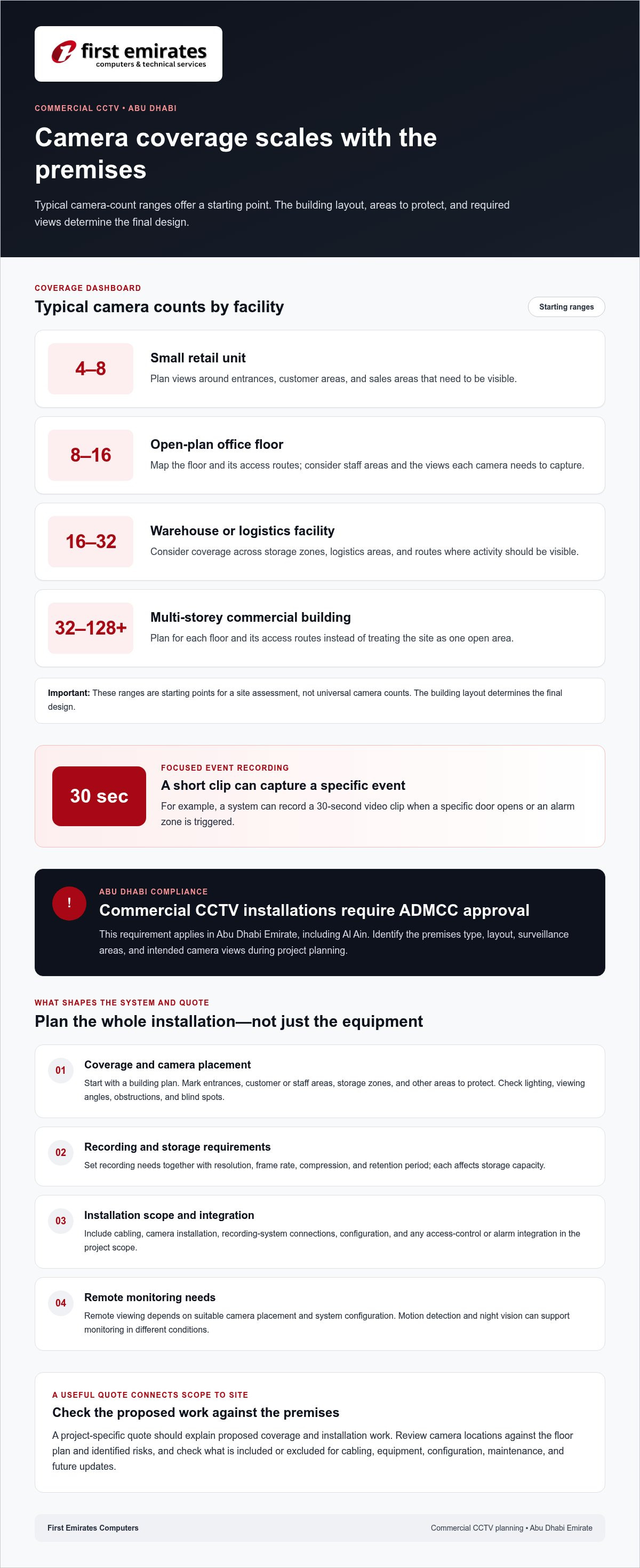
A small Abu Dhabi retail unit typically requires four to eight CCTV cameras, while an open-plan office floor typically requires eight to sixteen. A warehouse or logistics facility typically requires sixteen to thirty-two cameras. A multi-storey commercial building may need thirty-two to one hundred and twenty-eight or more.
These ranges are starting points for a site assessment, not universal camera counts. Consider entrances, customer or staff areas, storage zones, and routes where activity needs to be visible. Plan camera positions around the required views and check for blind spots throughout the premises.
Commercial CCTV can deter crime and help protect against theft. Recorded footage can also provide legal support as evidence. For example, a system can record a 30-second video clip when a specific door opens or an alarm zone is triggered, giving a focused record of an event.
Commercial CCTV Design and Installation
Commercial CCTV design turns the coverage plan into camera locations, recording requirements, and installation work. Start with a building plan and mark the areas that need surveillance. Then assess lighting, viewing angles, and obstructions, which affect what each camera can capture.
For a multi-storey building, plan for each floor and its access routes rather than treating the site as one open area. A warehouse may need coverage across storage and logistics areas, while a retail space may need distinct views of entrances and sales areas. These examples guide the design, not a fixed camera specification.
Installation involves fitting the cameras and connecting them to the recording system. A clear design links each camera position to the area it is intended to cover, helping the business assess whether the proposal meets its security priorities before work begins.
Quote Factors and Providers
A commercial security system quote in Abu Dhabi is shaped by the building layout, risk assessment, required camera views, applicable regulations, lighting, and areas to protect. Camera count and system requirements follow from these project conditions. The price depends on the project and is provided after a quote request, with coverage and installation scope shaping the specification.
Companies that design and install commercial CCTV in Abu Dhabi provide project-specific quotes. A useful quote sets out the proposed coverage and installation scope, showing how each camera contributes to the plan. Compare that coverage with your site priorities, such as entrances, work areas, and locations where recorded footage may be useful.
For a commercial building, review the proposed camera locations against the floor plan and risks identified during planning. This practical comparison can reveal coverage gaps or unnecessary overlap before installation. It also keeps the quote tied to the premises’ security needs instead of a generic camera count.
Is your CCTV installation compliant with Abu Dhabi regulations?
Commercial CCTV installations in Abu Dhabi Emirate, including Al Ain, require ADMCC approval. Start compliance planning with the building’s use, layout, and surveillance objectives, rather than relying on camera count alone.
For commercial premises, map the areas to monitor and document the intended camera views before installation. A retail unit, office, and warehouse have different access routes and operational risks. These details inform the design and help define the installation scope for an approval-focused project.
Residential surveillance is distinct from commercial CCTV. Homes and businesses differ in how people use the space and where cameras are directed. In the project brief, state whether the premises are commercial or residential, identify the areas involved, and describe the purpose of surveillance. The commercial ADMCC approval requirement applies to commercial installations.
A site survey turns these details into a practical installation plan. Record the building layout, lighting, access points, areas requiring coverage, and any existing cabling or security equipment. These observations support a risk assessment and help define camera positions, cabling routes, and recording needs. The written quote should relate the proposed equipment and work to this scope.
For an accurate quote, provide the site address, premises type, floor plans or layout details, areas to cover, and information about existing CCTV or access control equipment. Note operational needs, such as monitoring entrances or storage areas, and specify the intended recording requirements. This helps align the written scope with the site.
Before signing a security system contract, compare its installation scope with the quote. Review exclusions for cabling, equipment, configuration, ongoing maintenance, and future updates. Confirm which areas are covered and what work is included, so the scope is clear from the outset. The contract should distinguish installation from continuing support or maintenance arrangements.
A site survey is useful whether or not it is described as free; the written scope remains essential. Review the proposed camera locations and project assumptions against the site’s layout before approving work. For premises planning, CCTV surveillance planning can help frame the coverage requirements and installation discussion.
Can I monitor my CCTV cameras remotely?
Yes. Commercial CCTV systems can let businesses monitor premises remotely when cameras, recording equipment, and network access are configured for that purpose. Live viewing and reviewing recordings are separate tasks, so specify which locations staff need to see and whether they need recorded video. An Abu Dhabi business might monitor an entrance during operating hours and review footage after an incident.
Camera placement determines what remote monitoring can show. Well-planned placement can reduce blind spots and improve coverage, while poorly positioned cameras may leave important areas out of view. Map entrances, internal routes, and work areas, then match each camera’s view to a specific monitoring need. This makes the footage more useful for operational decisions.
Commercial CCTV systems may contain eight to one hundred and twenty-eight or more cameras, depending on the facility. This range reflects different coverage needs, not a standard system size. A retail site may need views of customer areas and entry points, while a larger property may require cameras across multiple sections. Camera count affects how the system is organized and monitored.
Image quality matters when staff need to interpret a scene remotely. HD cameras are recommended for business surveillance, alongside motion detection and night vision. Motion detection can draw attention to activity in a monitored area, while night vision supports viewing in low light. Consider the lighting around each camera and the detail required for its intended view when planning the system.
Remote access also depends on the site network and user permissions. Identify which staff need access, which cameras they should view, and whether they need live feeds, recorded footage, or both. For example, a manager might review a retail entrance remotely while another authorized user handles routine onsite monitoring. Clear access roles keep viewing aligned with operational responsibilities.
Construction projects can use time-lapse cameras to document visible progress over the project period. Unlike continuous surveillance focused on security events, time-lapse recording shows change across a site through a sequence of images. This can help teams review work stages remotely. Position the camera to capture the relevant construction area without obstruction as the site and its infrastructure change.
Before selecting remote monitoring features, give each camera a defined purpose. Consider its viewing angle, lighting conditions, motion detection needs, and whether recordings must be reviewed later. Then confirm how remote users will access the system and which areas each feed covers. This helps match camera quality and system design to the premises’ security and operational requirements.
Remote monitoring and video management software
Video management software organizes live feeds, recordings, and user access in one interface. For an Abu Dhabi business, remote monitoring can let authorized staff view the premises off-site. Define which cameras each user needs, whether they need live or recorded footage, and how long recordings should remain available. These choices shape storage and network requirements.
Storage planning begins with recording quality and schedule. A 4MP camera recording continuously at 25fps with H.265 compression generates approximately 500 GB over 30 days. A 32-camera system using those same settings requires roughly 16 TB of raw storage for 30 days. Motion-based recording can change storage demand, but the recording schedule and retention period still need clear planning.
Compression affects capacity. H.265 or H.265+ can reduce storage consumption by up to around 50 percent compared with H.264, depending on the scene and camera settings. Plan an additional 20 percent storage overhead for file system indexing and resilience. These figures help compare recording options, but the selected resolution, frame rate, activity, and retention period determine the actual configuration.
Cloud storage can support remote video access, while onsite recording keeps footage at the premises. The right arrangement depends on the business’s network infrastructure, recording needs, and access requirements. A branch manager, for example, may need to review footage from another location, while a site team relies on local recording. Specify where footage is stored and how users retrieve it.
Tie AI-powered monitoring and analytics to a defined operational task. A business might use analytics to draw attention to activity in a selected area instead of requiring staff to watch every feed continuously. Identify the event or area of interest, then consider how alerts and video review fit existing procedures. Analytics can support monitoring but do not replace a clear camera plan.
Before selecting software, list the users, camera groups, recording periods, and remote access needs. A sound system design connects each requirement to a practical setting, such as access permissions or retention. During CCTV installation, confirm that the network can handle the chosen video streams and that staff can find relevant recordings without searching through unrelated footage.
Test a sample scenario before finalizing the configuration. Trace how an authorized user would access a camera feed remotely, find a recording, and export the relevant clip. Then compare that workflow with storage needs for the required retention period. This connects software, recording capacity, and monitoring procedures in one operational plan.
Commercial security system installation in Abu Dhabi
Abu Dhabi businesses can combine CCTV with networking, access control, and alarm systems. The right combination depends on the premises, security priorities, and how the systems need to work together.
Commercial System Installation
A commercial installation turns the site plan into a working security system. Document the building layout, existing infrastructure, and areas requiring coverage. Then plan camera locations, cabling routes, recording arrangements, and connections to other systems. For example, an entrance camera and access control can be planned together to provide a clear view of entry activity.
Define the installation scope in writing before work starts. It should describe equipment, placement, cabling, configuration, and how components connect. For a business with several areas, clarify which cameras cover entrances, workspaces, and storage. If a tender specifies certified equipment, include that requirement in the project scope rather than treating the label as a complete design.
Installation should include system testing and handover. Test camera views, recording, access permissions, and any integrated alarm functions. A practical handover explains how authorized staff can view live feeds and retrieve recordings. These steps make the finished system easier to operate and maintain.
Security System Options for Businesses
Security solutions can include CCTV cameras, access control, and alarm systems, with networking connecting components. A tailored design combines options according to the building’s security needs. For example, a business may use CCTV to monitor selected areas and access control to manage entry points.
Integration involves more than installing separate devices in one building. The design should specify which systems connect, what information users need, and how the combined setup will operate. A business can list priorities, such as viewing camera footage alongside entry activity, and use them to define system requirements. Good security planning covers both equipment and daily procedures.
A commercial security system quote in Abu Dhabi should clearly describe the proposed system and installation scope. Compare the listed components with the site’s priorities, including camera coverage, access arrangements, alarm connections, and cabling. The price depends on the project and is provided after a quote request; system selection and installation scope shape the specification.
For a project-specific installation plan, discuss commercial CCTV installation in relation to your premises and security requirements.
First Emirates Computers: CCTV Surveillance Systems
First Emirates Computers plans and implements CCTV Surveillance Systems for Abu Dhabi businesses, based on their premises and security priorities. Turn to the team to translate camera coverage needs into a practical installation scope, or to plan CCTV alongside Biometric Access Control.
Structured Cabling provides the physical connections a security system needs, while an Annual Maintenance Contract supports ongoing system upkeep. These services can fit different project stages: cabling during planning, access control when managing entry is a priority, and maintenance after installation.
Share your site layout, areas to cover, and operational requirements to start planning a suitable system. Contact First Emirates Computers to discuss your commercial CCTV requirements.
Make the Next Step a Clear Project Brief
A commercial security system quote in Abu Dhabi is most useful when it reflects how your premises operate, not just a list of equipment. Before moving ahead, gather the site layout, priority areas, and outcomes your team needs from the system. This gives the project discussion a practical starting point and connects technical choices to day-to-day security requirements.
First Emirates Computers offers CCTV Surveillance Systems, Biometric Access Control, and Structured Cabling. These services can help when planning camera coverage, managing controlled entry, or preparing infrastructure for a connected installation. Discussing the requirements together helps define the intended project scope.
Share your commercial security requirements with the team and take the next step toward a defined project plan. Contact First Emirates Computers to discuss your needs and move forward with clarity.
Frequently Asked Questions
Do you offer cloud-based CCTV storage?
First Emirates Computers offers CCTV Surveillance Systems. Cloud storage is a separate part of the recording setup, so specify whether footage should be stored remotely or onsite. A business with several premises, for example, may want authorized staff to access recordings from different locations. The project specification should state the storage arrangement and access requirements, rather than assume cloud storage is included with every CCTV installation.
What is the average cost of a commercial security system in Abu Dhabi?
There is no single average cost for every Abu Dhabi business. The price depends on the project and is provided after a quote request. Scope varies with the premises layout, coverage needs, recording configuration, cabling, and integration requirements. For a useful estimate, define the areas to protect and whether the project includes access control or other connected systems.
How much do commercial CCTV cameras and installation cost in Abu Dhabi?
Camera and installation costs depend on the project specification, and the price is provided after a quote request. Camera type, quantity, mounting locations, cabling routes, and recording needs all affect the work involved. A site with existing cabling, for example, may have a different installation scope from one requiring new infrastructure. The quote should distinguish equipment from installation tasks.
What licenses or approvals are required for commercial security systems in Abu Dhabi?
This requirement concerns commercial CCTV installation; it does not establish a universal licensing rule for every security system component. Include the premises type and intended CCTV scope in project planning, and reflect the approval requirement in the installation plan. Residential surveillance is a separate context from commercial CCTV.
Do Abu Dhabi commercial CCTV systems need to meet police or government requirements?
Yes. Include that approval in the project’s compliance planning, rather than treating it as a camera specification. Document the commercial premises, proposed surveillance areas, and installation scope together. This connects approval planning to the system being designed and installed.
What should an Abu Dhabi commercial security system quote include?
A quote should describe the proposed equipment, installation tasks, and areas the system is intended to cover. It should also set out recording arrangements, cabling work, and any access control or alarm integration included in the scope. For a multi-tenant office, clarify which entrances and shared spaces are covered. Clear exclusions and maintenance terms distinguish the initial installation from future support.


