

A cable can show continuity without demonstrating that the link meets the network’s performance requirements. That distinction matters in structured cabling testing and labeling: a test result describes what was measured, while a clear label helps your team identify and manage the link later.
A handover report is useful only when its results can be matched to the installed cabling and understood in context. The type of test, the link configuration, and the selected criteria all affect what the results establish. Labels and records also need to connect each outlet to the correct patch-panel port and cable route, or troubleshooting can turn into guesswork.
This practical UAE guide explains what copper and fibre tests can establish, what they do not prove, and which details useful labels and records should identify. It also sets out a workflow for coordinating testing, labeling, and handover. First Emirates Computers and Technical Services provides structured cabling and optic fibre cabling for UAE projects, including work coordinated from its base in Abu Dhabi. Use the steps below to make network infrastructure easier to trace and maintain.
Key Takeaways
- Understand what copper and fibre tests measure, and why the right test depends on the link and project scope.
- Distinguish a measured result, a pass/fail outcome, and formal certification in a test report.
- Use consistent identifiers to connect outlets, patch panels, cable routes, and project records.
- Follow a practical handover workflow that brings labeling, testing, and documentation into alignment.
- See how structured cabling testing and labeling supports a traceable, maintainable network in the UAE.
What structured cabling testing and labeling establish for UAE businesses
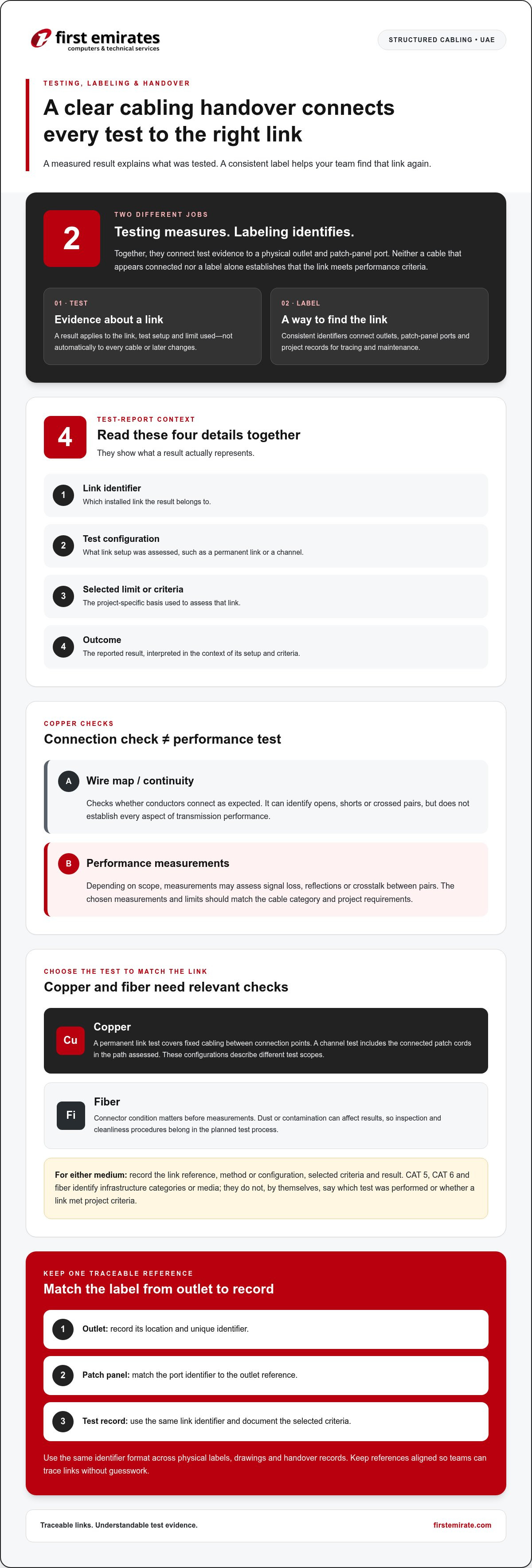
Testing measures a cabling link against a selected test setup and limit. Labeling identifies the link and its destinations. Together, they provide evidence about the tested link and a practical way to locate it. A cable that appears connected, or supports a device at the moment, has not necessarily been measured against the performance criteria selected for the project.
This distinction matters at UAE business sites where a network may span several floors, rooms, and work areas. Test records can show which links were assessed and which criteria were applied. Physical labels connect those records to real outlets and patch panels, helping operations teams investigate faults and plan changes without relying on guesswork.
Structured cabling includes more than cable. Pathways, connecting hardware, and subsystems also form part of the overall design. The Structured Cabling Overview provides broader background on these components. For day-to-day management, the priority is to make each installed link identifiable and its test evidence understandable.
What does a structured cabling test tell you?
A test records measurements for a particular link using a chosen configuration and limit. The result applies to that link and those criteria, not automatically to every cable in the building or to changes made after testing.
A basic continuity check can indicate whether conductors connect as expected. It is not equivalent to performance testing, which measures additional properties relevant to the selected cabling requirements. A link can pass a simple connection check and still need further measurement to establish whether it meets the project’s chosen criteria.
When reviewing evidence, match each result to the link identifier, test setup, and applied limit. This context helps project teams understand what was measured instead of treating a generic “pass” as proof of every aspect of network operation.
Why does structured cabling labeling matter?
Consistent identifiers let a team trace an outlet to its patch-panel port and corresponding network record. For example, the label at a workstation outlet should match the identifier recorded for the relevant panel connection. A technician can then follow the link without having to interpret separate naming systems.
Clear labels reduce ambiguity when staff move, equipment changes, or a fault needs investigation. They help identify the physical link, but they do not measure or certify cable performance. That evidence comes from testing and its associated records.
For a UAE project involving multiple rooms or teams, agree on one identifier format and use it across physical labels, drawings, and handover records. Keep the references aligned as work progresses, so the facilities team, IT team, and project stakeholders can work from the same link information.
- Outlet: Record its location and unique identifier.
- Patch panel: Match the port identifier to the outlet reference.
- Test record: Associate the result with the same link identifier and selected criteria.
This coordination makes structured cabling testing and labeling useful beyond installation day. It gives the receiving team a clearer basis for troubleshooting and future network changes, while making the limits of each test result visible.
Which structured cabling tests matter for copper and fiber links?
The right test depends on the cable type, link configuration, project scope, and acceptance criteria selected for the installation. A copper outlet link and a fibre backbone do not use identical checks, so a handover should make clear what was tested and what the result represents. TIA develops standards for telecommunications infrastructure; its TIA Structured Cabling Standards provide a reference point when project criteria are defined.
CAT 5, CAT 6, and fibre identify infrastructure categories, not interchangeable performance claims. The category or medium alone does not tell you which test was performed or whether a particular link met its project criteria. Check that the report connects each result to a link identifier, test configuration, selected limit, and outcome.
Copper cabling tests and certification results
A wire-map check looks for correct conductor connections and can identify issues such as opens, shorts, or crossed pairs. It does not establish every aspect of transmission performance. Depending on the selected scope, performance measurements may assess signal loss, reflections, or crosstalk between pairs. The applicable measurements and limits should match the cable category and project requirements rather than being assumed universal.
Test configuration matters. A permanent link test generally covers the fixed cabling between connection points, while a channel test includes the connected patch cords in the path being assessed. These tests describe different configurations, so the report should identify which one was used. Standard editions and test limits are project-specific and should be stated in the documentation.
Fiber optic inspection and testing
For fibre links, connector condition is an important consideration before measurements are taken. Dust or contamination at a connector interface can affect results, so inspection and cleanliness procedures belong in the planned test process. The methods selected depend on the fibre link, its configuration, and the project’s acceptance scope. Record the link reference, method, criteria, and result so the evidence can be interpreted in context.
A fibre result should not be treated as proof of every possible operating condition. It applies to the link and criteria assessed. Avoid comparing results from different configurations as though they were measured on the same basis.
| Link type | Test purpose | Record to retain | Limitation |
|---|---|---|---|
| Copper | Check conductor mapping and, where selected, transmission performance. | Link ID, configuration, criteria, measurements, and outcome. | A wire-map check alone does not establish performance against broader criteria. |
| Fibre | Assess the link using the method and acceptance scope defined for the project. | Link ID, inspection notes, method, criteria, and results. | The result applies to the tested configuration and selected criteria. |
For a practical testing plan, align the scope with the cabling design and the records required at handover. First Emirates Computers provides structured cabling services alongside optic fibre cabling for UAE projects that use copper and fibre infrastructure.
How to assess test reports and certification without confusing the two
A useful handover distinguishes the measurement taken from the conclusion drawn from it. Testing produces readings for a particular link and setup. A pass/fail result compares those readings with a selected limit. Certification refers to a formal assessment of the results against defined criteria within an agreed scope. These are related steps, but they are not interchangeable forms of evidence.
| Record type | What it tells you | What it does not establish by itself |
|---|---|---|
| Test measurement | The recorded values for a specific link and test configuration. | Whether the values meet a particular limit, unless that limit is included. |
| Pass/fail result | Whether the measured link meets the selected criteria. | That a different cable type, configuration, or limit would also pass. |
| Formal certification | That the assessed link or project scope has been evaluated against stated criteria. | Future performance after changes, damage, or other alterations to the installation. |
A certificate is not a blanket guarantee of future network performance or proof of every aspect of installation quality. Read it alongside the underlying results and the scope it covers. If a document refers to a batch or project rather than identifiable links, it may be difficult to connect the conclusion to a particular outlet or patch-panel port.
What information makes a cabling test report useful?
Report contents depend on the project and selected test scope. For each tested link, useful records can include its identifier, test date, cable category or medium, test configuration, selected limit, measured values, and outcome. Where relevant, note whether the result relates to a permanent link or a channel. This context lets a future reviewer interpret the result rather than seeing an isolated pass or set of numbers.
Use a short review checklist:
- Identification: Can you match each result to a physical link?
- Scope: Are the cable type and test configuration clear?
- Criteria: Does the record name the limit used?
- Outcome: Are measurements and pass/fail status distinguishable?
Missing context can make a report hard to use during maintenance or project closeout. A result without a link identifier, for example, may be technically detailed but difficult to assign to the correct room.
Testing versus certification: what is the difference?
Testing is the act of taking measurements. Certification assesses those measurements against defined criteria for the stated scope. The selected limit must suit the intended cable system and the configuration tested; otherwise, a pass/fail conclusion may not answer the project’s acceptance question. Standards references and editions should be recorded accurately and matched to project requirements, rather than assumed from a generic certificate template.
For structured cabling testing and labeling, keep the evidence traceable: the report identifier should correspond to the link label and project record. That alignment helps teams understand both what was measured and which installed link the result describes.
A practical workflow for labeling, testing, and cabling handover
A reliable handover is easier to manage when the cable label, outlet reference, patch-panel port, and test record all point to the same link. Set the process before installation is complete, then keep records aligned as work progresses. This is especially useful on UAE projects involving several rooms, floors, or teams coordinating installation and network operations.
Create a consistent cable-labeling scheme
Agree on a project-wide identifier format before applying labels. Keep it readable, unique within the project, and consistent across physical labels and records. The following is an illustrative example, not a mandatory UAE convention:
- Outlet: B1-R204-03, representing Building 1, Room 204, outlet 03.
- Panel port: B1-TR1-PP01-03, representing the corresponding telecommunications room, panel, and port.
- Schedule reference: Use the same link ID to associate the outlet and panel port in project records.
Choose a scheme that fits the site layout, and make its meaning clear to everyone working on the project. Apply the agreed identifiers at both ends of each link. Update drawings or schedules if room names, panel assignments, or outlet locations change.
Reconcile test results with handover records
Use the link identifier as the common reference across physical labels, the cable schedule, and test results. Before handover, compare these records to find missing labels, duplicate references, or results that cannot be matched to an installed link. Record exceptions and unresolved items plainly, rather than leaving the receiving team to infer what remains incomplete.
Use this sequence to keep the work controlled:
- Agree identifiers: Define the format and how building, room, outlet, and panel references will be represented.
- Label both ends: Apply matching identifiers at the outlet and corresponding panel connection.
- Test links: Record results against the agreed link ID and document the selected test scope.
- Reconcile records: Compare labels, cable schedules, location references, and test records; log discrepancies for resolution.
- Hand over: Provide the agreed records and identify any outstanding exceptions to the receiving team.
A practical handover checklist can include:
- Test records with link identifiers and the applicable test context.
- An updated cable schedule connecting outlets to panel ports.
- Current location references and drawings that reflect installed work.
- A clear list of exceptions or items still requiring resolution.
This workflow gives project teams a shared reference point for operations and future changes. For broader Abu Dhabi project context, see this structured cabling companies guide. First Emirates Computers also provides structured cabling services for UAE projects.
Plan structured cabling testing and labeling with First Emirates Computers
A clear project brief connects the physical network design with the records your team will need after installation. First Emirates Computers and Technical Services L.L.C. provides Cabling & Networking services, including Structured Cabling, Optic Fiber Cabling, and Wired & Wi-Fi Solutions. Its listed infrastructure products include fiber, CAT 5 and CAT 6 cables, SC APC adaptors, and patch cords. The right combination depends on the project design and requirements.
For UAE projects, planning should also account for how work across different rooms and site areas will be identified and coordinated. First Emirates Computers is based in Musaffah 9, Abu Dhabi, providing a local point of reference for project discussions. Broader infrastructure context is available in this structured cabling services in the UAE resource.
Prepare a structured cabling project brief
Before work begins, document site requirements in a format that connects each planned link to its location and intended use. Define the labeling convention early, so installers, project stakeholders, and the receiving IT team can refer to links consistently. State the testing scope and the records expected at handover as project requirements. Do not assume a generic test or certificate covers every need.
A useful brief can capture:
- Site areas: Buildings, floors, rooms, communications spaces, and outlet locations in scope.
- Required connections: The intended connection points and how each one will be referenced.
- Cable categories and media: The planned use of CAT 5, CAT 6, or fiber, as defined by the project design.
- Identifiers: The naming format for outlets, panel ports, and corresponding schedule entries.
- Test scope: The links to assess, configuration, selected criteria, and evidence required for acceptance.
- Handover records: The cable schedule, test documentation, location references, and a record of any exceptions.
This structure makes it easier to coordinate technical requirements with project administration. It also keeps the requested evidence aligned with the installation, rather than leaving documentation expectations until closeout.
Move from project requirements to a service discussion
Structured and optic fiber cabling form part of First Emirates Computers’ Cabling & Networking services, alongside Wired & Wi-Fi Solutions. Fiber, CAT 5 and CAT 6 cables, adaptors, and patch cords are relevant infrastructure components for project planning. The company focuses on customer satisfaction, quality, and competitive pricing.
Bring your site areas, connection requirements, preferred identifiers, and handover expectations into the discussion. These details provide a practical basis for aligning structured cabling requirements with the project scope. Discuss your structured cabling requirements with First Emirates Computers.
Make your cabling records useful beyond handover
Plan for the day after a network change, not only the day the installation is accepted. Assign responsibility for keeping cabling records current when outlets are reassigned, equipment moves, or additional links are introduced. A straightforward update process helps prevent old drawings and schedules from becoming unreliable references for future work.
Use structured cabling testing and labeling as part of a broader approach to infrastructure management. Set expectations for how project information will be maintained, who will receive updates, and how changes will be recorded. This gives your team a practical starting point for managing the network as business needs evolve.
First Emirates Computers supports cabling and networking requirements with structured cabling and optic fiber cabling services. If you are planning a new installation or reviewing an existing site, plan your cabling project with First Emirates Computers. A clear brief gives the project team a useful starting point for aligning the infrastructure and its records.
Frequently Asked Questions
What cabling and networking services does First Emirates Computers provide?
First Emirates Computers provides Cabling & Networking services, including Structured Cabling, Optic Fiber Cabling, and Wired & Wi-Fi Solutions. For a UAE project involving structured cabling testing and labeling, outline the site type, required connections, and whether the design includes copper, fibre, or both. This gives the project discussion a clear infrastructure context without treating different cable types as interchangeable.
Which cable types are listed in First Emirates Computers’ IT infrastructure range?
First Emirates Computers lists fiber, CAT 5 cables, and CAT 6 cables in its IT infrastructure range. These are product categories, not a statement that the cable types are interchangeable or meet a particular project’s performance target. For procurement planning, identify which cable category the design specifies for each area, then align component selection and documentation with that requirement.
Does First Emirates Computers provide optic fiber cabling?
Yes. Optic Fiber Cabling is one of First Emirates Computers’ Cabling & Networking services. Fiber is also included in its IT infrastructure range alongside other listed networking components. If your project includes fibre links, note their locations and intended connections in the project brief. This helps distinguish them from copper runs during coordination and when planning future network or facilities changes.
Which networking accessories are listed by First Emirates Computers?
Listed networking accessories include SC APC adaptors, patch cords, and wired and wireless networking accessories. The IT infrastructure range also includes UPS units and cabinets. In project records, list these separately from cable links because they are different infrastructure components. Clear references in purchasing and site documentation help teams organize project information.
Where is First Emirates Computers located in Abu Dhabi?
First Emirates Computers is located in Musaffah 9, Abu Dhabi, United Arab Emirates, with PO Box 38575. Use these location details for company correspondence and distinguish the company address from the cabling project’s site address. That distinction is useful when project documentation covers multiple buildings, rooms, or work areas across a UAE site.
When did First Emirates Computers begin serving customers?
First Emirates Computers has served customers since 2011. This is the company’s stated service-start year, not the age of a specific cabling installation or the date a particular service began. For a current project, base planning on present site requirements and the agreed project scope rather than inferring technical details from company history. Keep project records specific to the installation being delivered.


