

Could a warehouse have cameras across the floor and still miss the activity that matters? Coverage depends on more than camera count. For warehouse CCTV solutions Dubai facilities need, start with how people, goods, and vehicles move through each zone. Map entrances, loading areas, aisles, and storage spaces before selecting equipment, and include applicable Dubai authority requirements in the project plan. A generic layout can leave blind spots or create recording and network demands the system was not designed to handle.
Clear coverage does not mean adding equipment without an operational purpose. This guide explains how to build a site-specific CCTV plan, compare camera categories for different areas, and coordinate recording equipment and cabling. It also covers practical project preparation, compliance considerations, installation, and maintenance. The aim is to connect each proposed camera to a defined view, the infrastructure needed to support it, and the recording plan for your facility.
Key Takeaways
- Map warehouse zones and set coverage priorities before selecting camera types or quantities.
- Plan cameras, network video recorders (NVRs), and cabling together to support recording across the facility.
- Compare fixed, moving, indoor, and outdoor camera categories against each area’s purpose to avoid overbuying.
- Prepare the project in stages: document site needs, map coverage, review infrastructure, scope installation, and plan maintenance.
- First Emirates Computers provides CCTV cameras, NVRs, installation, and maintenance for customers across the UAE, and has served customers since 2011.
Why Warehouse CCTV Solutions in Dubai Must Start with Site Coverage
A warehouse is not one uniform space. Goods move through loading areas and vehicle routes, staff work in operational zones, and shelving can change sightlines from one aisle to the next. For teams planning warehouse CCTV solutions Dubai, choosing camera models or quantities first can overlook these differences. Start with a facility plan that marks where coverage matters, so potential gaps can be discussed before equipment is selected.
Warehouse CCTV is a system of cameras, recording equipment, and supporting infrastructure planned to provide views of relevant areas in a facility. Consider those elements together, but let the warehouse’s operations shape the initial coverage priorities. A general overview of video surveillance explains the broader technology and its applications. Warehouse planning turns that context into a layout based on the facility’s actual zones and workflows.
Which warehouse areas should a CCTV plan consider?
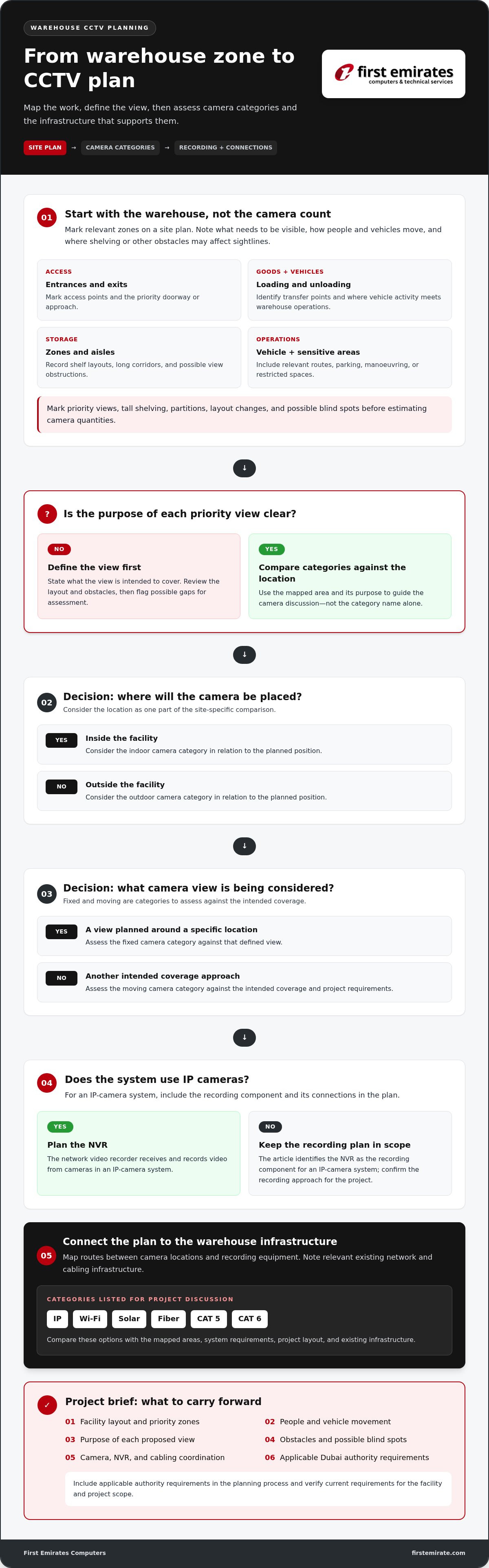
Use a site plan to mark the areas where a clear view supports day-to-day oversight. For each area, note what needs to be visible and any obstacles that could affect the proposed view. Common areas to consider include:
- Entrances and exits: Mark access points used by staff, visitors, or deliveries, and note which approach or doorway is the priority.
- Loading and unloading areas: Identify where goods are transferred and where vehicle activity intersects with warehouse operations.
- Storage zones and aisles: Record shelf layouts and long corridors, including places where racking or stored stock may obstruct a view.
- Vehicle areas: Include relevant parking, manoeuvring, or internal vehicle routes if they form part of the facility’s operations.
- Restricted or sensitive spaces: Include these when the facility’s processes make them a coverage priority.
On the drawing, distinguish priority views from areas that need further assessment. Mark tall shelving, partitions, changes in floor layout, and other obstructions, then flag possible blind spots. This gives the planning team a shared reference for discussing camera positions and coverage objectives. It is more useful than estimating camera quantities before understanding the layout.
What should a warehouse CCTV brief establish first?
Before comparing camera categories, document three things: the facility layout, operational priorities, and existing infrastructure. Show key work areas and access points, describe how people and vehicles move through the site, and note any cabling or network equipment relevant to the project. For each priority area, state what the view is intended to cover. This makes it easier to compare proposed positions against the facility’s needs without assuming a camera will deliver a particular result.
Camera placement should follow a documented site plan so each proposed view has a clear purpose and potential gaps can be reviewed. This keeps the discussion focused on coverage before choices about camera types and quantities are made. For a Dubai project, include applicable authority requirements in the planning process and verify current requirements for the facility and project scope. A clear brief gives the installation project a more useful starting point.
How Warehouse CCTV Cameras, NVRs, and Cabling Work Together
A warehouse CCTV system is made up of connected parts, not just cameras mounted around a building. Cameras provide views of selected areas, recording equipment stores video, and supporting network infrastructure links the components. For warehouse CCTV solutions Dubai, planning these elements together helps align equipment choices with the facility layout and the purpose of each view.
An NVR, or network video recorder, is the recording component used in an IP-camera system. It receives and records video from cameras. The camera captures a view, the NVR handles recording, and the infrastructure provides the connections between components. Plan how these parts will be arranged across the site, without assuming a particular recording capacity or retention period.
What camera types are listed for warehouse CCTV?
Camera categories describe options, not a universal ranking. First Emirates lists fixed and moving cameras, indoor and outdoor cameras, and IP, Wi-Fi, and solar cameras. Compare these categories with the mapped areas and project requirements. The category name alone does not establish how a particular camera will perform in a specific position.
For example, a fixed camera may be considered for a view planned around a specific location, while a moving camera is another category to assess against the intended coverage. Indoor and outdoor cameras can be considered in relation to where equipment will be placed. IP, Wi-Fi, and solar cameras are also categories to include in the project discussion where relevant. Select equipment based on the site plan and system requirements, rather than assuming one type suits every zone.
Why do recording and cabling belong in the same plan?
The NVR records video from an IP-camera system, so its location and connections need to be considered alongside camera placement. Cabling links equipment across the warehouse. First Emirates lists fiber, CAT 5, and CAT 6 infrastructure products. The appropriate options depend on the project layout and infrastructure requirements.
Map the routes between camera locations and recording equipment, and note where existing infrastructure may be relevant. This helps identify practical questions about connection paths, equipment placement, and areas where cabling may be needed. For more context on infrastructure planning, the structured cabling companies in Abu Dhabi guide covers related considerations.
Camera choice, recording equipment, and infrastructure should be planned as one system, with each component supporting the facility’s documented coverage needs. First Emirates provides CCTV installation and maintenance, as well as structured cabling and IT infrastructure services. To discuss how these services fit your site plan, explore First Emirates CCTV solutions in relation to your facility’s requirements.
How to Compare Warehouse CCTV Options Without Overbuying
A suitable setup depends on the facility’s layout, operating priorities, and project scope, not camera count alone. Start by matching each area to a coverage purpose. Then consider a camera category, its recording role, and the infrastructure needed to connect it. This keeps warehouse CCTV solutions Dubai focused on site requirements instead of adding equipment without a defined purpose.
Use a planning table to compare needs consistently. The examples below are prompts for assessment, not fixed recommendations. Base the final configuration on the actual site plan and documented priorities.
| Area | Camera category to consider | Recording role | Infrastructure considerations |
|---|---|---|---|
| Entrance or exit | Fixed or moving; indoor or outdoor, depending on location | Record the view identified as a priority | Review the camera position and connection route to recording equipment |
| Warehouse aisle | Fixed or moving; indoor | Include the selected aisle view in the recording plan | Consider aisle layout, obstructions, and the route for supporting cabling |
| Loading area | Fixed or moving; indoor or outdoor, based on the area | Plan recording around the operational view required | Account for equipment location and connection paths across the loading zone |
| Restricted operational space | Category selected according to the documented coverage priority | Include only where relevant to the project scope | Coordinate placement and connections with existing infrastructure |
When might fixed or moving cameras suit different areas?
Fixed cameras are one category to consider when the plan identifies a defined view. Moving cameras are another category to assess. Neither is automatically the better choice. Compare each against the intended area, layout, and coverage objective. First Emirates lists both categories, along with indoor and outdoor options. Selection should follow the site layout and documented priorities, rather than assumptions based on the camera label alone.
Use the table to record which category is being considered for each area and why. If a proposed camera cannot be linked to a marked location or coverage priority, revisit the project scope before adding it. This check helps distinguish a genuine site requirement from an assumption that more equipment will necessarily improve coverage.
When should a project consider connected security systems?
Access control can be considered alongside CCTV when managing entry is a separate project requirement. First Emirates lists biometric device categories including fingerprint and facial recognition, RFID, and proximity options. These are options to consider, not a requirement to include them in every CCTV project. The access control system selection guide provides related planning context.
First Emirates provides CCTV installation and can include access control in a project where it is part of the documented requirements. Explore First Emirates CCTV solutions as you define the appropriate system scope.
How to Prepare a Warehouse CCTV Project in Dubai
A clear project sequence helps turn warehouse coverage priorities into a practical installation brief. For warehouse CCTV solutions Dubai, start with what the facility needs to monitor, then consider camera locations, existing infrastructure, installation scope, and ongoing maintenance. This order keeps decisions tied to site requirements rather than assumptions about equipment or outcomes.
Documented site requirements give a CCTV project brief a clear structure, linking each proposed system decision to the facility’s layout and operating needs. Use the following sequence to prepare useful project inputs:
- Document site needs. Note how the warehouse operates, its key activities, and the views that matter to those operations.
- Map coverage areas. Mark relevant access points, work areas, storage zones, and vehicle areas on a facility layout. Note priority views and possible gaps.
- Review existing infrastructure. Record known cabling and networking details, including equipment that may be relevant to the project.
- Scope installation. Use documented priorities and infrastructure details to frame the CCTV installation requirements.
- Plan maintenance. Include ongoing CCTV maintenance in the project discussion so support is considered beyond the initial installation.
What information helps scope the installation?
A warehouse layout, a list of priority areas, access-point locations, and known infrastructure details can help shape project scoping. Clear notes also help distinguish operational priorities from assumptions about camera performance or security outcomes. If the layout changes, update the plan so coverage discussions reflect the facility as it is now. These inputs make it easier to define which areas the project needs to address.
How should infrastructure and maintenance be planned?
Include cabling and networking in the project discussion. First Emirates lists fiber, CAT 5, and CAT 6 products, but these categories should not be treated as a guaranteed specification for every warehouse. First Emirates provides CCTV installation and maintenance. For broader planning around business IT upkeep, the IT AMC services guide provides related context.
For a Dubai facility, verify current project requirements with the applicable authority before proceeding. Requirements can depend on the project, so general guidance is not a substitute for current authority information. This step does not imply any particular approval or certification for an installer.
First Emirates provides CCTV installation and maintenance for facilities across the UAE. With a documented layout, coverage priorities, and infrastructure notes in hand, discuss your warehouse CCTV project as part of planning its scope.
Warehouse CCTV Solutions from First Emirates Computers
A warehouse project needs a CCTV plan that reflects how the facility is laid out and used. First Emirates Computers and Technical Services L.L.C. provides CCTV systems, installation, and maintenance for customers across the UAE. The company has served customers since 2011 and supports businesses planning or reviewing their surveillance arrangements.
What CCTV and technical services does First Emirates provide?
First Emirates’ CCTV categories include fixed and moving cameras, indoor and outdoor cameras, IP, Wi-Fi, and solar cameras, as well as network video recorders (NVRs) and accessories. Its services include Installation and Maintenance of CCTV. Use the site plan to compare these categories with the warehouse’s coverage needs rather than assuming a standard package or fixed configuration for every facility.
Related technical infrastructure can also form part of a project. First Emirates provides structured cabling and IT infrastructure, and access control can be considered when managing entry is a separate requirement. Include these services according to the facility’s needs, rather than assuming they are necessary parts of every CCTV project. This keeps the system discussion specific to the warehouse and its operations.
For businesses comparing warehouse CCTV solutions Dubai, a useful starting point is a clear project brief: identify the areas that matter, note existing infrastructure, and connect proposed equipment to a defined purpose. This makes the discussion more concrete and supports a solution suited to the project budget. First Emirates focuses on customer satisfaction and solutions aligned with customer budgets, rather than a one-size-fits-all approach.
How can a Dubai business take the next step?
Prepare a site layout and a short summary of priority areas, access points, and known cabling or networking infrastructure. These details help frame the project scope and identify relevant CCTV categories. If the facility also needs infrastructure or access control, list those requirements separately so they can be considered alongside surveillance.
First Emirates is based in Musaffah 9, Abu Dhabi, and serves customers across the UAE. For a Dubai warehouse, share the facility’s requirements and budget considerations as the basis for discussing a suitable CCTV project.
Discuss your warehouse CCTV project with First Emirates and plan the system around your facility’s needs.
Turn Your Warehouse CCTV Plan into a Clear Next Step
A warehouse changes as workflows, storage arrangements, and access patterns evolve. Treat your CCTV plan as a working reference: revisit it when the facility layout or operating priorities change, and use those updates to guide future system decisions. This helps keep warehouse CCTV solutions Dubai aligned with how the site is used, rather than relying on assumptions made at the start of a project.
Before discussing the project, bring together the current site layout, the areas that matter most, and known infrastructure details. These notes create a practical basis for defining CCTV requirements and a solution that fits the project’s scope and budget. Include installation and ongoing maintenance in the planning conversation.
Discuss your warehouse CCTV requirements with First Emirates Computers and take the next step toward a plan shaped around your facility.
Frequently Asked Questions
Does First Emirates Computers provide CCTV installation and maintenance?
Yes. First Emirates Computers lists Installation and Maintenance of CCTV among its services. For businesses planning warehouse CCTV solutions Dubai, installation and ongoing CCTV maintenance can both be part of the project. A new facility and an existing site may have different requirements, so explain whether you are planning a new system or reviewing an installed one.
What types of CCTV cameras does First Emirates Computers offer?
First Emirates offers fixed and moving cameras, indoor and outdoor cameras, IP cameras, Wi-Fi cameras, and solar cameras. These are listed categories, not a single standard configuration for every site. For a warehouse project, identify the intended camera locations and whether they are indoors or outdoors. This gives the selection discussion a practical basis in the facility’s requirements.
Does the CCTV offering include network video recorders?
Yes. Network video recorders, commonly called NVRs, are included in First Emirates’ CCTV offering. An NVR is the recording component of an IP-camera system. When planning or updating a CCTV system, include the recorder in the equipment discussion alongside the cameras. The appropriate arrangement depends on the system being scoped, and this does not imply a particular storage capacity or footage retention period.
Does First Emirates Computers offer Wi-Fi or solar cameras?
Yes. Wi-Fi cameras and solar cameras are among the CCTV categories First Emirates lists. The category names identify options in its offering; they do not specify a particular camera’s power arrangement, connectivity details, or performance. For a warehouse project, note where you are considering these categories and what that area requires. This gives the project discussion practical context without assuming either option suits every location.
What biometric device categories does First Emirates Computers provide?
First Emirates lists biometric devices that include fingerprint and facial recognition, RFID, and proximity sensors. Its device categories also include networked and standalone options. These can be relevant when a business is considering access control or time attendance alongside CCTV. They serve a different role from surveillance cameras, so describe the operational requirement separately when defining the security system scope.
Does First Emirates Computers provide annual maintenance contracts?
Yes. First Emirates provides customized and integrated Annual Maintenance Contracts. These are separate from the listed Installation and Maintenance of CCTV service and can be included in a broader discussion of technical support needs. Identify which systems or infrastructure the project needs to cover. The contract is customized, so no particular coverage, response time, or service term is implied here.
Discuss your warehouse CCTV requirements with First Emirates Computers to plan a system around your facility’s layout, coverage priorities, and budget.


