

A card reader at your entrance is no longer just a hardware installation; it's a critical component of your company's data infrastructure and regulatory standing. You likely recognize that managing high-traffic entry points while maintaining strict security is a delicate balance. It's often difficult to reconcile the need for fast throughput with the complex requirements of the UAE Personal Data Protection Law and NESA standards. Many facility managers struggle to integrate modern card access systems Abu Dhabi requires with their existing legacy hardware, leading to technical friction and potential security gaps.
This guide will show you how to plan, select, and implement a professional access environment tailored for the capital's unique regulatory landscape. We'll help you move toward a secure, scalable system that provides automated reporting for attendance and security audits. You'll learn how to navigate local mandates while ensuring your infrastructure remains technically sound and ready for future expansion. We provide a methodical breakdown of the necessary steps to achieve a reliable and fully compliant security posture that simplifies your daily operations.
Key Takeaways
- Understand how modern card access systems Abu Dhabi organizations deploy have transitioned from simple physical locks to sophisticated, data-driven identity management platforms.
- Learn a systematic security audit process to categorize facility zones and quantify traffic patterns for optimal hardware placement and throughput.
- Compare technical specifications between legacy 125 kHz proximity cards and 13.56 MHz encrypted smart cards to determine the most secure credential for your staff.
- Identify the critical role of Extra Low Voltage (ELV) design in creating a reliable, integrated infrastructure that connects readers to centralized management servers.
- Ensure ongoing compliance with local ADMCC and Police standards by leveraging structured maintenance protocols and professional support contracts.
The Strategic Role of Card Access Systems in Abu Dhabi’s 2026 Security Landscape
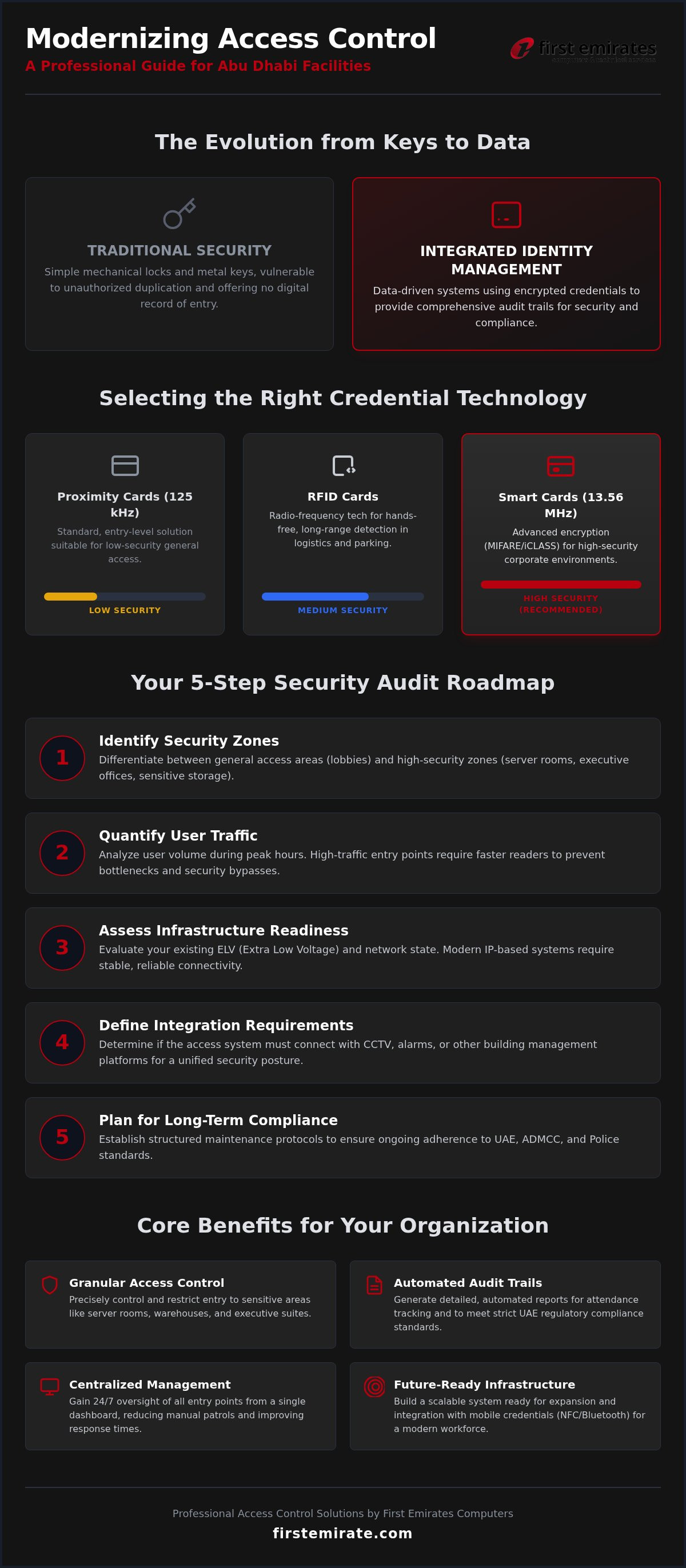
Modern security in the UAE has evolved beyond the simple mechanical lock and key. In the capital, card access systems Abu Dhabi businesses implement are now foundational to integrated identity management. These systems serve as the first line of defense, ensuring that only authorized personnel enter specific zones while providing a comprehensive digital record of every movement. This shift is driven by the UAE’s vision for digital-first business hubs, where physical security must match the sophistication of the region's technological infrastructure. Modern access control systems utilize encrypted credentials to mitigate the risks of unauthorized duplication, a common vulnerability with traditional metal keys.
Current technological choices generally fall into three categories:
- Proximity Cards (125 kHz): These are standard entry-level solutions suitable for low-security general access.
- RFID Cards: Radio-frequency identification technology allows for hands-free or long-range detection in logistics and parking areas.
- High-Frequency Smart Cards (13.56 MHz): These credentials feature advanced encryption standards, such as MIFARE or iCLASS, and represent the benchmark for high-security corporate environments.
Benefits for Abu Dhabi Corporate and Industrial Sectors
For businesses operating in Musaffah or the city's commercial towers, operational efficiency is a primary driver for adoption. Large-scale facilities require granular control over who can access server rooms, warehouses, or executive suites. Implementing professional card access systems Abu Dhabi offers ensures that industrial operators can track attendance and movement without manual intervention. These systems provide detailed audit trails, which are essential for meeting the strict compliance standards of UAE regulatory bodies. When integrated with remote monitoring systems Abu Dhabi specialists provide, facility managers gain 24/7 oversight of all entry points from a single dashboard. This centralized management reduces the need for manual security patrols and speeds up incident response times.
The Shift Toward Mobile and Keyless Credentials
The 2026 security landscape is increasingly mobile-centric. Many organizations are now complementing physical cards with mobile-native solutions that utilize Bluetooth or Near Field Communication (NFC). This approach allows employees to use their smartphones as secure credentials, reducing the administrative burden of replacing lost or damaged physical cards. While these systems offer high convenience, they require robust backend security to protect against digital interception. Professionals prioritize encrypted communication protocols to ensure that mobile signals remain as secure as high-frequency smart cards. It's a method that aligns with the broader push for smart city integration across the emirate, providing a seamless experience for the modern workforce.
Security Audit for Card Access: 5-Step Guide
A successful implementation of card access systems Abu Dhabi begins with a methodical security audit. This process ensures that the technical solution matches the physical reality of the building and the operational needs of the business. Without a structured evaluation, organizations often face post-installation issues such as technical bottlenecks or compliance gaps. A professional audit provides a clear roadmap for procurement and installation.
- Step 1: Identify Zones. Differentiate between general access areas, such as the main lobby, and high-security zones like server rooms, executive offices, or storage for sensitive documents.
- Step 2: Quantify Traffic. Analyze user volume during peak hours. High-traffic entry points require faster processing speeds to prevent employee frustration and security bypasses.
- Step 3: Infrastructure Readiness. Evaluate the state of your existing network. Modern systems are typically IP-based and require stable connectivity to function correctly.
- Step 4: Integration Requirements. Determine if the access system needs to communicate with existing CCTV or time-attendance software. This integration is vital for UAE regulatory compliance, as it creates a unified evidentiary trail for security audits.
- Step 5: Lifecycle Budgeting. Account for the total cost of ownership, including hardware, professional installation, software licensing, and long-term maintenance protocols.
Assessing Environmental and Infrastructure Readiness
Infrastructure evaluation must include a detailed look at door hardware. You'll need to decide between electric strikes, which are often suitable for standard office doors, and magnetic locks, which offer higher holding force for industrial entrances. Because of the extreme Abu Dhabi heat, outdoor readers must have high IP ratings to ensure durability and prevent hardware failure during the summer months. If your current network backbone is insufficient, you may require professional structured cabling services UAE to support the data requirements of IP-based controllers. For those in the early stages of planning, consulting with a local security specialist can help identify these technical needs before you commit to specific hardware.
Defining User Roles and Access Permissions
Mapping your organizational hierarchy to digital access levels prevents security sprawl and unauthorized movement. You should establish clear protocols for managing temporary access for visitors and contractors, ensuring that their credentials expire automatically once their task is complete. This disciplined approach reduces the risk of orphaned credentials staying active in your system. The principle of least privilege ensures that an individual is granted only the minimum level of access required to complete their specific job functions.
Evaluating Card Technologies: From Legacy Proximity to Encrypted Smart Cards
Selecting the appropriate credential technology is a technical decision that directly impacts the long-term integrity of your security posture. For many years, 125 kHz proximity cards were the standard for card access systems Abu Dhabi installations. These legacy cards are cost-effective but lack encryption, making them highly vulnerable to cloning with inexpensive, readily available tools. In contrast, 13.56 MHz smart cards, such as MIFARE DESFire or iCLASS SE, utilize high-security encryption standards to protect the data exchange between the card and the reader. This prevents the unauthorized duplication of badges, a critical requirement for modern corporate facilities.
For organizations prioritizing high-security environments, adhering to globally recognized secure identity verification standards is critical. These standards ensure that the credentials used are robust against sophisticated digital attacks. Many Abu Dhabi businesses now opt for dual-technology cards during transition periods. These cards contain both legacy and modern chips, allowing for a phased upgrade of reader hardware across multiple sites without disrupting daily operations. We also recommend prioritizing open-standard technologies over proprietary formats to avoid vendor lock-in, ensuring you can source hardware from multiple manufacturers in the future.
Understanding RFID and NFC Frequency Standards
High-frequency cards are essential for the financial and government sectors in Abu Dhabi due to their ability to handle complex encryption keys. Passive RFID tags, which draw power from the reader's field, are the most common choice for standard employee badges. Active tags, which contain their own power source, are typically reserved for long-range applications like vehicle gate entry. Using unencrypted formats in a modern office environment presents a significant risk, as unauthorized individuals can easily intercept and replicate the signal. This is why card access systems Abu Dhabi professionals prioritize encrypted high-frequency standards for any new installation.
Choosing the Right Reader Hardware
The physical reader hardware must be selected based on both aesthetic and environmental factors. Mullion readers are slim enough to fit on door frames, while wall-mount readers offer a larger surface area for easier interaction. In high-security zones, we often implement keypad-card combos to enable two-factor authentication (2FA). This requires both a physical credential and a PIN for entry. For industrial zones like Musaffah, readers must carry high durability ratings to withstand the fine dust and extreme temperatures typical of the UAE environment. Ensuring the hardware is rated for these conditions prevents premature failure and high replacement costs.
How to Implement Integrated Access Control within an ELV Framework
The reliability of card access systems Abu Dhabi facilities use is determined by the quality of the underlying Extra Low Voltage (ELV) project design. ELV systems encompass all building technologies that operate on low voltage, including security, data networking, and communication. By positioning access control within a broader ELV framework, engineers ensure that the system is not an isolated hardware installation. Instead, it becomes a high-performance network where door controllers communicate seamlessly with a centralized security management server. This centralization allows for real-time monitoring and immediate updates to user permissions across an entire building or industrial campus.
Integrating these systems with professional CCTV installation Abu Dhabi services provides a layer of visual verification that cards alone cannot offer. When a card is swiped, the system can automatically trigger a nearby camera to record a snapshot or a short video clip. This creates a dual-record of the event, linking a specific digital identity to a physical person. Modern systems also sync this access data with HR payroll software. This automation eliminates manual attendance tracking and reduces errors in calculating working hours for large workforces in sectors like manufacturing and logistics.
The Importance of Structured Cabling for Access Control
A robust structured cabling system is the physical foundation of any IP-based access solution. We utilize Cat6 or Fiber Optic backbones to ensure high-speed data transmission and minimal latency between the reader and the server. Power over Ethernet (PoE) technology is often preferred because it allows for both data and power to be delivered through a single cable, simplifying the installation process. However, in high-security configurations, dedicated power supplies with battery backups are essential to maintain operations during power outages. Building network redundancy into the design prevents lockouts or system failures if a primary network switch goes offline.
Software Integration and Real-Time Monitoring
Centralized management platforms are vital for multi-site businesses operating across the UAE. These platforms allow security managers to oversee several locations from a single headquarters, ensuring consistent policy enforcement. The system can be configured to send automated alerts for specific events, such as a "door forced" alarm or a "door held open" notification. By incorporating smart office technology Abu Dhabi, organizations can further enhance workplace efficiency through automated lighting or climate control based on room occupancy. For businesses seeking a comprehensive implementation, our team at First Emirates Computers offers specialized ELV project management to ensure every component is perfectly synchronized.
Ensuring Long-Term Reliability: Maintenance and Regulatory Compliance in the UAE
Installation marks the beginning of a system’s lifecycle, not its conclusion. To maintain the integrity of card access systems Abu Dhabi businesses must adhere to rigorous local standards. The Abu Dhabi Monitoring and Control Centre (ADMCC) and the local police department mandate specific technical requirements for hardware performance and data retention. Failing to meet these standards doesn't just compromise safety; it can lead to regulatory penalties. A disciplined approach to maintenance ensures that your infrastructure remains compliant and technically sound for years. Regulations aren't static. You need a partner who understands the evolving landscape of UAE security mandates.
Maintaining long-term reliability involves several technical layers:
- Regulatory Adherence: Following ADMCC data retention policies for access logs and integrated video feeds.
- Cybersecurity Health: Performing systematic firmware updates to patch vulnerabilities against evolving digital threats.
- Authority Coordination: Working with local authorities during annual inspections to verify system performance and documentation.
- Emergency Protocols: Implementing fail-safe protocols that unlock doors during power loss or fail-secure protocols that keep them locked, depending on the specific zone's security priority.
Annual Maintenance Contracts (AMC) for Security Systems
A professional security AMC provides the structured oversight needed for business continuity. These contracts should include comprehensive testing of magnetic locks, reader calibration, and server health checks. We prioritize preventative maintenance to catch minor technical glitches before they escalate into expensive hardware failures. The extreme UAE climate necessitates quarterly hardware inspections to prevent environmental damage from heat and fine dust from compromising electronic components. By utilizing IT AMC services Abu Dhabi specialists provide, you ensure that both the software backend and the physical hardware receive the specialized attention required for 24/7 operation.
Compliance with Local Data Privacy and Safety Standards
Managing cardholder information requires strict compliance with UAE Personal Data Protection Laws. This involves securing the databases where employee names, photos, and access logs are stored to prevent unauthorized data breaches. Safety is equally paramount; your access control must be physically integrated with the building’s fire alarm system. In the event of an emergency, the system must trigger an automatic release of all egress doors to allow for safe evacuation. This integrated safety strategy is often complemented by a video door phone installation Abu Dhabi specialists provide, which adds a layer of manual verification for visitors while maintaining the overall security perimeter.
Future-Proofing Your Facility’s Security Infrastructure
Implementing a robust security posture requires more than just installing hardware; it demands a systematic approach to identity management and regulatory compliance. You've learned that selecting encrypted smart card technology and integrating it within a professional ELV framework are essential steps for maintaining high security in the capital. By prioritizing a detailed audit and structured cabling, you ensure that your card access systems Abu Dhabi infrastructure remains scalable and reliable as your business grows. This methodical preparation mitigates the risks of technical bottlenecks and ensures your operations align with the latest ADMCC and Police standards.
First Emirates Computers has been a dependable partner in the UAE since 2011, serving as expert ELV and security system integrators. We provide comprehensive AMC support across Abu Dhabi to ensure your technical systems remain in peak condition regardless of environmental challenges. Our team is ready to help you navigate the complexities of modern access control with precision and technical readiness. Request a Professional Access Control Consultation from First Emirates Computers today to secure your facility with a steady and authoritative hand. We look forward to helping you establish a stable and fully integrated security environment.
Frequently Asked Questions
What is the best card access technology for a small office in Abu Dhabi?
Encrypted smart cards operating at 13.56 MHz are the most reliable choice for small offices. These cards utilize robust encryption protocols that prevent unauthorized cloning, unlike legacy proximity cards. For a professional office environment, this technology provides a high degree of security without the need for complex biometric infrastructure. It's a scalable solution that maintains a polished image while ensuring data integrity for your staff.
How does card access control integrate with my existing CCTV system?
Integration occurs through a centralized security management server that links your readers to the video recorder. When a user interacts with card access systems Abu Dhabi facilities have installed, the system triggers the CCTV camera to capture a real-time snapshot. This creates a visual audit trail that matches the digital entry log. This dual-layer approach is often necessary to meet the strict data retention standards set by the ADMCC.
Are card access systems compliant with Abu Dhabi fire safety regulations?
Card access systems are fully compliant with Abu Dhabi fire safety regulations if they're integrated with the building’s fire alarm control panel. A fire-trip relay must be installed to ensure that all fail-safe locks, such as magnetic locks, release immediately upon an alarm trigger. This integration is a critical requirement for Civil Defence inspections and ensures that emergency egress is never obstructed during a crisis.
What happens to the door locks if the power goes out in my building?
The behavior of your doors during a power failure depends on whether you've installed fail-safe or fail-secure hardware. Fail-safe locks, like magnetic locks, will automatically unlock to ensure safe exit. Fail-secure locks, often used for high-security storage, remain locked to protect assets. We recommend installing dedicated battery backup units within the door controllers to maintain system operations during short-term power interruptions.
Can I use my smartphone instead of a physical access card?
Modern readers support mobile credentials through Bluetooth or Near Field Communication (NFC) technology. This allows employees to use a secure application on their smartphone to gain entry, reducing the need for physical badges. Mobile solutions are increasingly popular in the UAE's digital-first business hubs because they offer high convenience while maintaining encrypted communication between the device and the reader.
How often should I update my access control system software?
You should perform software updates at least quarterly or immediately following the release of critical security patches. Regular updates are essential to protect your network from evolving cybersecurity threats and to ensure compatibility with new hardware. A methodical update schedule prevents system glitches and ensures that your access control infrastructure remains technically sound and ready for 24/7 operation.
What is the difference between RFID and Smart Card access?
RFID is a broad category of radio-frequency identification, while Smart Cards are a specific, high-security subset of this technology. Standard RFID often refers to legacy 125 kHz proximity cards which are unencrypted and vulnerable to duplication. Smart Cards operate at 13.56 MHz and use advanced encryption keys to secure the data exchange. This technical difference makes Smart Cards the preferred standard for corporate security.
Is an Annual Maintenance Contract (AMC) mandatory for security systems in the UAE?
While specific requirements vary by industry, an Annual Maintenance Contract (AMC) is practically essential for meeting ADMCC and Police standards. Many business licenses in regulated sectors require proof of a valid maintenance agreement with a certified provider. Given the extreme heat and dust in the region, an AMC ensures that card access systems Abu Dhabi organizations rely on continue to function correctly through preventative inspections and hardware testing.


