

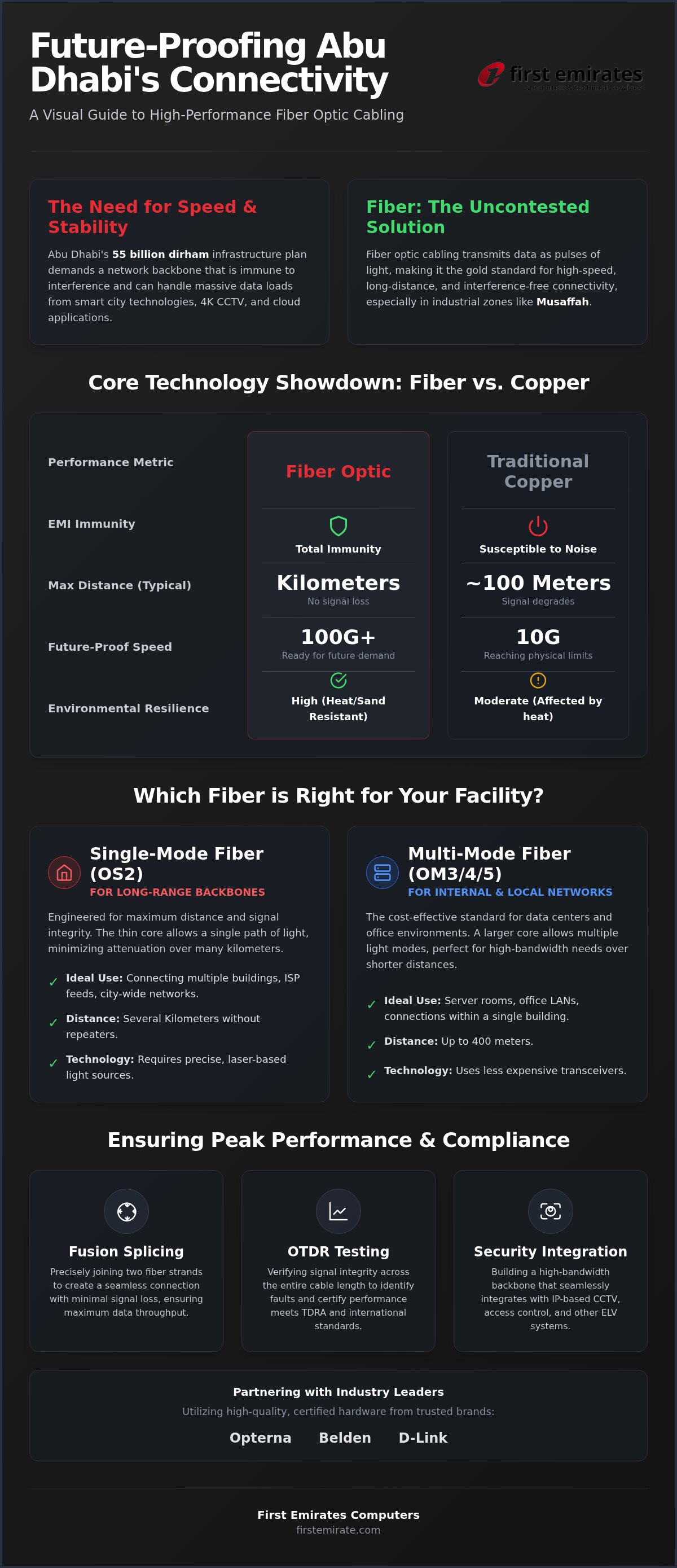
With the Abu Dhabi Investment Office rolling out a 55 billion dirham infrastructure pipeline through 2026, the demand for high-speed, interference-free connectivity has never been more critical. You likely recognize that a stable network is the lifeblood of your daily operations. However, many business owners still face the frustration of unreliable speeds over long distances or signal interference in industrial sectors like Musaffah. Choosing the correct fiber optic cabling Abu Dhabi solution is no longer just a technical upgrade; it's a requirement for remaining competitive in a smart-city economy.
This guide explains how fiber optic technology powers modern enterprise infrastructure and provides the clarity you need to choose the right cabling for your specific facility. We'll examine the practical differences between single-mode and multi-mode fiber while ensuring your installation meets the latest TDRA standards. By the end of this article, you'll understand how to build a future-proof backbone that integrates seamlessly with your CCTV and access control systems. This methodical approach ensures your network provides the stability and security your business requires for the long term.
Key Takeaways
- Learn why fiber optic cabling Abu Dhabi provides essential immunity to electromagnetic interference in industrial areas like Musaffah.
- Understand the functional differences between Single-mode (OS2) for long-range backbones and Multi-mode (OM3/OM4/OM5) for internal office networks.
- Discover how professional fusion splicing and OTDR testing ensure high-performance signal integrity and compliance with regional standards.
- Explore the integration of high-bandwidth fiber backbones with IP-based security systems for seamless CCTV and access control performance.
- Identify the benefits of partnering with local experts who utilize industry-leading hardware from brands like Opterna, Belden, and D-Link.
What is Fiber Optic Cabling and Why Does Abu Dhabi Need It?
Fiber optic cabling Abu Dhabi is the gold standard for high-speed, long-distance data transmission in 2026. It functions by transmitting data as pulses of light through strands of glass or plastic that are approximately the thickness of a human hair. This technology represents a fundamental shift from traditional electrical signals, providing a more stable and efficient medium for modern enterprise connectivity. Understanding how optical fiber works is essential for businesses that require high-bandwidth support for 4K CCTV surveillance and complex cloud-based applications.
In industrial zones such as Musaffah, the presence of heavy machinery and high-voltage power lines creates significant Electromagnetic Interference (EMI). While copper cables are susceptible to this noise, fiber optic strands are completely immune to electrical interference. This ensures that data remains intact and speeds stay consistent, regardless of the surrounding industrial activity. This reliability is why fiber has become the backbone of the city's smart infrastructure projects.
Fiber vs. Copper: The Local Performance Gap
Copper cabling often struggles with signal degradation over distances exceeding 100 meters, which is a major limitation for large commercial campuses in the UAE. Fiber optic cabling Abu Dhabi eliminates these distance barriers, allowing for seamless connectivity across vast facilities without the need for frequent signal boosters. It also provides a clear path to future-proofing. While copper has reached its physical limits, a properly installed fiber backbone is ready to support 100G speeds as your data needs grow over the next decade.
Environmental Resilience in the UAE
Abu Dhabi's climate presents unique challenges for IT infrastructure. High ambient temperatures can cause copper cables to expand or lose efficiency, but fiber maintains its signal integrity even in extreme heat. For outdoor installations or connections between buildings, we utilize armored fiber that resists the abrasive effects of sand and dust. This durability reduces long-term maintenance costs and prevents unexpected downtime during the summer months.
Fiber cables are also significantly thinner than their copper counterparts. This smaller footprint allows for better airflow within server racks and cable trays, helping to manage cooling costs in local data centers. By choosing fiber, you're investing in a durable solution that's specifically engineered to withstand the regional environment while maximizing space efficiency in your server room.
Choosing the Right Fiber Type: Single-mode vs. Multi-mode
Selecting the correct medium for your network infrastructure involves a detailed assessment of distance, bandwidth requirements, and environmental factors. In the context of fiber optic cabling Abu Dhabi, the decision typically centers on choosing between single-mode and multi-mode strands. Each type serves a specific function within a structured network, and selecting the wrong one can lead to unnecessary costs or performance bottlenecks. First Emirates Computers provides the technical oversight needed to align your hardware choices with international fiber optic standards, ensuring your system remains stable and compliant with local regulations.
Single-mode Fiber (OS2) for Long Distances
Single-mode fiber, categorized as OS2, is engineered for carrier-grade backbones and long-range transmissions. It utilizes a very thin core that allows light to travel in a single path, which significantly reduces signal attenuation. This makes it the ideal choice for connecting multiple buildings across an industrial complex or warehouse facility in Abu Dhabi. Because it relies on precise laser-based light sources, it can transmit data over several kilometers without the need for repeaters. It's frequently deployed for ISP feeds and critical wide-area network links where signal integrity over distance is the primary concern.
Multi-mode Fiber (OM3/OM4/OM5) for Local Networks
For internal office environments and server room cabling solutions, multi-mode fiber is the industry standard. This fiber type uses a larger core that allows multiple modes of light to propagate simultaneously. It's a cost-effective solution for shorter distances, typically up to 400 meters, depending on the specific grade used. Since the transceivers for multi-mode systems are generally less expensive than the lasers required for single-mode, it remains the preferred choice for local area networks. We categorize these into three main performance levels based on their bandwidth capabilities:
- OM3: Supports 10G speeds up to 300 meters; suitable for standard office backbones and basic vertical cabling.
- OM4: Optimized for 40G and 100G speeds; ideal for high-traffic data centers and backbone links between floors.
- OM5: Also known as wideband multi-mode fiber, it's designed for Shortwave Wavelength Division Multiplexing (SWDM). It allows for higher data rates over fewer strands, which is essential for future-proofing high-density environments.
If you're upgrading an existing facility, our team can help you determine which grade fits your current hardware and future expansion plans. You can learn more about our structured cabling services UAE to see how we implement these standards in local projects. For a comprehensive review of your facility's needs, contacting a specialist at First Emirates Computers is the most reliable way to ensure your network backbone is built correctly from the start.
The Installation Process: Fusion Splicing and OTDR Testing
A high-performance network depends as much on the quality of installation as it does on the hardware itself. For fiber optic cabling Abu Dhabi projects, the installation phase requires a methodical approach to termination and testing to ensure long-term reliability. Without precise execution, even the most advanced OS2 or OM4 cables will suffer from excessive signal loss, known as attenuation. Our technical teams prioritize standardized procedures to ensure every connection meets the rigorous demands of Abu Dhabi's modern business infrastructure.
Why Professional Fusion Splicing Matters
Fusion splicing is the industry-standard method for joining two optical fibers. This process uses a specialized machine to align the glass cores and fuse them together using an electric arc. The result is a seamless, continuous path for light pulses that minimizes reflection and signal loss. While mechanical splicing exists as a quicker alternative, it relies on alignment sleeves that are prone to failure over time, especially in the fluctuating temperatures of the UAE.
For enterprises managing large-scale facilities, fusion splicing is the only reliable choice. It provides the structural integrity needed for high-traffic environments, particularly in hybrid setups that utilize cat6 cabling services Abu Dhabi for end-user workstations while relying on a fiber backbone. By reducing attenuation at every connection point, we ensure that the network maintains its rated speed across the entire campus. This stability is essential for businesses that can't afford intermittent connectivity or slow data transfer rates.
Certification and Testing Standards
Verification is the final, critical step in any professional installation. We utilize Optical Time Domain Reflectometer (OTDR) testing to provide a comprehensive map of the fiber link. An OTDR works by sending light pulses down the cable and measuring the backscatter. This allows technicians to identify the exact location of any micro-bends, breaks, or faulty splices that could hinder performance. It's a non-negotiable part of the process for ensuring the network is free from manufacturing or installation defects.
Compliance with the UAE's official telecommunications infrastructure guidelines requires detailed documentation and certification. We perform Tier-1 and Tier-2 Fluke testing to validate that the installation meets international ISO/IEC 11801 standards. This testing phase culminates in the delivery of "as-built" documentation. These reports are vital for facility managers during future audits or network expansions, providing a clear record of the system's baseline performance and ensuring that all building and security standards are fully met.
Integrating Fiber with ELV and Security Systems
A sophisticated security infrastructure is only as effective as the network that supports it. Fiber optic cabling Abu Dhabi serves as the essential foundation for modern ELV (Extra-Low Voltage) projects, offering the massive bandwidth required for IP-based security assets. As businesses transition to higher resolution hardware and cloud-integrated management, the limitations of traditional copper wiring become a significant operational liability. Integrating your security systems onto a fiber backbone ensures a unified platform where data flows without interruption. This integration typically supports several key functions:
- High-resolution video transmission for real-time surveillance.
- Encrypted data paths for biometric and identity management.
- Centralized control of distributed building management systems.
- Low-latency communication for emergency response protocols.
Supporting High-Definition Surveillance
Modern CCTV installation Abu Dhabi projects increasingly utilize 4K and even 8K camera resolutions to meet security standards. These high-definition streams generate substantial data traffic that can easily congest a standard local network. Fiber optics handle multiple high-bandwidth streams simultaneously, allowing for lag-free monitoring from a central command center. This capacity is particularly vital for large-scale facilities where cameras are situated at remote perimeter points. Unlike copper, fiber transmits these signals over several kilometers without the need for signal boosters or intermediate switches, ensuring the integrity of AI-powered video analytics for real-time threat detection.
Biometrics and Access Control Connectivity
For a professional access control system company, network latency is a critical performance metric. Biometric scanners and facial recognition readers require near-instant communication with a central database to authorize entry. Fiber's low-latency characteristics ensure that distributed entry points across a campus respond in real-time, preventing bottlenecks at security checkpoints. Additionally, fiber optic cabling Abu Dhabi offers a higher level of physical security. Since it transmits light rather than electrical signals, it's virtually impossible to tap into the line without causing a detectable break, protecting your sensitive biometric data from interception.
Choosing a partner that understands the synergy between data networks and security hardware is the most efficient way to manage your facility. First Emirates Computers specializes in this integrated approach, providing a single point of responsibility for both the cabling and the security systems that run on it. If you're ready to secure your premises with a high-performance backbone, you can consult with our ELV specialists to design a solution tailored to your operational requirements.
Why Choose First Emirates Computers for Fiber Splicing?
Building a resilient network requires more than just high-quality materials; it requires a partner with deep regional knowledge and technical discipline. First Emirates Computers provides specialized fiber optic cabling Abu Dhabi solutions that align with the city's unique infrastructure requirements and environmental challenges. Our methodical approach to ELV project management ensures every installation, from initial design to final certification, is executed with technical precision. By maintaining a single point of responsibility for both the network backbone and the security systems that run on it, we provide a streamlined experience for business owners seeking reliable technical solutions.
A Trusted Partner Since 2011
Since 2011, we've served as a dependable technical resource for the commercial and industrial sectors across the UAE. Our status as authorized partners for leading brands like Opterna, Belden, and D-Link allows us to provide hardware that meets the highest international performance standards. When evaluating structured cabling companies in Abu Dhabi, businesses prioritize local presence and a proven track record. We fulfill these criteria by maintaining a steady, hands-on approach to every project. This commitment to professional standards ensures that your network backbone is both stable and ready to support the next generation of smart-city applications.
Comprehensive Maintenance and Support
While many providers focus solely on the initial installation, we recognize that the long-term health of a network depends on consistent oversight. Our IT AMC services Abu Dhabi are specifically designed to maintain 24/7 network uptime for critical infrastructure. Fiber networks, while durable, require specialized maintenance to prevent issues like connector contamination or accidental cable damage that can occur during facility upgrades. A well-managed fiber optic cabling Abu Dhabi system is an investment that requires periodic validation to ensure it continues to meet its performance benchmarks.
Our Annual Maintenance Contracts include proactive monitoring and periodic testing to identify potential signal degradation before it impacts your daily operations. In the event of a physical break or accidental damage, we provide emergency fusion splicing and repair services to restore connectivity as quickly as possible. This comprehensive support model offers business owners peace of mind, knowing that their technical infrastructure is managed by seasoned experts who value precision and long-term stability. We act as a steady hand in a complex technical landscape, ensuring your business remains connected and secure through every phase of its growth.
Securing Your Enterprise Connectivity for 2026 and Beyond
Investing in a robust network backbone is a strategic decision that dictates the long-term efficiency of your business operations. Selecting the correct fiber optic cabling Abu Dhabi solution provides the bandwidth and environmental resilience needed to support advanced IP-based security and high-speed data transfer. By prioritizing professional fusion splicing and rigorous OTDR testing, you ensure your infrastructure remains compliant with regional standards while avoiding the pitfalls of signal degradation.
A methodical approach to integration allows your CCTV, access control, and IT systems to function as a single, cohesive unit. Since 2011, First Emirates Computers has provided this level of technical oversight to businesses across the UAE. Our expertise with industry-leading hardware from Opterna, Belden, and D-Link ensures your facility is equipped with a backbone built for performance. We manage the entire lifecycle of your ELV projects to provide a stable, future-proof environment that protects your digital assets. Take the first step toward a more reliable network by choosing a partner committed to technical excellence.
Request a Professional Fiber Optic Site Survey from First Emirates Computers to ensure your infrastructure is ready for the demands of tomorrow. We're ready to help you build a network that grows with your business.
Frequently Asked Questions
What is the typical cost of fiber optic cabling in Abu Dhabi?
Project costs are determined by the specific requirements of the facility, including the total linear distance of the cable runs and the number of termination points. Factors such as the choice between single-mode and multi-mode fiber, as well as the complexity of the environment, will influence the final budget. We recommend a professional site survey to establish a precise estimate that accounts for your building's unique layout and technical specifications.
Is single-mode or multi-mode fiber better for a standard office?
Multi-mode fiber is typically the most efficient choice for standard office environments and internal backbones. It supports high-speed data transmission over distances up to 400 meters and utilizes more cost-effective transceivers compared to single-mode systems. For most fiber optic cabling Abu Dhabi projects within a single building, OM4 or OM5 provides ample bandwidth for current and future enterprise applications.
Can fiber optic cables be installed alongside existing copper wiring?
Yes, fiber optic cables can be safely routed through the same conduits or cable trays as copper wiring. Since fiber transmits data using light pulses rather than electrical signals, it isn't affected by electromagnetic interference (EMI) from nearby power lines or Cat6 cables. This immunity allows for flexible installation paths even in dense server rooms or industrial areas with high electrical activity.
How long does a professional fiber optic installation take?
The installation timeline varies based on the scale of the project and the number of cores requiring fusion splicing. A basic backbone for a small office might be completed in two to three business days. Larger industrial projects or multi-building campus environments may require several weeks to complete the pulling, termination, and certification phases to ensure a stable and reliable network.
What are the maintenance requirements for a fiber optic network?
Fiber optic networks are designed for long-term durability but require periodic inspections to ensure peak performance. Maintenance involves cleaning connectors to prevent dust contamination and checking for physical stress or macro-bends in the cable. Proactive oversight through an Annual Maintenance Contract helps identify potential signal loss early, ensuring the continued reliability of your enterprise infrastructure.
Why is OTDR testing necessary for fiber certification?
OTDR testing is essential because it provides a comprehensive diagnostic map of the entire fiber link. While standard power meters only measure total light loss, an OTDR identifies the exact location of every splice and connector. This precision is required for fiber optic cabling Abu Dhabi projects to verify that the installation meets international standards and is free from hidden defects or manufacturing flaws.
Do I need SIRA or ADMC approval for fiber cabling used in security systems?
In Abu Dhabi, security systems must adhere to the standards set by the Monitoring and Control Centre (MCC) or ADMC. While fiber is the underlying infrastructure, the integrated CCTV or access control system must be installed by a certified provider to ensure legal compliance. Using cabling that meets TDRA guidelines ensures your backbone is capable of supporting these regulated security systems effectively.
Can fiber optics improve my office Wi-Fi performance?
Fiber optics improve Wi-Fi performance by acting as a high-capacity backhaul for your Wireless Access Points (WAPs). Modern Wi-Fi standards require significant bandwidth that traditional copper cabling can struggle to provide over long distances. By connecting your WAPs to a fiber backbone, you eliminate network bottlenecks and ensure that high-speed data is delivered consistently to all wireless users across your facility.


