

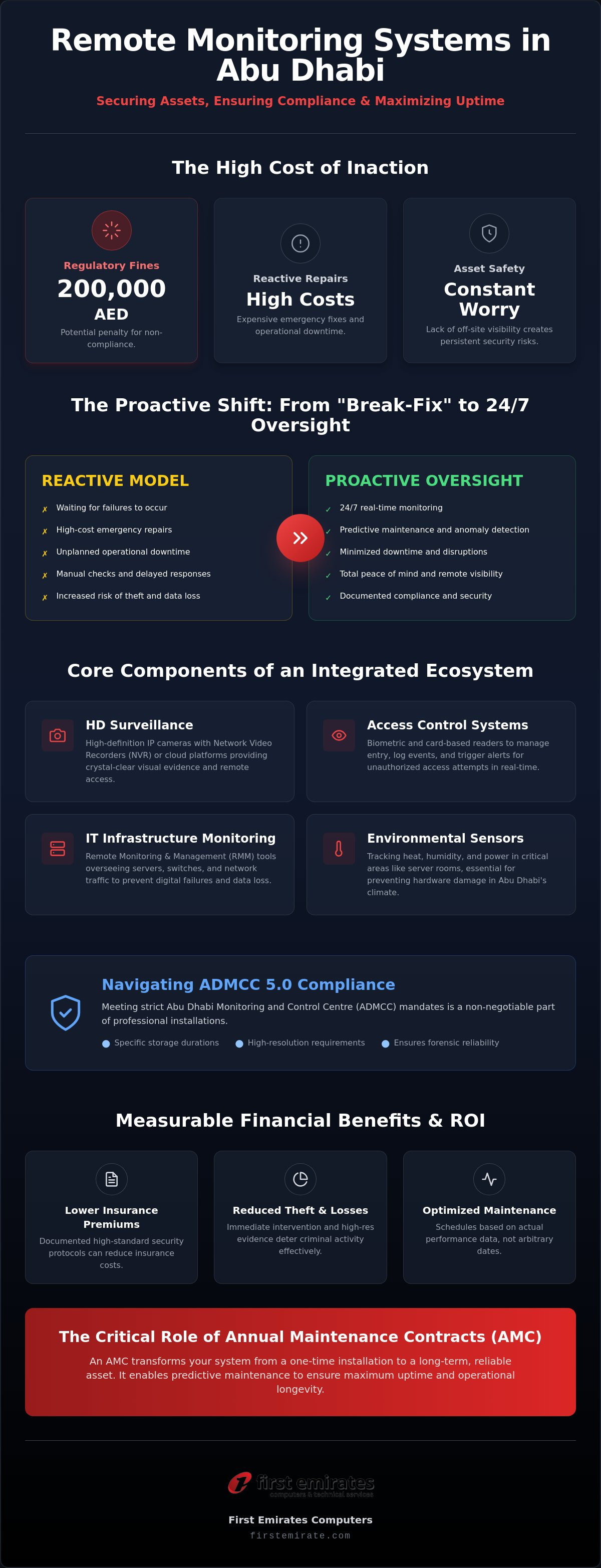
Operating a commercial facility without real-time oversight isn't just a security risk; in the current regulatory environment, it's a significant liability that can result in fines up to 200,000 AED. You likely recognize the stress of reactive IT repairs and the persistent worry about asset safety when you're off-site. Maintaining high productivity while navigating the strict requirements of ADMCC 5.0 compliance is a complex challenge for any business owner. Implementing professional remote monitoring systems Abu Dhabi wide provides a methodical solution to these operational pressures.
This guide demonstrates how integrated oversight secures your business assets and IT infrastructure through proactive 24/7 monitoring. You'll learn how to replace the high cost of emergency repairs with a steady, managed approach that provides total peace of mind. We'll examine the essential components of a compliant system, the role of Annual Maintenance Contracts in ensuring uptime, and how to utilize real-time data to prevent system failures before they impact your bottom line.
Key Takeaways
- Shift from reactive repairs to proactive 24/7 oversight to maintain constant visibility over your business assets and IT health.
- Identify the core components of an integrated ecosystem, including high-definition surveillance and biometric access control systems.
- Navigate the specific regulatory landscape by ensuring your remote monitoring systems Abu Dhabi installations meet ADMCC 5.0 standards and local data sovereignty rules.
- Understand the critical role of Annual Maintenance Contracts in performing predictive maintenance and ensuring long-term system reliability.
- Learn how a methodical site audit and custom ELV design provide a foundation for a secure and compliant infrastructure.
What are Remote Monitoring Systems and Why do Abu Dhabi Businesses Need Them?
Remote Monitoring Systems represent a centralized technology suite designed to track both security status and IT infrastructure health in real-time. For organizations in the capital, implementing professional remote monitoring systems Abu Dhabi wide marks a shift from the traditional "break-fix" model to a state of proactive 24/7 oversight. Rather than waiting for a hardware failure or a security breach to occur, these systems utilize a constant stream of data to identify anomalies before they escalate into critical incidents.
The core objective of this technology is the minimization of operational downtime. In Abu Dhabi's industrial zones, such as Musaffah, businesses often manage high-value assets and complex logistics that can't afford interruptions. Strict security mandates from local authorities require a level of vigilance that manual checks simply can't provide. By centralizing the management of CCTV, access control, and server health, a business gains a comprehensive view of its entire operational footprint from any location.
The Security vs. IT Infrastructure Hybrid
Modern monitoring isn't limited to just watching a video feed. It's a hybrid discipline that merges physical surveillance with digital systems health. Through the integration of ELV (Extra Low Voltage) systems, a unified data stream is created. This allows for live event notifications rather than just recorded footage. For instance, if a biometric reader in a warehouse detects an unauthorized entry attempt, the system doesn't just log the event; it can immediately trigger a high-definition IP camera to focus on that specific zone and alert the facility manager's mobile device. This convergence ensures that both the physical perimeter and the underlying IT hardware are functioning within established parameters.
Economic Impact of Remote Oversight
The financial benefits of remote monitoring systems Abu Dhabi organizations deploy are measurable across several areas. It reduces the necessity for constant on-site security personnel in every sector of a large facility. Smart surveillance can cover more ground with higher accuracy than manual patrols. It also protects the lifespan of expensive IT hardware. By monitoring server temperatures and power loads, the system prevents costly data loss and hardware burnout caused by cooling failures. Organizations often see a high ROI through:
- Lower insurance premiums due to documented, high-standard security protocols.
- Reduced theft losses through immediate intervention and high-resolution evidence.
- Optimized maintenance schedules based on actual equipment performance data rather than arbitrary dates.
The Core Components of an Integrated Monitoring Ecosystem
Building a robust oversight network requires a systematic integration of hardware and software. For organizations implementing remote monitoring systems Abu Dhabi based, this ecosystem consists of surveillance, access control, IT infrastructure management, and environmental sensing. Each component must communicate through a unified interface. This ensures that data from a biometric reader correlates precisely with visual evidence from a high-definition IP camera. Data integrity is the priority.
High-definition IP cameras serve as the visual foundation, providing remote access through Network Video Recorders (NVR) or cloud-based platforms. These systems must comply with technical standards set by the Abu Dhabi Monitoring and Control Centre (ADMCC). The ADMCC mandates specific storage durations and resolution requirements for commercial premises to ensure public safety and forensic reliability. Without meeting these benchmarks, a system cannot be considered fully professional or compliant.
IT infrastructure monitoring involves using RMM tools to oversee servers, switches, and network traffic. This digital oversight is a core part of comprehensive remote monitoring systems Abu Dhabi deployments, often paired with environmental sensors. These sensors track heat, humidity, and power status in critical server rooms. Since Abu Dhabi's climate places high demand on cooling systems, monitoring these variables is essential. A sudden spike in temperature or a humidity fluctuation can trigger an automated alert. This allows technical teams to intervene before hardware suffers permanent damage or data loss occurs.
Security Surveillance and Biometric Integration
Modern security strategies involve linking a professional CCTV installation Abu Dhabi directly to secure mobile applications. This allows management to view live feeds and receive push notifications for motion-triggered events. Biometric and RFID systems add a layer of accountability by logging every entry and exit remotely. This data is invaluable for monitoring staff attendance and controlling access to restricted zones like server rooms or chemical storage. High-definition resolution remains a technical priority because it ensures that remote forensic identification is clear and admissible if an incident requires investigation.
Structured Cabling: The Backbone of Remote Data
High-quality structured cabling services UAE are the literal backbone of any remote oversight strategy. Without a disciplined cabling layout, high-bandwidth video streams from 4K cameras will suffer from latency and packet loss. Professional installers utilize Cat6 or Fiber Optic cables to support these heavy data loads across large industrial or corporate sites. Building redundancy into the cabling infrastructure is a methodical way to prevent monitoring blackouts. If one path is compromised, the system automatically reroutes data to maintain the integrity of the live feed. For businesses seeking a stable foundation, exploring professional structured cabling solutions ensures your infrastructure can handle the demands of 24/7 oversight.
Abu Dhabi Specific Requirements: SIRA Compliance and Local Factors
Legal compliance in the capital is a strict prerequisite for business licensing. While regional enterprises often reference SIRA standards, organizations must prioritize the mandates of the Abu Dhabi Monitoring and Control Centre (ADMCC). As of February 2026, the ADMCC 5.0 standard is the governing framework for all security installations. Operating without MCC approval can lead to severe penalties; fines range from 50,000 AED to 200,000 AED. Implementing remote monitoring systems Abu Dhabi wide requires a methodical approach that aligns technical capabilities with these specific government regulations.
Data sovereignty and retention are critical pillars of local law. Standard commercial premises must store CCTV footage for a minimum of 30 days. However, licensed financial institutions face more rigorous requirements, with the Central Bank of the UAE mandating at least 90 calendar days of recordings. Following a professional guide to setting up a remote monitoring system helps ensures that your storage architecture can handle these high-bandwidth demands without failing during an audit.
Navigating Regulatory Compliance
Success depends on using certified contractors who understand mandatory camera placements and specific usability standards. For a remote system to be approved for licensing, it must provide clear, lag-free feeds to the authorities when required. Certified ELV contractors ensure that every component, from the IP cameras to the NVR, meets the technical benchmarks for forensic clarity. This disciplined attention to detail prevents operational disruptions during license renewals and ensures your facility remains in good standing with the MCC.
Industrial Monitoring: Musaffah and ICAD Focus
Industrial zones like Musaffah and ICAD present unique environmental challenges that affect system longevity. Extreme heat exceeding 45°C and pervasive dust can degrade standard hardware quickly. Professional remote monitoring systems Abu Dhabi deployments in these areas utilize industrial-grade housings and specialized cooling for outdoor components. For large-scale warehouses, perimeter security often incorporates long-range thermal imaging to detect movement in low-visibility conditions. Managing remote access across multiple geographically dispersed branches requires a centralized management platform. This allows a single security team to oversee various sites from a central command center, ensuring consistent protection across the entire industrial footprint. By integrating high-durability hardware with robust network connectivity, businesses in Musaffah can maintain 24/7 oversight despite the harsh local climate.
Maximising Uptime: The Role of Annual Maintenance Contracts (AMC)
A professional oversight system is only as effective as its last technical check. While remote monitoring systems Abu Dhabi organizations utilize are designed for 24/7 operation, the physical hardware remains subject to environmental stress and mechanical wear. Relying on a "break-fix" model is a high-risk strategy that often leads to data gaps when footage is needed most. A structured Annual Maintenance Contract (AMC) provides a steady, methodical approach to system health, ensuring every camera, sensor, and server remains operational.
Predictive maintenance is a core benefit of a professional contract. By monitoring the health of storage media, technicians can identify failing hard drives before they stop recording. This proactive replacement prevents the loss of critical evidence and ensures compliance with mandatory retention periods. Firmware updates are equally vital. These updates protect remote portals from evolving cyber threats, closing security vulnerabilities that could otherwise allow unauthorized access to your private network feeds. It's about maintaining a steady hand over your infrastructure to ensure peace of mind.
What an IT AMC Should Cover
A comprehensive maintenance agreement includes routine health checks for all IP cameras and biometric readers. In Abu Dhabi's industrial sectors, such as Musaffah, dust accumulation on optical lenses and sensors is a constant challenge. Regular cleaning and recalibration are necessary to maintain image clarity and biometric accuracy. A professional AMC also defines clear emergency response times for critical system failures. This ensures that if a primary monitoring gateway goes offline, technical support is deployed immediately to restore visibility. These scheduled visits prevent minor technical glitches from escalating into total system blackouts.
Software and Cybersecurity Oversight
Remote access portals must be encrypted and secure from external hacking attempts. A disciplined AMC includes regular audits of these access points to ensure protocols remain current. Backups of configuration data are also performed regularly. If a hardware failure occurs, these backups allow for rapid disaster recovery, returning the system to its optimal state with minimal downtime. Automated alerts are configured to "monitor the monitors," sending immediate notifications to the support team if a system component goes offline. To maintain the integrity of your security infrastructure, consider establishing a professional Annual Maintenance Contract tailored to your specific facility needs.
Implementing Your Remote Monitoring Strategy with First Emirates
First Emirates Computers has provided reliable technical services in the capital since 2011. Our approach to deploying remote monitoring systems Abu Dhabi organizations need is built on a foundation of local expertise and regulatory precision. We don't believe in generic deployments; every project follows a disciplined five-step roadmap to ensure full operational readiness and long-term stability.
- Step 1: Comprehensive Site Audit: Technicians conduct a thorough assessment of your physical infrastructure to identify blind spots and network limitations.
- Step 2: Custom ELV Design: We create a technical blueprint tailored to ADMCC 5.0 mandates, ensuring every camera and sensor is positioned for maximum compliance.
- Step 3: Professional Installation: Our teams implement structured cabling and hardware with a focus on durability and signal integrity.
- Step 4: Platform Integration: We synchronize your hardware with secure mobile and desktop platforms for seamless remote management.
- Step 5: Structured AMC: Ongoing support through an Annual Maintenance Contract ensures the system remains updated and functional.
This systematic process ensures that your investment in remote monitoring systems Abu Dhabi technology translates into actual business resilience. By following a structured path, we eliminate the technical friction often associated with complex security upgrades.
Choosing the Right Local Technical Partner
Selecting a partner with 15 years of local experience provides a distinct advantage in the UAE's specific regulatory environment. We manage every phase of the project, from the initial technical drawings to the final government approval. This methodical project management is essential for avoiding the delays common with inexperienced providers. While many firms offer "one-size-fits-all" software, these generic tools often fail to account for the unique bandwidth and environmental challenges of the Musaffah industrial landscape. A local specialist understands how to navigate these variables while maintaining a steady, professional presence.
Future-Proofing Your Business Technology
A professional monitoring strategy must account for future growth. Our designs prioritize scalability, allowing you to add additional IP cameras or environmental sensors as your Abu Dhabi operations expand. This modular approach prevents the need for costly infrastructure overhauls later. Beyond the workplace, we also offer the integration of home automation systems for executive residential security, providing the same level of professional oversight for your private assets. Securing your business and IT infrastructure requires a methodical, technical hand. Contact First Emirates today for a professional consultation to review your current security posture and implement a compliant, 24/7 monitoring solution.
Securing Your Operational Future in Abu Dhabi
Implementing a professional oversight ecosystem is a strategic move that addresses both security risks and technical downtime. By aligning your infrastructure with local mandates like ADMCC 5.0 and securing it through structured cabling, you create a resilient foundation for long-term growth. It's clear that a methodical approach ensures your remote monitoring systems Abu Dhabi installations remain compliant and operational in the face of both environmental and digital challenges. Transitioning from reactive repairs to a proactive 24/7 oversight model isn't just about security; it's about maintaining a disciplined grip on your operational efficiency.
First Emirates Computers brings 15+ years of Abu Dhabi technical expertise to every project, offering SIRA approved security solutions and comprehensive AMC support packages. Our team provides a steady, reliable presence in a complex technical landscape, ensuring your systems meet the highest industry standards. To ensure your business assets and IT infrastructure are protected by a seasoned, authoritative partner, Request a Professional Remote Monitoring Consultation from First Emirates Computers. Taking this proactive step today guarantees that your facility is prepared for the technical and regulatory demands of tomorrow.
Frequently Asked Questions
What is the difference between remote monitoring and traditional CCTV?
Remote monitoring provides real-time access and proactive alerts, while traditional CCTV often relies on local recording for retrospective review. Modern systems utilize cloud or NVR gateways to stream live data directly to mobile or desktop applications. This allows for immediate intervention and event notification rather than just reviewing footage after a security incident has already occurred.
Is remote monitoring legal for businesses in Abu Dhabi?
Yes, remote monitoring is legal provided it complies with the Abu Dhabi Monitoring and Control Centre (ADMCC) regulations. Businesses must ensure their systems meet current ADMCC 5.0 standards and maintain the required data retention periods. For most commercial entities, this involves 30 days of storage, while financial institutions require 90 days of recordings to remain compliant.
Do I need a special internet connection for remote monitoring systems?
You need a stable, high-bandwidth connection to ensure lag-free video streaming and reliable data transmission. Fiber optic connections are preferred for remote monitoring systems Abu Dhabi installations to handle the heavy upload requirements of high-definition feeds. Utilizing professional structured cabling further ensures that internal network speeds don't become a bottleneck for your remote access portals.
How does SIRA approval affect my remote monitoring setup?
While SIRA is the primary authority in Dubai, Abu Dhabi businesses must focus on ADMCC approval for their monitoring and control systems. ADMCC certification ensures your setup meets local technical benchmarks for resolution, storage, and camera placement. Using a certified contractor who understands these specific mandates is essential for passing government audits and maintaining your commercial trade license.
Can I monitor multiple warehouse locations from a single app?
Yes, modern centralized management software allows you to aggregate feeds from multiple geographically dispersed sites into one interface. This is particularly useful for industrial operations in zones like Musaffah or ICAD. You can view live footage, manage biometric access logs, and receive real-time alerts from all your locations on a single, secure mobile or desktop application.
What happens to the remote feed if the power goes out?
The remote feed will drop unless the system is supported by an Uninterruptible Power Supply (UPS) or a backup generator. Professional installations typically include battery backups for the NVR and network switches to maintain recording and connectivity during short outages. Once power is restored, the system's hardware is designed to reconnect to the network automatically without manual intervention.
How much does a remote monitoring system cost in Abu Dhabi?
The total investment depends on the number of cameras, storage requirements, and the complexity of the integrated ELV design. Factors such as the choice between IP or analog technology and the length of structured cabling needed also influence the final project scope. It's best to consult with a technical specialist for a site audit to receive an accurate assessment based on your facility's specific layout.
Is remote monitoring only for large corporations, or can small businesses use it?
Remote monitoring systems Abu Dhabi technology is highly scalable and beneficial for businesses of all sizes. Small businesses use these systems to reduce on-site security costs and prevent inventory shrinkage through constant oversight. The modular nature of modern hardware allows smaller enterprises to start with a basic setup and expand their monitoring capabilities as their operational footprint grows over time.


