

Construction site security cameras in the UAE help reduce theft, vandalism and unauthorised access when they cover vulnerable areas and provide clear footage for review. For Dubai construction sites, CCTV footage retention is commonly 30-90 days, depending on site classification. Remote viewing and AI detection can help managers monitor activity and receive alerts about restricted-area entry or potential safety violations.
Security cameras are useful only when their coverage, power supply and connectivity suit an active construction site. Gates move, fencing changes and equipment needs protection after hours, so the system should support practical monitoring as the project develops.
This article explains how AI detection and remote viewing work, which camera features can support site security, and how solar, battery-powered and 4G options can help where fixed power or connectivity is limited. It also covers camera placement and key considerations for CCTV installation in Dubai, giving you a clear basis for planning site coverage.
Key Takeaways
- Prioritise camera views at entry points, equipment storage and active work areas to focus coverage on site vulnerabilities.
- AI detection and remote viewing can help supervisors identify restricted-area entry and review activity across projects.
- Compare night vision, motion alerts and camera types against the areas and conditions you need to monitor.
- For Dubai sites, CCTV footage retention is commonly 30-90 days, depending on site classification.
- Where fixed power or connectivity is limited, consider how solar, battery-powered and 4G options could support camera placement as the site changes.
CCTV with AI detection, real-time alerts, and remote viewing
Remote CCTV combines live camera feeds, recorded footage and AI-based alerts. For construction site security cameras in the UAE, remote access can help managers monitor several project locations from a laptop or smartphone.
Remote Viewing and Monitoring
Remote viewing lets authorised managers open live camera feeds on a laptop or smartphone. A manager overseeing separate work areas can check the main gate, equipment storage and active zones without travelling between them. Decide which views help assess site activity and progress, then assign access according to each person’s role. This keeps camera access relevant and manageable.
Recorded Footage Access
Recorded footage provides a timeline for reviewing an incident or checking work activity after it happens. For example, a site supervisor can search footage around a reported entry and compare views from the gate and nearby storage area. In Dubai, CCTV footage retention is commonly 30-90 days, depending on site classification. Storage capacity and the recording system affect how footage is retained, so plan these alongside camera coverage.
Remote Monitoring and Access Control
Remote monitoring can complement access control by showing activity around controlled entrances. If a person enters a restricted area, an AI camera can alert supervisors, while access-control records can help establish whether entry was authorised. Biometric access control can limit entry to authorised personnel; align camera views with controlled doors and gates to make review more useful.
AI detection supports targeted alerts rather than relying only on someone watching a screen. Cameras can be configured to identify workers without helmets or protective vests, detect entry into restricted areas, or identify a person falling. These functions help supervisors focus attention on specific events. They do not replace site safety procedures or direct supervision.
Set alerts according to the site layout and routine. A camera covering a restricted equipment zone can flag entry, while another monitors a busy pedestrian gate. Position cameras so managers can interpret alerts against a clear view of the scene and review relevant footage when follow-up is needed. These are practical considerations when selecting construction site security cameras in the UAE.
Use a practical review sequence for remote monitoring:
- Open the live feed for the location named in the alert.
- Review recorded footage around the event and compare nearby camera views.
- Record the incident details and route the footage to authorised personnel.
For managers tracking progress across projects, remote access brings separate locations into one monitoring routine. Set clear permissions for live viewing and recorded footage, then use consistent review steps so alerts, camera views and follow-up remain connected.
Construction CCTV installation services in Dubai
Plan CCTV around site boundaries, changing work zones and project requirements. In Dubai, installation planning should also account for applicable security requirements and responsible handling of footage.
Flexible CCTV Project Planning
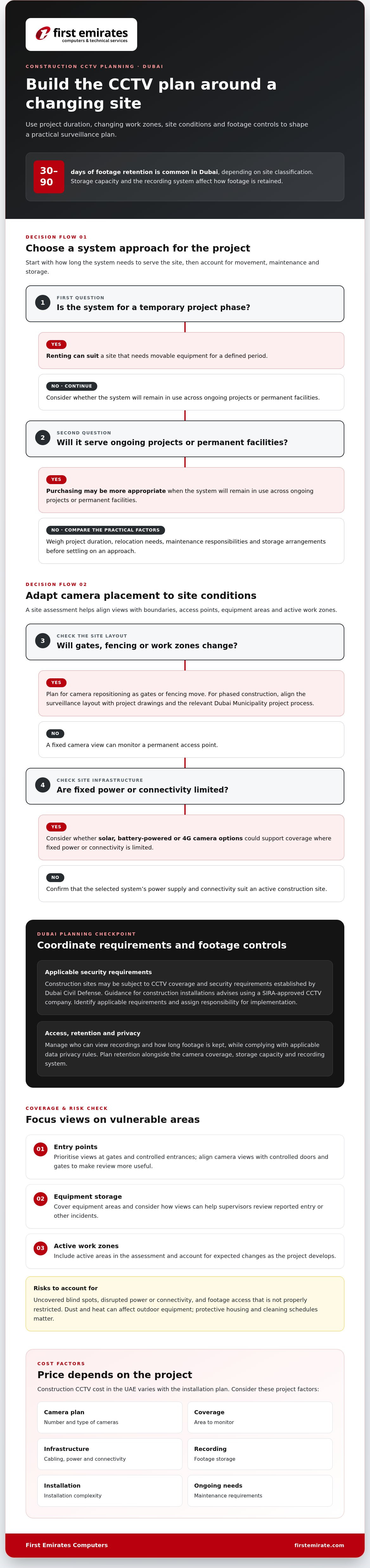
Start with a site assessment covering entrances, equipment areas, active work zones and expected changes. A camera covering a temporary gate may need repositioning when fencing moves, while a fixed view can monitor a permanent access point. For phased construction, align the surveillance layout with project drawings and the relevant Dubai Municipality project process.
Dubai CCTV Requirements and Regulations
Dubai construction sites may be subject to CCTV coverage and security requirements established by Dubai Civil Defense. Guidance for construction installations advises using a SIRA-approved CCTV company. Treat these as separate planning considerations: identify applicable requirements and assign responsibility for implementation.
Footage access and retention also need controls. Construction companies should manage who can view recordings and how long they are kept, while complying with applicable data privacy rules. In Dubai, CCTV footage retention is commonly 30-90 days, depending on site classification. Risks include uncovered blind spots, disrupted power or connectivity, and footage access that is not properly restricted. Dust and heat can also affect outdoor equipment, so protective housing and cleaning schedules matter.
Renting or Purchasing CCTV Systems
For a temporary project phase, renting can suit a site that needs movable equipment for a defined period. Purchasing may be more appropriate when the system will remain in use across ongoing projects or permanent facilities. Compare project duration, relocation needs, maintenance responsibilities and storage arrangements. Either approach needs a coverage plan that adapts as gates and work areas change.
Construction Camera Costs in the UAE
How much do construction site security cameras cost in the UAE? The price depends on the project and is provided after a quote request. Factors include the number and type of cameras, coverage area, cabling, power and connectivity, recording storage, installation complexity and maintenance needs.
For an installation plan, document the site layout, priority locations and project phases before defining camera positions. This gives the design a practical basis for coverage, footage retention and authority coordination. A structured CCTV installation plan can help organise those requirements around the construction project.
Camera features such as night vision and motion alerts
For a Dubai site, choose camera features according to the activity and hazards each view needs to capture. Night vision, motion alerts and AI detection serve different purposes, so configure each camera for a defined monitoring task.
Night Vision and Motion Alerts
Night vision supports monitoring after crews leave and lighting is limited, such as around a materials store. Motion alerts can draw attention to movement in a defined view, helping supervisors review activity instead of watching every feed continuously. During installation, consider lighting, obstructions and camera direction, as these affect what footage shows after dark.
Real-Time Alerts and Notifications
Real-time alerts are most useful when they identify events that need attention. AI cameras can alert supervisors to restricted-area entry or potential perimeter breaches. Depending on the system, detection may also identify workers without helmets or protective vests, or a person falling. Set rules around relevant work zones so notifications support a specific response rather than general observation.
Tamper Alerts and Theft Deterrence
Cameras can deter theft, and recorded footage may help identify suspected thieves or recover stolen items. Dome cameras offer wide-angle coverage and are difficult to tamper with, making them a consideration for exposed locations. If a system includes tamper alerts, define which events matter, such as an obstructed view or a moved camera. Pair alerts with a clear review and escalation process.
For fire-related monitoring, thermal cameras detect heat in smoky conditions or at night and can help identify a fire starting. This differs from motion detection: movement triggers activity-based detection, while a thermal camera responds to heat patterns. Consider the specific hazard and camera view before selecting a detection type. A thermal feed can add a monitoring layer where smoke limits ordinary visibility.
Image detail also matters when reviewing an alert. Construction-site surveillance systems can offer video coverage up to 4K, which may help supervisors examine activity in recorded footage. The usable detail depends on the camera’s position, view and lighting. Aim the camera at the relevant area, such as a gate or equipment zone, rather than a broad scene that leaves key activity too small to interpret.
During installation, connect each alert to a practical action. For example, a restricted-area alert can prompt a supervisor to open the live view, assess the scene and review recorded footage. A fall-detection alert should direct attention to the affected work zone. Clear alert names and assigned responsibilities help teams distinguish safety events from routine movement in busy construction areas.
Construction-site theft, vandalism and unauthorised access prevention
Effective site security combines camera coverage, controlled entry and a clear response process. Prioritise locations where equipment, materials or people enter and leave, then align surveillance with the site’s access-control arrangements.
Prioritise Vulnerable Site Areas
Plan camera views around the main vehicle gate, pedestrian entrance, fuel and generator storage, and overnight tool or material staging areas. These locations create useful coverage of entry activity and valuable assets. Add views of active work zones where vandalism could damage equipment or delay work. Dome cameras provide wide-angle coverage and are difficult to tamper with, which can suit exposed areas.
Visible cameras can deter theft, while recorded footage may help identify suspected thieves and support recovery of stolen items. Coverage matters: a camera aimed at a gate should show people or vehicles entering, not just a wide, distant view. Review sightlines as fencing, stored materials and site activity change. New obstructions can create blind spots even when a camera remains operational.
Use Access Control for Restricted Areas
Digital access control can limit entry to authorised personnel through biometrics, facial recognition or RFID cards. Assign permissions according to work responsibilities. For example, workers who need access to a general site area may not need access to fuel storage or a restricted plant room. In dusty, high-turnover sites, RFID cards can be more practical for regular workers than biometric readers.
Connect the access-control plan to camera coverage at controlled doors and gates. If an access event needs review, footage can show the surrounding activity and help establish what happened. AI surveillance can also detect restricted-area entry, vehicle recognition or unusual activity. These functions support oversight, but teams still need defined procedures for handling alerts and investigating incidents.
Integrate Cameras, Alarms and Entry Systems
Integrating cameras with alarms and access controls can create a coordinated security network. For instance, an alarm near a materials store can direct attention to the relevant camera view. Access records can help distinguish authorised entry from activity that needs investigation. Define which staff receive alerts and who reviews the associated footage.
Use a practical coverage review during site changes:
- Check camera views at the vehicle gate and pedestrian entrance.
- Confirm fuel, generator and overnight storage areas remain visible.
- Review access permissions for restricted zones and changing work teams.
- Test how alarms, camera views and entry records support incident review.
This approach combines visible surveillance, controlled entry and useful evidence. For example, a camera can record activity around a generator area while access control limits who can enter. Reviewing both systems together gives site managers a clearer basis for responding to theft, vandalism or unauthorised access.
Solar, battery-powered and 4G camera options
The best camera type depends on site power, connectivity and how often locations change. For construction sites in the UAE, fixed cameras can suit areas with reliable cabling, while solar or battery-powered units can cover places without direct power.
Match Power to the Camera Location
Solar-powered CCTV systems can operate without a direct power connection by charging batteries through solar panels. This can suit a remote boundary or temporary work zone where trenching for power is impractical. Before selecting a position, consider sunlight exposure, likely shading and whether the camera can be moved as the site develops. Solar power supports independence from fixed connections, but the camera still needs a suitable route for transmitting its video.
Power over Ethernet (PoE) is another option for fixed camera points. It carries power and network connectivity through an Ethernet cable, which can simplify installation where cabling can reach the camera. A wired connection may suit a gatehouse or permanent building, while a solar-powered unit can cover a temporary perimeter. Map power and data routes alongside camera locations to plan a comprehensive system.
Battery and Solar Power Options
Battery-powered cameras can provide temporary coverage where direct power is unavailable. Solar panels can recharge batteries, supporting operation at sites without a fixed connection. Mobile or temporary cameras may also be mounted on trailers or supplied with their own power, allowing teams to move coverage as work progresses. Select a position that can be accessed for maintenance and repositioning without obstructing site activity.
Construction sites can change layout every week as gates move, fencing extends, and camera locations or power availability shift. A practical review should compare the current site plan with camera positions, power sources and network coverage. For example, when a gate moves, check whether the existing camera still captures entry activity or whether a mobile unit needs relocation.
Connectivity for Mobile Cameras
4G connectivity is an option for solar- or battery-powered mobile camera towers. It can send video from locations without a fixed network connection, supporting remote monitoring while the camera remains mobile. Compare the camera position with available connectivity and the monitoring team’s needs. The power source keeps the unit running; the connection determines how its footage reaches viewers.
Choose the arrangement by location: use PoE where fixed cabling is practical, and consider solar or battery power where a camera must operate independently. Add 4G where mobile coverage needs a connection without fixed network cabling. To plan a CCTV surveillance system around changing site conditions, discuss CCTV system planning with the team.
First Emirates Computers: CCTV Surveillance Systems
First Emirates Computers supplies and installs CCTV Surveillance Systems for construction sites. Turn to the team when assessing camera locations, cabling needs or how site entry should be controlled. Biometric Access Control can support controlled entry, while Structured Cabling can connect CCTV equipment where wired infrastructure suits the project. Annual Maintenance Contracts provide an option for ongoing system support.
A project with permanent camera positions and controlled entry points may need coordinated planning across CCTV, access control and cabling. The arrangement depends on the site layout and operational requirements. Contact First Emirates Computers to discuss CCTV planning for your construction site.
Plan the Next Step for Your Site
Prepare a clear site brief by identifying the areas to monitor, how the project may change and who will use the system. This gives your installation discussion a practical starting point and helps align construction site security cameras in the UAE with day-to-day site operations.
First Emirates Computers supplies CCTV Surveillance Systems, Biometric Access Control and Structured Cabling. These solutions address camera coverage, controlled entry and the infrastructure connecting equipment. Share your project requirements with the team to discuss an arrangement suited to your site.
Contact First Emirates Computers to discuss your construction site camera installation. A considered plan can help your team move forward with greater clarity and a security setup designed around the work ahead.
Frequently Asked Questions
Which UAE companies supply or install construction site CCTV systems?
First Emirates Computers supplies and installs CCTV surveillance systems in the UAE. For a construction project, plan camera coverage around site entrances, equipment areas and cabling requirements. Biometric access control can support controlled entry, while structured cabling can connect cameras where wired infrastructure suits the site. Share the project layout and security priorities when discussing an installation, so the proposed system reflects how the site operates.
What are the UAE privacy and CCTV regulations for construction sites?
Construction companies should control who can access CCTV footage and how long it is retained, while following applicable data privacy rules. Define which roles can view recordings and establish a process for handling footage after an incident. Keep permissions aligned with staff responsibilities as project teams and site operations change.
Do UAE construction sites need permits or approvals to install CCTV cameras?
Dubai construction sites may be subject to CCTV coverage and security requirements established by Dubai Civil Defense. Guidance for Dubai installations also recommends using a SIRA-approved CCTV company. Requirements can depend on the site and its classification, so include relevant authority requirements in project planning. Do not assume one approval process applies throughout the UAE; location and project conditions affect the applicable installation steps.
How do solar-powered and 4G construction site cameras compare in the UAE?
Solar power supplies a camera by charging its batteries, while 4G provides a wireless connectivity option. They address different needs and can be used together: solar supports operation without a direct power connection, and 4G can transmit video from a mobile camera location. This can help on sites where layouts change every week. Assess camera positioning, available sunlight and connectivity separately when planning coverage.
What camera features help protect construction sites from theft and vandalism?
Useful features include night vision, motion alerts, remote viewing and recording, with AI detection for restricted-area entry or unusual activity. For example, a camera aimed at an equipment area can capture movement after working hours, while recorded footage supports incident review. Visible cameras can deter theft, and footage may help identify suspected thieves or recover stolen items. Choose features according to the risks at each location.
How to choose camera placement and coverage for a UAE construction site?
Begin by mapping the main vehicle gate, pedestrian entrance, fuel and generator storage, and overnight tool or material staging areas. Check that proposed camera views capture useful details rather than leaving key activity distant or obscured. Include active work zones where damage could disrupt operations. Revisit the layout when fencing, gates or storage areas move, so coverage continues to match the site.
Can construction site CCTV in the UAE be monitored remotely and how much does monitoring cost?
Yes. CCTV systems can provide remote viewing through an application on a laptop or smartphone, allowing managers to monitor multiple project locations. Monitoring cost depends on the project and is provided after a quote request; factors include camera setup, site coverage, connectivity, storage and monitoring scope. Remote viewing provides access to camera feeds, while monitoring by personnel is a separate service arrangement.


