

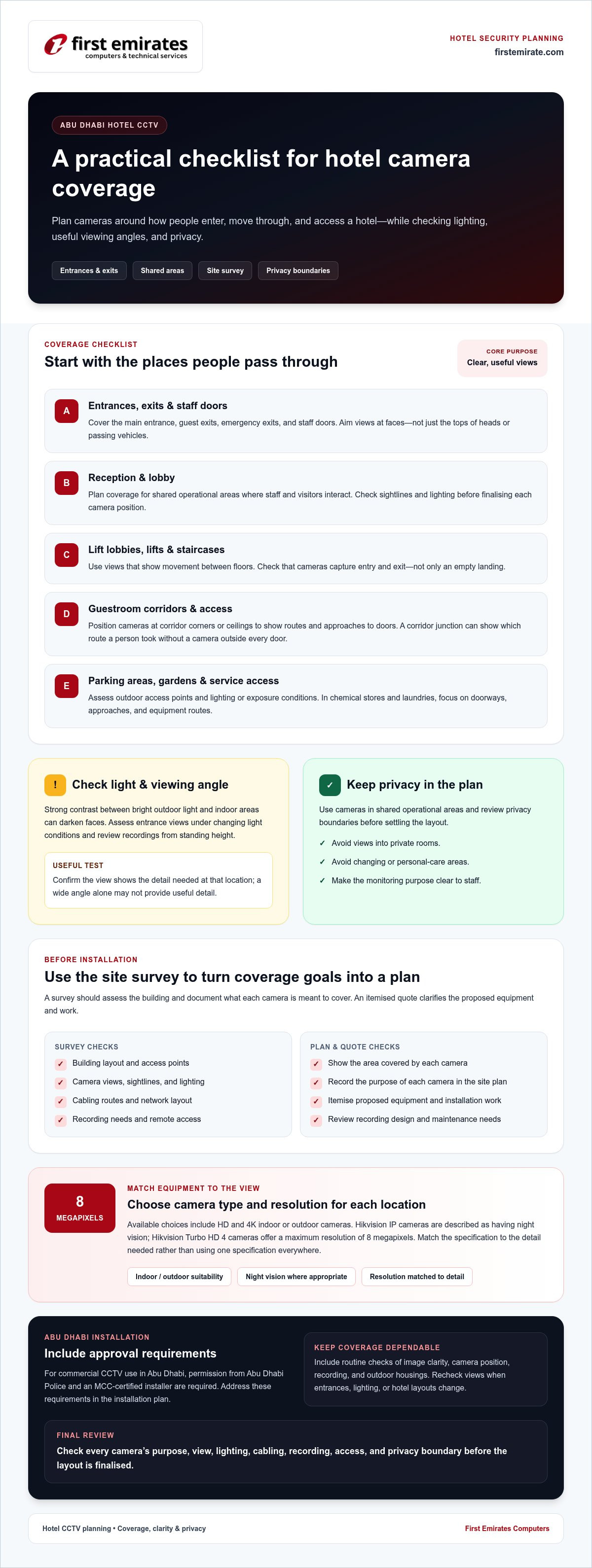
The most useful hotel security camera systems in Abu Dhabi prioritise entrances and exits, reception and lobby areas, lift lobbies, corridors, and access points to parking areas or gardens. Camera position and viewing angle matter as much as coverage, particularly at entrances, where strong light contrast can obscure faces. Plan camera placement in guest areas carefully to respect privacy.
A hotel CCTV plan should cover the points where people enter, move between floors, and interact with staff. A site survey turns that goal into a practical layout by assessing the building, lighting, camera views, cabling routes, recording needs, and remote access. An itemised quote then clarifies the proposed equipment and work.
This guide explains which hotel areas cameras can monitor, what a survey and quote should address, and how storage, remote viewing, and UAE privacy requirements affect system choices. It also outlines the factors that shape project costs, helping hotel teams assess the scope before deciding on next steps.
Key Takeaways
- Prioritise entrances, reception areas, lift lobbies, and outdoor access points, then assess camera angles and lighting to make footage useful.
- Use a site survey to map coverage, cabling routes, recording needs, and remote access before comparing itemised project scopes and cost factors.
- Plan corridor and guestroom-access monitoring to address visibility and unauthorised access while respecting guest privacy.
- Choose recording and remote-viewing arrangements around the hotel’s operational needs, network layout, and retention requirements.
- The UAE PDPL is Federal Decree-Law No. 45 of 2021, and biometric templates are Sensitive Personal Data under that law, according to the UAE legislation register.
What are the Best Places to Install a CCTV Camera System in Hotels?
For hotels in Abu Dhabi, prioritise entrances, exits, reception, lift lobbies, and outdoor access points. Position cameras to capture clear views of faces, and plan for commercial CCTV approval and installation requirements.
Hotel Entrance and Exit Coverage
Cover the main entrance, guest exits, emergency exits, and staff doors. These views help establish who entered or left and when. At each entrance, angle the camera to capture faces, not just the tops of heads or passing vehicles. Strong light contrast in Abu Dhabi can darken faces against bright outdoor backgrounds, so assess each view under changing light conditions.
Hotel Camera Placement Requirements
There is no single camera layout for every hotel. Match coverage to the property’s access points and risks. For commercial CCTV use in Abu Dhabi, permission from Abu Dhabi Police and an MCC-certified installer are required. Place cameras in shared operational areas, then review sightlines, lighting, and privacy before finalising the layout. Record the purpose of each camera in the site plan.
Extend coverage to reception and lobby areas, where cameras can help deter theft, fraud, and disputes. Cameras in lift lobbies and lifts can show movement between floors, while those in staircases and guestroom corridors can help identify unauthorised access. Parking areas and gardens may also need coverage. For outdoors, choose cameras suited to the lighting and exposure conditions, including night-vision and weatherproof options where appropriate.
Hikvision is a named CCTV option in Abu Dhabi. Hikvision IP cameras are described as having night vision, while Hikvision Turbo HD 4 cameras offer a maximum resolution of 8 megapixels. Available CCTV choices also include HD and 4K indoor or outdoor cameras. Match resolution and camera type to the detail needed at each location, rather than choosing one specification for every view.
The same planning approach applies to offices, clinics, and retail businesses. An office may prioritise reception and staff entrances, a clinic may focus on shared access areas, and a retailer may monitor entrances, tills, and sales-floor routes. In every setting, match CCTV coverage to the activity being monitored. Where door permissions matter, consider how access control can support the camera plan.
When choosing a CCTV installation company, review its survey process, proposed camera positions, cabling plan, and recording design. For installation in Abu Dhabi, address commercial approval requirements and the MCC certification requirement. A clear plan should show which entrances, lobbies, or outdoor areas each camera covers, making gaps easier to spot before work begins.
Maintenance matters: a blocked lens, failed connection, or misaligned camera can weaken coverage. Include routine checks of image clarity, camera positioning, recording, and outdoor housings in the maintenance plan. Hotels that depend on continuous CCTV monitoring may benefit from an Annual Maintenance Contract. Regular upkeep helps keep the system operational as entrances, lighting, or hotel layouts change.
Monitoring hallways, corridors, and guestroom access
Corridor cameras help hotel teams review movement between shared areas and guestroom doors. Position them at corners or on ceilings to capture the corridor and approaches to doors, while avoiding views into private rooms. For example, a camera at a corridor junction can show which route a person took without needing a camera outside every door. Review the recorded view from standing height, since a wide angle alone may not provide useful detail.
Coverage can support investigations into unauthorised access, suspicious activity, or reported hallway noise. A camera records movement; it does not establish why a guest entered an area or resolve a complaint on its own. Review footage alongside the incident’s time and location, then follow the hotel’s procedures. In lifts and staircases, check that the camera captures entry and exit, not just an empty landing.
Kitchen monitoring needs a different approach. Frequent movement, steam, reflective surfaces, and overlapping work zones can complicate video analysis in busy kitchens. AI analytics cannot reliably identify theft in a busy hotel kitchen. Use footage to locate relevant periods and speed up review, rather than treating an alert as proof. Position cameras to show work routes and access points, and make the monitoring purpose clear to staff.
Remote video monitoring lets authorised hotel personnel review footage from different areas without being beside the recorder. Define which users can view or export recordings, and establish a controlled process for handling incidents. In larger properties, edge-AI cameras at choke-points can flag activity for review, while server-side analytics can correlate events across cameras. These systems should support human review, not replace it.
Service areas also need deliberate coverage. In a chemical store, aim the camera at the doorway and approach to record access, rather than just the shelves. In a laundry, position cameras near entry points and equipment routes where staff movement or property handling may need review. Avoid areas used for changing or personal care. In both locations, check lighting and image clarity during the working shift.
Map each camera to a specific purpose: corridor movement, guestroom access, kitchen review, or service-area entry. Then test daytime and night vision, review privacy boundaries, and confirm that footage can be found by location and time. A hotel team planning these decisions can use a hotel CCTV coverage plan to organise monitoring priorities across guest and staff areas.
Hotel site surveys and itemised quotations
A hotel site survey turns security priorities into a camera layout and defined project scope. Walk the property with a floor plan, noting entrances, reception, corridors, lifts, parking, gardens, and service areas. At each location, record lighting, viewing direction, obstructions, and available cabling routes. This gives the quotation a practical basis and helps identify blind spots before installation.
For indoor surveillance, assess reception and lobby activity from the camera’s intended position. A useful view should show movement through the area and help with incident review, rather than simply displaying a wide room. Assess outdoor areas separately for exposure, lighting, and distance. Parking areas and gardens may call for night vision and weatherproofing; a parking entrance may also require a camera suited to license plate recognition.
Hotels with broad parking areas can assess PTZ cameras, which can cover large areas such as parking lots. The survey should identify what each camera must observe and whether a fixed view or adjustable coverage better suits the location. Warehouse operators can apply the same planning method to loading areas, storage aisles, and vehicle access. In both settings, map camera views to operational routes and security objectives.
An itemised quotation should separate the main project components so hotel teams can understand the proposed work. Review it for:
- Camera types and intended locations, such as reception, lobby, or parking access.
- Recording equipment, storage, and the planned method for remote viewing.
- Cabling, power connections, installation work, configuration, and testing.
- Any maintenance scope, with the covered equipment and service tasks clearly described.
Compare each line with the survey plan. If a camera appears in the quotation without a stated purpose, ask how its view supports the hotel’s coverage plan. If a surveyed area has no camera listed, determine whether the omission is intentional or leaves a coverage gap. This comparison makes security solutions easier to assess without treating every camera as interchangeable.
Project pricing depends on the case and is provided after a quote request. Key factors include camera count and type, cable routes, site access, recording capacity, and outdoor requirements. A clear quotation connects these factors to specific work rather than presenting an unexplained total. For example, an exposed parking entrance may require different equipment and cabling from an indoor lobby camera.
Before approving the scope, check that the plan distinguishes indoor and outdoor cameras, identifies reception and lobby views, and explains parking coverage. Confirm that testing and handover are defined tasks. This final review connects the survey findings to the itemised quotation and gives hotel management a clear basis for assessing project scope and planned coverage.
Network video recorders and remote access
Hotel CCTV systems should include suitable recording, controlled remote viewing, and access-control integration. AI analytics can help direct footage review but cannot reliably identify theft in a busy kitchen. Key cybersecurity risks include unauthorised viewing, exposed recordings, and misuse of staff accounts, so limit access and secure the network and recorder.
A network video recorder (NVR) stores footage from compatible IP cameras in one surveillance system. A central recorder can make it easier to review cameras across a hotel, while a hard disk drive or NVR provides local storage. For shops and offices, NVR systems can record for up to 30 days. Hotel recording duration depends on camera count, image settings, storage capacity, and the selected retention plan.
Remote access lets authorised users view cameras through a local area network or the internet. Decide which roles need live viewing, playback, or footage export. For example, a duty manager may need to review an incident, while routine users may only need live views. Use individual accounts, strong passwords, and permissions limited to each person’s duties. Avoid shared logins, which make activity harder to trace.
Protect the remote connection as part of the installation. Keep the recorder on a managed network, restrict access to approved users, and change default credentials before operational use. Review account permissions when staff responsibilities change. These steps reduce the risk that an unused account or exposed device becomes a route to hotel footage. Remote viewing should support operations without making recordings broadly accessible.
Access-control integration can connect camera footage with door activity. A hotel may use card readers or intercoms at staff entrances, then review relevant footage alongside access events. This can help teams understand a specific entry sequence. Keep each system’s purpose clear, and ensure users know which records they can access. Biometric access control also requires careful handling of information associated with credentials.
AI analytics can flag events or camera views for review, while cross-camera analytics can correlate activity across a property. Treat analytics as a review aid, not a final judgement. In a busy kitchen, for example, analytics cannot reliably identify theft; operators can use them to locate relevant footage faster. Human review is still needed to interpret context and determine what a recording shows.
Before handover, test the complete setup in its operating environment. Confirm that each IP camera appears on the NVR, recordings can be played back, remote access works for authorised accounts, and access-control events can be reviewed alongside relevant footage. Document account roles, storage settings, and footage-export procedures. This gives hotel teams a repeatable process for managing recordings and responding to incidents.
Local authority requirements and privacy considerations
Abu Dhabi hotels should address authority approval, footage access, and privacy during CCTV planning. Set retention according to the hotel’s purpose and applicable requirements, rather than assuming one duration suits every property.
Local Authority Requirements
Commercial CCTV use in Abu Dhabi requires permission from Abu Dhabi Police and an MCC-certified installer. Before installation, establish whether the property or activity needs approval from the relevant authority, then include that requirement in the project plan. The UAE PDPL is Federal Decree-Law No. 45 of 2021, and biometric templates are Sensitive Personal Data under that law, according to the UAE legislation register.
Staff Privacy and Exception-Based Alerts
Staff privacy depends partly on where cameras point and how recordings are reviewed. Define a clear monitoring purpose for each view, such as controlling access to a chemical store, and limit footage access to authorised roles. Exception-based alerts can direct attention to unusual activity, but an alert should prompt a review, not serve as proof of misconduct.
For example, a hotel can configure monitoring around a staff-only doorway to flag access outside its usual pattern. Managers should assess the recorded context before acting, since a camera may not show why an employee entered. Tie alert rules to specific operational risks, and review them when access procedures or work areas change. Avoid continuous scrutiny of routine staff activity when targeted monitoring addresses the concern.
Guest Privacy and Footage Retention
Place cameras in shared areas such as reception, corridors, and lift lobbies, framing views to avoid private guest spaces. In a guestroom corridor, aim at shared circulation and door approaches, not inside rooms. Access to CCTV footage on mobile devices should use authorised accounts, with permissions limited to staff who need recordings for defined duties.
Abu Dhabi’s stated requirements do not set a single footage-retention duration for every hotel. Set a documented period based on the surveillance purpose and applicable requirements, then configure the recorder accordingly. Restrict playback and export, and record who handles footage during an incident review. These controls apply whether the hotel uses Hikvision equipment or another CCTV system.
Before activating CCTV systems, map camera views, approval responsibilities, alert rules, and footage access in one review. This helps hotel organizations connect privacy safeguards with operational monitoring. For help planning hotel CCTV privacy and coverage, align each camera’s purpose with its position and access controls.
First Emirates Computers: CCTV Surveillance Systems
First Emirates Computers provides CCTV Surveillance Systems for hotel teams planning new coverage or reviewing an existing setup. Use its CCTV service to turn a camera layout into a coordinated installation, or to plan surveillance for reception, guest access, and service areas. Structured Cabling supports the physical connections across the property, while Biometric Access Control can support controlled staff entry. For ongoing system upkeep, Annual Maintenance Contracts offer a defined maintenance option. The right scope depends on the hotel’s layout, monitoring priorities, and existing infrastructure. Share your project requirements with First Emirates Computers to discuss the next step.
Set a Clear Direction for Your Hotel’s Security Plan
Planning hotel security camera systems in Abu Dhabi is an opportunity to align surveillance with how guests and staff use the property. Treat the next step as an operational decision: identify the areas that matter most, decide who needs access to footage, and define how the system should support hotel procedures as they evolve.
First Emirates Computers offers CCTV Surveillance Systems, Biometric Access Control, and Structured Cabling for projects where camera coverage, controlled entry, and supporting infrastructure need to work together. A focused discussion about your hotel’s priorities can help shape a practical scope for the next stage, recognising that each property has different requirements.
Contact First Emirates Computers to discuss your hotel’s CCTV requirements and plan a suitable next step. A well-defined project starts with clear priorities and a considered approach.
Frequently Asked Questions
Can AI CCTV detect theft automatically in the back-of-house?
No. AI analytics cannot reliably identify theft in a busy hotel kitchen, where staff, equipment, and routine movements overlap. Use analytics to flag activity or locate relevant footage for faster review, then have an authorised person assess the context. For example, an alert near a service entrance can guide a review of that camera’s recording, but it is not proof that theft occurred.
Edge-AI cameras or server-side analytics for a hotel?
Use edge-AI at specific choke-points when local event detection is useful, and server-side analytics when the task involves comparing activity across cameras. A hotel might use edge processing near a staff entrance, then correlate related views centrally during an incident review. The choice depends on camera locations, network design, and whether the operational need is a local alert or a property-wide view.
What Does a Professional CCTV Installation Service Include?
A professional installation turns the hotel’s coverage plan into a tested working system. The project should define camera positions, cabling routes, power connections, recording equipment, configuration, and handover. Testing should confirm that each camera produces a usable view and that recordings can be retrieved. For example, a manager should be able to locate a sample recording from a designated lobby camera using the agreed review process.
What about PDPL where staff faces are captured?
The UAE PDPL is Federal Decree-Law No. 45 of 2021, and biometric templates are Sensitive Personal Data under that law, according to the UAE legislation register. A CCTV image showing a staff member’s face is not automatically the same as a biometric template. Set a clear monitoring purpose, restrict who can view or export recordings, and treat biometric access data with particular care.
Why Is CCTV Installation Important for Businesses in Abu Dhabi?
CCTV can help businesses review incidents, monitor access points, and investigate disputes or suspicious activity. In an office, footage can help establish movement through reception; in a retail setting, it can support review of a reported incident. Cameras do not replace physical security or access control. Their value depends on useful placement, reliable recording, and a clear process for reviewing footage.
Which CCTV and security camera systems are suitable for hotels in Abu Dhabi?
Suitable hotel security camera systems in Abu Dhabi depend on the space, lighting, and detail needed in each view. Camera options vary by setting, including models designed for indoor and outdoor use. Hikvision IP cameras have night vision, and Hikvision network video recorders are compatible with IP cameras. Match each component to its intended use.
What are the UAE and Abu Dhabi regulations for hotel CCTV systems and guest privacy?
Commercial CCTV use in Abu Dhabi requires permission from Abu Dhabi Police and an MCC-certified installer. Businesses should also establish whether their property or activity needs approval from the relevant authority. Plan camera views to monitor shared operational areas without intruding into private guest spaces. The UAE PDPL also matters when systems process biometric templates, which are Sensitive Personal Data under the law.
How much does hotel CCTV installation cost in Abu Dhabi?
Project cost depends on the scope and is provided after a quote request. Key factors include camera types and quantities, cabling routes, site access, recording capacity, remote-viewing requirements, and outdoor conditions. A site survey connects these decisions to a defined scope, while an itemised quotation separates equipment and installation work. This helps hotel teams assess the proposed coverage before approving the project.


