

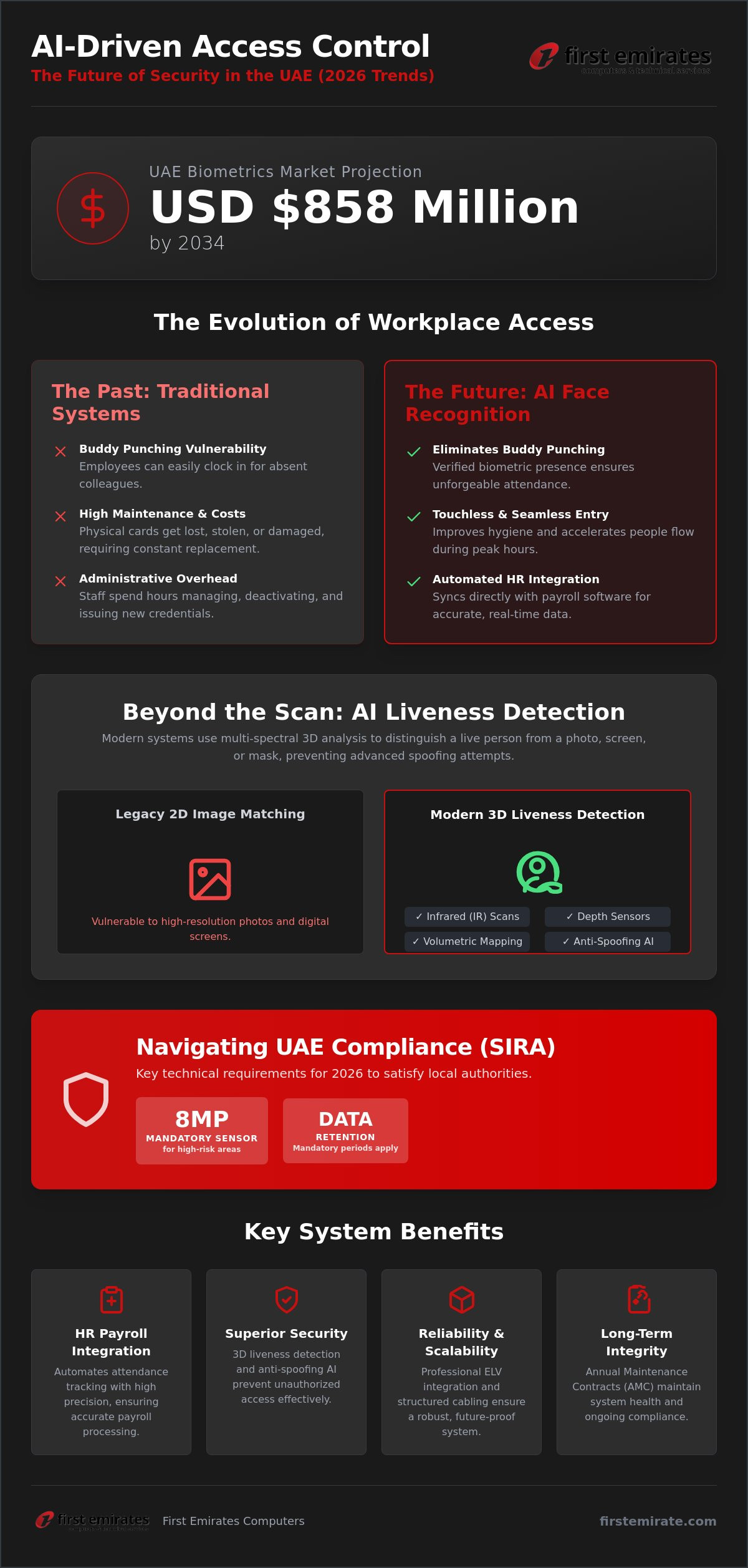
With the UAE biometrics market projected to reach over USD 858 million by 2034, the transition from plastic keycards to AI-driven identity is no longer a futuristic concept; it's a standard business requirement. Many organizations across Dubai and Abu Dhabi are now prioritizing face recognition access control UAE systems to eliminate the persistent issues of buddy punching and the high maintenance costs of traditional hardware.
You're likely looking for a way to streamline entry while ensuring your facility meets the latest SIRA resolution requirements, which now mandate 8MP sensors for high-risk facial capture areas. This article provides a comprehensive look at how AI-driven technology is transforming workplace security and regulatory compliance in 2026. We'll examine the shift toward cloud-native solutions, seamless HR payroll integration, and the technical steps necessary to satisfy local authorities while maintaining a touchless, secure environment.
Key Takeaways
- Understand how face recognition access control UAE systems have evolved into multi-spectral 3D analysis to provide superior liveness detection and security.
- Learn the technical specifications required by SIRA and local authorities for 2026, including mandatory data retention periods and specific sensor resolutions.
- Discover how to integrate biometric systems with HR payroll platforms to eliminate buddy punching and automate attendance tracking with high precision.
- Identify the importance of professional ELV integration and structured cabling to ensure your access control system remains reliable and scalable.
- Evaluate the long-term benefits of Annual Maintenance Contracts (AMC) for maintaining system integrity and meeting ongoing regulatory standards.
The Evolution of Face Recognition Access Control in the UAE (2026 Trends)
In the context of the UAE's rapid digital transformation, facial recognition technology has transitioned from a specialized security feature into a fundamental component of corporate infrastructure. By 2026, the definition of these systems has matured significantly. They're no longer just cameras capturing simple images; they're AI-driven biometric processors that analyze unique facial geometry to grant or deny access in milliseconds. This methodical approach to identity management ensures that security is both invisible and absolute.
The most significant technological shift in 2026 is the transition from 2D image matching to multi-spectral 3D analysis. While older systems could occasionally be compromised by high-resolution photographs or digital screens, current face recognition access control UAE standards utilize infrared and depth sensors to map the physical contours of a face. This ensures that only a living, physical person can trigger the system. UAE businesses are rapidly abandoning legacy RFID card systems because cards are easily lost, shared, or stolen. The "Smart UAE" initiative has been a primary driver of this change, encouraging the corporate sector to adopt biometrics to align with the nation's vision for a seamless, paperless, and highly secure urban environment.
Touchless Entry: The New Standard for UAE Workplaces
Facility managers in high-end Abu Dhabi commercial towers now view touchless entry as the baseline for modern workplace standards. Beyond the obvious hygiene benefits, removing physical touchpoints accelerates the flow of people during peak hours. From an HR perspective, the reduction in "lost card" administrative overhead is substantial. Administrators don't need to spend hours each week deactivating lost credentials and printing replacements. Instead, the face recognition access control UAE system manages credentials digitally, offering a smoother experience for both long-term employees and temporary visitors.
Integration with Time and Attendance Systems
One of the most practical applications of this technology is its direct link to time and attendance. Buddy punching, where one employee clocks in for another, is effectively eliminated because the system requires a verified biometric presence. Modern installations facilitate real-time data synchronization with local payroll software, ensuring that attendance records are accurate and immediately available for processing. By automating these verification steps, face recognition access control UAE systems maximize workforce ROI in 2026 by ensuring every dirham spent on payroll is backed by verified, unforgeable attendance data.
Beyond the Scan: How AI and Liveness Detection Redefine Security
Modern security protocols in the Gulf region now demand more than simple image capture. Verification is the priority. High-performance face recognition access control UAE systems in 2026 utilize 3D depth sensing to ensure that the person at the door is physically present. This technology uses specialized infrared (IR) cameras to measure the unique topography of a face, including the distance between the eyes and the bridge of the nose. By creating a volumetric map, the system can instantly distinguish between a living human and a high-resolution photograph or a digital screen replay. It's a methodical approach that eliminates the vulnerabilities associated with older 2D scanning methods.
This technical rigor aligns with the UAE government's biometric identification plans, which prioritize high-fidelity data for national security. For facilities like Dubai and Abu Dhabi malls, where foot traffic is constant, sub-second matching is essential. These terminals handle thousands of entries daily without creating bottlenecks. Additionally, many businesses are now integrating thermal screening into their access points. This creates a dual-purpose system that monitors both health parameters and security credentials simultaneously, providing a comprehensive oversight solution for large-scale corporate environments.
Anti-Spoofing Technology in 2026
Security breaches have become more sophisticated, but liveness detection has kept pace. Current systems are calibrated to detect advanced spoofing attempts, such as 3D silicone masks or deepfake video projections. This is particularly critical for high-security zones like data centers or financial vaults where identity theft is a significant risk. Professional calibration is necessary to ensure these sensors function correctly under different light conditions. Outdoor terminals in the UAE must account for intense sunlight, while indoor systems require sensitivity to artificial lighting to maintain consistent accuracy.
Processing Power at the Door
The industry has shifted from centralized server processing to "Edge" computing. This means the biometric data is processed locally on the device itself rather than being sent to a distant server. It's a more secure and efficient architecture. Local processing reduces network latency, allowing for the seamless throughput required in busy lobbies. It also aligns with UAE data sovereignty preferences, as sensitive biometric information stays within the local hardware. To keep these edge devices running at peak performance, a proactive Annual Maintenance Contract is recommended to manage firmware updates and sensor cleaning. This systematic maintenance ensures that your face recognition access control UAE infrastructure remains a reliable, long-term asset for your organization.
Comparing Face Recognition with Traditional Biometric Systems
Selecting the appropriate biometric modality requires a methodical evaluation of security needs, environmental conditions, and user throughput. While fingerprint scanners have historically dominated the market, face recognition access control UAE systems have become the preferred choice for modern infrastructure in 2026. Fingerprint systems often encounter operational hurdles in the Gulf, where high humidity and dust can interfere with sensor accuracy. Additionally, contact-based systems require frequent cleaning to maintain hygiene standards and sensor clarity, leading to higher long-term maintenance costs compared to non-contact facial terminals.
When compared to iris scanning, facial recognition offers a more balanced profile for general corporate use. Iris scanning provides extreme security but often at a significantly higher price point and with a more intrusive user experience. Facial recognition provides sub-second authentication without requiring the user to pause or align their eyes with a specific lens. This makes it the superior choice for high-traffic entry points where maintaining a steady flow of people is essential. Many organizations are now adopting a hybrid approach, using facial biometrics as the primary credential while integrating mobile-based 2FA for restricted areas. This strategy ensures that businesses remain compliant with Safeguarding Individual Privacy under UAE Law by managing biometric data through encrypted, localized templates.
Operational Pros and Cons
The primary advantage of face recognition access control UAE technology is its environmental resilience. In the UAE's industrial zones, workers often have soiled hands or wear gloves, making fingerprint scanners impractical. Facial recognition bypasses these physical limitations entirely. While the initial hardware investment for AI-capable facial terminals is higher than for legacy RFID readers, the operational savings are realized through the elimination of physical card management and the reduction in hardware wear-and-tear. Because the system is touchless, there's no mechanical degradation of the scanning surface, ensuring a longer lifecycle for the installation.
Choosing the Right Modality for Your Sector
Sector-specific requirements often dictate the final system design. Corporate offices in Abu Dhabi prioritize aesthetics and speed, making sleek facial recognition terminals the ideal fit. In contrast, construction and heavy industrial sectors value the technology for its robustness and ability to function despite the presence of dust or safety gear. For a detailed breakdown of how different systems perform across various industries, refer to our Access Control System Company comparison guide. This resource provides a systematic framework for selecting a solution that aligns with your specific operational environment and security tier.
Navigating UAE Compliance: SIRA Standards and Data Privacy
Compliance in the UAE is a fundamental requirement for maintaining a valid commercial trade license. For any organization implementing face recognition access control UAE technology, the Security Industry Regulatory Agency (SIRA) in Dubai and the Monitoring and Control Centre (MCC) in Abu Dhabi define the mandatory hardware and installation standards. These agencies ensure that security systems are not only functional but also capable of providing high-quality forensic evidence when required. As of 2026, SIRA has updated its requirements for facial capture areas, now mandating a minimum resolution of 8MP to ensure biometric data is clear and actionable.
System uptime is equally scrutinized by local authorities. SIRA regulations mandate that continuous surveillance data must be stored for at least 31 days on specialized surveillance-grade hard drives. Failing to meet these storage or resolution standards can lead to significant fines or delays during trade license renewals. This is why an Annual Maintenance Contract (AMC) is indispensable. A professional AMC ensures that your system undergoes regular audits and performance checks, keeping your hardware in line with the latest regulatory updates without administrative friction.
SIRA and MCC Compliance in Abu Dhabi and Dubai
System approval requires more than just high-end hardware; it demands that the installation be performed by certified technicians. These professionals understand the specific cabling and mounting requirements that authority inspectors look for during an audit. In Abu Dhabi, compliance often involves specific ELV integration protocols to ensure system longevity. First Emirates Computers manages this entire lifecycle, from the initial systematic design to the final authority audit, ensuring your face recognition access control UAE system satisfies all local mandates from the moment it's activated.
Biometric Data Security Protocols
Data privacy is a priority for both employees and corporate stakeholders. Federal Decree Law No. 45 of 2021 remains the primary legislation governing personal data protection in the UAE. It's critical to understand that modern systems store biometric templates, which are mathematical representations of facial geometry, rather than actual photographic images. These templates are encrypted to prevent unauthorized access. To maintain this security layer, ensure your access control system maintenance plan includes regular security patch updates to protect against emerging cyber threats. If you're unsure about your current system's compliance status, contact First Emirates Computers for a professional regulatory assessment.
Implementing Future-Proof Access Control with First Emirates Computers
Transitioning from a theoretical security plan to a physical deployment requires a methodical framework that prioritizes system longevity and technical integrity. At First Emirates Computers, we approach every project with a systematic design phase that considers the specific layout of your facility and the expected user throughput. We don't just sell devices; we deliver fully integrated ELV projects that serve as the backbone of your building's security architecture. This comprehensive approach ensures that your face recognition access control UAE system is not a standalone tool but a primary component of a broader, unified security strategy.
The reliability of any biometric system is fundamentally tied to the quality of its underlying network. We provide comprehensive structured cabling services to ensure that every terminal has a stable, high-bandwidth connection to the central management server. Without professional cabling, even the most advanced AI-driven cameras can suffer from latency issues or data loss, undermining the security of the entire facility. Our technicians ensure that all wiring is organized, labeled, and protected against the environmental factors typical of the UAE, ensuring consistent system uptime.
The Role of Integrated ELV Systems
A unified security posture is achieved when various systems communicate without friction. Our expertise in ELV project integration allows us to connect your access control terminals directly with CCTV installation in Abu Dhabi protocols. This integration ensures that every face recognition event is cross-referenced with video footage, providing a secondary layer of verification for security audits. By managing the communication between door controllers and central management software, we eliminate the operational silos that often lead to security gaps in complex commercial environments. Our process follows a disciplined rhythm, moving from structured cabling to final commissioning with precise attention to detail.
Why Choose a Local Abu Dhabi Specialist?
Choosing a local Abu Dhabi specialist provides a level of grounded reliability that international vendors often lack. Founded in 2011, First Emirates Computers has spent over a decade navigating the specific regulatory hurdles and environmental challenges of the region. We understand that a face recognition access control UAE system in a coastal office requires different maintenance considerations than one in an inland industrial zone. Our technical readiness and quiet confidence come from years of executing enterprise-level deployments for both commercial and residential clients. We remain a constant, supportive presence through our Annual Maintenance Contracts (AMC), ensuring that your security infrastructure continues to perform exactly as designed for the long term.
Securing Your Corporate Future with Advanced Biometrics
The landscape of physical security in 2026 demands a shift toward AI-driven, touchless systems that prioritize both speed and data integrity. We've explored how multi-spectral 3D analysis and liveness detection have redefined the standard for identity verification across the region. Implementing a robust face recognition access control UAE system requires more than just high-quality hardware. It necessitates a methodical approach to ELV integration and structured cabling to ensure long-term reliability. Compliance with SIRA and MCC standards remains a critical factor for any commercial entity operating in Dubai or Abu Dhabi.
Since 2011, First Emirates Computers has provided grounded expertise as an Abu Dhabi-based partner. We specialize in SIRA-compliant security solutions and comprehensive IT infrastructure integration to keep your facility secure and compliant. Contact First Emirates Computers for a professional face recognition consultation to evaluate your current setup and technical readiness. Taking these steps today ensures your organization is prepared for the technical and regulatory demands of tomorrow.
Frequently Asked Questions
Is face recognition access control legal for businesses in the UAE?
Yes, the implementation of face recognition access control UAE systems is legal, provided the organization complies with Federal Decree Law No. 45 of 2021 regarding personal data protection. Businesses must ensure that biometric data is collected for legitimate security purposes and stored securely. In Dubai, commercial entities must also verify that their chosen hardware meets the specific standards set by the Security Industry Regulatory Agency (SIRA).
Can a face recognition system be fooled by a photograph or a video?
Modern enterprise systems in 2026 utilize 3D multi-spectral analysis and liveness detection sensors that prevent spoofing. These devices use infrared light to map the physical depth and contours of a face, making it impossible to gain access using a high-resolution photograph or a digital screen. This technology ensures that only a living person physically present at the terminal can trigger a successful authentication event.
How many users can a typical face recognition terminal handle in 2026?
Standard enterprise-grade terminals in 2026 typically manage between 10,000 and 50,000 unique face templates. For larger organizations with higher requirements, edge-based systems can be integrated with local servers to support even larger databases. The matching speed remains sub-second regardless of the database size, ensuring that high-traffic entry points in office towers or malls remain clear of bottlenecks.
Does face recognition work in low-light or outdoor UAE conditions?
Current face recognition access control UAE hardware is designed to perform in diverse environmental conditions. Terminals use high-dynamic-range (HDR) sensors and infrared illumination to maintain accuracy in total darkness or intense, direct sunlight. Outdoor-rated units also feature IP65 or higher ingress protection, which prevents the fine dust and high humidity typical of the UAE from interfering with the internal optical components.
What happens to the access control system if the internet goes down?
Most professional systems utilize edge-based processing, which allows them to function autonomously without an active internet connection. The local controller stores the user database and access permissions internally. Once the network connection is restored, the terminal automatically synchronizes all locally stored entry logs with the central management software. This architecture ensures that your facility remains secure and accessible during network outages.
How often does a biometric access control system require maintenance?
A methodical maintenance schedule involves a professional inspection at least once every three months. Regular service ensures that sensors are free of dust, firmware is updated to the latest security patch, and the structured cabling remains intact. Utilizing an Annual Maintenance Contract (AMC) is the most reliable way to ensure consistent system uptime and to meet the recurring audit requirements of local security authorities.
Is it possible to integrate facial recognition with my existing CCTV system?
Integration is a standard feature of modern ELV project design. By using industry-standard ONVIF protocols, facial recognition terminals can communicate directly with your CCTV surveillance systems. This allows for a unified security posture where a biometric entry event can automatically trigger a specific camera to record or bookmark the event. It provides a comprehensive forensic trail that is highly valued during security audits.
What are the SIRA requirements for biometric data storage?
SIRA mandates that all continuous surveillance data must be stored for a minimum of 31 days on surveillance-grade hard drives. While biometric templates are mathematical files rather than images, the systems managing them must be installed by SIRA-certified technicians to ensure compliance. These professionals ensure that the storage architecture meets the required encryption standards and that the hardware is capable of providing the necessary resolution for forensic identification.


