
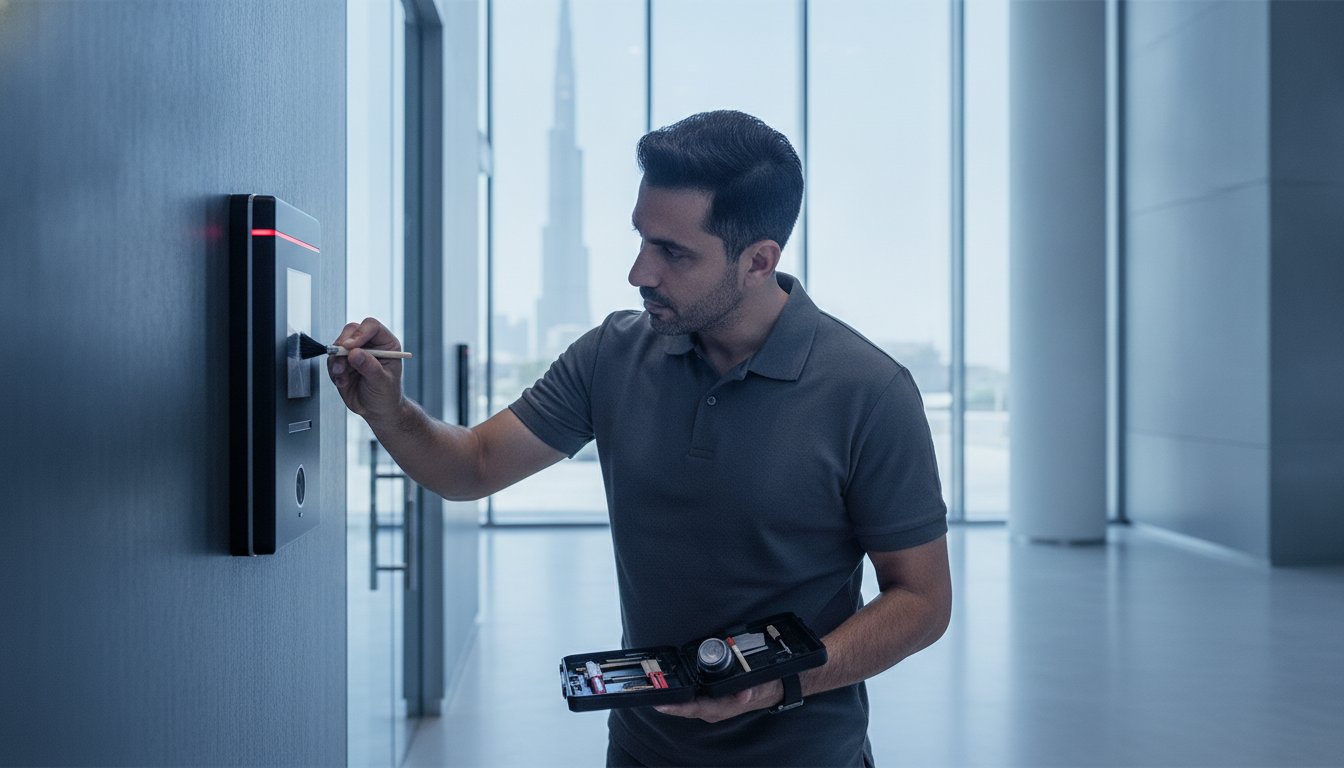
A single afternoon of extreme heat and fine desert dust can do more damage to an unmaintained biometric scanner than a year of heavy use. You likely understand that your security infrastructure is the backbone of your facility's safety, yet it's easy to overlook the gradual wear caused by the UAE's unique environmental conditions. Consistent access control system maintenance isn't just a technical recommendation; it's a critical requirement for ensuring that your hardware remains functional and your business stays compliant with current SIRA regulations.
We've designed this guide to help you transition from reactive repairs to a disciplined, preventive strategy. You'll gain a clear understanding of how to protect your investment, reduce unexpected downtime, and meet the latest security standards, including the 31-day footage retention and biometric data protection laws. This article provides a methodical checklist covering hardware cleaning, software synchronization, and the essential steps for a reliable annual maintenance schedule.
Key Takeaways
- Understand how the UAE's heat and dust physically degrade biometric sensors and why proactive care is necessary for system longevity.
- Implement a structured access control system maintenance schedule that includes monthly visual inspections and quarterly emergency release testing.
- Learn how regular system audits help you maintain compliance with SIRA regulations and avoid costly operational delays.
- Identify common causes of hardware failure, from intermittent reader errors to "ghost alarms" triggered by faulty door sensors.
- Discover how an Annual Maintenance Contract provides a methodical approach to technical oversight and ensures priority response during security failures.
Why Access Control System Maintenance is Critical in the UAE
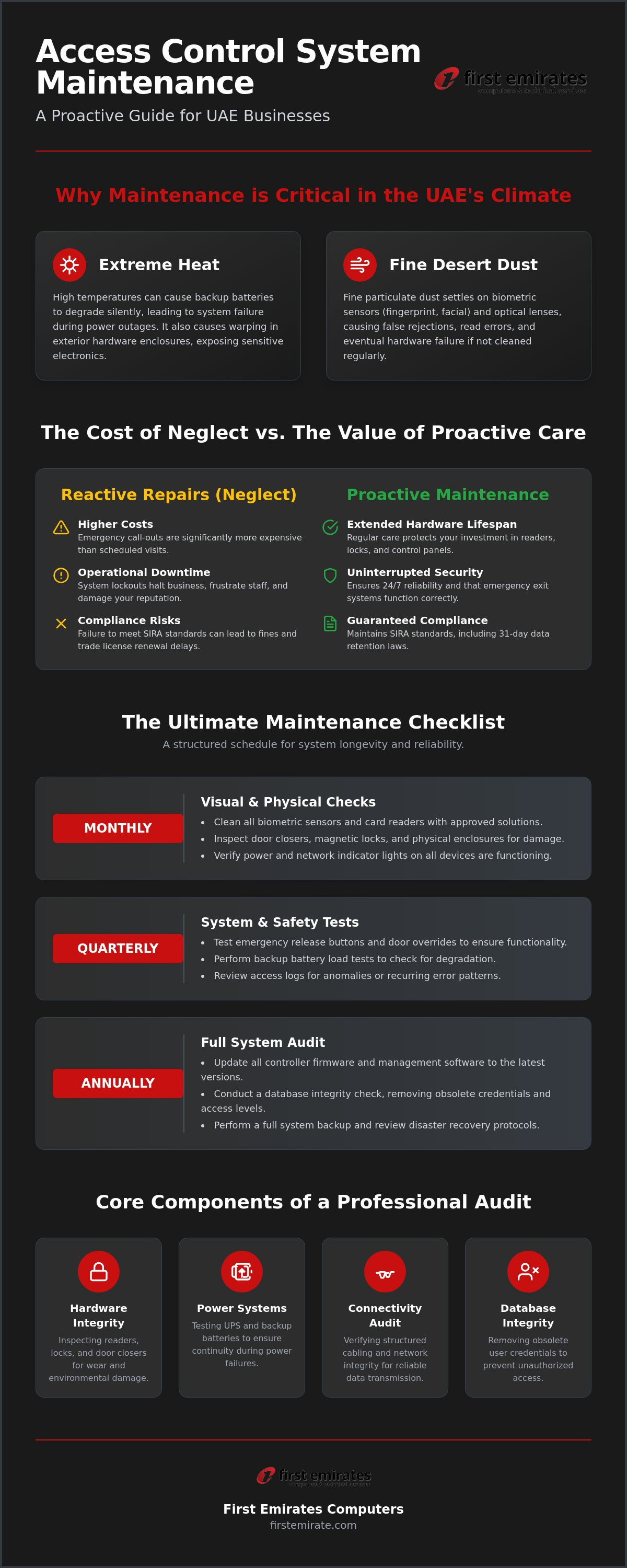
Professional access control system maintenance is a methodical protocol involving physical inspections, sensor calibration, and software updates to ensure uninterrupted security. It serves as the technical safeguard that ensures Access control protocols function exactly as designed without hardware degradation. In the UAE, this process is heavily influenced by the local climate. Fine particulate dust and extreme temperatures can quickly compromise the sensitivity of biometric scanners and the mechanical integrity of magnetic locks.
Dust is a constant challenge for businesses in Abu Dhabi. It settles on optical sensors and capacitive readers, causing frequent false rejections or complete reader failure. When a system fails, the result is often a total lockout. This halts business operations and leaves staff waiting for emergency repairs. Beyond operational convenience, maintenance is a legal necessity. For many enterprises, maintaining a SIRA-compliant security system is a prerequisite for trade license renewal. Failing to meet these standards can lead to fines or delays in official documentation.
The Cost of Neglect vs. Proactive Care
Emergency call-outs for hardware failure are significantly more expensive than scheduled inspections. Proactive care extends the operational lifespan of high-value assets like biometric readers and control panels. It's about protecting your initial investment. Regular testing also ensures that emergency exit overrides function correctly during a fire or power failure. This reduces corporate liability and ensures that life safety systems are always ready to respond during a crisis.
Addressing the 'If It Isn't Broken' Misconception
Security systems often hide failures until a crisis occurs. Backup batteries can degrade silently over several months in high-heat environments. Without methodical testing, you won't know they've failed until a power surge or outage hits your facility. Software requires consistent attention too. Unpatched firmware leaves your security network open to digital breaches. Regular audits also verify the accuracy of your access log history. This data is vital for internal investigations and for meeting the 31-day data retention requirements mandated by UAE Federal Decree-Law No. 45 of 2021 regarding personal data protection.
A disciplined approach to access control system maintenance prevents these hidden issues from becoming operational disasters. By identifying cable interference or battery degradation early, you ensure that your facility remains secure and accessible 24/7. This systematic oversight provides the grounded reliability that modern UAE businesses require to maintain a professional and secure environment.
Core Components of a Professional Maintenance Audit
A professional audit follows a methodical architecture to ensure every physical and digital layer of your security infrastructure is addressed. Effective access control system maintenance begins with the hardware that staff interact with daily, but it extends deep into the electrical and network backbone of your facility. By categorizing these components, we can identify specific failure points before they impact your operational continuity. This systematic approach aligns with international standards for physical security, such as the NIST security controls, which emphasize the importance of maintaining and testing all entry point mechanisms.
The audit process focuses on four primary pillars. Physical hardware inspections verify the mechanical health of readers and locks. Power system testing ensures that Uninterruptible Power Supplies (UPS) and backup batteries can sustain operations during a voltage drop. Connectivity audits examine the integrity of structured cabling services UAE businesses rely on for data transmission. Finally, database integrity checks ensure that the software layer accurately reflects your current organizational structure by removing obsolete credentials.
Hardware Integrity and Environmental Cleaning
Biometric fingerprint and facial recognition sensors require specialized cleaning to remain accurate. Standard chemical cleaners can damage sensitive coatings, so technicians use industry-approved solutions to remove oils and dust. Beyond the sensors, we check the lubrication and alignment of heavy-duty commercial door closers. If a door doesn't seat correctly in its frame, the magnetic lock may fail to engage. We also inspect all exterior enclosures for heat-related warping or signs of moisture ingress, which are common issues in the Abu Dhabi climate.
Software and Database Optimization
Firmware updates are essential for patching security vulnerabilities and improving hardware performance. A professional audit includes verifying that all controllers are running the latest manufacturer versions. We also verify time-synchronization across all entry points. If your readers aren't synchronized, your access logs become unreliable for forensic audits or attendance reporting. Running diagnostic reports allows us to identify frequent "denied access" anomalies. These patterns often reveal a failing card reader or a user badge that needs replacement before it stops working entirely.
Maintaining this level of detail requires technical proficiency and a disciplined schedule. If you haven't reviewed your hardware health recently, a professional security audit can provide the clarity needed to prevent future system failures.
The Ultimate Access Control Maintenance Checklist
A disciplined maintenance schedule is the only way to ensure 24/7 security and operational stability. In the UAE's demanding environment, access control system maintenance must be performed at regular intervals to prevent hardware fatigue and software lag. This systematic approach allows facility managers to catch minor issues before they escalate into total system failures. We've structured this checklist into specific timeframes to help you manage your technical resources effectively.
- Monthly: Conduct a visual inspection of all card readers and biometric scanners. Look for physical damage, loose mountings, or signs of tampering.
- Quarterly: Perform a comprehensive test of the emergency release and fire alarm integration for every door. This is a critical life-safety requirement.
- Bi-Annually: Execute battery load testing for all power supplies. This period should also include a full verification of biometric access control systems UAE software backups to ensure data can be recovered in a crisis.
- Annually: Schedule a full system recalibration. This includes testing every hardware component and conducting structured cabling health checks to identify any signal degradation.
Physical Entry Point Checklist
The mechanical components of your doors bear the most physical stress. Check all strike plates and magnetic locks to ensure they are securely mounted and properly aligned. If a door sags even slightly, the magnetic lock may not achieve full holding force. You should also verify that "request-to-exit" (REX) sensors trigger instantly when approached. Don't forget to clean all external-facing hardware with approved non-abrasive solutions. Removing fine dust prevents sensor interference and maintains the professional appearance of your facility entry points.
System Logic and User Audit
Security isn't just about hardware; it's about accurate data. Use your maintenance window to remove access for former employees or contractors with expired badges. This prevents unauthorized entry using "ghost" credentials. You should also review and test "anti-passback" rules. These rules prevent a user from passing their card back to another person to gain entry. Finally, archive old event logs. A bloated database can slow down system response times and lead to intermittent software crashes during peak traffic hours.
By following this methodical access control system maintenance routine, you ensure that your security infrastructure remains a reliable asset. This proactive stance minimizes the risk of unexpected downtime and keeps your business compliant with local safety standards.
Troubleshooting Common Access Control Failures
Even with a disciplined maintenance schedule, technical failures can occur due to environmental stress or hardware aging. Effective access control system maintenance requires a methodical approach to troubleshooting that distinguishes between minor sensor issues and systemic failures. Identifying the root cause quickly is essential for maintaining facility security and preventing long-term damage to your ELV infrastructure.
Intermittent reader failures are often the most difficult to diagnose. These frequently stem from electromagnetic interference in the cabling or hardware reaching its end-of-life. Technicians must test for signal noise before assuming a reader needs replacement. "Ghost alarms," such as door-held-open or false tamper alerts, are another common frustration. These are usually caused by misaligned door contact sensors or dust accumulation inside the reader housing. In industrial zones like Musaffah, power fluctuations are a significant concern. Voltage spikes can damage sensitive controllers, making high-quality surge protection and stable UPS units a technical necessity for any industrial facility.
Communication errors, where a controller appears offline, typically indicate a local network issue rather than a hardware fault. Our technicians check PoE switch ports and IP configurations first to resolve these "offline" status messages. Systematic troubleshooting ensures that your security remains intact while avoiding the cost of unnecessary hardware replacements.
When to Repair vs. When to Upgrade
Legacy systems that no longer receive security firmware updates represent a significant vulnerability. If your hardware can't support modern encryption, it's time to consider an upgrade. Many UAE businesses are now evaluating the cost-benefit of switching from traditional proximity cards to mobile credentials, which offer higher security and lower administrative overhead. If you notice that your access logs don't match your visual records, it's a clear sign that your CCTV installation Abu Dhabi needs tighter integration with your entry points to provide a unified security overview.
Emergency Procedures for System Lockouts
Every facility manager should establish a manual override protocol for security personnel. While digital systems are reliable, you must have a plan for total system failure. This includes keeping physical master keys in a secure, off-site location known only to authorized stakeholders. A professional AMC provider offers a steady hand during these crises, providing priority response to resolve critical lockouts. If your current system is showing signs of intermittent failure, contact our technical team for a comprehensive diagnostic audit before a total lockout occurs.
Securing Reliability with an Annual Maintenance Contract (AMC)
An Annual Maintenance Contract (AMC) provides a methodical approach to technical oversight that moves beyond simple repair services. For UAE businesses, an AMC acts as a structured agreement where a dedicated service provider takes professional responsibility for the health of your security infrastructure. This model ensures that access control system maintenance is performed on a fixed schedule, preventing the gradual degradation often caused by the region's environmental stressors. By outsourcing this technical management, facility managers can focus on core operations while maintaining a high standard of security readiness.
One of the primary advantages of a formal contract is priority response. When a critical hardware failure occurs, AMC holders receive expedited resolution times compared to on-call requests. This minimized downtime is essential for high-traffic commercial buildings where a malfunctioning entry point can cause significant operational delays. Additionally, an AMC offers budget predictability. It eliminates the financial shock of unexpected major repair bills by covering labor and routine diagnostic costs under a fixed annual fee. This shift from reactive spending to a planned operational expenditure allows for more accurate long-term fiscal planning.
Professional accountability is also a core benefit. A seasoned provider ensures that all security systems meet current regional regulatory standards, including SIRA requirements for data retention and hardware resolution. This oversight provides peace of mind that your facility remains compliant with UAE laws without requiring constant internal monitoring.
The First Emirates Approach to System Care
Since our establishment in 2011, First Emirates Computers has built a reputation as a steady hand in Abu Dhabi's security landscape. We bring over 15 years of technical proficiency to every project, managing complex ELV and biometric installations for a wide range of clients. Our AMC tiers are customized to fit specific needs, whether you manage a small office or a large industrial warehouse. We integrate our IT hardware sales with long-term maintenance support, ensuring that every component we install is backed by a methodical support structure.
Next Steps for Your Facility's Security
Transitioning from reactive repairs to a proactive maintenance strategy begins with a clear understanding of your current system's health. We recommend a comprehensive site audit to identify immediate vulnerabilities and establish a baseline for future service. Our technical team evaluates everything from sensor sensitivity to cable integrity, providing a detailed report on necessary optimizations. To ensure your facility remains secure and compliant, contact First Emirates for a professional access control audit and discover how a structured maintenance plan can protect your security investment.
Protecting Your Security Infrastructure for the Long Term
Maintaining a secure facility requires more than just high-quality installation; it demands a disciplined approach to access control system maintenance to counter the effects of dust, heat, and technical wear. By implementing a structured checklist and understanding the critical integration of hardware and software, you ensure that your security remains uncompromised and your operations stay compliant with UAE regulations. Moving from reactive repairs to a proactive strategy is the most effective way to protect your long-term investment and ensure 24/7 operational continuity.
First Emirates Computers has served as a steady hand in Abu Dhabi's security landscape since 2011. As methodical ELV and security specialists, we provide the technical proficiency needed to manage complex biometric and door access systems. Our comprehensive Annual Maintenance Contracts are designed to offer you priority support and budget predictability, ensuring your infrastructure remains a reliable asset rather than a source of operational delay. Secure Your Business with a Professional Maintenance Contract to establish a stable and secure environment for your staff and assets.
Taking these proactive steps today will safeguard your facility's future and provide the peace of mind that comes with professional technical oversight.
Frequently Asked Questions
How often should an access control system be maintained?
You should schedule a comprehensive maintenance review at least quarterly, with monthly visual inspections of high-traffic entry points. This systematic approach allows you to identify hardware wear before it causes an operational lockout. Bi-annual deep audits are also recommended to test battery load and verify database backups.
What are the signs that my door access system is about to fail?
Common warning signs include delayed door releases, cards requiring multiple swipes, or "ghost alarms" where sensors trigger without cause. If readers become hot to the touch or show visible warping from the heat, a hardware failure is likely imminent. You should also listen for unusual clicking sounds from magnetic locks, which suggest misalignment.
Does an AMC cover both hardware and software issues?
A professional Annual Maintenance Contract (AMC) is designed to cover both physical hardware health and software optimization. This includes cleaning sensors and testing locks alongside database backups and firmware patches. This dual-layered approach ensures total system reliability and prevents the technical gaps that lead to security breaches.
Can dust and heat really stop my biometric reader from working?
Fine desert dust and extreme heat are primary causes of sensor failure in Abu Dhabi. Dust accumulates on optical lenses and capacitive sensors, causing false rejections, while heat can degrade internal circuitry over time. Consistent access control system maintenance is the only way to mitigate these environmental risks and ensure hardware longevity.
Is it necessary to update the firmware on my security controllers?
Firmware updates are critical for maintaining the digital security of your facility. These updates often contain patches for newly discovered vulnerabilities that could allow unauthorized network access. Regular updates also ensure your hardware remains compatible with new software features and improves overall system response times.
What should I do if my access control system goes offline?
First, verify that your local network and PoE switches are functioning correctly, as many "offline" errors are network-related. If the controller remains offline after a network check, you should engage your technical support team to inspect the structured cabling and power supply units. Professional AMC holders receive priority response to resolve these critical failures quickly.
How do I ensure my access control system is compliant with UAE regulations?
Compliance requires meeting specific SIRA mandates, such as the 31-day data retention period for event logs and integrated surveillance footage. You must also implement role-based access and data protection measures as mandated by Federal Decree-Law No. 45 of 2021. A professional maintenance audit will verify that your system settings meet these legal requirements.
Can I perform access control maintenance myself?
Internal staff can perform basic surface cleaning of readers, but a professional technician is required for deep-level technical audits. Expert oversight ensures that emergency fire alarm integrations and anti-passback logic are functioning according to industry standards. Professional access control system maintenance provides the accountability needed for commercial insurance and regulatory compliance.


