
Could your organization manage a 200,000 AED fine or a major security gap simply because a hard drive failed without warning? Many UAE business owners view their technical infrastructure as a static installation, yet hardware degrades and regulatory standards shift. Professional security surveillance system maintenance is a critical operational requirement in 2026, moving beyond simple repairs to become a proactive risk-management tool. It's understandable to feel confident in your initial investment, but the reality of the UAE's environmental conditions and strict oversight requires a more disciplined approach to system health.
This article demonstrates how scheduled maintenance safeguards your security investment, ensures full compliance with SIRA and ADMCC regulations, and prevents critical system failures during high-stakes incidents. We'll examine the technical protocols that guarantee 100% uptime and extend the functional lifespan of your hardware. By adopting a methodical maintenance framework, you can replace the unpredictability of emergency repairs with the stability of a reliable, high-performing security environment.
Key Takeaways
- Understand why functioning cameras do not always guarantee system readiness and how to eliminate hidden "blind spots" through systematic inspection.
- Identify the critical hardware and power components, including PoE switches and housing seals, that require regular testing to prevent premature equipment failure.
- Navigate the specific 2026 SIRA and ADMCC regulatory requirements to ensure your business remains compliant and avoids significant financial penalties.
- Evaluate the technical advantages of professional security surveillance system maintenance over generalist IT support for identifying specialized hardware issues.
- Learn how a structured Annual Maintenance Contract (AMC) provides a methodical framework for long-term infrastructure health and operational peace of mind.
The Strategic Importance of Security Surveillance System Maintenance
Professional security surveillance system maintenance is a disciplined protocol involving the systematic inspection, testing, and optimization of every hardware and software component within a security network. It's a methodical process that moves beyond surface-level cleaning to ensure technical readiness. For UAE businesses, this service provides a steady framework for asset protection, ensuring that the initial investment in security technology continues to deliver reliable results year after year.
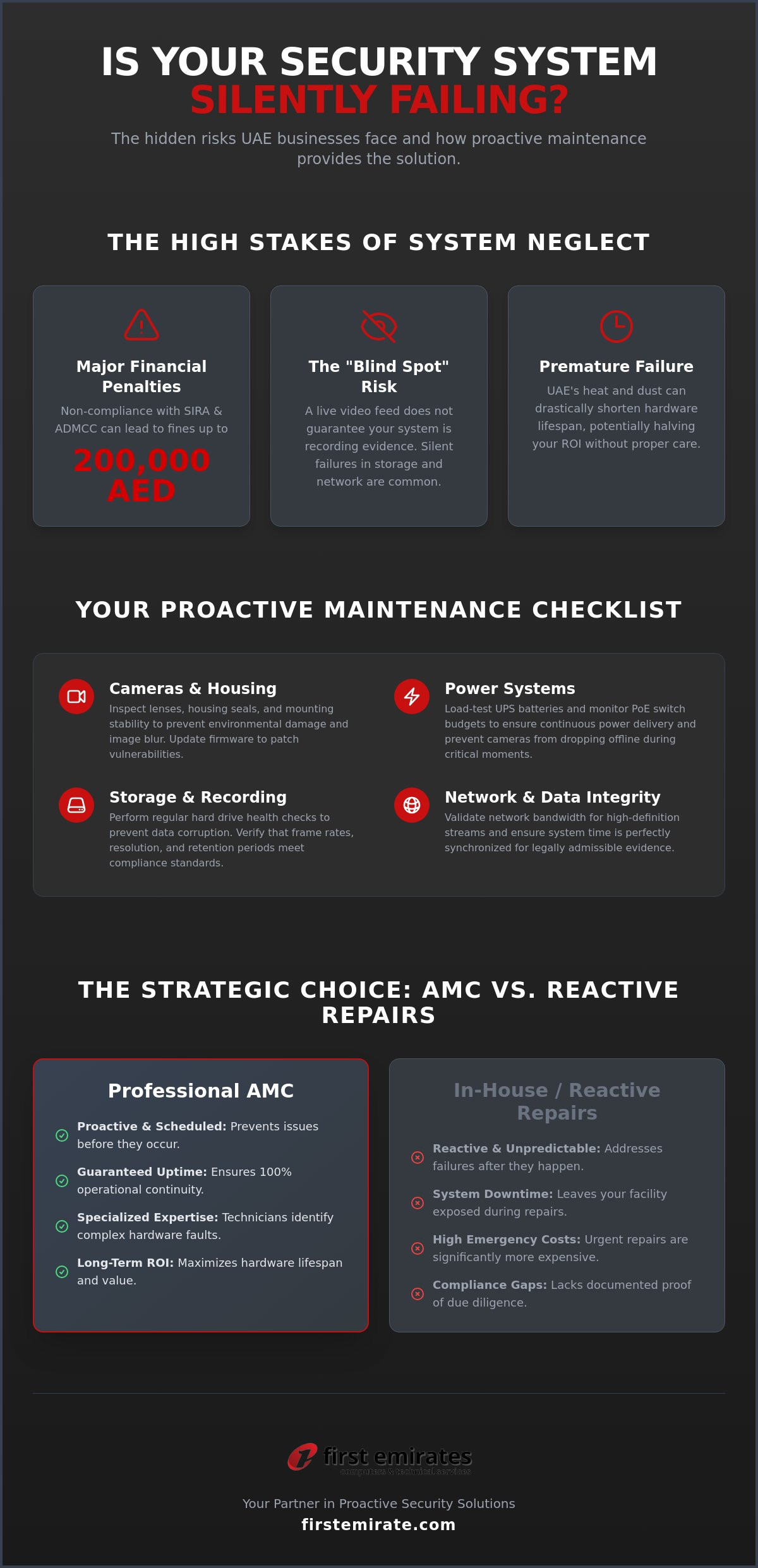
A significant risk for many organizations is the "blind spot" phenomenon. This occurs when a security manager assumes the system is fully operational because the live camera feeds are visible on a monitor. However, a green light on a camera doesn't guarantee that the backend storage is recording or that the network is transmitting data at the required bandwidth. Without regular technical audits, these silent failures often remain hidden until a critical incident occurs, leaving the business without the evidence it needs.
Modern Closed-circuit television (CCTV) installations represent a substantial financial commitment. In the UAE, environmental factors like extreme heat and fine dust can accelerate the wear on sensitive electronic components. Routine care and professional oversight can effectively double the operational lifespan of high-definition hardware. By maintaining cooling systems, updating firmware, and ensuring electrical stability, businesses protect their ROI and avoid the premature cost of total system replacement.
Liability and insurance requirements also dictate a need for consistent record-keeping. Maintenance logs serve as documented proof of due diligence. In the event of a security breach or a workplace accident, insurance providers and legal authorities often require evidence that the surveillance system was being managed according to professional standards. A gap in these records can complicate claims and expose a business to unnecessary legal vulnerability.
Operational Continuity vs. Emergency Repair
Transitioning from a reactive to a proactive security posture is essential for long-term stability. Emergency repairs are not only expensive but also result in unpredictable downtime that leaves your facility exposed. Methodical maintenance identifies potential issues in power supplies and storage arrays before they trigger a system blackout. This steady approach ensures 100% uptime, allowing your security team to focus on monitoring rather than troubleshooting technical failures.
Data Integrity and Evidence Reliability
Security footage is only valuable if it meets evidentiary standards. Technicians verify that frame rates and resolution settings remain optimized for clear identification. They also monitor the health of hard drives to prevent data corruption during critical retention periods. Timestamp accuracy is another vital factor; in the UAE, even a minor drift in system time can compromise the validity of footage during legal proceedings. Regular synchronization ensures your data remains a reliable tool for investigation.
A Comprehensive Technical Checklist for Surveillance Longevity
Effective security surveillance system maintenance requires a granular approach that addresses both the visible and invisible layers of your infrastructure. While most basic services focus on wiping lenses, a professional audit examines the integrity of housing seals and the stability of camera mounts to prevent vibration-induced blur. In the UAE's high-temperature environment, these physical checks are the first line of defense against hardware degradation. If these seals fail, dust and moisture can penetrate the unit, leading to internal component failure long before the manufacturer's expected end-of-life.
The power layer is often the most neglected aspect of a security network. Technicians must test Uninterruptible Power Supply (UPS) batteries under load to ensure they can sustain operations during a blackout. Simultaneously, Power over Ethernet (PoE) switches require monitoring for port stability and power budget allocation. If your PoE switches are oversubscribed, cameras may drop offline intermittently, creating gaps in your security coverage. Regular testing ensures your power delivery remains stable enough to handle the peak demands of high-definition recording.
Digital hygiene is just as critical as physical upkeep. Outdated firmware remains a primary vulnerability for modern IP-based systems, providing an entry point for cyber threats. Regular updates patch these security holes and often improve device performance. This process must be conducted in alignment with SIRA regulations to ensure that all software versions remain compliant with local security standards. Managing these updates methodically prevents the system from becoming a liability to your corporate network.
Storage audits involve more than checking if the record light is on. A thorough review verifies the sector health of hard drives and confirms that NVR/DVR recording cycles meet your required retention periods. If you're unsure about your current storage health, a professional Annual Maintenance Contract can provide the systematic oversight needed to prevent data loss. This level of oversight ensures that when you need to retrieve footage, the data is actually there and accessible.
Physical Component Optimization
Lenses require precise calibration to maintain focus as environmental conditions shift between seasons. Infrared (IR) illuminators must be tested individually to ensure consistent nighttime performance across the entire field of view. Technicians also prioritize checking for corrosion in outdoor connectors, a frequent challenge in the UAE's humid and salty coastal air. These small adjustments prevent the gradual degradation of image quality that often goes unnoticed by daily operators.
The Digital Backbone: Network and Storage
Bandwidth management is essential to ensure that high-resolution video streams don't saturate your corporate network. Cyber hardening involves changing default manufacturer passwords and closing unused network ports to prevent unauthorized access. Storage redundancy is the practice of simultaneously recording data to multiple locations or drives to ensure that a single hardware failure doesn't result in the total loss of critical security footage.
Navigating UAE Regulatory Compliance: SIRA and ADMCC Standards
Operating a business in the UAE requires strict adherence to regional security mandates. In Dubai, the Security Industry Regulatory Agency (SIRA) sets the benchmark, while the Abu Dhabi Monitoring and Control Centre (ADMCC) oversees the capital. Both agencies mandate regular security surveillance system maintenance to ensure that public and private facilities remain protected by reliable, high-quality video evidence. This isn't just a best practice; it's a legal requirement that supports the nation's broader safety infrastructure.
Legal requirements for commercial establishments specify mandatory maintenance intervals, typically requiring a certified technician to inspect the system quarterly. A central part of this process is the "Maintenance Logbook." This document acts as a formal record of every test, repair, and software update performed on the system. During government audits, failure to produce a current, accurate logbook is often the first red flag for inspectors, potentially triggering a more invasive review of your facility's security protocols.
Non-compliance carries heavy consequences. Penalties for operating monitoring devices without proper approval or failing to maintain standards in Abu Dhabi can include fines ranging from 50,000 AED to 200,000 AED. Beyond immediate financial loss, businesses may face delays in trade license renewals or a mandatory security downgrade. These administrative hurdles can impact insurance premiums and operational permits, making security surveillance system maintenance a fundamental business necessity for long-term stability.
SIRA Approved Standards in 2026
SIRA has updated its resolution standards for 2026, requiring a 4MP baseline for general surveillance and 8MP for high-risk zones like facial capture areas. Connectivity to central monitoring stations is mandatory for specific sectors. Data retention mandates vary by industry, requiring businesses to maintain robust storage arrays that don't fail during the retention period. Understanding these nuances is vital, as explored in our guide on Annual Maintenance Contract for CCTV UAE: 5 Myths Debunked.
ADMCC Compliance for Abu Dhabi Infrastructure
ADMCC regulates security for both residential and commercial buildings across Abu Dhabi. Maintenance providers must hold specific ADMCC certifications to work on these systems in the capital. A professional AMC simplifies the annual inspection process by ensuring that all technical specifications, from camera angles to storage redundancy, meet the capital's stringent infrastructure standards. This methodical oversight provides the steady hand needed to navigate complex regulatory audits without stress or operational disruption.
Professional AMC vs. In-House Maintenance: Making the Choice
Deciding between an internal IT team and a specialized provider for your security surveillance system maintenance often comes down to the depth of technical expertise required. While your IT department excels at managing data networks and server uptime, security hardware presents unique physical and electrical challenges. This is the "generalist trap" where critical security-specific failures go unnoticed because the team lacks specialized training in ELV (Extra Low Voltage) systems. A dedicated security partner focuses exclusively on the nuances of surveillance, ensuring that every sensor and lens is optimized for its specific environment.
Professional audits utilize tools that are rarely found in a standard IT toolkit. Technicians use thermal imagers to detect overheating in power supplies or NVR processors before they fail. Signal testers verify the integrity of structured cabling, identifying micro-breaks that cause intermittent video loss. These specialized diagnostics provide a level of precision that internal teams simply can't match. By choosing a professional Annual Maintenance Contract (AMC), you're investing in a methodical inspection process that identifies risks at the component level.
Response times are another critical differentiator. Professional contracts include Service Level Agreements (SLAs) that guarantee a specific timeframe for on-site support. If a camera goes down in a high-risk area, you don't have to wait for an internal team to clear their ticket queue. When comparing costs, the predictable fee of an AMC is almost always lower than the volatility of ad-hoc emergency call-outs. Emergency repairs often involve premium labor rates and expedited shipping for parts; these are costs that are usually mitigated within a structured maintenance agreement.
The Value of Specialized Expertise
Security specialists bring deep knowledge of ELV projects and the specific requirements of structured cabling. They have direct access to manufacturer-specific diagnostic software and a ready supply of spare parts tailored to your system's architecture. This ensures that repairs are handled correctly the first time, rather than through trial and error. For more guidance on choosing the right partner, you can review our checklist on Evaluating IT Maintenance Companies Abu Dhabi.
Risk Management and Accountability
Outsourcing your maintenance effectively transfers technical risk to a certified partner. Many professional AMCs now include 24/7 remote health checks that alert technicians to drive failures or power drops in real-time. This proactive oversight provides documented proof of care, which is essential for satisfying both internal stakeholders and UAE regulatory bodies. If you're looking to establish a more stable security environment, consider securing a professional Annual Maintenance Contract to ensure your infrastructure remains under expert care.
Implementing a Comprehensive Security Maintenance Strategy with First Emirates
The First Emirates Method is built on a capability-first architecture that prioritizes the long-term stability of your technical environment. When you engage with our team for security surveillance system maintenance, we don't just look at the cameras; we evaluate the entire ecosystem. This methodical approach begins with a comprehensive baseline audit. We document the current state of every hardware component, from lens clarity to cable tension, creating a detailed health report that serves as the foundation for your maintenance strategy. This initial transparency ensures that both parties understand the technical starting point before any ongoing work begins.
Customization is essential because every facility has a unique risk profile. A retail outlet in Dubai has different uptime requirements than a high-security industrial site in Abu Dhabi. We tailor our Annual Maintenance Contracts to reflect these realities, ensuring that your resources are allocated where they provide the most protection. This disciplined planning prevents the waste of broad-spectrum maintenance while ensuring that critical facial recognition zones or cash-handling areas receive the highest level of technical readiness. We believe that a maintenance plan should be as unique as the facility it protects.
Our expertise extends beyond simple surveillance. We manage integrated ELV projects that combine CCTV, Biometric Access Control, and Structured Cabling into a single, cohesive infrastructure. This integration is vital for operational efficiency. If your access control logs don't sync with your video timestamps, your security data loses its investigative value. By managing these systems under a unified maintenance plan, we ensure that every piece of technology works in harmony to protect your assets and provides a clear, reliable audit trail for your security team.
Integrated ELV Maintenance Solutions
System stability depends on the health of the underlying data network. For many clients, the Network Maintenance Contract UAE is a critical companion to their security AMC. This ensures that the high-bandwidth video streams generated by 8MP cameras don't compromise the performance of other business-critical applications. First Emirates Computers serves as a steady, long-term infrastructure partner for organizations across the UAE, providing a constant and supportive presence in a complex technical landscape.
Next Steps for Your Facility
Starting a professional partnership begins with a request for a system assessment. Our technicians visit your Abu Dhabi or UAE-based facility to perform an exhaustive technical review. During the first 90 days of a First Emirates AMC, we focus on stabilization. This includes patching firmware vulnerabilities, recalibrating sensors, and updating your Maintenance Logbook to meet current regulatory standards. You can contact First Emirates Computers today for a professional security audit to begin securing your operational continuity.
Future-Proofing Your Security Infrastructure
Maintaining a robust security posture in 2026 requires more than a reactive approach to hardware failure. It demands a disciplined framework of security surveillance system maintenance that addresses physical degradation, digital vulnerabilities, and strict UAE regulatory standards. By prioritizing systematic audits and specialized technical oversight, your organization ensures maximum uptime while protecting the long-term value of your infrastructure investment.
First Emirates Computers has been serving the UAE since 2011, providing the steady expertise needed to navigate the complexities of SIRA and ADMCC compliance. Our methodical approach covers everything from comprehensive ELV projects to specialized IT hardware support, ensuring your facility remains a secure environment. We're committed to being a dependable partner that provides the technical readiness your business deserves.
Secure your infrastructure with a professional First Emirates AMC today and build a foundation of reliability for your organization's future.
Frequently Asked Questions
How often should security surveillance system maintenance be performed?
Commercial establishments in the UAE typically require quarterly inspections to maintain peak performance and regulatory compliance. This frequency ensures that environmental factors like extreme heat and fine dust don't cause permanent hardware damage. Some high-security sectors, such as banking or jewelry retail, may opt for monthly visits to guarantee 100% system readiness and meet more stringent insurance requirements.
What is included in a standard Annual Maintenance Contract (AMC) for CCTV?
A professional AMC covers a comprehensive list of technical tasks including lens calibration, hardware cleaning, and cable integrity checks. It also involves testing power supply stability and verifying the health of storage drives. Technicians update firmware to patch security vulnerabilities and maintain the mandatory Maintenance Logbook for government audits, ensuring the entire system remains in a state of technical readiness.
Can my own IT department perform the required security maintenance?
While internal IT teams manage network stability, they often lack the specialized diagnostic tools and ELV expertise required for comprehensive security surveillance system maintenance. Professional providers bring signal testers and thermal imagers specifically for security hardware. Additionally, only certified maintenance contractors can officially sign off on the logbooks required by UAE regulatory bodies like SIRA and ADMCC to ensure legal compliance.
What are the SIRA requirements for CCTV maintenance in 2026?
In 2026, SIRA mandates that all commercial surveillance systems undergo quarterly maintenance by a certified service provider. The agency requires documented proof of these visits in an official logbook. Systems must also meet specific technical benchmarks, including 4MP or 8MP resolution standards and verified connectivity to central monitoring stations where applicable, to remain compliant with Dubai's updated security laws.
How long does a typical professional maintenance visit take?
The duration of a maintenance visit depends largely on the number of cameras and the complexity of the network. For a small to medium-sized facility, a thorough inspection usually takes between two and four hours. Larger industrial sites or multi-story buildings may require a full day or even multiple visits to complete the exhaustive checklist of hardware and software audits effectively.
Will my cameras be offline during the maintenance process?
Most maintenance tasks are performed while the system is live, ensuring continuous monitoring of your premises. Cameras may go offline briefly during firmware updates or individual hardware tests, but these are handled sequentially to avoid a total system blackout. Technicians schedule these minor interruptions during low-traffic periods to minimize any potential security gaps during the service window.
What happens if a critical component fails between scheduled maintenance visits?
A professional Annual Maintenance Contract includes provisions for emergency support between scheduled visits. If a critical component like an NVR or a main PoE switch fails, the contract guarantees a specific response time through an agreed-upon Service Level Agreement (SLA). This support structure ensures that unexpected hardware failures are addressed immediately, preventing prolonged periods of system downtime and facility vulnerability.
Does maintenance help in extending the storage life of my NVR?
Regular security surveillance system maintenance directly impacts the longevity of your storage drives by monitoring operating temperatures and sector health. Technicians optimize recording bitrates and frame rates to ensure efficient data management without unnecessary wear on the hardware. This methodical oversight prevents premature drive failure and ensures that your video retention periods consistently meet legal requirements without data loss.


