

In the UAE, your IT infrastructure is no longer just a technical choice; it's a regulated utility that can determine whether your building receives its final completion certificate. Most project managers understand the frustration of trying to reconcile international ANSI/TIA-568-E guidelines with the specific mandates from Etisalat, Du, or the Abu Dhabi Municipality. It's often unclear if a design meets the TDRA Buildings Telecommunications Network Specification Manual V3.0 or if security cabling will pass a SIRA inspection. This guide will help you master the structured cabling standards UAE requires for 2026. You'll gain the technical clarity needed to ensure your network is both high-performing and fully compliant with local authorities. We'll examine the technical shift toward Cat6A for 10GBASE-T and 90W PoE++ support, the mandatory fire safety requirements for LSZH cabling under IEC standards, and the critical steps needed to future-proof your building's digital backbone. By following these methodical specifications, you can avoid costly inspection failures and build a scalable infrastructure that supports everything from biometric access control to high-speed data systems.
Key Takeaways
- Understand the mandatory TDRA V3.0 guidelines and local municipality requirements to ensure your building completion certificates are approved without technical delays.
- Learn how to align international ANSI/TIA-568-E and ISO/IEC 11801 frameworks with the specific structured cabling standards UAE regulators demand for 2026.
- Identify why Cat6A and LSZH (Low Smoke Zero Halogen) cables are now the technical baseline for supporting 10Gbps speeds and meeting fire safety codes.
- Gain practical insights into cable management best practices, including bend radius rules and conduit sizing, to prevent signal degradation and physical damage.
- Discover the benefits of integrating your cabling infrastructure with security systems and home automation through professional ELV project management.
The Regulatory Landscape of Structured Cabling in the UAE
In the United Arab Emirates, structured cabling isn't merely an IT preference; it's a standardized architecture for telecommunications infrastructure mandated by federal and local authorities. Every commercial and residential project must adhere to structured cabling principles to ensure interoperability between building systems and public service providers. The primary authority governing these benchmarks is the Telecommunications and Digital Government Regulatory Authority (TDRA). Their updated Buildings Telecommunications Network Specification Manual (Version 3.0), released in 2024, serves as the definitive technical baseline for 2026 projects.
Strict adherence to structured cabling standards UAE regulators have established is non-negotiable for obtaining a Building Completion Certificate (BCC). In jurisdictions like Abu Dhabi and Dubai, inspectors won't issue a BCC if the cabling fails to meet specific physical and logical requirements. This regulatory oversight extends to specialized security infrastructure. For instance, the Security Industry Regulatory Agency (SIRA) mandates that cabling for CCTV surveillance systems must follow specific shielding and fire-rating protocols to ensure system integrity during emergencies. Failure to align your network design with these multi-agency requirements often results in project delays and costly remedial work.
Etisalat and Du: Service Provider Requirements
To receive active internet and voice services, your building must comply with the 'Building File' requirements set by Etisalat by e& or du. These specifications dictate the exact dimensions and environmental controls for Main Distribution Frame (MDF) and Intermediate Distribution Frame (IDF) rooms. You must ensure that internal riser systems use Fiber-to-the-Home (FTTH) architecture, with designated spaces for Optical Network Terminals (ONT). Your internal structured cabling must interface seamlessly with the provider's lead-in pipes at the building entry point. If the containment system or the fiber termination doesn't match the service provider's physical standards, they'll refuse to activate the connection.
Local Authority Inspections: Abu Dhabi and Dubai
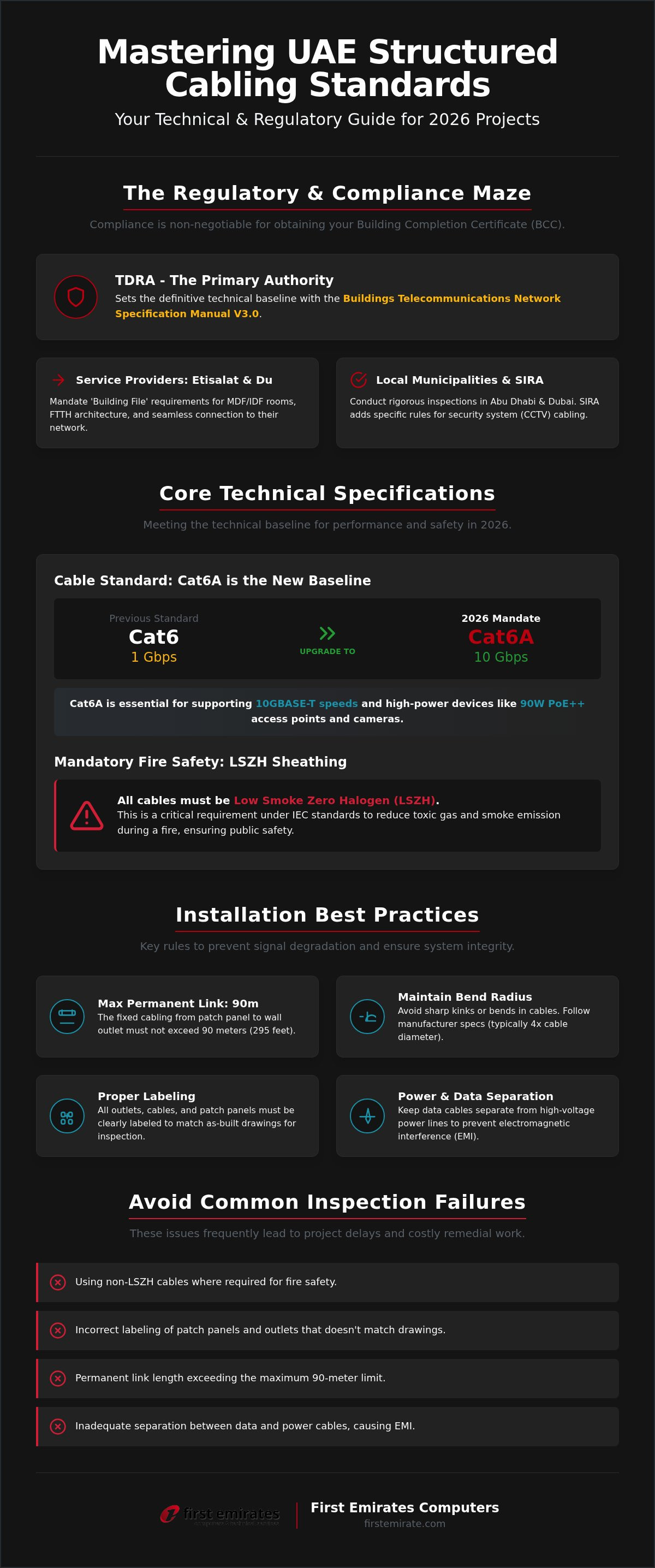
The Abu Dhabi Municipality (ADM) and Dubai Municipality maintain rigorous inspection schedules for commercial fit-outs and new developments. During these inspections, you're required to present comprehensive documentation, including as-built drawings and certified test reports. These reports must show that every link meets the performance criteria for its category. In 2026 infrastructure projects, common reasons for inspection failure include:
- Incorrect labeling of patch panels and wall outlets that doesn't match the submitted drawings.
- Use of non-LSZH (Low Smoke Zero Halogen) cables in areas where they're legally required for fire safety.
- Exceeding the maximum permanent link length of 90 meters.
- Inadequate separation between data cables and high-voltage power lines, leading to electromagnetic interference.
By treating structured cabling standards UAE as a core compliance requirement rather than a secondary technical task, you ensure a smoother path to building handover and a more reliable network foundation.
International Standards Applied to the UAE Market
While the TDRA provides the local framework, the actual technical specifications for most projects are derived from international benchmarks. The ANSI/TIA-568-E standard, originally published in 2020 and updated with addendums in 2022, remains the primary North American reference for commercial buildings in the Middle East. For government contracts or multi-national headquarters, you might encounter the ISO/IEC 11801 standard instead. Understanding how these international frameworks define structured cabling standards UAE projects must follow is essential for technical readiness. You can explore the UAE's Regulatory Landscape to see how these global rules are localized.
As of April 20, 2026, the Telecommunications Industry Association (TIA) has issued a call for comments on the new TIA-568.1-F version. This update, along with the ISO/IEC 11801-1:2017/AMD1:2025 amendment, focuses on supporting 40Gbps and 100Gbps data rates over shorter distances. These updates are critical for data centers and high-density office environments where bandwidth demand is surging. When designing your infrastructure, it's vital to distinguish between 'Permanent Link' and 'Channel' performance. The Permanent Link represents the fixed portion of the cabling, while the Channel includes the patch cords. Most local inspections focus on Permanent Link results because it's the foundation of your building's connectivity.
TIA/EIA vs. ISO/IEC: Which should you follow?
The choice often depends on the project's scale and origin. ANSI/TIA uses 'Category' terminology, such as Cat6A, while ISO/IEC uses 'Class' designations like Class Ea. If you're managing a large industrial project in Musaffah or JAFZA, ISO/IEC is frequently preferred due to its international reach. Regardless of the choice, you must ensure that all components, including jacks, patch panels, and cables, belong to the same standard family to avoid impedance mismatches.
Standardized Topology: Backbone vs. Horizontal Cabling
UAE enterprise environments require a hierarchical star topology. This structure separates horizontal cabling, which connects workstations to the floor's telecommunications room, from the backbone cabling that links those rooms to the main equipment room. The 90-meter rule for copper horizontal cabling is non-negotiable. Exceeding this limit leads to signal attenuation and packet loss. For vertical risers and inter-floor connectivity, fiber optic backbones are the standard, ensuring high-speed data flow across the entire facility. If you need assistance designing a compliant topology, our team can help you implement professional structured cabling solutions tailored to your building's layout.
Material Specifications: Cat6, Cat6A, and LSZH Requirements
Selecting the correct physical medium is the most critical step in meeting the structured cabling standards UAE inspectors expect for 2026 projects. While Category 6 (Cat6) was once the default for commercial spaces, Category 6A (Cat6A) has become the technical baseline for new Abu Dhabi office fit-outs. This transition is driven by the increasing demand for 10GBASE-T performance and the necessity of managing heat buildup in high-density cable bundles. Cat6A cables provide the bandwidth required for modern enterprise applications while ensuring your infrastructure remains relevant for the next decade of hardware upgrades.
Beyond data speed, material composition is a matter of legal compliance under the UAE Fire and Life Safety Code of Practice. Every installation must prioritize fire-rated jackets to protect occupants and equipment. Utilizing the correct materials ensures that your project aligns with global Implementation Best Practices, which emphasize safety alongside performance. In industrial zones like Musaffah or JAFZA, where electromagnetic interference (EMI) is prevalent, you should deploy Shielded Twisted Pair (STP) cabling. For standard office environments with minimal interference, Unshielded Twisted Pair (UTP) remains a cost-effective and compliant choice.
Fire Safety and LSZH Compliance
The UAE Fire and Life Safety Code of Practice mandates the use of Low Smoke Zero Halogen (LSZH) materials in specific zones. Low Smoke Zero Halogen (LSZH) cabling is a mandatory material standard in UAE high-rise buildings and public infrastructure designed to minimize toxic gas emissions and improve visibility during fire incidents. To avoid project delays during civil defense inspections, you must verify that your cable jackets are clearly marked with IEC 60332, IEC 61034, or IEC 60754 certifications. Genuine LSZH cables don't produce the thick black smoke or corrosive acid gas associated with standard PVC jackets, making them essential for any project seeking a building completion certificate.
Selecting the Right Performance Category
While Cat6 is still suitable for basic VoIP and standard office data, it lacks the headroom required for advanced systems. Cat6A is specifically engineered to support 10 Gigabit speeds over the full 90-meter permanent link. This category is also vital for supporting Power over Ethernet (PoE++) standards, which deliver up to 90W of power to devices. This capability is especially important for modern CCTV installation Abu Dhabi projects where high-resolution cameras and pan-tilt-zoom motors require consistent, high-wattage power delivery.
Quality control is a major focus for UAE regulators in 2026. You must strictly avoid Copper Clad Aluminum (CCA) cables. CCA cables use an aluminum core with a thin copper coating, which violates both TIA and TDRA standards. These cables are brittle, pose a fire risk under PoE loads, and will fail the mandatory Fluke testing required for building handover. For high-speed server room links, emphasize fiber optic standards like OM4 for multimode distances up to 400 meters or OS2 single-mode fiber for backbone connectivity that requires unlimited bandwidth potential.
Implementation Best Practices: Installation and Testing
The physical execution of a network determines its long-term stability and reliability. Adhering to the structured cabling standards UAE regulators mandate requires a disciplined approach to cable management and pathway design. Proper use of galvanized trays, PVC trunking, and flexible conduits protects the physical integrity of the links from environmental stress and accidental damage. During the pulling process, technicians must respect the 'Bend Radius' rule. For Cat6A cabling, the bend radius must typically be at least four times the cable diameter. Exceeding this limit causes micro-fractures in the copper core, leading to permanent signal degradation that basic continuity tests might not detect.
Administrative discipline is equally important for 2026 infrastructure projects. Every cable, patch panel port, and wall outlet must follow the TIA-606-C administration standard for labeling. This ensures that any future troubleshooting or maintenance is efficient and logical. Documentation should include a comprehensive floor plan showing all drop locations and cable routes. Once the physical installation is complete, post-installation testing is required to verify performance. You must obtain Fluke certification reports for every link. These reports provide a detailed analysis of the cable's performance and are often a prerequisite for building handover and manufacturer warranties. If you need a methodical partner to manage your next installation, our team provides expert structured cabling services that guarantee full compliance.
The Testing and Certification Process
A simple 'link light' or a basic continuity tester is not sufficient for professional cat6 cabling services Abu Dhabi projects. We utilize advanced cable analyzers to measure specific parameters, including Wiremap, Attenuation, and Near-End Crosstalk (NEXT). Wiremap testing confirms that all eight conductors are connected to the correct pins at both ends. Attenuation measures the loss of signal strength over the length of the cable, while NEXT testing ensures that signals on one pair don't interfere with another. We compile these results into a final warranty folder, providing you with a permanent record of your network's health and technical readiness.
Pathway and Space Management
Effective pathway management prevents electromagnetic interference (EMI) from compromising your data. You must maintain a minimum separation of 200mm between data cables and high-voltage power lines. In IDF and MDF rooms, standardized rack organization is essential. Use horizontal and vertical cable managers to route patch cords neatly, ensuring they don't obstruct airflow to active equipment. Adequate ventilation and cooling are mandatory for server room cabling solutions to prevent equipment overheating. A well-organized rack not only looks professional but also simplifies the process of adding or moving connections as your business grows.
The Role of an Expert ELV Contractor in UAE Compliance
Attempting a DIY installation or hiring non-specialist labor for high-stakes infrastructure often leads to critical non-compliance and persistent network downtime. In the UAE, where regulatory bodies like the TDRA and SIRA maintain strict oversight, the technical margin for error is slim. An expert Extra Low Voltage (ELV) contractor serves as a bridge between abstract structured cabling standards UAE regulators enforce and the physical reality of a functioning building. Professional installers understand that a network's integrity isn't just about the cables themselves; it's about how those cables are terminated, tested, and documented to meet government benchmarks.
A significant part of modern infrastructure involves the seamless integration of various systems. For example, when working with a specialized access control system company, the underlying cabling must support high-security biometric readers and electronic locks without latency or power drops. First Emirates Computers brings over 15 years of local experience to these complex 2026 infrastructure projects. Our methodical approach ensures that your data backbone is designed to accommodate CCTV, home automation, and enterprise networking simultaneously, preventing the siloed infrastructure that often leads to maintenance headaches.
Comprehensive ELV Project Management
Managing an ELV project requires careful coordination between civil works and technical installations. We design unified cabling backbones that serve as a single, robust pathway for all building services. This includes managing the interface with lead-in pipes, ensuring proper conduit sizing, and supervising the installation to prevent interference between data and power lines. Our goal is 100% compliance with Abu Dhabi and UAE-wide regulations, ensuring your project moves from design to building completion certificate without technical objections from local inspectors.
Long-term Reliability and AMC
The work doesn't end once the cables are in the walls. Environmental factors in the Middle East, such as heat and humidity, can impact the lifespan of your physical connections over time. This is where the value of IT AMC services Abu Dhabi businesses trust becomes apparent. Proactive maintenance involves regular inspection of patch cords, cleaning of IDF/MDF rooms, and re-testing links to ensure they still meet the structured cabling standards UAE authorities expect.
Scalability is also a core focus of our designs. We plan for 2026 and beyond by utilizing modular cabling architectures that allow you to upgrade individual components without replacing the entire backbone. This forward-thinking strategy protects your investment and ensures your business stays technically ready for future bandwidth demands. Contact First Emirates Computers today for a professional site survey and a standards-compliant design tailored to your specific facility requirements.
Securing Your Infrastructure for 2026 and Beyond
Building a robust IT foundation in the Emirates requires precise alignment between global performance standards and local regulatory mandates. We've explored how navigating the structured cabling standards UAE authorities require involves more than just selecting high-quality materials like Cat6A and LSZH. It's a process that demands a systematic approach to installation, rigorous Fluke testing, and comprehensive documentation to ensure your facility receives its building completion certificate without delay. By integrating these technical specifications early in your project lifecycle, you create a scalable network capable of supporting everything from biometric security to high-speed data systems.
As expert ELV contractors established in 2011, our methodical Abu Dhabi-based technical team specializes in delivering SIRA-compliant installations that stand the test of time. We provide the technical readiness and stability your business needs to operate with confidence in a complex regulatory landscape. Request a Standards-Compliant Cabling Quote from First Emirates Computers to ensure your next project meets every national benchmark for performance and safety. Your infrastructure's long-term reliability starts with a disciplined, standards-first design.
Frequently Asked Questions
What is the standard for structured cabling in the UAE?
The primary benchmark is the TDRA's "Buildings Telecommunications Network Specification Manual - V3.0," released in March 2024. This federal document outlines the mandatory requirements for all new developments. It incorporates international frameworks like ANSI/TIA-568-E and ISO/IEC 11801 to ensure that the structured cabling standards UAE developers follow are globally compatible. Adherence to these specifications is essential for seamless integration with national service providers like Etisalat and Du.
Is Cat6 cable mandatory for new office setups in Abu Dhabi?
Technically, Cat6 remains a permissible minimum for many basic installations, but Cat6A is the recommended baseline for 2026 office fit-outs. Cat6A provides the necessary headroom for 10 Gigabit Ethernet and high-wattage Power over Ethernet (PoE++) devices. While local municipalities focus on meeting specific permanent link test results, choosing Cat6A ensures your infrastructure remains compliant with the evolving bandwidth requirements of modern enterprise hardware and high-density data environments.
Do I need LSZH cables for my warehouse in Musaffah?
LSZH (Low Smoke Zero Halogen) cables are required if your warehouse falls under specific categories of the UAE Fire and Life Safety Code of Practice. In industrial areas like Musaffah, fire safety regulations often mandate LSZH jackets for any cabling installed in plenums or high-occupancy zones. These cables minimize toxic gas emissions during a fire, which is a non-negotiable safety requirement for obtaining civil defense approvals in most commercial and industrial structures.
What are the Etisalat requirements for structured cabling?
Etisalat requires strict adherence to their 'Building File' specifications, which dictate the design of Main Distribution Frame (MDF) and Intermediate Distribution Frame (IDF) rooms. Your installation must support Fiber-to-the-Home (FTTH) architecture and provide designated spaces for Optical Network Terminals (ONT). The internal cabling must also interface correctly with the provider's lead-in pipes. Failure to meet these physical room and containment standards will prevent service activation for your facility.
Can I use the same cabling for CCTV and data networks?
You can utilize a unified structured cabling backbone for both CCTV and data networks, provided the cabling supports the necessary Power over Ethernet (PoE) requirements. For modern security systems, Cat6A is preferred because its thicker gauge handles the heat generated by high-power PoE++ devices more effectively. This integrated approach simplifies management and is fully compliant with SIRA regulations, as long as the security cabling maintains proper shielding and separation from power lines.
How often should structured cabling be tested or certified?
Comprehensive certification is mandatory immediately following the initial installation to secure your building completion certificate. After that, we recommend re-testing your network every three to five years or whenever you implement significant hardware upgrades. Regular physical inspections are typically managed through an Annual Maintenance Contract (AMC), which ensures that patch cords, connectors, and labeling remain in optimal condition throughout the infrastructure's lifespan to prevent unexpected network downtime.
What documentation is required for a building completion certificate regarding IT?
To obtain a building completion certificate (BCC), you must submit a complete technical dossier to the relevant municipality. This documentation includes detailed as-built drawings showing cable routes and drop locations, along with certified Fluke test reports for every permanent link. The reports must demonstrate that the installation meets the specified performance category. Additionally, all components must be labeled according to the TIA-606-C administration standard to pass the final municipality inspection.
Is there a difference between Dubai and Abu Dhabi cabling regulations?
While the TDRA sets the federal structured cabling standards UAE projects must follow, local municipalities have different administrative procedures. In Abu Dhabi, the Abu Dhabi Municipality (ADM) oversees the inspection of commercial fit-outs, while the Dubai Development Authority (DDA) or Dubai Municipality handles projects in Dubai. The technical requirements for the cabling itself are consistent across the emirates, but the submission portals and specific documentation formats for inspection vary by jurisdiction.


