

Treating your office wireless network as a simple hardware purchase is the most common mistake made in the UAE corporate sector. In a city that ranks first globally on the Telecommunication Infrastructure Index, it's jarring when dropped VoIP calls or persistent dead zones disrupt daily operations. Implementing robust enterprise WiFi solutions Abu Dhabi requires a shift from reactive troubleshooting to a comprehensive, standards-based design that accounts for the unique architectural and regulatory environment of the capital. A professional network is a physical infrastructure project, not just a series of plug-in devices.
You likely recognize that your current setup shouldn't struggle with guest access or warehouse connectivity gaps. This guide provides a technical roadmap for designing a secure, high-performance network that meets TDRA Type Approval standards and utilizes modern Wi-Fi 7 capabilities. We'll examine how professional structured cabling forms the backbone of reliable connectivity, the necessity of segmented networks for data security, and the planning required for the upcoming UAE Spectrum Outlook 2026-2031. By treating your wireless environment as a scalable asset, you ensure your corporate infrastructure remains ready for the demands of the next decade.
Key Takeaways
- Learn why professional enterprise WiFi solutions Abu Dhabi are essential for high-density corporate environments where consumer-grade hardware fails to maintain seamless roaming.
- Understand the technical role of RF heatmapping and site surveys in eliminating coverage dead zones across large floor plans and warehouses.
- Discover how the quality of your underlying structured cabling directly determines the performance and stability of your wireless access points.
- Master the implementation of 802.1X authentication and network segmentation to secure sensitive corporate data while providing safe guest access.
- Explore the importance of professional ELV project management and long-term maintenance contracts to ensure your network infrastructure remains reliable.
The Shift from Consumer to Enterprise WiFi Solutions in Abu Dhabi
Abu Dhabi's corporate environment is defined by high-density office towers and expansive industrial zones. In these settings, the requirements for wireless connectivity extend far beyond basic internet access. Professionally deployed enterprise WiFi solutions represent a centrally managed ecosystem of access points designed for 99.9% uptime. As the UAE continues to lead global telecommunication infrastructure rankings, businesses must align their internal networks with these high standards to maintain operational efficiency and reliability. Relying on residential-grade equipment in a professional setting creates unnecessary risks for data integrity and staff productivity.
Limitations of Standard Office Routers
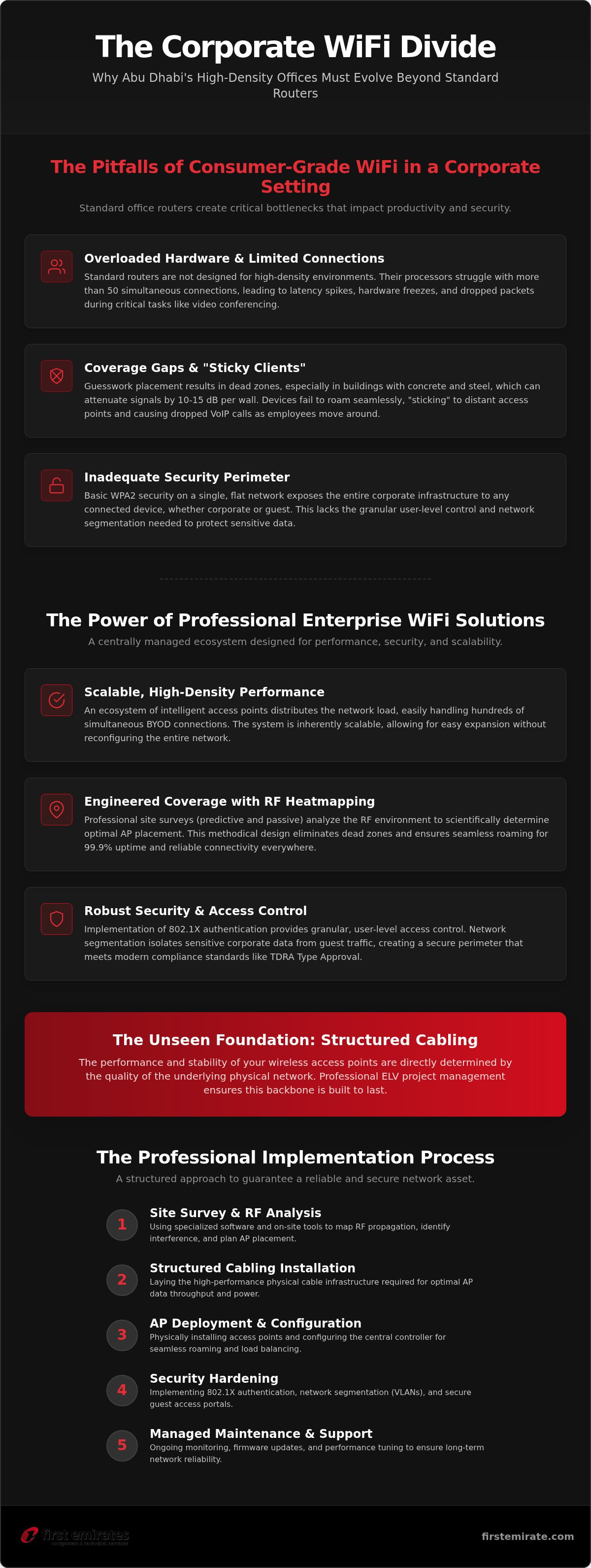
Standard office routers often become the primary bottleneck in a growing company. These devices typically feature integrated processors that struggle when managing more than 50 simultaneous connections. When a team attempts a synchronized 4K video conference or large file transfers, the hardware's CPU cycles peak, causing latency spikes and hardware freezes. Another critical failure point is the lack of seamless roaming. In a consumer setup, a laptop often remains "stuck" to a distant router even when a closer one is available. This "sticky client" phenomenon leads to dropped VoIP calls as staff move between meeting rooms. Basic WPA2 implementations also lack the granular user-level control and encryption standards required for modern corporate security.
The Business Case for Enterprise Wireless
The economic impact of patchy connectivity is often higher than the cost of a professional upgrade. Dropped connections during critical client presentations or delayed data synchronization in warehouses result in tangible productivity losses. Modern Abu Dhabi offices face extreme device density due to Bring Your Own Device (BYOD) policies. Each employee might connect a laptop, phone, and tablet simultaneously, tripling the expected load on the network. Enterprise WiFi solutions Abu Dhabi address this by distributing the load across multiple intelligent access points. This infrastructure is inherently scalable. Adding coverage to a new floor or wing involves simply adding hardware to the existing controller. You don't need to reconfigure the entire network from scratch, which saves time and prevents configuration errors.
RF Heatmapping and Site Surveys: The Methodical Design Process
A "plug-and-play" approach is the primary cause of dead zones in large corporate offices. Effective enterprise WiFi solutions Abu Dhabi require a methodical site survey to account for the city's unique architectural landscape and ensure compliance with TDRA technical standards. Abu Dhabi’s high-rise towers and industrial warehouses utilize heavy concrete, reinforced steel, and specialized glass. These materials don't just block signals; they reflect and absorb them. For instance, reinforced concrete can attenuate a 5GHz signal by as much as 10 to 15 dB per wall. Without a technical survey, access point placement is based on guesswork, leading to inconsistent coverage and frustrating connectivity gaps.
Identifying sources of electromagnetic interference (EMI) is equally vital. Industrial machinery, microwave ovens, and even neighboring wireless networks can saturate the available spectrum. Professional design involves a detailed analysis of the radio frequency (RF) environment to ensure that your network operates on clean channels. This process is a critical step in Protecting the Corporate Perimeter by ensuring there are no weak points in the physical signal coverage where unauthorized access could be attempted. For businesses planning a new facility, integrating these surveys into your initial ELV projects ensures the infrastructure is ready from day one.
Predictive vs. Passive Site Surveys
Predictive site surveys use CAD drawings and specialized software to simulate how RF signals will propagate through a building. This allows engineers to estimate the optimal number of Access Points (APs) before a single cable is pulled. However, real-world conditions often differ from blueprints. A passive site survey involves a technician walking the premises with specialized equipment to measure actual signal strength, Signal-to-Noise Ratio (SNR), and interference levels. Combining these methods ensures that AP placement is mathematically sound and verified against the physical reality of the office.
Accounting for High-Density Areas
Modern office layouts often include boardrooms or training centers where device density peaks. A single AP that functions perfectly in a quiet hallway will fail when 50 laptops and 50 smartphones attempt to connect simultaneously in a meeting room. Design strategies for enterprise WiFi solutions Abu Dhabi must include load balancing techniques that distribute clients across multiple APs. Optimization of the 5GHz and 6GHz spectrums, particularly for WiFi 6E and WiFi 7, is necessary to provide the bandwidth required for high-definition video conferencing and cloud-based collaboration tools without congestion.
Why WiFi Performance Depends on Structured Cabling
Wireless signals don't exist in a vacuum; every high-performance Access Point (AP) relies on a physical cable to transmit data back to the core network. If the underlying cabling is substandard, even the most sophisticated enterprise WiFi solutions Abu Dhabi will underperform. We view the wired infrastructure as the "backbone" of the wireless ecosystem. A mismatch between high-speed wireless standards and legacy cabling creates immediate bottlenecks that frustrate users and limit the return on hardware investment.
Cat6 and Cat6A cabling represent the minimum requirement for modern corporate deployments. Cat6A is particularly vital because it supports 10Gbps data rates over 100 meters, providing the necessary overhead for the multi-gigabit throughput of Wi-Fi 7. Beyond speed, professional installations utilize Power over Ethernet (PoE) to deliver both data and electrical power through a single cable. This methodical approach simplifies deployment by removing the need for dedicated electrical outlets at every mounting location. Integrating these elements into a comprehensive structured cabling services UAE strategy ensures that the entire physical layer is certified and tested for signal integrity. Compliance with the TDRA Internet Access Management Regulatory Policy is also managed at this stage, ensuring the backend infrastructure supports federal data management standards.
The Role of High-Speed Backhaul
A common failure point in enterprise networks is the switch-level bottleneck. While an AP might support high wireless speeds, the uplink to the core switch often lacks the capacity to handle aggregated traffic from dozens of users. Implementing professional enterprise WiFi solutions Abu Dhabi requires a 10Gbps uplink standard for modern deployments to prevent congestion. Proper cable management within the server room is also necessary to maintain signal integrity and simplify long-term maintenance under an AMC.
Future-Proofing with Fiber Optics
In multi-floor buildings or industrial complexes, copper cabling hits its physical limits. We utilize fiber optic cabling Abu Dhabi for vertical backbones to connect IDF closets across different levels. Fiber optics offer near-zero latency and immunity to electromagnetic interference. This ensures the network can handle next-generation wireless standards without a total infrastructure overhaul. Investing in a fiber backbone today provides the stability needed for future bandwidth-intensive applications.
Security and Management: Protecting the Corporate Perimeter
Professional security for enterprise WiFi solutions Abu Dhabi must move beyond the shared-password model used in residential settings. Relying on a single Pre-Shared Key (PSK) creates a significant vulnerability; if one employee leaves the company, the entire password should technically be changed to maintain integrity. We implement the 802.1X authentication standard, which requires each user to log in with unique credentials verified against a central database like Active Directory. This ensures that access is tied to a specific identity, allowing for granular control over who can connect to the network. Network segmentation through Virtual Local Area Networks (VLANs) creates a logical barrier that prevents guest users from discovering or accessing sensitive internal server resources.
The choice between cloud and on-premise controllers depends on your specific operational requirements and security posture. Cloud-based management offers centralized oversight for businesses with multiple branches across the UAE, allowing for rapid configuration changes from a single dashboard. Conversely, on-premise controllers are often preferred by industrial and government sectors in Abu Dhabi where data sovereignty and local control are paramount. To ensure your perimeter remains secure, consider our specialized IT hardware sales for the latest security-hardened access points and controllers.
Guest WiFi and Captive Portals
Guest access is a standard requirement, but it must be managed with discipline. Branded captive portals serve as a professional landing page where guests accept terms of service before gaining access. This environment allows for bandwidth limiting, which ensures that guest streaming or large downloads don't consume the capacity needed for corporate VoIP and video conferencing. In the UAE, legal compliance is a critical factor. The TDRA provides specific guidelines regarding user accountability and data management for public-facing networks. A methodical design ensures that your guest portal meets these regulatory standards while providing a seamless user experience.
Advanced Threat Protection
A secure network actively monitors for "Rogue Access Points"—unauthorized devices plugged into your network by employees or outsiders that create backdoors for attackers. Modern enterprise systems include Wireless Intrusion Prevention Systems (WIPS) to detect and mitigate these threats automatically. We also prioritize WPA3-Enterprise encryption, which provides superior protection against brute-force attacks compared to previous standards. Integrating your wireless management with existing firewalls and endpoint security solutions creates a unified defense strategy. This multi-layered approach ensures that your wireless infrastructure is a robust component of your overall corporate security posture.
Implementation and Managed Maintenance in Abu Dhabi
Successful deployment of enterprise WiFi solutions Abu Dhabi concludes with a disciplined implementation phase. We manage the entire process from the initial ELV design through to final system certification. This end-to-end responsibility is why we are a trusted choice for ELV project contractors Abu Dhabi who require precise execution on large-scale infrastructure projects. A local specialist understands the specific regulatory landscape, including TDRA Type Approval requirements, ensuring that every piece of hardware is compliant before it's commissioned.
Long-term network stability is achieved through proactive IT AMC services Abu Dhabi. Wireless environments are dynamic; new neighboring networks or physical office changes can alter signal propagation over time. A dedicated maintenance contract provides the oversight needed to identify these shifts and adjust the network configuration accordingly. Working with a local partner established in 2011 ensures that your business has access to rapid on-site technical support when hardware failures occur, minimizing the window of operational disruption.
The Importance of Post-Installation Certification
We don't consider an installation complete until the network undergoes rigorous post-installation certification. Our engineers use industry-standard testers to verify that every cable drop meets Cat6A performance metrics and that signal strength aligns with the initial predictive heatmap. Clients receive comprehensive "As-Built" documentation, which includes detailed physical layouts and logical network maps. This level of transparency ensures that the system meets all local safety and technical standards, providing a baseline for any future expansions.
Annual Maintenance Contracts (AMC) for WiFi
An AMC for your wireless infrastructure covers more than just hardware replacement. It includes regular firmware updates to patch critical security vulnerabilities and periodic RF environment checks to mitigate new external interference. We also offer 24/7 monitoring options that allow us to identify and resolve Access Point failures before your staff or guests notice a drop in service. This methodical approach to maintenance transforms your WiFi from a potential point of failure into a stable, high-performance asset that grows with your company.
Building Your Future-Ready Wireless Infrastructure
Establishing a high-performance network in the capital requires more than just high-speed access points. It demands a methodical approach that integrates professional RF heatmapping with a robust backbone of certified structured cabling. By prioritizing security standards like 802.1X and ensuring compliance with federal TDRA regulations, your organization creates a stable environment for both internal operations and guest connectivity. Treating your wireless network as a disciplined infrastructure project ensures that your enterprise WiFi solutions Abu Dhabi remain scalable and secure as your business grows.
First Emirates Computers has served as a reliable ELV partner since 2011, specializing in the complex commercial infrastructure requirements of the region. Our team provides the technical precision needed for seamless deployment and comprehensive IT AMC support to maintain maximum uptime. To ensure your office is optimized for the next generation of wireless standards, request a professional WiFi site survey from First Emirates Computers today. We're ready to help you build a dependable foundation for your digital operations.
Frequently Asked Questions
What is the difference between a home router and enterprise WiFi?
Enterprise systems utilize multiple access points managed by a central controller, whereas home routers function as standalone devices. Professional solutions are built to handle higher device density and provide seamless roaming as users move between different office areas. These systems offer advanced security protocols and network segmentation capabilities that are not available in consumer hardware. This infrastructure is designed for 99.9% uptime and supports hundreds of simultaneous connections without performance degradation.
How many access points do I need for my office in Abu Dhabi?
The required number of access points depends on your office square footage, the total number of users, and the building's layout. Specific building materials common in Abu Dhabi, such as reinforced concrete and specialized glass, significantly impact signal penetration and must be accounted for during design. A professional site survey is the only way to determine the exact count accurately. This process ensures full coverage while preventing signal overlap and radio frequency interference.
Does First Emirates Computers provide site surveys for WiFi?
Yes, First Emirates Computers provides comprehensive site surveys as a fundamental part of our ELV and IT infrastructure services. We utilize specialized software and physical testing to map your radio frequency environment accurately. This methodical approach allows us to design enterprise WiFi solutions Abu Dhabi that eliminate dead zones and account for architectural obstacles. Our surveys ensure that your wireless deployment is grounded in technical data rather than estimation or guesswork.
Can I use my existing cabling for a WiFi 6 upgrade?
You can often reuse existing cabling if it meets Cat6 or Cat6A standards. However, older Cat5e cabling may limit the multi-gigabit performance capabilities of WiFi 6 and WiFi 7 hardware. During our structured cabling assessment, we test your current infrastructure to ensure it can support Power over Ethernet requirements and the high-speed backhaul necessary for modern access points. Upgrading to Cat6A is typically recommended to future-proof your corporate network effectively.
What is an RF heatmap and why is it necessary?
An RF heatmap is a visual representation of wireless signal strength and coverage levels across your premises. It's a necessary tool for identifying potential dead zones and areas of high interference before the installation phase begins. By simulating signal propagation through different wall materials, we can optimize access point placement for maximum efficiency. This technical planning prevents costly post-installation adjustments and ensures that bandwidth-heavy applications function reliably in every corner of your office.
How long does a professional WiFi installation take?
Installation timelines vary based on the project's scope and the complexity of the required structured cabling. A standard office deployment usually spans from a few days to two weeks. This timeline includes the initial site survey, cable pulling, hardware mounting, and final system certification. We prioritize a disciplined implementation process to minimize disruption to your daily operations. Larger ELV projects involving multiple floors or industrial warehouses naturally require a more extended schedule.
Is an Annual Maintenance Contract (AMC) mandatory for enterprise WiFi?
While not legally mandatory, an Annual Maintenance Contract is essential for maintaining long-term network security and performance. Wireless environments change as neighboring businesses install new equipment or as you modify your office layout. Our AMC services include regular firmware updates, security patching, and periodic RF environment re-evaluations. This proactive oversight identifies potential failures before they impact your productivity, ensuring your investment in IT hardware continues to deliver reliable connectivity throughout the year.
Do enterprise WiFi solutions support guest network isolation?
Yes, professional systems utilize Virtual Local Area Networks to completely isolate guest traffic from your internal corporate data. This segmentation is a critical security measure that prevents visitors from accessing sensitive servers or printers. You can manage guest access through branded captive portals, which also allow you to set specific bandwidth limits. This ensures that guest usage doesn't compromise the performance of mission-critical applications used by your staff on the primary network.


