

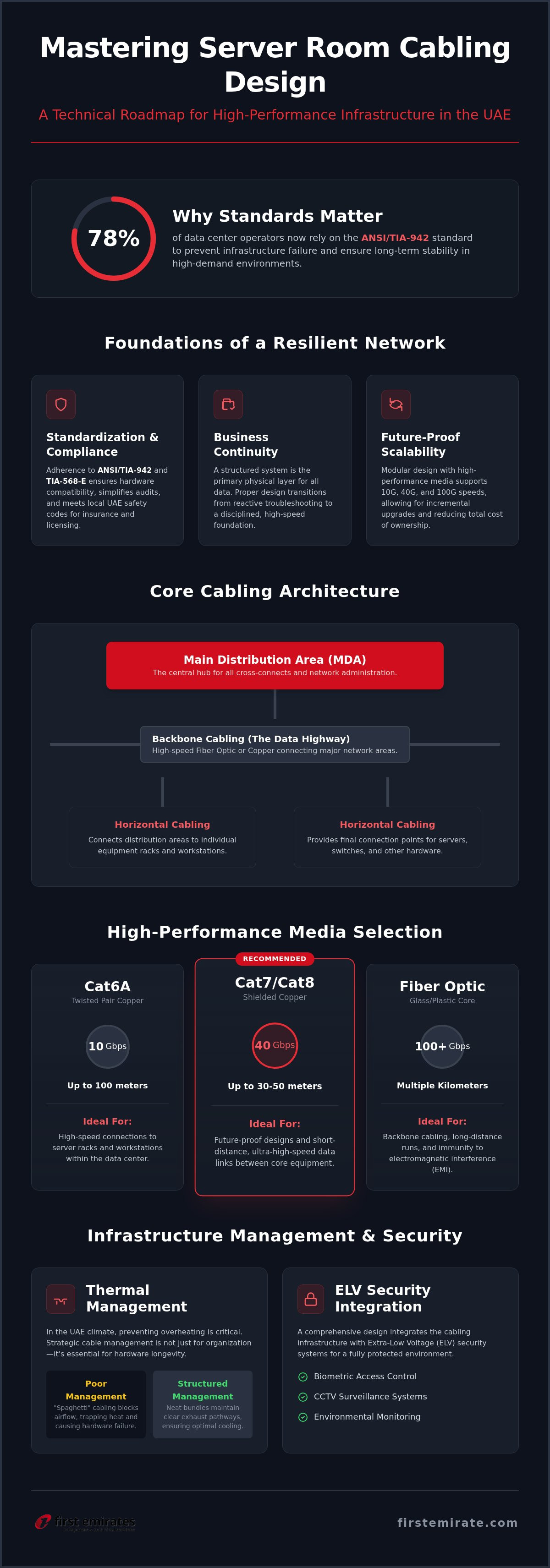
Approximately 78% of data center operators now rely on the ANSI/TIA-942 standard to prevent infrastructure failure. In the high-demand business environment of the UAE, a single cooling blockage or a misplaced patch cord can lead to hours of costly downtime. We understand the frustration of troubleshooting through a "spaghetti" of unmanaged wires or realizing that your legacy setup can't handle modern 10Gbps speeds. Effective server room cabling design Abu Dhabi requires more than just connecting hardware. It demands a methodical approach to thermal management and logical organization to ensure long-term stability.
This guide provides the technical roadmap you need to build a scalable, high-performance environment that meets both international TIA/EIA-568-E standards and local UAE regulations. You'll master the design principles required to eliminate overheating and ensure your infrastructure supports future growth. We will detail everything from Cat6A implementation to integrated ELV security, ensuring your server room remains a clean, reliable asset for years to come. By following these professional standards, you can transition from reactive troubleshooting to a disciplined, high-speed network foundation.
Key Takeaways
- Establish a foundation for business continuity by implementing structured cabling that adheres to ANSI/TIA-942 and local UAE standards.
- Learn how to centralize network control through a Main Distribution Area (MDA) while distinguishing between backbone and horizontal cabling hierarchies.
- Optimize your server room cabling design Abu Dhabi by selecting high-performance media like Cat6A or Fiber Optic to support 10Gbps+ speeds.
- Prevent hardware overheating by using strategic cable management techniques that maintain clear exhaust pathways for cooling systems in the UAE climate.
- Integrate your cabling infrastructure with ELV security systems, including biometric access control and CCTV, for a comprehensive and secure server environment.
The Fundamentals of Server Room Cabling Design in Abu Dhabi
In a dedicated server environment, a professional structured cabling system serves as the primary physical layer for all data exchange. It isn't merely a collection of wires; it's a highly engineered architecture of cables, connectors, and management devices designed to provide a predictable performance level. For enterprises in the UAE, a methodical server room cabling design Abu Dhabi is the difference between a resilient network and one prone to intermittent failure. This systematic approach ensures that every component, from the patch panels to the server racks, functions as a unified whole. It directly supports broader structured cabling services UAE by providing a stable core that can handle the heavy traffic loads typical of modern corporate data centers.
Professional design is essential for business continuity within Abu Dhabi’s competitive enterprise sector. We rely on established international frameworks like ANSI/TIA-568-E and the more specialized ANSI/TIA-942-C, which was updated in May 2024. These standards provide the necessary specifications for data center infrastructure, covering everything from cabling distances to redundancy levels. Adhering to these protocols ensures that your infrastructure isn't just functional today but remains compatible with the next generation of networking hardware.
Standardization and Compliance in the UAE
Utilizing international standards like TIA-942-C facilitates smoother commercial audits and hardware migrations. When a system follows a recognized standard, it's easier for technical teams to identify and resolve issues without deciphering proprietary or disorganized layouts. In the UAE, standardized designs also play a critical role in building safety and insurance compliance. Proper cable labeling and fire-rated materials ensure that the server room meets local safety codes, which can be a prerequisite for comprehensive insurance coverage and operational licensing. A disciplined design simplifies the process of adding new hardware, as the pathways and port densities are already calculated for expansion.
Scalability: Planning for 2026 and Beyond
Modern server room cabling design Abu Dhabi must account for the "Day 2" scenario, where capacity needs to increase without interrupting current operations. With global data generation expected to reach 181 trillion gigabytes by 2025, the demand for bandwidth in Abu Dhabi’s financial and tech hubs is accelerating. Current designs often prioritize Cat6A or fiber optic backbones to support 10G, 40G, and even 100G requirements. By implementing a modular design, businesses can reduce their total cost of ownership over a 10-year lifecycle. This approach allows for incremental upgrades to specific sections of the network without the need for a complete, expensive overhaul of the entire cabling plant.
Core Architecture: Backbone vs. Horizontal Cabling
A methodical hierarchy is the foundation of any successful server room. In a professional server room cabling design Abu Dhabi, we categorize the network into distinct functional areas to ensure maximum efficiency. The Main Distribution Area (MDA) serves as the central hub, managing all cross-connects and providing the primary point of administration. This structured approach allows for a logical flow of data from the service provider's entrance room through to the individual server racks. By centralizing control within the MDA, technical teams can perform maintenance or upgrades without disrupting the entire facility's connectivity. It's a system that prioritizes order over convenience.
Backbone Cabling: The Data Highway
The backbone cabling subsystem acts as the primary data thoroughfare, connecting the server room to various telecommunications rooms across the enterprise. For these critical runs, fiber optic cabling is the preferred media due to its high bandwidth and immunity to electromagnetic interference. While high-grade copper can be used for shorter distances, fiber provides the necessary performance for 40G and 100G uplinks. We emphasize redundancy in this layer. Implementing path diversity ensures that if one cable pathway is compromised, the network remains operational through an alternate route. This level of planning is standard practice for leading structured cabling companies in Abu Dhabi who prioritize long-term uptime.
Horizontal Cabling: Connecting the Racks
Horizontal cabling extends from the patch panels in the distribution area to the specific equipment outlets in the server racks. This layer is where the majority of the active connections occur. Signal integrity is paramount here, as even minor interference can cause packet loss. Following established Data center cabling standards, every permanent link must undergo rigorous testing to ensure it meets the required performance specifications. Managing the "last meter" of the connection involves using high-quality, factory-terminated patch cords that don't degrade the signal. Poorly constructed cables are a common cause of troubleshooting delays and reduced throughput. Ensuring that every connection is labeled and tested provides a clean, manageable environment. If your current infrastructure lacks this level of organization, it might be time to consult with experts in professional cabling design services to audit your existing setup and identify potential bottlenecks.
Media Selection: Comparing Cat6A, Cat7, and Fiber Optic
Choosing the right physical media is a decisive step in server room cabling design Abu Dhabi. It isn't merely about selecting the fastest cable available; it's about balancing performance, distance, and environmental factors. Copper remains the primary choice for horizontal cabling due to its cost-efficiency and ease of termination, while fiber optic is indispensable for backbone connectivity. Professional cabling standards are the cornerstone of any stable network. These standards dictate that media selection should align with the expected lifespan of the hardware it supports, ensuring the infrastructure doesn't become a bottleneck as your business grows.
Shielding is a critical technical consideration, especially in Abu Dhabi's industrial or high-density sectors. Environments with high electromagnetic interference (EMI) benefit from F/UTP (Foiled/Unshielded Twisted Pair) cabling. This shielding provides a layer of protection that standard U/UTP cables lack, preventing data corruption. This choice also impacts the long-term scope of IT AMC services Abu Dhabi. Fiber-heavy environments require specialized cleaning and testing equipment during annual maintenance to ensure signal loss remains within acceptable decibel limits. A methodical approach to media selection simplifies these maintenance tasks and extends the system's operational life.
Copper Solutions: Cat6A and Cat7
Cat6A is the industry-standard baseline for 10Gbps performance over the full 100-meter channel. It's the most common choice for modern server rooms because it's recognized by the TIA/EIA standard. While Cat7 offers higher frequency performance at 600 MHz, it isn't recognized by TIA/EIA and requires non-standard connectors like GG45 or TERA. For short-distance, high-density applications where frequencies reach 2000 MHz, Cat8 is an emerging alternative. Regardless of the category, maintaining termination consistency using the T568B standard is vital. This consistency ensures that any technician can efficiently troubleshoot the system without deciphering non-standard wiring patterns.
Fiber Optic: OM3, OM4, and Single-Mode
For high-speed server-to-switch links, multimode fiber like OM4 or OM5 is the preferred solution. These media support 40G and 100G speeds over distances common within a single facility. In larger Abu Dhabi complexes, single-mode fiber is necessary for long-distance backbone connectivity because it offers virtually unlimited bandwidth over many kilometers. Modern fiber terminations rely on SFP+ and QSFP modules to provide the high-density ports required for high-performance computing. Using these modules allows for a modular approach to hardware upgrades, as the underlying fiber remains the same even as the transceivers are updated to support higher speeds.
Abu Dhabi's extreme climate creates a unique set of thermal challenges for data centers. With outdoor temperatures frequently exceeding 40°C, the internal cooling systems must operate without any physical obstruction. Improper server room cabling design Abu Dhabi is a primary contributor to equipment failure when cables are allowed to "nest" behind server exhaust fans. This blockage restricts the exit of hot air, leading to recirculated heat and the formation of dangerous hot spots. A methodical approach to cable routing ensures that every rack maintains a clear exhaust pathway, protecting your investment in high-performance hardware.
We implement strict color-coding protocols to streamline both troubleshooting and maintenance. By assigning distinct colors to power feeds, copper data links, and fiber uplinks, technical teams can identify critical infrastructure components at a glance. This discipline reduces the time spent on tracing cables during an outage and ensures that maintenance tasks are performed accurately. Effective cable management is a functional necessity that directly impacts the reliability of the entire system.
Rack Management Best Practices
Effective rack organization begins with the use of "Zero-U" vertical cable managers. These components reside in the space between the rack's side panels and the equipment mounting rails, ensuring that no cables cross the rear exhaust area of the servers. We prioritize the use of Velcro ties over plastic zip ties for all bundles. Velcro provides a secure hold without applying excessive pressure that could cause signal degradation or "kinking" in high-speed copper lines. Additionally, blanking panels must be installed in every unused rack unit. These panels prevent cold air from bypassing the servers, maintaining the pressure differentials required for efficient cooling.
Underfloor vs. Overhead Cabling
Choosing between underfloor and overhead pathways depends on the facility's cooling architecture. Raised floor systems are excellent for cold-aisle containment, but they require disciplined management to prevent "cable dams" that block the flow of chilled air. Alternatively, overhead ladder racks offer superior accessibility and keep the floor space clear for cooling infrastructure. In high-density environments, we monitor cable tray capacity closely. It's essential to prevent trays from becoming so congested that they impede airflow in tight spaces. If your server room is experiencing thermal alarms or disorganized cabling, our specialists can perform a professional structured cabling audit to optimize your environment for peak performance.
Implementing Professional Infrastructure with First Emirates Computers
At First Emirates Computers, we treat every installation as a comprehensive ELV project rather than a series of isolated tasks. Our approach to server room cabling design Abu Dhabi starts with a detailed site survey and a deep understanding of your business's operational requirements. We coordinate the physical layer with other critical systems, ensuring that your network infrastructure seamlessly integrates with essential security protocols. For instance, we work closely with your chosen access control system company to ensure that biometric readers and CCTV surveillance are powered and networked through the same methodical cabling architecture. This integration provides a unified security posture for your most sensitive technical assets.
We emphasize a "documentation-first" philosophy. Every cable drop is tested, certified, and labeled according to TIA-606 standards. This isn't just for the initial setup; it's a vital requirement for long-term troubleshooting. When every port in the patch panel corresponds to a clearly marked outlet in the rack, maintenance teams can resolve issues in minutes rather than hours. This level of precision is what distinguishes a professional build from a generic installation. It ensures that any technician who enters the room can understand the logic of the system immediately.
Integrated ELV Project Management
Managing complex technical infrastructure requires a single point of contact to ensure consistency across all ELV systems. We handle the coordination between structured cabling, CCTV, and office automation, reducing the risk of conflicting hardware or redundant pathways. Our team follows a disciplined execution phase where every connection is verified through rigorous certification processes. This methodical oversight ensures that the server room cabling design Abu Dhabi meets the exact performance specifications promised during the planning stage. We don't consider a project complete until every link is documented and the physical environment is organized for peak efficiency.
Proactive Support and Maintenance
The transition from a successful installation to long-term reliability is managed through our proactive Annual Maintenance Contracts (AMC). Infrastructure decay is a common issue in server rooms where frequent hardware swaps lead to disorganized cabling over time. Our AMC services prevent this by providing regular audits of cable integrity and rack organization. We ensure that your server room remains a business asset that supports growth rather than a technical liability that hinders it. By maintaining the standards established during the design phase, we provide the peace of mind that comes with knowing your infrastructure is under constant, professional oversight.
Securing Your Infrastructure for Future Growth
Establishing a resilient technical foundation requires a disciplined approach to every connection and pathway. We've explored how a methodical hierarchy, precise media selection, and strategic airflow management create a stable environment capable of supporting 10Gbps+ speeds. A professional server room cabling design Abu Dhabi isn't just about the initial setup; it's about building a system that remains accessible, cool, and compliant with international TIA/EIA standards for its entire lifecycle. This precision ensures that your hardware operates at peak efficiency without the risk of thermal failure or signal degradation.
Since 2011, First Emirates Computers has served as a steady partner for complex ELV projects across the region. We ensure that your infrastructure integrates seamlessly with biometric access and CCTV systems while remaining protected through comprehensive Annual Maintenance Contracts. This methodical oversight prevents technical decay and ensures your data center remains a high-performance asset. If you're ready to transition from disorganized cabling to a certified and labeled environment, we're prepared to assist. Contact First Emirates Computers for a professional server room cabling consultation in Abu Dhabi to ensure your facility's technical readiness. We look forward to providing the stability your enterprise requires.
Frequently Asked Questions
What is the best type of cable for a new server room in Abu Dhabi?
Cat6A is the recommended baseline for a modern server room cabling design Abu Dhabi. It provides reliable 10 Gbps performance over a full 100-meter channel. While Cat7 offers higher frequencies, Cat6A remains the TIA/EIA recognized standard for most commercial installations. For backbone connectivity between floors or buildings, we prioritize OM4 or single-mode fiber optic cabling to ensure maximum bandwidth and immunity from interference.
How does professional cabling design improve server room cooling?
Professional design eliminates disorganized cabling that blocks critical exhaust pathways behind server racks. By using vertical and horizontal managers, we keep the airflow path clear, allowing hot air to exit the servers efficiently. This prevents the formation of hot spots, which are particularly dangerous in the UAE's high-temperature climate. Strategic placement ensures that cooling systems don't have to work harder than necessary to maintain safe operating temperatures.
Does First Emirates Computers provide certified testing for structured cabling?
Yes, First Emirates Computers performs rigorous certification for every structured cabling installation. We use industry-standard testing equipment to verify that each link meets ANSI/TIA-568-E and TIA-942-C performance requirements. Our methodical approach includes providing clients with detailed test reports for every drop. This documentation serves as a performance guarantee and a baseline for future troubleshooting or infrastructure audits during your Annual Maintenance Contract.
Can we upgrade our server room cabling without significant downtime?
We minimize downtime through careful planning and the implementation of redundant cable pathways. By designing a modular infrastructure, we can often run new lines or upgrade specific segments while the primary network remains active. Our team schedules high-impact transitions during off-peak hours to ensure business continuity. Methodical server room cabling design Abu Dhabi prioritizes these "Day 2" scenarios so your operations aren't disrupted by growth.
What is the difference between backbone and horizontal cabling?
Backbone cabling acts as the main thoroughfare, connecting the entrance room or Main Distribution Area (MDA) to other telecommunications rooms. It handles high-traffic loads and often uses fiber optic media. Horizontal cabling connects the patch panels in the distribution area to the individual equipment outlets in the server racks. While the backbone facilitates site-wide connectivity, the horizontal layer focuses on the "last mile" delivery of data to your servers.
Why should I use fiber optic instead of copper for my server backbone?
Fiber optic cabling is the superior choice for backbones because it supports much higher bandwidth over longer distances than copper. It's completely immune to electromagnetic interference (EMI), which is essential in dense corporate environments. Fiber supports speeds of 40G and 100G with ease, providing a future-proof foundation for your network. It's also lighter and takes up less space in cable trays, improving overall airflow and management.
How often should server room cabling be audited or maintained?
We recommend a comprehensive audit of your cabling infrastructure at least once a year. This is typically handled through an Annual Maintenance Contract (AMC) to ensure that temporary hardware changes haven't compromised the original design. Regular maintenance includes checking for cable stress, verifying label accuracy, and ensuring that airflow pathways remain unobstructed. Frequent audits prevent technical decay and ensure the system remains reliable as your hardware evolves.
Is professional labeling really necessary for a small server room?
Professional labeling is absolutely essential regardless of the room's size. Without clear, standard-compliant labels, even a small outage can take hours to resolve as technicians struggle to trace connections. Proper documentation ensures that anyone entering the server room can immediately understand the network logic. It reduces human error during maintenance and simplifies the process of adding new equipment, making it a critical requirement for long-term operational stability.


