

With the UAE biometrics market projected to reach a value of USD 858.3 million by 2034, the era of the manual punch card and the shared fingerprint scanner is ending. Most operations managers in Abu Dhabi and Dubai already understand the persistent frustration of inaccurate attendance logs caused by buddy punching or the hygiene risks associated with touch-based systems. It’s a constant challenge to maintain 100% accuracy when legacy hardware fails to sync properly with UAE payroll and Wage Protection Systems.
Adopting advanced face recognition attendance UAE solutions provides a methodical way to streamline workforce management while ensuring strict compliance with Federal Decree-Law No. 45 of 2021. This technology eliminates time fraud and offers a seamless, contactless experience for your employees. In this 2026 guide, we provide a technical overview of integrated biometric access control, covering everything from SIRA-compliant hardware to the systematic integration of ELV projects into your existing IT infrastructure. You'll discover how a structured approach to facial recognition can transform your operational reliability, data security, and long-term technical readiness.
Key Takeaways
- Transitioning to AI-driven facial recognition eliminates unauthorized proxy attendance and enhances workplace hygiene through 100% contactless identification.
- A professionally installed face recognition attendance UAE system ensures accurate time tracking and seamless synchronization with national payroll and Wage Protection Systems.
- Stable biometric operations rely on high-quality structured cabling and expert ELV integration to maintain network reliability across complex enterprise environments.
- Professional site surveys are essential for selecting hardware that matches your specific user capacity and environmental requirements, whether for indoor or outdoor deployment.
- Securing a comprehensive Annual Maintenance Contract (AMC) is a methodical way to protect your technical investment and ensure hardware longevity in the UAE climate.
Understanding Face Recognition Attendance Technology in 2026
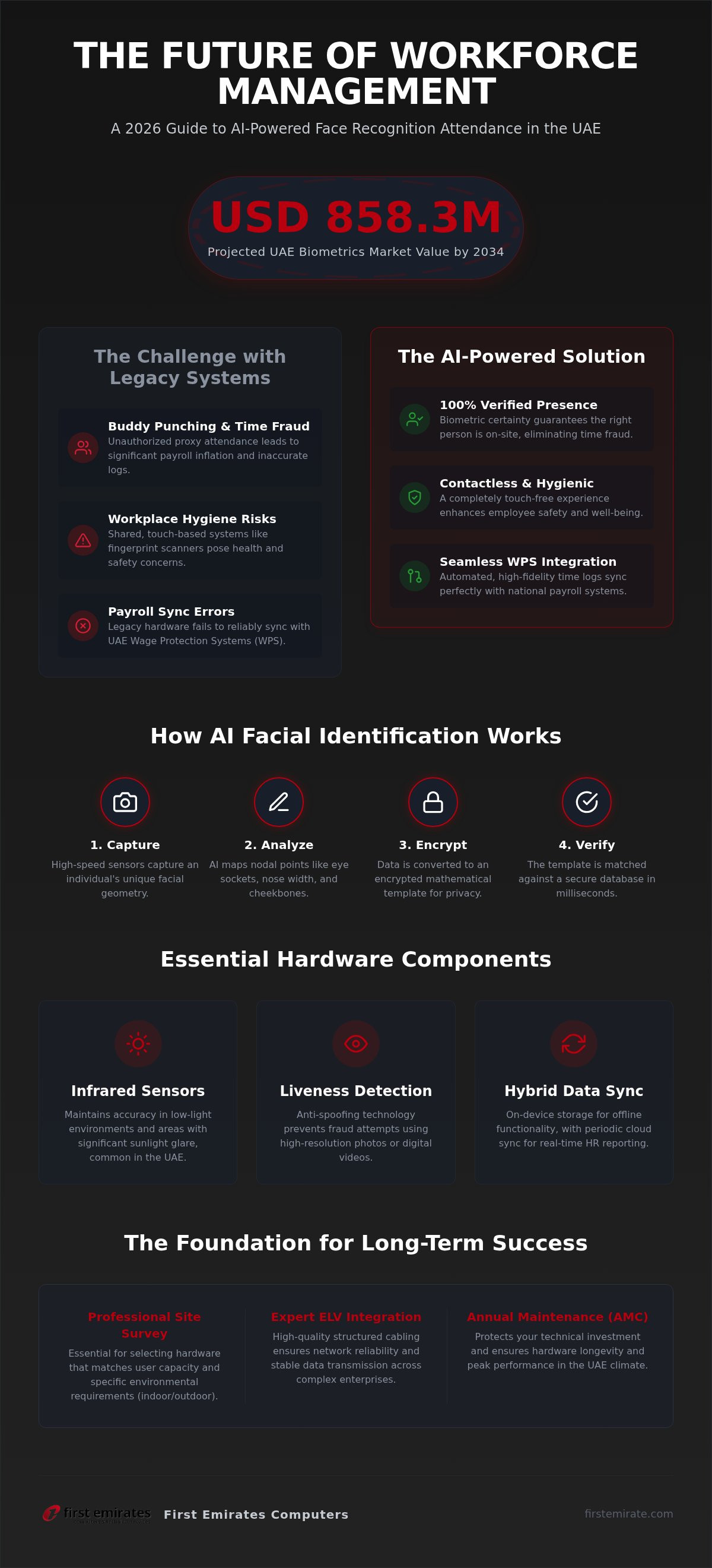
AI-driven facial recognition for time and attendance is a sophisticated biometric solution that utilizes neural networks to identify individuals based on unique physiological traits. Unlike legacy systems that rely on physical contact, this technology captures facial geometry and processes it through complex algorithms to verify identity in milliseconds. It represents a significant technological shift for corporate environments. Traditional fingerprint biometrics often present challenges, including hygiene concerns and high failure-to-enroll rates due to worn or damaged prints. In contrast, modern face recognition attendance UAE systems offer a completely contactless experience that is both faster and more reliable for large-scale operations.
The transition to facial recognition is now the preferred standard for UAE enterprises. This preference is driven by the need for high-security standards and the requirement for systems that integrate seamlessly with the UAE’s Wage Protection System (WPS). By using a combination of high-speed sensors and database integration, these systems provide a methodical way to manage workforce data without the physical bottlenecks common in older hardware. The reliability of these systems makes them a core component of modern ELV (Extra Low Voltage) projects, ensuring that attendance data is a stable part of a building's integrated IT infrastructure.
How AI Facial Identification Works
The identification process involves mapping specific nodal points on a face, such as the depth of eye sockets or the width of the nose. The system then converts these spatial relationships into an encrypted mathematical data string. This ensures that the terminal stores a template rather than a raw image, which is a critical privacy requirement under UAE data protection laws. Systems typically operate in two modes: verification and identification. Verification, or 1:1 matching, compares a live face against a specific pre-selected profile. Identification, or 1:N matching, scans the entire database to find a match among thousands of records. High-precision 3D facial mapping has become the 2026 security standard for enterprise-grade attendance systems.
Key Components of an Enterprise-Grade Terminal
A dependable attendance terminal requires specific hardware components to function effectively in the diverse lighting conditions found in UAE offices and industrial sites. These components include:
- Infrared sensors: These are essential for maintaining accuracy in low-light environments or areas with significant sunlight glare, which is common in Abu Dhabi and Dubai.
- Liveness detection: This anti-spoofing technology ensures the terminal is scanning a living person, preventing fraud attempts using high-resolution photos or digital videos.
- Data synchronization: Terminals use on-device storage for immediate processing during network outages, while periodically syncing with cloud-based databases to provide real-time reporting for HR departments.
These features ensure that the hardware remains a resilient part of the business's security and management ecosystem. By focusing on these technical standards, businesses can achieve a higher level of operational discipline and data accuracy.
Critical Benefits for UAE Businesses and HR Departments
Implementing a professional face recognition attendance UAE system offers more than just technical modernization. It provides a structured solution for workforce oversight that directly impacts the bottom line. For HR departments, the primary advantage is the transition from manual data entry to automated, high-fidelity time logs. This shift ensures that every recorded hour is verified by biometric data, removing the ambiguity of traditional sign-in sheets or swipe cards.
Combatting Time Fraud and Buddy Punching
Unauthorized proxy attendance, commonly known as buddy punching, remains a significant source of financial leakage for UAE enterprises. In high-traffic environments such as construction sites or large retail hubs, the ability for one employee to clock in for another can lead to substantial payroll inflation. Biometric certainty eliminates this risk entirely. By requiring a live facial scan, the system guarantees that the individual being paid is the one physically present on-site. This level of precision reduces administrative overhead, as HR teams no longer need to investigate discrepancies between logs and actual attendance. For businesses seeking these efficiencies, choosing a partner with expertise in biometric access control ensures the hardware is deployed to maximize these specific operational gains.
Hygiene and Employee Wellness Standards
Modern office environments in Abu Dhabi and Dubai prioritize health standards and employee wellness. Contactless interaction has become a baseline expectation for corporate facilities. Unlike fingerprint scanners, which require thousands of daily physical contacts, facial recognition terminals operate without any surface interaction. This approach significantly reduces the transmission of surface-borne pathogens, contributing to a cleaner workplace. Beyond hygiene, the technology enhances the employee experience by providing friction-free entry and exit. Staff can move through secure checkpoints without stopping to search for badges or press sensors, maintaining a steady flow during peak shift changes.
The automation of time logs provides a direct feed into payroll systems, which is critical for maintaining compliance with the UAE Wage Protection System (WPS). By integrating attendance with broader access control, businesses can also restrict entry to sensitive zones based on shift schedules. This dual-purpose utility transforms a simple time-tracking tool into a comprehensive security and management asset that supports the disciplined rhythm of a professional enterprise.
Technical Integration: ELV and Structured Cabling Requirements
A high-performance face recognition attendance UAE system requires more than just high-end terminals; it demands a stable, high-bandwidth backbone. For enterprises in Abu Dhabi and across the UAE, the reliability of biometric identification depends entirely on the underlying infrastructure. Without professional-grade cabling and electrical integration, even the most advanced AI algorithms will suffer from data latency, leading to slow verification times and system bottlenecks during peak morning rushes.
The Role of Structured Cabling in Attendance Systems
Structured cabling serves as the nervous system for your biometric network. During peak clock-in hours, hundreds of high-resolution facial templates are transmitted across the network for real-time verification. If the cabling is substandard, the resulting data latency can cause terminals to lag, creating queues at entry points. High-quality Cat6 or fiber optic connectivity is essential to handle this traffic without packet loss. For a deeper understanding of these requirements, businesses should consult resources on Structured Cabling Services UAE: Infrastructure Basics to ensure their physical layer meets modern standards.
Methodical cable management is equally vital. In the server room and at terminal points, cables must be properly labeled and organized within patch panels to facilitate easy maintenance and troubleshooting. This disciplined approach prevents accidental disconnections and ensures that data stability remains constant. It's also necessary to implement power redundancy, such as Uninterruptible Power Supplies (UPS), to keep the system operational during power fluctuations, ensuring 24/7 reliability for shift-based industries.
ELV System Integration for Integrated Security
Modern attendance terminals don't exist in isolation. They are typically part of a comprehensive Extra Low Voltage (ELV) project that includes CCTV surveillance and door access control. Integrating these systems allows for a centralized management approach where HR and security teams can oversee the entire facility through a single software interface. For instance, a facial recognition match can simultaneously log attendance and trigger an electronic door strike to grant access, while the event is bookmarked on the CCTV recording for future audit.
Achieving this level of synergy requires the expertise of a seasoned ELV project contractor in Abu Dhabi who understands the complexities of multi-system communication protocols. A professional contractor follows a methodical workflow, starting with a comprehensive network design that accounts for current user capacity and future scalability. This ensures that your face recognition attendance UAE infrastructure remains a robust and supportive presence in your technical landscape, providing the peace of mind that comes with a fully integrated security solution.
Implementation Strategy for Abu Dhabi and UAE Enterprises
Implementing a face recognition attendance UAE solution requires a disciplined approach that extends beyond simple hardware installation. It's a systematic process where technical capabilities must align with both the physical environment and local regulatory frameworks. This methodical strategy ensures that the system remains functional, secure, and fully compliant with the evolving standards of the UAE corporate sector. A successful deployment is built on a foundation of technical readiness and professional oversight.
Site Survey and Hardware Selection Criteria
Every successful installation begins with a comprehensive site survey. Technical specialists must assess ambient lighting conditions, as excessive glare from large windows or insufficient lobby lighting can degrade capture accuracy. Mounting heights are equally critical. Terminals must be positioned to accommodate a diverse workforce while maintaining optimal camera angles for 3D mapping. Poor placement often leads to slower verification times, which compromises the efficiency of the entire system.
Selecting the right face recognition attendance UAE hardware involves evaluating the specific needs of your facility. Enterprises must decide between standalone terminals for simple time tracking or integrated door controllers that manage both attendance and physical security. Planning for scalability is essential for growing businesses. Selecting hardware with a user capacity that exceeds your current headcount prevents the need for premature upgrades as your workforce expands. High-capacity devices ensure that the system handles peak traffic without hardware fatigue.
Compliance with Local UAE Security Standards
Compliance is a non-negotiable aspect of biometric deployment. Under Federal Decree-Law No. 45 of 2021 (PDPL), facial data is classified as sensitive personal information. Systems must be configured to store data as encrypted mathematical templates rather than raw images to ensure privacy. In Dubai, businesses must adhere to SIRA regulations, while Abu Dhabi enterprises follow specific local security hardware approvals. This ensures that the data processing remains within the legal boundaries of the UAE.
Navigating these requirements demands a partner who understands the nuances of local law. Consulting with a professional Access Control System Company helps clarify these technical and legal obligations. This ensures your investment meets MOHRE requirements and provides a secure, audited trail for payroll. For organizations ready to modernize their infrastructure, our team provides the expert guidance needed for a seamless transition to biometric access control solutions. This professional approach guarantees that your technical projects are delivered with precision and long-term stability.
Maximizing ROI with Professional Maintenance and AMC
The deployment of a face recognition attendance UAE system represents a significant capital investment. To ensure this investment delivers a high return, businesses must look beyond the initial setup and focus on long-term operational health. The UAE climate, characterized by high temperatures and fine dust, can quickly degrade sensitive biometric sensors if they aren't properly maintained. Professional oversight is the most effective way to protect these assets from premature failure and technical obsolescence.
Professional Installation and Configuration
A methodical installation involves more than just mounting hardware. It requires precise system calibration to account for the diverse demographic profile of the UAE workforce. Professional technicians ensure the AI algorithms are tuned to recognize various ethnicities and facial features with equal speed and accuracy. This prevents the frustration of false rejects that can occur with unverified vendors or DIY attempts. It's a matter of technical precision that ensures the system supports, rather than hinders, employee movement.
Once the physical layer is secure, providing structured training for HR and IT staff is the next step. This allows your internal teams to manage the database effectively and troubleshoot minor software queries independently. For enterprises seeking comprehensive oversight, integrating these systems into broader IT AMC Services in Abu Dhabi provides a single point of responsibility for all technical infrastructure. This unified approach ensures that your attendance terminals, servers, and network switches remain in peak condition through a single, reliable service provider.
Long-term Reliability via Annual Maintenance
The reliability of biometric hardware depends on regular technical intervention. Annual Maintenance Contracts (AMC) provide a structured schedule for firmware updates, which are necessary to improve AI recognition speed and patch security vulnerabilities. Without these updates, systems can become sluggish or susceptible to new spoofing techniques. Regular maintenance is a proactive strategy to prevent downtime before it impacts your payroll processing.
Environmental factors also play a role in hardware longevity. Fine dust can accumulate on infrared sensors and camera lenses, reducing the clarity of facial capture and increasing verification times. A professional maintenance routine includes several critical tasks:
- Sensor cleaning and lens calibration to maintain high-fidelity capture.
- Database optimization to ensure identification speeds remain constant as employee records grow.
- Priority technical support to resolve hardware issues before they cause operational bottlenecks.
First Emirates Computers provides this level of methodical support, acting as a dependable partner for enterprises across Abu Dhabi and the wider UAE. By prioritizing technical readiness and comprehensive oversight, we ensure your face recognition attendance UAE system remains a stable, supportive presence in your corporate environment. This disciplined approach to maintenance guarantees business continuity and secures the long-term value of your security infrastructure.
Securing Your Workforce Infrastructure for 2026
Adopting a modern biometric solution is a strategic move that aligns your business with the UAE's digital transformation goals. By integrating face recognition attendance UAE systems into your broader ELV infrastructure, you ensure 100% accurate time tracking and a hygienic, contactless employee experience. Success in these technical projects depends on a methodical approach to structured cabling and precise hardware calibration.
Since 2011, First Emirates Computers has operated as a dependable Abu Dhabi-based expert in biometric access control and ELV integration. We provide comprehensive Annual Maintenance Contracts to protect your technical investment against the challenging local climate. Our team ensures that your security standards remain stable and fully compliant with all local regulations. Take the next step in optimizing your facility management and operational discipline. Request a Professional Site Survey for Your UAE Attendance System today and establish a resilient, high-performance foundation for your enterprise operations.
Frequently Asked Questions
Is face recognition attendance legal in the UAE?
It's legal and regulated by Federal Decree-Law No. 45 of 2021, known as the Personal Data Protection Law (PDPL). Businesses must obtain explicit consent from employees before collecting biometric data. The law classifies facial data as sensitive, requiring high protection standards. Compliance involves storing data as encrypted mathematical templates rather than raw images to ensure privacy. Professional installation ensures these legal and security standards are met across all UAE jurisdictions.
Can facial recognition systems be fooled by photographs or masks?
Modern enterprise-grade terminals use liveness detection and anti-spoofing technology to prevent fraud attempts using photos, videos, or masks. These systems utilize 3D facial mapping and infrared sensors to verify that a living person is physically present. Advanced AI algorithms can also identify individuals accurately even while wearing medical masks or hijabs. This biometric certainty makes face recognition attendance UAE solutions far more secure than traditional card-based or manual tracking methods.
How does a face recognition attendance system integrate with payroll software?
Integration occurs through automated data synchronization between the attendance terminal and the HR management system. The terminal logs each clock-in event with a precise timestamp and biometric ID. This data is exported via API or CSV files directly into payroll software to calculate working hours and overtime. This methodical process ensures compliance with the UAE Wage Protection System (WPS) by providing an audited, error-free trail of employee attendance for every pay cycle.
What happens if the internet goes down? Will the attendance system still work?
The system continues to function because enterprise terminals feature on-device storage. Each unit maintains a local database of employee templates and can store thousands of attendance logs offline. Once the network connection is restored, the terminal automatically synchronizes the cached data with the central server or cloud dashboard. This technical redundancy ensures that business operations remain undisrupted during temporary IT infrastructure outages or structured cabling maintenance sessions.
Is facial recognition more expensive than fingerprint biometric systems?
Facial recognition hardware typically requires a higher initial investment compared to basic fingerprint scanners due to advanced AI sensors and processing power. However, the total cost of ownership is often lower when accounting for long-term operational gains. Contactless systems have fewer moving parts and no physical touchpoints, which reduces wear and tear. This leads to lower maintenance costs and higher longevity, especially when supported by a professional Annual Maintenance Contract (AMC).
Can face recognition terminals work in low-light or outdoor UAE conditions?
Specialized terminals are designed specifically for varied environments, utilizing infrared sensors to maintain accuracy in low-light or high-glare settings. For outdoor use in the UAE, hardware must be rated for high temperatures and dust resistance, typically with an IP65 or higher rating. Professional site surveys help identify the correct hardware specifications for your specific location, ensuring the face recognition attendance UAE system remains reliable despite the challenging climate conditions found in Abu Dhabi.
What is the storage capacity for employee face templates in a standard terminal?
Standard enterprise terminals typically support between 1,500 and 10,000 face templates, depending on the specific hardware model. High-capacity terminals used in large industrial or retail sectors can store up to 50,000 templates or more. It's important to select hardware that exceeds your current headcount to allow for future scalability. A methodical approach to hardware selection ensures the system performs efficiently as your workforce grows without requiring immediate infrastructure upgrades or technical overhauls.
Do I need a server on-site to run a face recognition attendance system?
A physical on-site server isn't strictly required as many modern systems offer cloud-based management. However, many UAE enterprises prefer a local server for enhanced data control and faster synchronization within their structured cabling network. Hybrid solutions are also common, where data is stored locally for immediate access and backed up to the cloud for remote reporting. The choice depends on your specific security protocols, data privacy requirements, and existing IT infrastructure standards.


