

What if your surveillance system was actually the biggest bottleneck in your company's digital workflow? For many IT managers, integrating CCTV with business networks Abu Dhabi often feels like a choice between high-definition clarity and reliable network speeds. You've likely dealt with the frustration of slow file transfers during peak hours or the anxiety of ensuring every camera meets the strict 2026 ADMCC requirements. It's a complex balancing act where a single misconfiguration can lead to significant fines or operational downtime.
We understand that your goal is a stable, high-performance environment where security and productivity coexist. This guide provides a methodical roadmap to achieving that balance. You'll discover how to seamlessly merge high-definition surveillance with your corporate IT infrastructure without compromising network speed or security. We'll examine the technical foundations of structured cabling, secure IP configurations, and the specific hardware standards required to protect your business assets while ensuring full compliance with Abu Dhabi's 30 to 90-day storage mandates. This systematic approach ensures your security system remains a silent, reliable asset rather than a technical burden.
Key Takeaways
- Understand how to use VLAN segmentation and Power over Ethernet (PoE) to isolate surveillance traffic, ensuring your security data doesn't interfere with daily office operations.
- Learn how to implement H.265+ compression and Quality of Service (QoS) protocols to maintain high-definition video feeds without slowing down critical business applications.
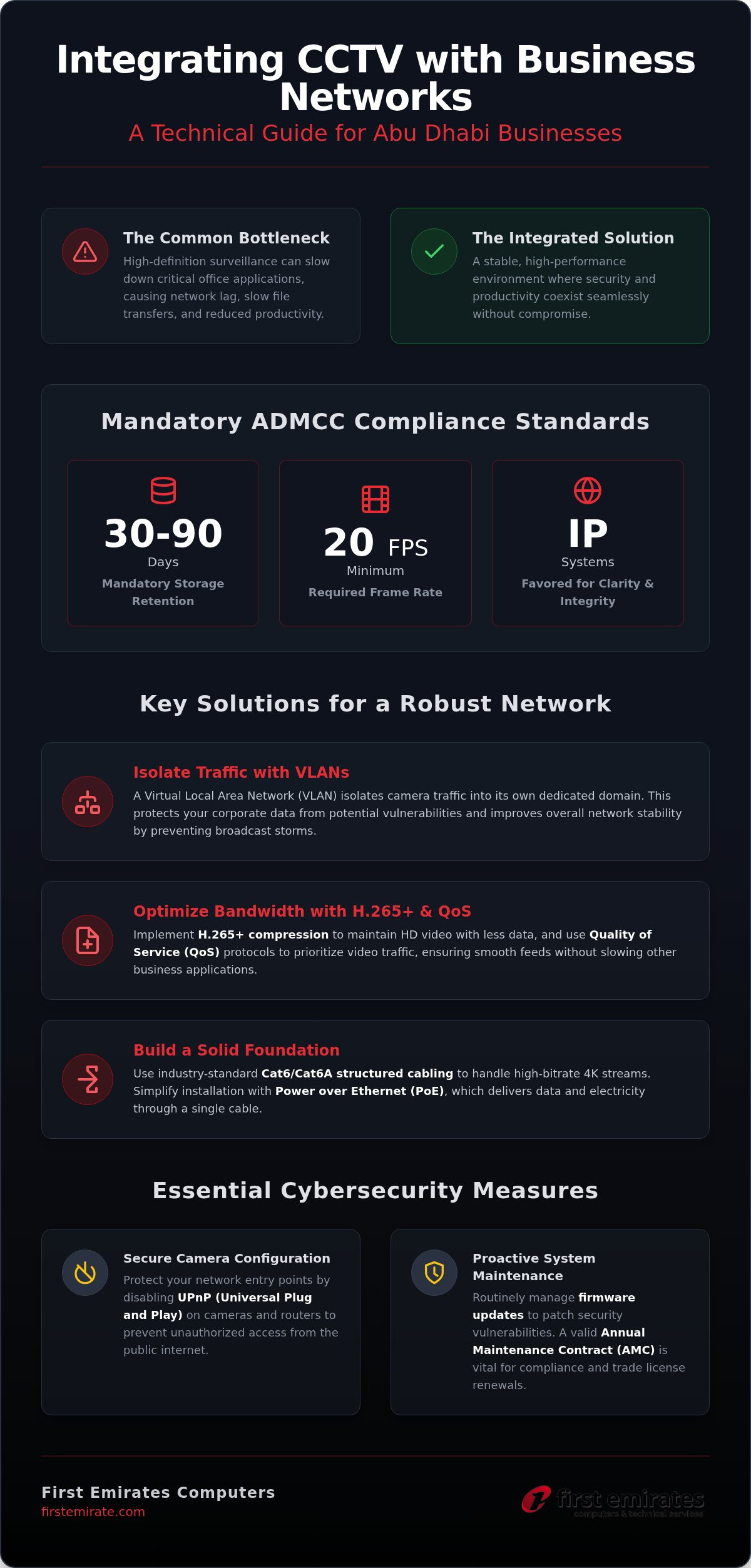
- Master the latest ADMCC requirements for integrating CCTV with business networks Abu Dhabi, including the mandatory 30 to 90-day storage retention and 20 fps frame rate standards.
- Identify essential cybersecurity measures, such as disabling UPnP and managing firmware updates, to protect your IP cameras from becoming vulnerabilities in your corporate network.
- Discover why structured cabling and a valid Annual Maintenance Contract (AMC) are the foundations for long-term system reliability and successful trade license renewals.
The Shift to IP Surveillance: Why Business Network Integration Matters
The transition from traditional analog systems to modern IP camera technology represents a fundamental change in how Abu Dhabi companies manage their security assets. Legacy analog systems relied on dedicated coaxial cables and localized Digital Video Recorders (DVRs), creating isolated silos of data that were difficult to access or scale. Modern IP systems treat every camera as an intelligent network node. This shift positions the business network as the central nervous system for corporate security. When integrating CCTV with business networks Abu Dhabi organizations gain the ability to manage surveillance through their existing IT infrastructure, allowing for remote access across the UAE and the deployment of high-definition analytics. However, if this integration is poorly executed, it creates network bottlenecks that slow down office applications and leaves security gaps for unauthorized access.
Understanding IP vs. Analog in the Abu Dhabi Context
Regulatory bodies like the Abu Dhabi Monitoring and Control Centre (ADMCC) and local law enforcement increasingly favor IP-based systems for their superior clarity and data integrity. While upgrading existing coaxial cabling to Cat6 or fiber optics requires a methodical approach, the long-term cost-benefit analysis is clear. IP systems support high-bandwidth features like facial recognition and license plate reading (LPR) that analog hardware simply cannot match. These systems provide the forensic detail required by Abu Dhabi's strict security regulations, ensuring that every frame captured is actionable and compliant with 2026 standards.
The Interplay Between Security and IT Infrastructure
Security is no longer a standalone silo. It's a core IT function. Centralized management occurs via a Network Video Recorder (NVR), which handles data processing and storage within the network environment. The physical layer is equally critical to success. High-quality structured cabling services UAE ensure that the backbone of the system can handle multiple 4K streams without latency. By treating surveillance as an IT project, businesses can implement robust Quality of Service (QoS) rules that prioritize security traffic while protecting general office bandwidth. This disciplined approach ensures that integrating CCTV with business networks Abu Dhabi results in a stable, compliant, and future-proof security environment that supports long-term growth.
Technical Architecture: Designing a Robust CCTV Network
Designing a surveillance network requires a blueprint that prioritizes data integrity and operational continuity. It's not enough to simply plug cameras into the nearest port. When integrating CCTV with business networks Abu Dhabi, the selection of network switches is the first critical decision. While unmanaged switches might suffice for small residential setups, enterprise environments require managed switches. These devices allow for granular control over traffic, enabling the implementation of Quality of Service (QoS) and virtual segmentation that keeps your security data flowing without interruption. A methodical approach to hardware selection prevents the common pitfalls of packet loss and video jitter during peak business hours.
VLAN Segmentation for Enhanced Security
Logical network separation is the most effective way to protect your corporate data from potential vulnerabilities in IoT devices. By configuring a Virtual Local Area Network (VLAN), you isolate all camera traffic into its own dedicated broadcast domain. This prevents a visitor on your guest Wi-Fi or a compromised office workstation from accessing the camera management interface. Beyond security, VLANs improve network stability by containing "broadcast storms" within the surveillance segment. This ensures that a technical glitch in one camera doesn't flood the entire office network with useless data packets, preserving bandwidth for your ERP and communication tools.
PoE and Structured Cabling Standards
Power over Ethernet (PoE) simplifies the physical layer by delivering both electricity and data through a single cable. To support the high-bitrate requirements of 4K surveillance, Cat6 or Cat6A cabling is the industry standard in the UAE. When planning an office setup, it's vital to calculate the total power budget of your PoE switches to avoid mid-day system reboots. For larger industrial sites, such as connecting remote warehouses in Musaffah to a central server in downtown Abu Dhabi, fiber optic backbones are necessary to overcome the 100-meter distance limitation of copper cabling. If you're unsure about your current infrastructure's capacity, a professional network audit can identify potential bottlenecks before installation begins.
Storage calculations are the final piece of the architectural puzzle. ADMCC regulations typically require a minimum of 31 days of continuous recording for standard businesses. A typical 32-camera system running at 1080p resolution generates roughly 3 to 4 terabytes of data per month. For high-security sectors like jewelry shops or hospitals, this retention period extends to 90 days, which triples the required storage capacity. Accurate calculation of these terabyte needs ensures you remain compliant with local laws without overspending on redundant hardware.
Solving the Bandwidth Dilemma: High-Def Video vs. Office Speed
High-definition surveillance often creates a direct conflict with daily office operations. When businesses expand their camera counts, the resulting data surge can saturate the local area network. This is particularly challenging when integrating CCTV with business networks Abu Dhabi, as the requirement for 1080p or 4K resolution at 20 frames per second (fps) creates significant traffic. If left unmanaged, these video streams compete with critical applications like email servers and cloud-based accounting software. Solving this dilemma requires a methodical approach to data compression and traffic management.
Implementing H.265+ Compression Technology
Modern codecs are the first line of defense against network congestion. Transitioning from H.264 to H.265+ allows systems to compress video data up to 50% more efficiently without compromising the image clarity required for forensic evidence. H.265+ is an advanced video compression algorithm that dynamically reduces bitrate by analyzing the scene for static backgrounds, effectively doubling the storage ROI for Abu Dhabi firms by halving the data footprint of high-resolution feeds. By 2026, as 8K cameras become more common in high-security sectors, this level of efficiency is a technical necessity for maintaining network stability.
Optimizing the frame rate is another disciplined way to preserve bandwidth. While the Abu Dhabi Monitoring and Control Centre (ADMCC) mandates a minimum of 20 fps, exceeding this without a specific operational need wastes network capacity. Dual-streaming provides a sophisticated solution to this dilemma. The system records the "main stream" in full resolution for local storage while transmitting a lower-resolution "sub-stream" for remote viewing on mobile devices or monitoring stations. This ensures that security staff can keep eyes on the property without choking the office Wi-Fi.
QoS and Traffic Shaping for Surveillance
Quality of Service (QoS) rules allow IT managers to dictate how the router handles competing data. By assigning a lower priority to routine surveillance traffic and a higher priority to Voice over IP (VOIP) and Enterprise Resource Planning (ERP) systems, you ensure that business-critical communication never lags. Scheduling high-bandwidth operations, such as off-site cloud backups, for non-business hours further reduces the load. This systematic organization of data flow prevents the performance drops often associated with complex ELV projects.
Maintaining this delicate balance requires consistent oversight and technical readiness. Professional IT AMC services Abu Dhabi provide the regular network health checks and traffic shaping adjustments needed to keep your systems running at peak efficiency. This hands-on management approach prevents the "slow internet" complaints that often plague poorly integrated surveillance projects, ensuring your infrastructure remains both secure and productive.
Compliance and Cybersecurity: Meeting Abu Dhabi Standards
Achieving technical stability is only half the challenge when integrating CCTV with business networks Abu Dhabi. In the UAE capital, strict regulatory frameworks govern how surveillance data is captured, stored, and protected. Failure to meet these standards results in more than just technical glitches. It can lead to significant financial penalties, with fines for non-compliant systems ranging from AED 5,000 to AED 20,000 for a first offense. These regulations ensure that business security systems contribute to the city's overall safety while respecting the privacy of the public. A methodical approach to compliance is necessary to avoid trade license delays and operational holds.
Navigating ADMCC Compliance in 2026
The Abu Dhabi Monitoring and Control Centre (ADMCC) mandates specific operational parameters that every business must follow. A primary requirement is the 30-day continuous recording retention rule, which increases to 90 days for high-security sectors like banks, exchange houses, and jewelry shops. Cameras must maintain a minimum resolution of 2 megapixels and a frame rate of 20 fps. Beyond hardware specs, placement is critical. Cameras are strictly prohibited in private areas such as prayer rooms or changing rooms, and clear signage must notify the public of active surveillance. Working with a SIRA approved CCTV company Abu Dhabi ensures that all certification paperwork and site drawings meet the exact standards required for government approval and successful trade license renewal.
Securing the "Internet of Things" (IoT) Vulnerability
Once cameras are part of your network, they become potential entry points for cyber threats. IP cameras are frequent targets for DDoS attacks and unauthorized access if they aren't properly firewalled. Security shouldn't be an afterthought. It requires changing all default passwords, disabling Universal Plug and Play (UPnP), and ensuring that video streams use encrypted transmission protocols like HTTPS and SRTP. These measures prevent "man-in-the-middle" attacks where data is intercepted between the camera and the NVR. Regular firmware audits are a technical necessity, as manufacturers frequently release patches to close newly discovered security holes.
Physical security of the infrastructure is equally vital. The NVR and core network switches should be housed in a locked, climate-controlled server room to prevent tampering or accidental damage. Comprehensive documentation of your network topology and camera locations is required for ADMCC inspections. If you need assistance verifying your current system's security posture, you can request a compliance audit to identify and remediate any vulnerabilities. Maintaining a valid Annual Maintenance Contract (AMC) is the most reliable way to ensure these cybersecurity protocols and physical checks are performed consistently throughout the year.
The First Emirates Approach: Integrated ELV and Maintenance
The First Emirates Computers approach centers on the belief that security is a holistic discipline. Successful ELV (Extra-Low Voltage) projects require more than just mounting cameras; they demand a thorough understanding of how different systems interact on a shared infrastructure. When integrating CCTV with business networks Abu Dhabi, our team manages the entire lifecycle of the project. This end-to-end management ensures that the physical cabling, network configuration, and software interfaces are perfectly aligned to provide a stable and secure environment. By treating surveillance as a critical IT asset, we eliminate the technical friction that often occurs when security and IT are managed as separate silos.
Comprehensive ELV Integration Services
Integrating CCTV with biometric access control and time attendance systems creates a unified security posture. Instead of managing disparate streams of information, businesses benefit from a "single-pane-of-glass" management dashboard. This allows security personnel to cross-reference video footage with access logs instantly. For instance, in a project involving a large Musaffah warehouse, we deployed a fiber-optic backbone to support high-definition IP cameras while simultaneously integrating biometric readers at all entry points. This methodical integration provided the client with comprehensive oversight across a vast industrial site. Choosing an experienced access control system company to handle your CCTV integration ensures that these complex interdependencies are managed by experts who understand both hardware and software protocols.
The Value of an IT-Focused AMC
A standard maintenance contract often focuses on surface-level tasks like cleaning camera lenses. However, our IT-focused Annual Maintenance Contracts (AMC) go much deeper. We prioritize the health of the underlying network that supports your surveillance. Our technicians perform regular checks on network switch performance and monitor the SMART status of hard drives in your NVR to predict and prevent hardware failures before they result in data loss. This proactive approach is designed to ensure 99.9% uptime, which is vital for maintaining continuous ADMCC compliance and protecting your business interests.
Our methodology is disciplined and transparent. It begins with a comprehensive site survey and a network audit to assess your current capacity. We then proceed with installation and rigorous testing, culminating in the required government certification. This systematic process ensures that integrating CCTV with business networks Abu Dhabi results in a reliable, long-term solution rather than a series of technical headaches. For businesses seeking a dependable partner in the UAE capital, First Emirates Computers offers the technical proficiency and local expertise needed for complex ELV projects. Contact us today to schedule a methodical network and security audit for your facility.
Future-Proofing Your Corporate Security Infrastructure
Achieving a seamless merge of high-definition surveillance and IT performance requires a disciplined approach to network architecture. By implementing VLAN segmentation and H.265+ compression, your business can maintain the high-bitrate requirements of ADMCC-compliant video without sacrificing office productivity. It's a technical necessity to ensure your security infrastructure doesn't become a bottleneck during high-traffic hours or a vulnerability for cyber threats.
Successfully integrating CCTV with business networks Abu Dhabi provides the foundation for a scalable, secure, and fully compliant operational environment. As an ADMCC Certified Integrator with deep expertise in Cat6 and fiber optic cabling, First Emirates Computers is prepared to manage your complex ELV projects. We provide the comprehensive IT AMC support needed to maintain system health and ensure your business meets all 2026 regulatory standards. Get a Professional CCTV Network Audit from First Emirates Computers to verify your technical readiness and compliance status. Taking these methodical steps today ensures your business remains protected and productive for years to come.
Frequently Asked Questions
Will integrating CCTV slow down my office internet speed?
Integrating CCTV with business networks Abu Dhabi doesn't slow down your internet speed when traffic is properly segmented. By using Virtual Local Area Networks (VLANs), we isolate video data from your general office traffic. This ensures high-definition streams remain on their own path, preventing congestion. Quality of Service (QoS) rules further prioritize critical business applications like VOIP, ensuring that surveillance operations never interfere with your daily digital workflow.
What are the ADMCC requirements for CCTV in Abu Dhabi businesses?
The Abu Dhabi Monitoring and Control Centre (ADMCC) mandates that most businesses maintain a minimum of 30 days of continuous recording. High-security sectors, such as jewelry shops and hospitals, must extend this to 90 days. Additionally, cameras must provide at least 2-megapixel resolution and operate at a frame rate of 20 frames per second. Compliance also requires using an ADMCC-certified integrator for all official installations and certifications.
Is Cat6 cabling necessary for IP cameras, or can I use Cat5e?
Cat6 cabling is the recommended standard for modern IP camera installations in Abu Dhabi. While Cat5e can technically support lower resolutions, Cat6 provides the higher bandwidth and reduced crosstalk necessary for 4K video streams and future-proofing your infrastructure. Since IP cameras often rely on Power over Ethernet (PoE), the thicker copper in Cat6 cables handles heat dissipation more effectively, ensuring long-term stability for your security network.
How much storage do I need for 10 cameras recording for 31 days?
For a 10-camera system recording at 1080p resolution and 20 fps, you'll typically need approximately 1.2 to 1.5 terabytes of storage to meet the 31-day retention requirement. This calculation depends on the compression codec used, such as H.265+, which can significantly reduce the data footprint. It's vital to include a buffer for metadata and system logs to ensure you remain fully compliant with local storage regulations and audit requirements.
Can I access my business CCTV cameras from my phone outside the UAE?
Yes, you can access your surveillance feeds remotely from anywhere in the world using a secure mobile application or web portal. This requires your NVR to be connected to the internet with proper port forwarding or VPN configurations. To maintain high security, we recommend using encrypted transmission protocols and strong multi-factor authentication to prevent unauthorized access while you're traveling or managing your business from outside the UAE.
What is the difference between SIRA and ADMCC approval?
The primary difference is geographical jurisdiction and governing authority. ADMCC (Abu Dhabi Monitoring and Control Centre) regulates security systems specifically within the Emirate of Abu Dhabi. SIRA (Security Industry Regulatory Agency) performs a similar role but only within the Emirate of Dubai. Businesses must comply with the specific regulations of the Emirate where their trade license is issued to ensure legal operation and successful license renewal.
Why do I need a managed switch for my CCTV network?
A managed switch is essential for enterprise CCTV networks because it allows for the configuration of VLANs and traffic prioritization. Unlike unmanaged switches, managed versions provide technical oversight, enabling IT managers to monitor port status and remotely reboot cameras via PoE. This level of control is necessary for maintaining a stable environment when integrating CCTV with business networks Abu Dhabi, as it prevents broadcast storms from crashing the system.
How often should a business CCTV system undergo maintenance?
Business CCTV systems should undergo professional maintenance at least once every quarter to remain compliant with ADMCC standards. These quarterly inspections include cleaning lenses, checking the health of hard drives, and verifying that all cameras are recording at the required frame rates. A valid Annual Maintenance Contract (AMC) is a mandatory requirement for renewing your CCTV compliance certificate and your Abu Dhabi trade license each year.


