

A simple connectivity light on a switch doesn't guarantee that your infrastructure can handle the 90W power demands of modern PoE++ devices or the intense thermal stress of the UAE climate. In a professional environment, "it works for now" is a high-risk strategy that often leads to intermittent VoIP drops and security cameras that reboot at critical moments. Utilizing professional network cable testing services Abu Dhabi is the only way to move beyond guesswork and establish a baseline of reliability for your entire ELV system. You recognize that a stable digital foundation is the backbone of your business, yet finding contractors who provide rigorous, standards-compliant certification remains a persistent challenge.
This article provides a technical roadmap for achieving a certified network that supports high-bandwidth applications and minimizes long-term maintenance costs. We will detail the essential equipment used for copper and fiber certification, such as the Fluke DSX 5000, and the necessity of ISO/IEC 11801 compliance. You'll learn how comprehensive PASS/FAIL documentation secures your project handovers and protects your structured cabling investments through 2026 and beyond.
Key Takeaways
- Learn why Abu Dhabi's high temperatures and humidity necessitate rigorous verification to prevent premature cable degradation and signal loss.
- Understand how professional network cable testing services Abu Dhabi ensure your infrastructure complies with global ISO/IEC and TIA standards for CAT6A and fiber optic links.
- Identify hidden physical and electrical faults, such as improper termination or power line interference, that cause system instability in CCTV and access control setups.
- Discover the systematic certification process that provides detailed PASS/FAIL reports, which are essential for project documentation and long-term maintenance.
- Evaluate the benefits of partnering with a local ELV specialist who integrates testing into comprehensive Annual Maintenance Contracts for sustained network health.
Understanding Network Cable Testing Services in Abu Dhabi
Network cable testing is the technical process of verifying that the physical infrastructure of a building supports reliable data transmission. In the unique environmental conditions of the UAE, professional network cable testing services Abu Dhabi are essential for identifying vulnerabilities before they cause system failure. High ambient temperatures and humidity levels can lead to the premature degradation of copper and fiber materials, causing signal attenuation or physical brittleness. This systematic approach isn't just about finding broken wires; it's about validating that the electrical characteristics of the medium can support high-speed data without interference. By evaluating the performance of structured cabling systems against international standards, businesses ensure their backbone is ready for 2026 demands.
Why Your Business Can't Ignore Cable Quality
Faulty cabling is often the silent culprit behind sluggish network speeds that traditional software troubleshooting fails to resolve. In Abu Dhabi's fast-paced corporate sector, even minor packet loss can disrupt 24/7 operations, leading to dropped VoIP calls and lagging cloud applications. Testing uncovers hidden bottlenecks like excessive near-end crosstalk or return loss. This is particularly vital for integrated security, where a robust foundation is required for a reliable CCTV installation Abu Dhabi. Without verified cabling, high-definition video feeds may stutter or drop entirely, compromising the security of the premises. A methodical testing phase ensures that every link in the ELV chain functions as an integrated whole, providing the stability required for biometric access control and other critical systems.
Testing vs. Certification: What Do You Need?
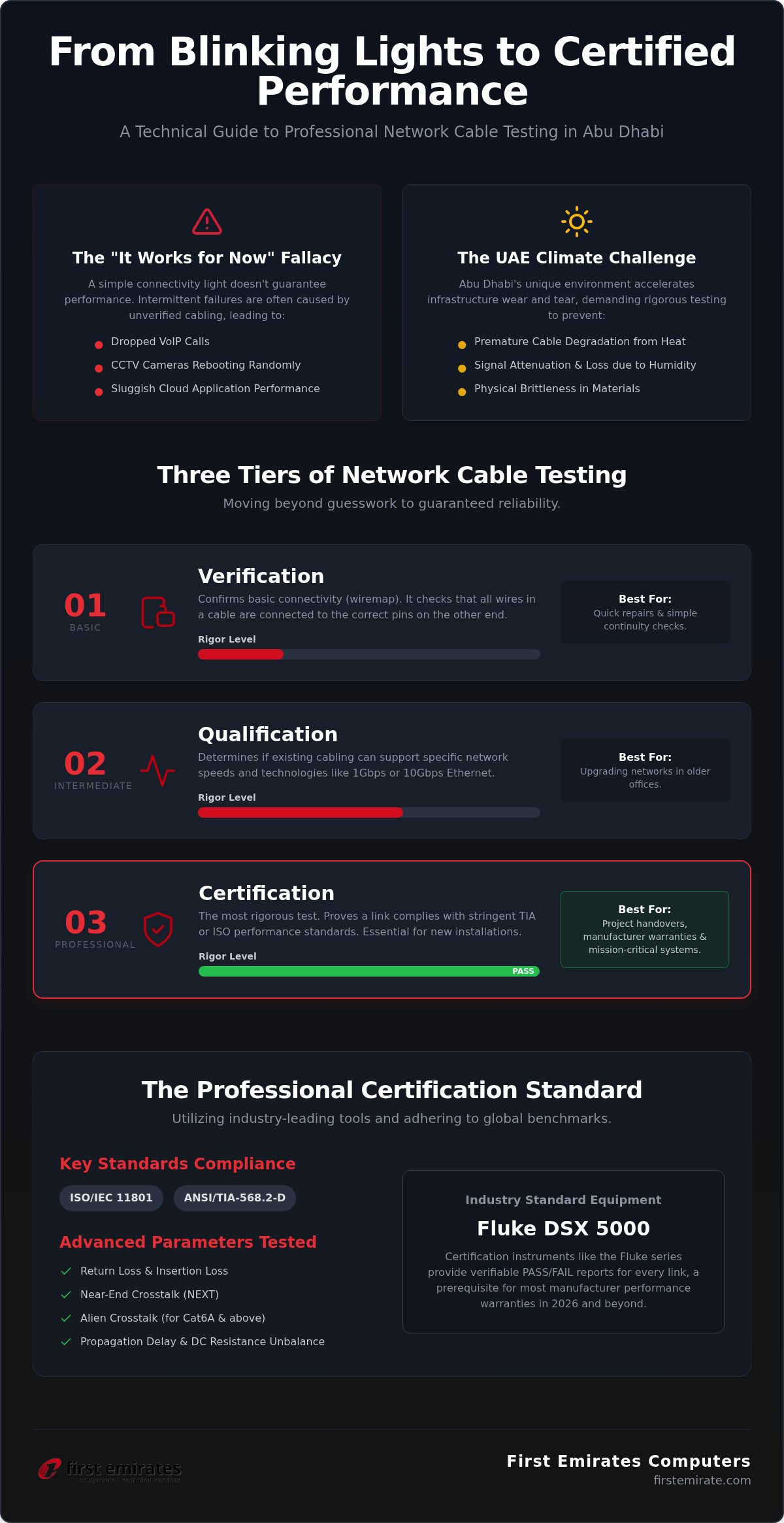
It's vital to distinguish between basic checks and comprehensive certification. Many contractors offer simple continuity tests, but these don't guarantee long-term performance. Professional network cable testing services Abu Dhabi typically categorize their work into three distinct levels:
- Verification: This is a basic wiremap test. It confirms that wires are connected to the correct pins but doesn't measure signal quality or bandwidth capacity.
- Qualification: This determines if the existing cable supports specific speeds, such as 1Gbps or 10Gbps. It's useful for retrofitting older offices to see if they can handle modern hardware.
- Certification: This is the most rigorous level. It uses specialized tools to prove the link meets stringent TIA or ISO standards. Certification reports are a mandatory requirement for project handovers and manufacturer warranties.
Choosing the correct level of testing depends on your specific project goals. While verification might suffice for a quick repair, full certification provides the documented peace of mind required for large-scale commercial installations.
Copper and Fiber Optic Certification Standards
Adhering to international benchmarks is the only way to ensure that your local infrastructure remains compatible with global hardware. Professional network cable testing services Abu Dhabi rely on two primary frameworks: the ANSI/TIA-568.2-D standard and the ISO/IEC 11801. These guidelines define the maximum allowable signal loss and crosstalk for various cable categories. While basic testers check for continuity, certification instruments like the Fluke DSX 5000 analyze complex parameters. This includes propagation delay, return loss, and resistance unbalance; factors that directly determine if a network link will support high-speed data or fail under load.
For businesses planning a new facility, consulting with an expert for professional structured cabling certification ensures the infrastructure is ready for high-speed hardware. Using industry-standard equipment provides a verifiable PASS/FAIL report for every link, which is a prerequisite for most manufacturer performance warranties in 2026.
Cat6 and Cat6A: The Abu Dhabi Office Standard
Cat6A has become the preferred choice for modern enterprise environments in the UAE. Unlike standard Cat6, which is limited to 1Gbps over 100 meters, Cat6A supports 10Gbps speeds across the full channel length. This makes it ideal for high-density offices and data-heavy applications. A critical part of certifying these links involves testing for "Alien Crosstalk." This occurs when signal interference leaks between adjacent cables in a bundle. In the tightly packed conduits common in Abu Dhabi high-rises, this interference can cripple network performance. Ensuring your structured cabling services UAE meet these rigorous 2026 standards prevents future bottlenecks as your business scales.
Fiber Optic Testing for High-Speed Uplinks
Fiber optic backbones are the lifelines connecting server rooms to various floors in large facilities. Testing these links requires a two-tiered approach to guarantee performance. Tier 1 testing measures the total optical loss (attenuation) and the length of the cable using an Optical Loss Test Set (OLTS). This verifies that the signal strength remains within acceptable decibel (dB) limits from end to end. Tier 2 testing involves using an Optical Time Domain Reflectometer (OTDR), such as the AFL Noyes M210, to create a visual trace of the fiber path. This trace identifies micro-bends, poor splices, or contaminated connectors that a Tier 1 test might miss. Identifying these specific faults is essential for maintaining the high-speed uplinks required for modern ELV systems and cloud-based operations.
Common Cabling Faults and Their Business Impact
Physical integrity is the bedrock of any ELV project. Professional network cable testing services Abu Dhabi often identify "invisible" physical faults like kinks or sharp bends that breach the minimum bend radius of the cable. These issues might not stop a signal entirely, but they cause significant return loss, where the signal reflects back to the source. Improper termination at the patch panel or outlet is another frequent failure point. If the twist of the copper pairs is undone too far during installation, it leads to signal leakage and performance drops that standard IT tools can't diagnose.
Electrical interference occurs when data cables are installed in parallel with high-voltage power lines without adequate separation. This induction introduces noise that corrupts data packets, leading to slow transfer speeds. In industrial zones like Musaffah, warehouses face additional challenges from environmental degradation. Extreme heat and fine dust can infiltrate non-industrial grade jackets, accelerating the breakdown of the cable's insulation and leading to high attenuation. Without a certified shield or proper routing, these environmental factors can significantly shorten the lifespan of your infrastructure.
Power over Ethernet (PoE) failures are particularly disruptive in modern offices. If a cable has high resistance due to poor quality or damaged copper strands, it cannot deliver the consistent 30W to 90W required by advanced hardware. This often manifests as IP cameras or wireless access points that reboot randomly during peak usage hours when power demand is highest. Testing ensures that DC resistance is balanced across all pairs, preventing these sudden hardware resets.
The Impact on Security and Surveillance
Security systems are highly sensitive to packet loss and signal instability. When a network backbone hasn't been certified, high-definition CCTV feeds often suffer from "ghosting" or dropped frames, rendering the footage useless for forensic review. Reliable power delivery is equally critical for biometric access control systems UAE, where a momentary drop in voltage can lead to door lock failures or synchronization errors with the central database. Professional security integration requires a "PASS" certified network backbone to ensure 24/7 uptime and equipment longevity.
Network Lag and Packet Loss in the Workplace
Real-time communication tools like Microsoft Teams or Zoom are the first to show symptoms of poor cabling. "Jitter" or audio distortion is frequently caused by Near-End Crosstalk (NEXT), where signals from one pair interfere with another at the connection point. This slows down internal server access and frustrates employees who depend on cloud-based applications. A single faulty patch cord can degrade the performance of an entire network segment by introducing errors that force the switch to retransmit data constantly.
The Network Certification Process and Deliverables
Professional certification is a systematic undertaking that converts a physical installation into a validated business asset. When engaging network cable testing services Abu Dhabi, the process must follow a disciplined sequence to ensure no detail is overlooked. This methodical approach starts with a physical audit and concludes with a technical document that serves as the network's permanent record of health. Every link is tested. Every failure is corrected.
- Visual Inspection: Technicians review the physical state of patch panels, outlets, and cable management. This ensures the minimum bend radius hasn't been violated and cables are securely seated.
- Link Identification: Every cable is labeled at both ends according to the master floor plan. This creates a logical map for future troubleshooting and maintenance.
- Execution of Tests: Using calibrated Fluke instruments, every copper and fiber link is analyzed for performance against international standards.
- Rectification: Any links returning a 'FAIL' result are investigated. Common fixes include re-terminating connectors or replacing damaged patch cords.
- Final Handover: The data is compiled into a comprehensive PDF report. This document provides the transparency required for project closure.
What to Look for in a Certification Report
A professional report provides more than just a passing grade. You should examine the "Headroom" value, which indicates how far the cable exceeds the minimum standard; higher headroom suggests a more resilient installation. The report also includes a wiremap to confirm all 8 pins are correctly terminated. If a link fails, modern testers use Time Domain Reflectometry to provide the exact distance to the fault. This allows for surgical repairs rather than costly re-pulling of cables. Precise data saves time.
Documentation for Project Handover in Abu Dhabi
In the UAE, consultants and government entities require these certified results for final project sign-off. These reports are also the primary requirement for securing long-term manufacturer warranties, which typically range from 15 to 25 years. Having this documentation on file significantly simplifies future IT AMC services Abu Dhabi, as technicians can quickly reference the original performance baselines during annual audits. To ensure your project meets these rigorous requirements, you should request a professional certification consultation to validate your infrastructure.
Choosing an ELV Partner for Testing in Abu Dhabi
Selecting a provider for network cable testing services Abu Dhabi requires a focus on local accountability and technical breadth. An Abu Dhabi-based partner understands the specific building codes and civil defense requirements that govern commercial installations in the capital. This local expertise ensures that your cabling infrastructure isn't just functional but also fully compliant with regional standards. Beyond compliance, a dedicated local partner provides the rapid response times necessary for maintaining business continuity in a 24/7 economy.
Reliability is built through consistent oversight rather than sporadic repairs. This is why incorporating cable testing into an Annual Maintenance Contract (AMC) is a strategic move for long-term stability. A structured AMC ensures that your network is periodically re-certified, identifying potential degradation before it leads to a total system failure. First Emirates Computers leverages this methodical approach to keep your infrastructure future-proof, providing a steady hand that manages the complexities of integrated ELV systems with quiet confidence.
Integrating Security and IT Infrastructure
There's a significant operational benefit to using a single partner for your CCTV surveillance, biometric access control, and structured cabling needs. When one team manages the entire ELV stack, they ensure that the network backbone is perfectly optimized for the specific hardware it supports. First Emirates Computers brings over 15 years of UAE experience to every project, having established a reputation for excellence since 2011. Our team acts as a methodical problem-solver, providing a "steady hand" approach that ensures complex technical installations are delivered on time and within the specified performance parameters.
Next Steps for Your Abu Dhabi Facility
If you're experiencing unexplained network lag or preparing for an office relocation, a professional audit is the first step toward resolution. Auditing your existing network identifies hidden bottlenecks and confirms if your cabling can support the next generation of high-speed hardware. For new facilities, ensuring that testing is included in your project checklist is vital for a smooth handover and for securing manufacturer warranties. You can contact First Emirates Computers to arrange a comprehensive site survey and consultation, allowing our experts to evaluate your current technical readiness and provide a clear roadmap for your infrastructure.
Securing Your Digital Infrastructure for 2026
A certified network is more than just a collection of wires; it's the stable foundation upon which your entire business operation rests. By prioritizing professional network cable testing services Abu Dhabi, you ensure that environmental stressors and physical faults don't compromise your data integrity. The transition from basic connectivity to a fully validated system provides the documented headroom required for high-bandwidth applications and reliable PoE delivery. This methodical approach protects your investment in structured cabling and ensures that integrated systems like CCTV and access control function without interruption.
First Emirates Computers has been a dependable presence in the capital since 2011, providing the technical readiness required for complex ELV projects. Our team utilizes Fluke-certified testing equipment to deliver precise reports that meet the stringent requirements of local consultants and government bodies. Whether you're auditing an existing facility or preparing for a new office handover, our expertise in full ELV and security integration ensures a seamless transition. Book a Professional Network Audit with First Emirates Computers to validate your infrastructure today. We're here to help you build a resilient and compliant digital backbone.
Frequently Asked Questions
What is the difference between network cable testing and certification?
Testing verifies basic connectivity and wiremap to ensure wires are connected to the correct pins. Certification is more rigorous; it validates the cable against international performance standards like ISO/IEC 11801. Certification uses specialized equipment to measure parameters like crosstalk, return loss, and attenuation. While simple testing confirms the link exists, certification proves it can handle specific data speeds and power loads required for modern enterprise hardware.
How long does it take to test a standard office network in Abu Dhabi?
A typical office with 50 to 100 network points usually requires one to two business days for comprehensive certification. This timeline includes the initial visual inspection, labeling, and the actual execution of tests for each link. Larger facilities or those with complex fiber optic backbones may take longer. Our technicians maintain a methodical pace to ensure accuracy and provide detailed documentation for every network point tested.
Do I need to test my cables if my internet is already working?
Yes, because basic internet connectivity doesn't reveal underlying physical faults that cause intermittent performance drops or hardware resets. Cables that seem functional for light web browsing often fail under the heavy data loads of 4K CCTV streaming or high-wattage PoE++ delivery. Professional network cable testing services Abu Dhabi identify these hidden bottlenecks before they lead to costly downtime or equipment damage in your facility.
What equipment is used for professional network cable certification?
Professional certification relies on high-precision instruments like the Fluke DSX 5000 or DSX 8000 CableAnalyzer series. For fiber optic links, technicians use Optical Loss Test Sets and Optical Time Domain Reflectometers to identify micro-bends and signal loss. These calibrated tools are essential for generating the detailed PASS/FAIL reports required by consultants and manufacturer warranty programs across the United Arab Emirates.
Can faulty cabling affect the performance of my CCTV cameras?
Faulty cabling is a leading cause of frame drops, signal "ghosting," and random camera reboots in surveillance systems. High-definition cameras require consistent bandwidth and stable Power over Ethernet delivery. If the cable has high resistance or excessive crosstalk, the camera might not receive sufficient power or data throughput. This leads to compromised security footage and increased wear on your hardware components over time.
How often should a business perform network cable testing?
Businesses should perform a full certification during the initial installation and after any significant office renovations or network expansions. For ongoing stability, it's advisable to include a cable audit as part of your Annual Maintenance Contract. Periodic testing is especially important in Abu Dhabi's climate, where intense heat and humidity can accelerate the degradation of insulation and connectors over several years.
What kind of report will I receive after the testing is complete?
You'll receive a comprehensive PDF certification report that includes a detailed analysis of every tested link. This document features the PASS/FAIL status, wiremap results, cable length, and specific performance metrics like Near-End Crosstalk and return loss. These reports serve as a technical baseline for your infrastructure and are often a mandatory requirement for project handovers to consultants or government authorities.
Is network cable testing required for MCC approval in Abu Dhabi?
The Abu Dhabi Monitoring and Control Centre (MCC) has strict standards for security infrastructure. Utilizing network cable testing services Abu Dhabi is often a prerequisite for final approval of CCTV systems. Consultants require these reports to verify that the underlying cabling can support the mandatory retention periods and video quality standards set by local regulations for commercial and industrial facilities.


