

A failed technical inspection can stall your venue's commercial trade license long before the first order reaches the kitchen pass. Operating a profitable dining venue requires tight operational control, but selecting the right restaurant security cameras Dubai authorities require often proves far more demanding than business owners anticipate. Beyond managing internal shrinkage and cash register discrepancies, commercial kitchens present intense heat and vapor that rapidly degrade standard equipment, all while local authorities mandate precise video retention and uninterrupted system connectivity.
You shouldn't have to face licensing delays or expensive hardware replacements due to avoidable technical oversights. This 2026 commercial buying guide details how to select, deploy, and maintain SIRA-compliant surveillance systems that protect your daily revenue while ensuring strict regulatory alignment. We'll examine verified camera placement protocols, commercial structured cabling foundations, and the exact hardware standards needed to secure official inspection clearance on your very first walkthrough.
Key Takeaways
- Understand mandatory SIRA specifications and connectivity rules to secure trade license inspection clearance without costly venue delays.
- Discover how deploying specialized commercial-grade hardware shields kitchen lenses from intense heat, moisture, and grease accumulation.
- Learn why professional structured cabling and PoE architecture are vital when deploying restaurant security cameras Dubai venues rely on for continuous uptime.
- Design a strategic coverage blueprint across cash points, dining floors, and storage rooms to resolve patron disputes and reduce internal shrinkage.
- Evaluate the core technical capabilities required from a systems integrator to ensure seamless installation, commissioning, and ongoing maintenance support.
Regulatory Compliance: SIRA Standards for Dubai Restaurant Security Systems
Operating a licensed dining establishment in Dubai requires absolute adherence to technical mandates enforced by the Security Industry Regulatory Agency (SIRA). SIRA compliance for hospitality venues defines a legal framework governing equipment performance, storage architecture, and systematic field-of-view monitoring across commercial spaces. Meeting these standards is mandatory to obtain or renew a commercial trade license, as municipal inspectors actively review technical infrastructure before issuing operational permits.
Integrating modern Closed-circuit television (CCTV) infrastructure ensures business assets remain safeguarded while satisfying regulatory obligations. Deploying compliant restaurant security cameras Dubai inspectors approve prevents costly administrative penalties, stop-work notices, and operational shutdowns caused by failed technical audits.
Mandatory Coverage Zones in Commercial Dining Spaces
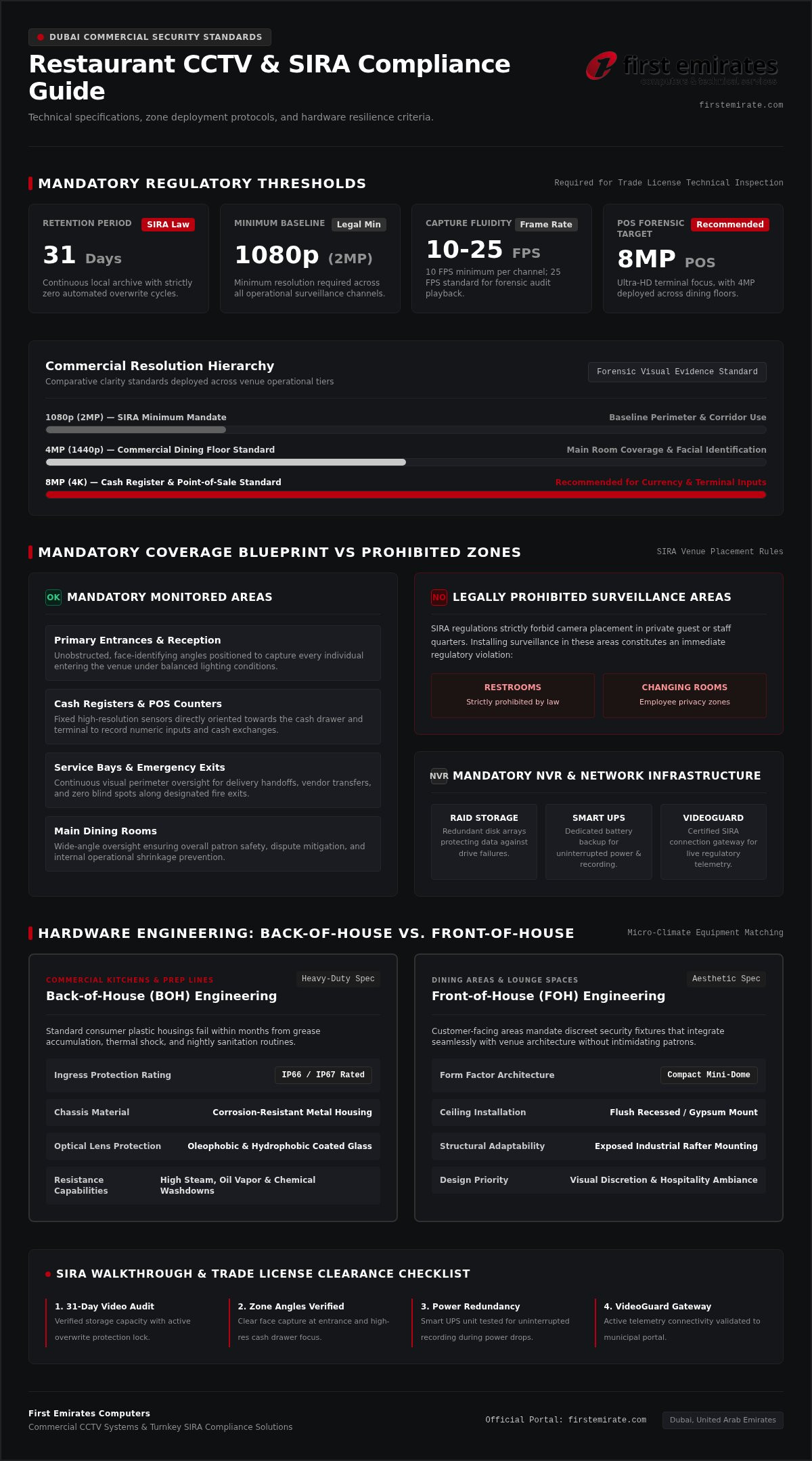
SIRA requires comprehensive visual coverage across operational perimeters, prioritizing zones with frequent public circulation and financial transactions. Deploying restaurant security cameras Dubai authorities approve involves precise lens positioning across critical areas:
- Primary Entrances and Reception: Unobstructed, face-identifying angles capture every individual entering the venue under balanced lighting conditions.
- Cash Registers and POS Counters: Fixed high-resolution cameras must directly face the cash drawer and terminal to record numeric inputs and transaction exchanges clearly.
- Service Bays and Emergency Exits: Continuous coverage ensures perimeter control, monitoring delivery handoffs, and eliminating blind spots along fire exits.
- Main Dining Rooms: Wide-angle sensors provide broad safety oversight while strictly avoiding private areas, such as restrooms and employee changing facilities, where surveillance is legally prohibited.
Video Storage, Resolution, and Frame Rate Criteria
Regulatory authorities mandate that recorded video preserves sufficient forensic clarity to serve as legal evidence. Cameras must deliver a minimum resolution of 1080p (2MP), with current commercial practices favoring 4MP for dining floors and 8MP for point-of-sale terminals. Capture rates must maintain at least 10 frames per second per channel, though 25 frames per second is widely adopted to ensure fluid playback during forensic audits.
Storage architecture requires strict engineering. Network Video Recorders (NVR) must preserve all recorded streams for a mandatory minimum retention period of 31 days without automatic overwrite cycles deleting active logs. Systems must utilize redundant RAID storage arrays to safeguard data against hard drive failures, alongside dedicated uninterruptible power supplies (Smart UPS) and certified connection gateways to maintain continuous SIRA VideoGuard compliance.
Front-of-House vs. Back-of-House: Matching Hardware to Restaurant Zones
Deploying uniform hardware across an entire dining venue invites swift technical failure. High-volume kitchens expose equipment to airborne oils, high humidity, and intense thermal loads, while dining rooms require unobtrusive designs that preserve guest hospitality. Designing an effective deployment of restaurant security cameras Dubai operators depend on requires matching specific camera mechanics to each operational micro-climate. All selections must remain fully compliant with official SIRA security regulations while maintaining day-to-day resilience.
Kitchen and Prep Line Surveillance Engineering
Back-of-house areas destroy consumer-grade plastic cameras within months. Hot cooking oil vapors cling to standard acrylic domes, forming an opaque film that compromises image clarity. Prep lines and dishwashing stations demand cameras with minimum IP66 or IP67 ingress protection to prevent moisture infiltration during nightly chemical washdowns. Specifying corrosion-resistant metal housings alongside specialized oleophobic and hydrophobic lens glass ensures steam and grease won't blind sensors during peak service hours.
Dining Room and Lounge Aesthetic Integration
Customer-facing spaces require visual discretion. Compact mini-dome and flush recessed architectural housings mount neatly into custom gypsum ceilings or exposed industrial rafters without disrupting interior design. Dynamic lighting presents another technical challenge. Floor-to-ceiling perimeter windows flood front tables with harsh desert sunlight, while lounge areas maintain intimate, subdued illumination. Cameras equipped with true Wide Dynamic Range (WDR) balance these severe light contrasts, preventing silhouetted figures without invading table privacy.
Outdoor Dining, Patios, and Service Entrances
Exterior dining terraces, valet kiosks, and back delivery bays must withstand extreme Gulf summer temperatures that frequently surpass 45°C. Unshielded hardware quickly overheats, causing processor throttling and frozen video feeds. Exterior restaurant security cameras Dubai venues install require operating tolerances rated up to 60°C, housed inside IK10 vandal-resistant enclosures to prevent mechanical damage from delivery trolleys. Adaptive infrared illuminators deliver balanced night vision across unlit service bays, ensuring complete perimeter tracking throughout late-night operations. Consulting an engineering partner for turnkey CCTV surveillance systems ensures each physical zone receives correctly rated hardware from the outset.
Critical Technical Features to Evaluate Before Purchasing Restaurant CCTV
Commercial hospitality surveillance demands enterprise components engineered for continuous operational stability. Consumer-grade devices often drop offline, suffer from overheating, or deliver distorted footage during critical moments. Aligning physical equipment with recognized international CCTV standards guarantees that every camera captures actionable, legally admissible evidence. Selecting reliable restaurant security cameras Dubai operators can depend on requires evaluating specific technical capabilities before procuring hardware.
POS Integration and Cash Handling Auditing
Point-of-sale counters present significant risks for internal shrinkage and transactional discrepancies. Text-insertion protocols resolve these issues by syncing live transaction metadata directly over recorded video footage. Every scanned item, cash drawer opening, manual price override, or voided receipt appears as a synchronized text overlay. Motorized varifocal lenses allow technicians to calibrate focal depth precisely onto cash trays and card terminals. This level of detail eliminates fraudulent transactions, unauthorized discounts, and tip-skimming disputes without digital pixelation.
Wired PoE Infrastructure vs. Wireless Limitations
Commercial food service environments contain heavy stainless steel prep stations, industrial chillers, and reinforced partitions that disrupt wireless network signals. Relying on Wi-Fi cameras causes frequent signal dropping and lost video frames. Professional systems utilize wired Power over Ethernet (PoE) architecture, transmitting data and electrical power through a single network line. Deploying enterprise structured cabling services UAE facilities require ensures signal integrity under high thermal conditions. Centralized PoE switches also keep cameras running steadily through backup battery power during municipal grid fluctuations.
Remote Management and Role-Based Access Security
Multi-branch operators require centralized operational visibility without compromising system security. Modern network recorders support encrypted remote streams, enabling management to monitor dining floor volume, kitchen lines, and service pacing across multiple branches. Role-based privilege hierarchies ensure shift workers cannot delete footage, modify timestamps, or alter recording settings. Facilities often combine video monitoring with an experienced access control system company to secure managers' offices, server racks, and liquor storage rooms from unauthorized entry.
Designing a Strategic Camera Layout to Prevent Shrinkage and Disputes
An effective surveillance layout relies on methodical spatial planning rather than saturating walls with excessive hardware. Installing too many units inflates cabling costs and overburdens network switches without delivering better security. Conversely, haphazard positioning leaves vulnerable blind spots where inventory vanishes and liability disputes arise. Structuring your deployment of restaurant security cameras Dubai properties demand requires a systematic, zone-by-zone floor plan assessment.
Step 1: Auditing High-Risk Inventory and Waste Storage
Internal inventory loss rarely occurs at the dining table. It concentrates in quiet storage zones and peripheral exits during inventory replenishment or post-shift cleanup. Securing these zones involves specific layout tactics:
- Cold and Dry Storage: Mount wide-angle lenses directly facing entry doors inside walk-in meat chillers and dry store rooms. This records stock levels whenever expensive inventory is moved.
- Receiving Bays: Position angled cameras over delivery thresholds to verify supplier box counts, detect broken packaging, and match received goods against procurement manifests.
- Refuse Disposal Points: Focus dedicated fixed lenses on rear trash compactors and recycling corridors. Unmonitored disposal bins remain a frequent vector for staging stolen raw goods or liquor bottles for later recovery.
Step 2: Mitigating Dining Room Liability and Slip-and-Fall Claims
Customer-facing liability claims demand rapid evidentiary review. Positioning 180-degree or 360-degree panoramic lenses at ceiling intersections across the dining room captures complete customer movement patterns without blind areas. When a patron reports a slip-and-fall incident, high-definition historical footage clarifies whether wet floor signs were posted and establishes the exact sequence of events. Broad coverage across main service paths also reveals whether floor spills were addressed promptly, protecting management against unverified damage claims.
Step 3: Calculating Network Bandwidth and NVR Storage Capacity
Continuous recording across multiple high-definition channels generates massive continuous data streams. Deploying modern H.265 or H.265+ smart video compression reduces bandwidth loads and storage consumption by up to 50 percent compared to older H.264 codecs. Storage calculations must account for the required continuous 31-day retention window at 1080p, 4MP, or 8MP resolution thresholds across all connected channels. Engineering the network switch throughput and storage array capacity ensures you can add dining floor cameras as your seating layout expands. To design a structured floor layout that secures every operational blind spot, consult with our ELV engineering team.
Selecting an Enterprise CCTV Partner for Turnkey Dubai Deployment
Securing municipal approvals and achieving full operational readiness requires partnering with an integrator capable of executing turnkey deployments. Procuring equipment through consumer storefronts leaves business owners without the engineering documentation, structured conduit infrastructure, or certified commissioning required by regulatory authorities. A seasoned systems integrator oversees the entire project lifecycle, managing architectural drawings, cable containment, hardware installation, and testing to prevent opening schedule disruptions.
Evaluating Vendor Certifications and Engineering Scope
Deploying restaurant security cameras Dubai authorities will certify involves more than mounting hardware to walls. Contractors must handle end-to-end extra-low voltage (ELV) works, ensuring cabling meets fire safety standards and technical layout specifications. When evaluating potential engineering partners, verify the following core capabilities:
- Regulatory Documentation: Ensure the contractor designs camera topologies that strictly align with SIRA inspection criteria and handles the necessary portal submissions.
- Integrated Infrastructure Capabilities: Technicians should possess proven proficiency in structured cabling, data switching, and physical conduit pathways to avoid fragmented subcontractor handoffs.
- Hardware Procurement: The integrator should supply enterprise-tier hardware tested for durability in commercial hospitality environments.
Long-Term Reliability Through Annual Maintenance Contracts
Surveillance hardware requires ongoing maintenance to sustain peak operational performance after inspection sign-off. Airborne grease in hot commercial kitchens gradually coats lenses, degrading visual quality and impairing motion triggers over time. Dust infiltration inside NVR cooling vents can cause processor overheating, leading to unplanned hardware downtime. Backing your deployment with structured IT AMC services Abu Dhabi and nationwide support guarantees preventative upkeep across every branch.
Comprehensive Annual Maintenance Contracts (AMC) include scheduled lens cleaning, storage array integrity diagnostics, and essential firmware security updates to eliminate network vulnerabilities. Routine preventative checks ensure all restaurant security cameras Dubai venues maintain run uninterrupted during business hours. To discuss your venue requirements with an engineering partner operating across the UAE since 2011, contact First Emirates Computers for complete surveillance, ELV implementation, and ongoing maintenance support.
Future-Proofing Your Hospitality Surveillance Infrastructure
Navigating municipal licensing while protecting dining profit margins requires a methodical security strategy. Selecting compliant restaurant security cameras Dubai authorities approve protects your venue against administrative penalties, while zone-specific hardware shields sensitive sensors against harsh kitchen grease and high ambient heat. Backed by solid structured cabling and precise POS coverage, your surveillance architecture becomes an active operational asset that mitigates liability and curtails inventory shrinkage.
Executing a dependable deployment demands an engineering partner with proven local expertise. Operating across the UAE since 2011, our specialized teams deliver turnkey ELV projects encompassing certified structured cabling, seamless system commissioning, and comprehensive Annual Maintenance Contracts that guarantee ongoing operational uptime. Build your dining venue on a foundation of technical readiness and long-term stability. Consult First Emirates Computers for SIRA-Compliant Restaurant CCTV Systems to ensure first-time inspection clearance and operational peace of mind.
Frequently Asked Questions
What are the mandatory SIRA requirements for restaurant security cameras in Dubai?
SIRA mandates that all commercial restaurants deploy high-definition surveillance covering all entrances, cash points, dining spaces, and service doors. Systems must capture at least 1080p resolution at a minimum of 10 frames per second, retain footage for 31 days, and connect directly to SIRA's VideoGuard platform. In addition, installations must feature an uninterruptible power supply and clear entrance warning signage to pass official trade license audits.
Can I install consumer wireless security cameras in my Dubai restaurant?
No, consumer-grade wireless units don't satisfy local commercial regulations or operational demands. Dubai authorities require enterprise-tier hardware installed with dedicated conduit and wired connections. In busy dining environments, stainless steel appliances, solid partition walls, and refrigeration equipment block Wi-Fi signals, causing severe latency and packet drops. Professional restaurant security cameras Dubai inspectors certify utilize wired Power over Ethernet cabling to maintain uninterrupted data transmission and electrical stability.
How long must a restaurant in Dubai retain security camera video footage?
Restaurants operating in Dubai must retain all recorded surveillance footage for a minimum continuous window of 31 days. Dubai Municipality inspectors and law enforcement officials can request historical footage from any point during this period. To prevent automatic overwriting errors, network video recorders require properly sized hard drive arrays configured with RAID redundancy, ensuring data remains intact even if an individual storage drive encounters a mechanical failure.
How do security cameras handle heat and airborne grease in commercial kitchens?
Commercial kitchen surveillance relies on specialized industrial enclosures rather than standard indoor camera domes. Integrators specify rugged aluminum casings with IP66 or IP67 ratings to block moisture during routine high-pressure cleaning. Lenses feature hydrophobic and oleophobic glass coatings that resist vapor condensation and oil accumulation, ensuring boiling steam and aerosolized cooking fat don't obscure the field of view over busy prep lines.
Can security cameras integrate directly with our restaurant point-of-sale system?
Yes, modern enterprise video surveillance systems integrate with point-of-sale registers through dedicated text-overlay protocols. As cashiers scan menu items, process card transactions, or initiate cash drawer openings, the register data prints synchronously onto the recorded camera footage. This live metadata overlay provides clear visual context for managerial audits, helping operators rapidly pinpoint cashier sweet-hearting, unauthorized item voids, and till discrepancies.
Do dining room cameras violate customer privacy laws in the UAE?
Dining room surveillance is entirely lawful across the UAE as long as operators adhere to strict regulatory boundaries. Cameras must only monitor public dining areas, entry foyers, and service pathways, accompanied by conspicuous bilingual signage warning guests of active recording. Positioning cameras inside private rest areas, washrooms, or staff locker rooms is strictly illegal under UAE privacy legislation and results in immediate fines and license suspension.
Why is an annual maintenance contract necessary for restaurant CCTV systems?
An Annual Maintenance Contract guarantees that your restaurant security cameras Dubai installation remains fully operational and technically compliant throughout the trading year. Commercial kitchen environments subject hardware to heavy thermal stress and airborne grime, demanding regular physical cleaning and focus calibration. Preventative maintenance agreements also ensure prompt firmware patching, power supply testing, and NVR storage diagnostics, preventing sudden hardware outages that could compromise venue security or void licensing compliance.


