

A cluttered server rack isn't just an eyesore; it's a direct threat to your facility's operational stability. In many Abu Dhabi data centers, what begins as a few extra patch cords quickly evolves into a "spaghetti" mess that blocks critical airflow and complicates even the simplest hardware swaps. You've likely felt the pressure of an emergency repair where identifying a single cable took longer than the actual fix. This lack of server room cabling organization doesn't just frustrate your IT team. It drives up cooling costs and increases the risk of accidental disconnects during routine maintenance.
We understand that maintaining a pristine infrastructure is a continuous challenge, especially as your network scales. This guide provides a professional framework to transform your cable management into a structured, reliable asset. You'll learn how to implement systematic labeling, optimize vertical and horizontal pathways, and improve thermal performance through better airflow. By following these methodical steps, you'll achieve a scalable server environment that reduces mean-time-to-repair and secures the long-term health of your ELV projects. We'll outline the exact standards required to maintain a high-performance environment that remains manageable for years to come.
Key Takeaways
- Understand how professional server room cabling organization prevents server rack overheating and minimizes the risk of accidental network disconnects.
- Learn to implement a structured cabling architecture using patch panels to create a scalable, modular environment that simplifies future hardware upgrades.
- Discover how to apply standardized color-coding and the "Source-Destination" labeling rule to significantly reduce mean-time-to-repair (MTTR) during critical outages.
- Master a systematic approach to remediating existing cable "spaghetti" through a disciplined audit and migration planning process.
- Identify the importance of certified Fluke testing and professional ELV standards to ensure long-term system stability and performance in the UAE market.
Why Server Room Cabling Organization is Critical for Business Continuity
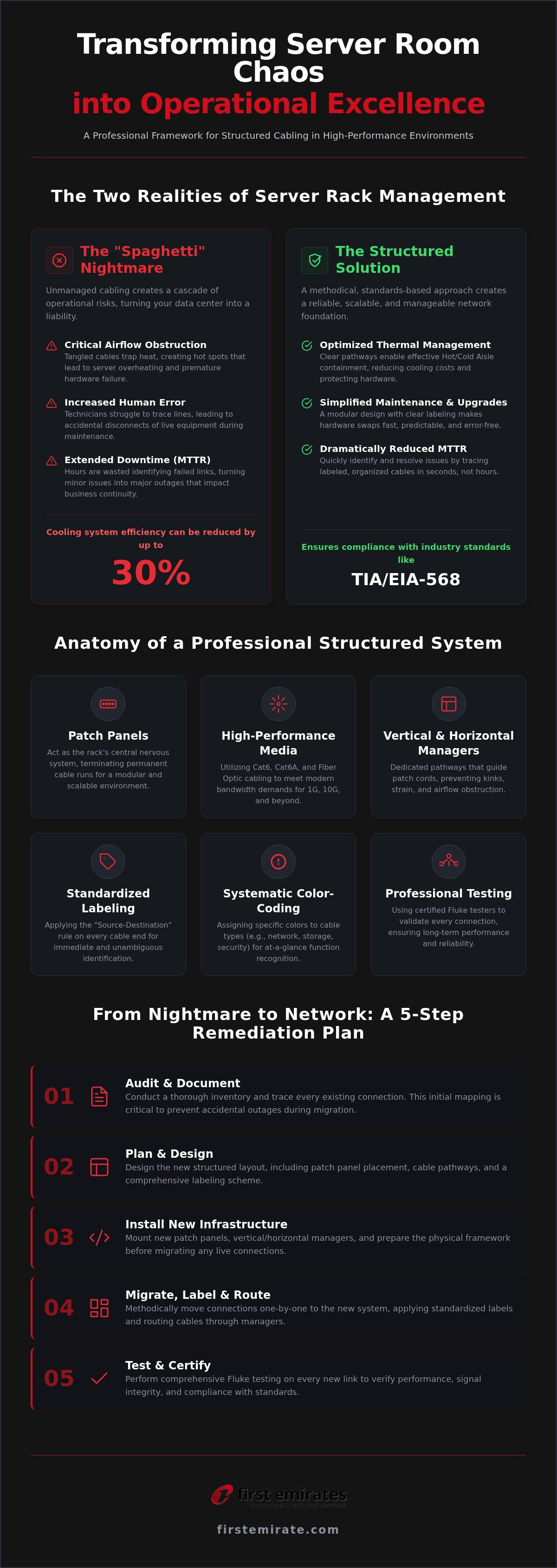
Effective server room cabling organization is the foundation of physical network security and operational uptime. When cables are left to accumulate in unmanaged bundles, they create a high-density barrier that traps heat directly within the server rack. This thermal buildup forces cooling systems to work significantly harder, often reducing the efficiency of air conditioning units by as much as 30%. For businesses operating in the UAE, where ambient temperatures are naturally high, this inefficiency doesn't just increase utility bills; it accelerates hardware degradation and leads to premature equipment failure.
Beyond thermal concerns, disorganized wiring is a primary catalyst for human error. During emergency hardware swaps or upgrades, technicians often struggle to trace specific lines through a "spaghetti" of unmarked wires. This confusion leads to the accidental disconnection of neighboring live equipment, turning a simple maintenance task into a major service outage. The hidden cost of troubleshooting disorganized networks in UAE businesses often manifests as an extended mean-time-to-repair (MTTR). Hours are frequently wasted simply identifying the physical path of a failed link, a delay that is entirely avoidable with a structured approach.
Thermal Management and Airflow Optimization
In a professional server environment, maintaining a strict "Hot Aisle/Cold Aisle" containment strategy is vital for stability. Disorganized cabling often obstructs the rear exhaust of servers, preventing hot air from escaping into the designated hot aisle. This creates localized hot spots where temperatures can spike well above safe operating limits, even if the room itself feels cool. In the UAE, the interaction between high humidity and intense heat can also impact the longevity of cable jackets. If cables are compressed or tangled, the lack of airflow accelerates the breakdown of outer insulation, which can lead to signal interference or physical failure over time. A methodical approach to routing ensures that every rack maintains clear pathways for intake and exhaust air.
Safety and Compliance Standards
Systematic organization is a prerequisite for safety and regulatory compliance. Massive, unmanaged cable bundles pose a combustion risk because they trap heat and can sustain a fire if a short circuit occurs. Adhering to international standards, such as TIA/EIA-568, ensures that your infrastructure is built on a predictable and tested architecture. In Abu Dhabi and Dubai, server rooms often house critical security infrastructure that must comply with specific SIRA requirements for integration. Professional organization ensures these security lines remain accessible for inspection and maintenance without disturbing the broader network. A clean rack reflects a commitment to technical readiness and provides a stable platform for long-term growth.
Core Components of a Structured Cabling System
Structured cabling is a standardized architecture designed to support a wide range of hardware applications through a unified infrastructure. Unlike point-to-point wiring, which creates a tangled web of direct connections, structured systems use a hierarchical approach to ensure every link is documented and accessible. This framework is essential for effective server room cabling organization, as it allows for logical growth without compromising the physical integrity of the network. A well-planned system ensures that your infrastructure remains flexible enough to adapt to changing technology requirements.
The physical media used within this system typically includes Cat6, Cat6A, and Fiber Optic cabling. Cat6 remains a standard for Gigabit Ethernet, while Cat6A is preferred for 10-Gigabit speeds over longer distances. Fiber Optic infrastructure serves as the high-speed backbone, connecting core switches to distribution layers or linking separate server rooms. Each media type requires specific handling and termination techniques to maintain signal integrity and prevent data loss. Choosing the correct media is the first step in building a resilient network that meets modern bandwidth demands.
Patch Panels and Termination Points
Directly attaching long cables from a device to a switch is a significant professional "red flag" that complicates future maintenance. Instead, a structured system terminates permanent cable runs into patch panels, which act as fixed connection points. The patch panel serves as the central nervous system of the rack. By using modular patch panels, you gain the flexibility to swap individual jacks or upgrade specific ports without re-pulling entire cable runs. This isolation between the fixed network and the equipment makes the environment highly scalable and easier to manage during routine updates.
Cable Management Hardware
Maintaining order requires specific hardware designed to guide cables along designated paths. Horizontal cable managers sit between equipment to route patch cords to the sides, while vertical managers handle the volume of cables running up the rack's height. Horizontal managers are ideal for high-density switching environments where patch cords must move laterally to reach ports. Vertical managers are essential for large-scale racks where hundreds of cables must travel from the top-of-rack down to lower servers. Tools like D-rings, brush panels, and finger duct managers help maintain a clean aesthetic while protecting the cables from physical strain.
When organizing Fiber Optic cabling, technicians must prioritize the "bend radius" to avoid micro-fractures in the glass core that degrade performance. Using structured cabling services UAE ensures that these termination zones are designed with the correct clearance and support. If you're planning a new installation or need to reorganize an existing rack, a professional cabling audit can identify the specific hardware needed to support your unique hardware density and operational needs.
Professional Strategies for Rack Organization and Labeling
A methodical approach to rack layout is the primary difference between a resilient network and a fragile one. High-quality server room cabling organization relies on the use of tension-controlled fasteners and strategic routing. Professionals exclusively use Velcro wraps rather than plastic zip ties. Plastic ties are often overtightened, which can pinch the cable jacket and degrade signal performance or even crush fragile fiber optic cores. Velcro allows for easy adjustments and additions without the risk of physical damage, ensuring the infrastructure remains flexible for future expansions.
Vertical cable management is equally vital for maintaining the integrity of the server environment. By routing bundles through vertical managers on the sides of the rack, you keep the central exhaust area clear. This practice prevents the formation of a "cable curtain" that traps hot air behind the servers. Keeping the airflow path unobstructed is a simple but effective way to protect your hardware from heat-induced throttling. These strategies ensure that every component remains accessible and within safe thermal operating limits.
Implementing a Color-Coding System
Establishing a logical color-coding scheme is a highly effective way to identify network segments at a glance. A standard professional configuration might use Blue for general data, Red for security and CCTV, Green for VoIP, and Yellow for fiber optic uplinks. This visual separation eliminates confusion during high-pressure troubleshooting scenarios. Standardizing patch cord lengths is also a requirement. Using a three-meter cord where a 0.5-meter cord is sufficient creates unnecessary "slack" that contributes to clutter and blocks airflow. This systematic approach significantly speeds up IT AMC services Abu Dhabi onsite visits, as technicians can immediately distinguish between different service types without manually tracing each line.
Labeling and Documentation Protocols
Consistency in labeling is the final step in professional organization. Every cable should follow the "Source-Destination" rule, clearly indicating where the link originates and where it terminates. For example, a label might read "SW1-P24 / SRV4-NIC1," allowing a technician to identify both ends of the connection instantly. It's best to use professional wrap-around thermal labels. Traditional adhesive flags often peel off or become brittle in the high-airflow environment of a server rack. For integrated security projects, every port on the access control system company controller needs a matching label to facilitate rapid repairs. This physical labeling must be mirrored in a digital "Cable Schedule" or rack map, providing a comprehensive reference for your entire ELV infrastructure.
Step-by-Step: Remediating a "Cabling Nightmare"
Transforming a disorganized rack into a professional environment requires a disciplined, multi-phase approach. It isn't just about untangling wires; it's about re-establishing a logical architecture without disrupting current operations. For many facilities, server room cabling organization is a corrective project that must be managed with surgical precision to avoid unintended downtime. A systematic remediation process ensures that your infrastructure moves from a state of "infrastructure debt" to a clean, scalable asset.
The Audit and Planning Phase
Before disconnecting a single link, you must document the current state of the rack. Start by photographing every angle of the existing configuration to serve as a baseline reference. This documentation is essential for identifying "dead" or abandoned cables, often called "zombie cables," which consume space and block airflow without providing any network value. Consulting with structured cabling companies in Abu Dhabi for professional site surveys can help uncover hidden issues that might not be visible to the naked eye.
Once the audit is complete, develop a detailed downtime window and migration plan. This plan should prioritize critical paths and identify which services can be migrated during off-peak hours. A successful remediation relies on a clear map of every source and destination, ensuring that the re-cabling process follows the structured standards discussed in previous sections. You should never begin a remediation project without a verified digital "Cable Schedule" that accounts for every active port.
Execution and Cable Dressing
In a live environment, the "One Cable at a Time" rule is the safest way to manage remediation. By replacing old, over-length patch cords with correctly sized ones individually, you minimize the risk of a widespread outage. During this phase, group cables by their destination rack or switch to maintain logical pathways. Professionals use specialized "combing" tools to keep bundles parallel and prevent the internal crossing that leads to "cable knots" within the vertical managers.
Cable dressing is the process of arranging cables neatly for maximum airflow. This step involves more than just aesthetics; it ensures that the physical weight of the cable bundles is supported by the rack hardware rather than the equipment ports themselves. Once the dressing is complete, every link must undergo post-organization testing. Using industry-standard certification tools ensures that every re-terminated or re-routed line meets the required performance specifications. If your current infrastructure has become unmanageable, you can schedule a professional server room audit to begin the remediation process with expert oversight.
Professional Structured Cabling Solutions in Abu Dhabi
Attempting a DIY approach to server room cabling organization often introduces hidden instabilities that standard visual inspections cannot detect. While a rack may appear tidy on the surface, professional installers utilize advanced diagnostic tools, such as Fluke testing, to certify that every link meets rigorous performance standards for signal-to-noise ratios and data throughput. Without this certification, a network remains vulnerable to intermittent packet loss and electromagnetic interference, especially in high-density environments. First Emirates Computers, established in 2011, specializes in providing these high-precision structured cabling and ELV project services across Abu Dhabi.
A professional partner ensures that your physical infrastructure is prepared for the integration of multiple critical systems. Modern server racks no longer just house data servers; they are the central hub for CCTV Surveillance Systems, Biometric Access Control, and Home Automation controllers. Managing these diverse services within a single organized rack requires a deep understanding of both high-voltage and low-voltage separation to prevent signal degradation. By consolidating these systems into a unified, labeled, and documented environment, you create a more resilient facility that is easier to manage and secure.
Enterprise-Grade Infrastructure Design
For businesses planning new office fit-outs, implementing a tailored ELV design is a prerequisite for long-term operational success. We focus on ensuring your server room meets evolving Abu Dhabi tech standards for 2026, prioritizing scalability and thermal efficiency from day one. This proactive approach prevents the accumulation of "infrastructure debt," where poorly planned wiring becomes a bottleneck for future hardware upgrades. To maintain these standards, we provide dedicated Annual Maintenance Contracts (AMC). These contracts ensure that your server room cabling organization remains pristine as your business grows, with regular audits and testing to identify potential issues before they cause downtime.
Conclusion: Building a Foundation for Growth
Mastering the physical organization of your server room is a strategic investment in business continuity. As we've explored, a structured approach directly improves airflow, lowers cooling costs, and significantly reduces the time required for emergency repairs. By moving away from disorganized "spaghetti" wiring and embracing standardized labeling and high-quality hardware, you provide your IT team with a stable and predictable environment. This foundation is essential for any UAE business that values uptime and technical readiness.
If your current server room is struggling with heat issues or unmanageable clutter, a professional assessment is the first step toward remediation. You can contact First Emirates Computers today to schedule a comprehensive site survey and discover how a structured cabling overhaul can secure your network's future.
Securing Your Infrastructure for Future Growth
A disciplined approach to server room cabling organization is more than a maintenance task; it's a strategic necessity for any high-performance data environment. By implementing a structured architecture, you eliminate the critical risks of equipment overheating and accidental network disconnects that lead to costly downtime. Standardized labeling and logical color-coding transform a complex web of wires into a manageable, scalable asset that supports your business's long-term operational goals.
First Emirates Computers has been a trusted partner for Abu Dhabi businesses since 2011. As SIRA-compliant security integrators and specialists in high-density fiber and Cat6 solutions, we provide the technical precision required for complex ELV projects. Our methodical processes ensure your infrastructure meets the highest industry standards for reliability and performance. You can take the first step toward a more efficient facility today. Request a Professional Structured Cabling Audit from First Emirates Computers to identify optimization opportunities within your rack environment. We're ready to help you build a stable foundation for your technical future.
Frequently Asked Questions
How often should I audit my server room cabling organization?
You should audit your server room cabling organization at least once every quarter or immediately following any significant hardware additions. Regular reviews ensure that temporary patch cords don't become permanent fixtures that block airflow. For businesses under an Annual Maintenance Contract (AMC), these audits are typically integrated into the scheduled service visits. This proactive approach prevents the gradual accumulation of unmanaged wiring that complicates troubleshooting and increases the risk of downtime.
Is it better to use Cat6 or Cat6A for server room patch cables?
Cat6A is the superior choice for modern data centers because it supports 10-Gigabit speeds and offers better shielding against alien crosstalk. While Cat6 is sufficient for standard Gigabit Ethernet, Cat6A provides the necessary bandwidth for high-density server environments and future-proofs your infrastructure. It's essential to match your patch cord category with your permanent horizontal cabling to maintain the performance integrity of the entire channel and ensure maximum data throughput.
Can I reorganize my server rack without shutting down the network?
It's possible to reorganize a server rack while the network is live by using the "one cable at a time" methodology. This involves replacing individual patch cords with correctly sized and labeled alternatives during low-traffic periods. However, for a complete overhaul of the structured cabling system, a scheduled downtime window is highly recommended. This ensures that critical links aren't accidentally disrupted and allows for comprehensive post-reorganization testing to certify the stability of every connection.
Why are velcro straps preferred over plastic zip ties in data centers?
Velcro straps are preferred because they provide tension control and are easily adjustable for future additions. Plastic zip ties are permanent and often overtightened, which can crush the internal copper pairs or fragile fiber optic cores, leading to signal degradation. In a professional data center, maintaining the physical integrity of the cable jacket is vital for long-term performance. Velcro also eliminates the risk of sharp edges that can cause injury during routine maintenance.
What is the maximum length for a patch cable in a server room?
In a standard structured cabling channel, the total length of patch cords at both ends should not exceed 10 meters combined. This ensures the total link length stays within the 100-meter limit defined by international TIA/EIA standards. Using excessively long patch cables within the rack creates unnecessary slack that obstructs airflow and increases signal attenuation. Professional organization involves using the shortest possible cord to reach from the patch panel to the equipment port.
How does cable organization affect my server room cooling costs?
Proper server room cabling organization can reduce cooling costs by up to 30% by eliminating obstructions in the cold aisle intake and hot aisle exhaust. When cables block the rear of a server, the internal fans must spin at higher RPMs to move air, consuming more power. By clearing these pathways, your precision cooling units can operate more efficiently. This extends the lifespan of your hardware while lowering monthly utility expenses in the UAE's high-heat environment.
What are the SIRA requirements for cabling in Abu Dhabi security rooms?
While SIRA governs security standards in Dubai, Abu Dhabi facilities must adhere to the Monitoring and Control Centre (MCC) regulations. These requirements mandate that all security-related cabling, including CCTV and access control lines, must be clearly labeled and terminated in secure, organized racks. Ensuring your cabling is documented and accessible is a prerequisite for passing mandatory inspections. Our team ensures all ELV projects remain compliant with the specific regulatory framework of the emirate where the installation resides.


