

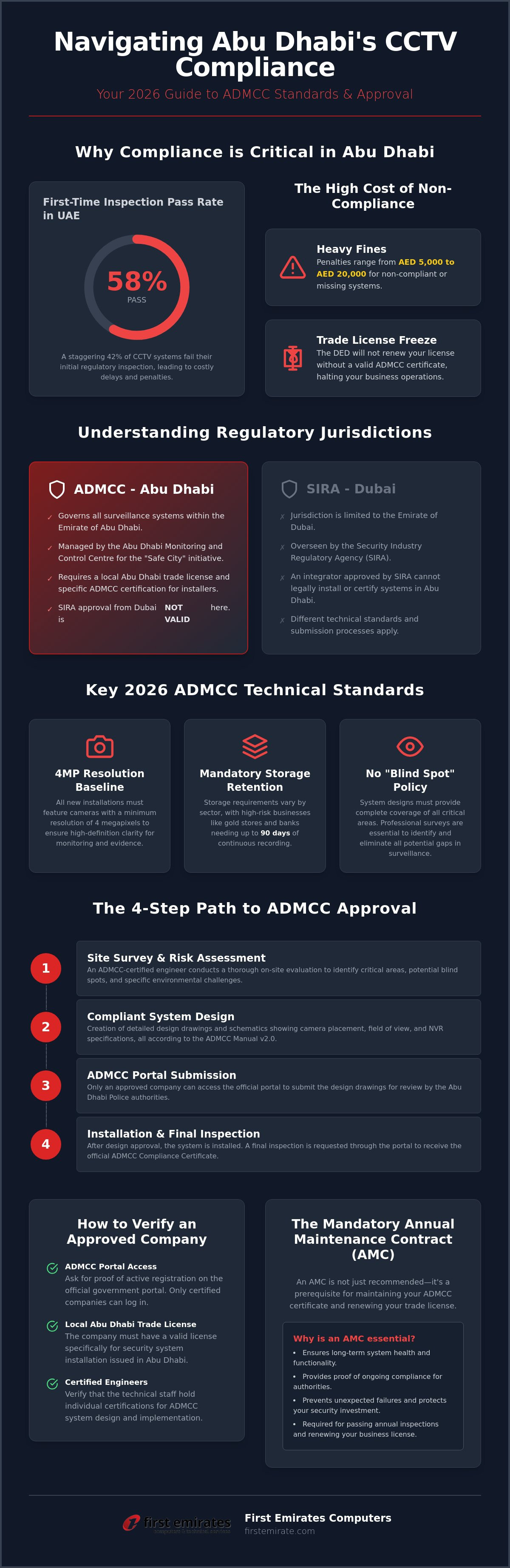
Did you know that only 58% of CCTV installations in the UAE pass their first regulatory inspection? For business owners in the capital, failing to meet the strict standards of the Abu Dhabi Monitoring and Control Centre (ADMCC) can lead to more than just a failed inspection. It can result in fines ranging from AED 5,000 to AED 20,000 and a potential freeze on your trade license. Finding a qualified Abu Dhabi police approved CCTV company is no longer just a security preference; it's a fundamental requirement for operational continuity in 2026.
It's common to feel confused by the differences between SIRA regulations in Dubai and the ADMCC requirements here in Abu Dhabi. You've likely felt the pressure of ensuring your hardware meets the latest compliance standards while trying to avoid the high costs of rectifying a non-compliant system. This guide provides a clear roadmap to achieving full legal compliance through professional surveillance solutions. We'll break down the technical specifications of the ADMCC Manual v2.0, explain the mandatory role of Annual Maintenance Contracts (AMC), and show you how a methodical approach to ELV integration secures your business for the long term.
Key Takeaways
- Distinguish between SIRA and ADMCC jurisdictions to ensure your security infrastructure aligns with the specific legal requirements of the Abu Dhabi Emirate.
- Learn the methodical process of verifying an Abu Dhabi police approved CCTV company to ensure your integrator possesses the required technical certifications.
- Review the updated 2026 technical standards, including the 4MP resolution baseline and the specific storage retention requirements for high-risk commercial sectors.
- Navigate the compliance pathway from the initial site survey and "blind spot" identification to the final submission of ADMCC-compliant design drawings.
- Understand why a professional Annual Maintenance Contract (AMC) is a mandatory prerequisite for trade license renewal and long-term asset protection.
Understanding ADMCC and SIRA Compliance for Abu Dhabi Businesses
Business owners often assume that security regulations are uniform across the United Arab Emirates. This misconception leads to significant legal and financial risks. While the Security Industry Regulatory Agency (SIRA) governs Dubai, the Emirate of Abu Dhabi operates under the strict jurisdiction of the Abu Dhabi Monitoring and Control Centre (ADMCC). Selecting an Abu Dhabi police approved CCTV company is the only way to ensure your facility meets the specific technical mandates required for the capital.
By 2026, regulatory standards have evolved to prioritize high-definition clarity and centralized integration. The legal consequences of using uncertified integrators are severe. Fines for non-compliant systems range from AED 3,000 to AED 10,000, while the absence of a required system can trigger penalties up to AED 20,000. Most importantly, the Department of Economic Development (DED) will not renew a trade license without a valid ADMCC certificate. This link between security compliance and legal operation makes professional surveillance a core business necessity rather than an optional expense.
The Role of the Monitoring and Control Centre (ADMCC)
The ADMCC, formerly known as the MCC, is the central authority responsible for regulating surveillance systems in Abu Dhabi. Its primary mission is to manage the "Safe City" initiative, which integrates private and public surveillance data to enhance public safety. This centralized approach to Understanding ADMCC and SIRA Compliance for Abu Dhabi Businesses ensures that all commercial installations contribute to a cohesive security network. Certain sectors must comply with these standards immediately, including:
- Financial Institutions: Banks and exchange houses require high-level storage and specific camera placements.
- Retail and Trade: Gold and jewelry stores must meet 90-day storage retention rules.
- Healthcare: Hospitals and pharmacies dispensing controlled substances are subject to strict monitoring.
- Public Spaces: Hotels, malls, and large residential complexes.
Cross-Emirate Regulatory Requirements
A common question for businesses with branches in multiple emirates is whether a SIRA-approved company from Dubai can install systems in Abu Dhabi. The regulatory answer is a firm no. To operate legally in the capital, a security integrator must possess a local Abu Dhabi trade license and specific ADMCC certification. Integrators without these credentials cannot access the ADMCC portal to submit drawings or request final inspections.
First Emirates Computers has operated with a grounded reliability in Abu Dhabi since 2011. Our approach focuses on the specific technical nuances of the ADMCC Manual v2.0. We understand that compliance in Abu Dhabi requires a methodical alignment with local police standards that out-of-emirate providers cannot provide. Whether you are managing a single shop or a complex ELV project, local expertise is the only way to guarantee your system passes the first inspection.
How to Verify an Abu Dhabi Police Approved CCTV Company
Verification is a critical step in securing your business assets and ensuring legal compliance. You shouldn't rely solely on verbal assurances or marketing materials. The primary method for verification is through the official ADMCC portal. Only registered and active integrators can log in to this portal to submit system designs and request inspections. An authentic Abu Dhabi police approved CCTV company will have a valid trade license specifically categorized for security systems and will be listed as an active provider in the government database.
Beyond the company license, you must verify the credentials of the individual engineers and project managers. ADMCC requires technical staff to undergo specific training and certification to handle CCTV installation Abu Dhabi projects. These certifications ensure the team understands the technical nuances of the ADMCC Manual v2.0, such as the correct placement of cameras to avoid "blind spots" and the proper configuration of network video recorders (NVRs) to meet storage mandates. This technical readiness separates a professional integrator from a general IT vendor.
Technical Certifications and Brand Partnerships
Compliance in Abu Dhabi is often tied to the use of approved hardware brands. A reputable integrator maintains strong partnerships with manufacturers like Hikvision, Dahua, and UNV, as these brands are frequently used in ADMCC-compliant designs. A methodical provider should also demonstrate expertise beyond simple surveillance. Evaluating an access control system company for their ability to integrate biometric security with your CCTV network provides a more comprehensive safety net. Ask potential partners about their internal quality control protocols and how they test systems before the final police inspection.
Local Expertise and Physical Presence
A physical office in Abu Dhabi, particularly in areas like Musaffah or the city center, is a strong indicator of a company's commitment to the local market. Local presence ensures that support teams can respond rapidly to maintenance requests or technical failures. First Emirates Computers has maintained a grounded reliability in the capital since 2011, building an extensive portfolio of successful ELV projects. When you begin The Compliance Journey: From Site Survey to Final Approval, working with a local specialist reduces the risk of delays. Watch for these red flags during your selection process:
- Vendors who provide quotes without performing a physical site survey.
- An inability to demonstrate active access to the ADMCC portal.
- Lack of a local Abu Dhabi trade license for security services.
- Vague explanations regarding the 31-day minimum storage retention rules.
Selecting the right partner is about more than just hardware; it's about finding a steady hand to manage the complex technical landscape of the capital. For a thorough assessment of your site's current compliance status, you can consult with our technical team to identify and rectify potential regulatory gaps before they lead to fines.
2026 Technical Standards for ADMCC Compliant CCTV Systems
The 2026 technical landscape for surveillance in the capital is defined by the ADMCC Manual v2.0. To pass a government inspection, your system must meet specific hardware and software benchmarks that exceed standard commercial setups. Working with an Abu Dhabi police approved CCTV company ensures that your equipment isn't just high-definition, but technically compliant with the specific bitrate and frame rate requirements mandated by the Monitoring and Control Centre. These standards are designed to ensure that footage is usable for forensic purposes, rather than just acting as a visual deterrent.
Resolution standards have shifted significantly. While 2MP was previously the acceptable minimum, 4MP is now the functional baseline for the majority of commercial sites. This higher resolution is necessary for accurate facial identification at entry and exit points. Additionally, the industry has moved decisively away from legacy analog setups. Modern approvals require IP-based systems that utilize digital signals for superior clarity and easier integration with centralized monitoring networks. For most installations, ADMCC requires a minimum frame rate of 20 to 25 frames per second (fps) to ensure smooth, continuous motion capture.
Storage retention remains one of the most strictly enforced aspects of compliance. Most businesses must maintain a minimum of 31 days of continuous footage. However, high-risk entities such as exchange houses, jewelry stores, and pharmacies must navigate archive rules that extend to 90 days. Failing to provide this historical data during an audit results in immediate penalties. A professional integrator will calculate the exact storage capacity needed, accounting for the higher bitrates required by 4MP cameras, to ensure you don't run out of space before the mandatory retention period ends.
Storage and Server Specifications
Enterprise-grade storage is a requirement for larger installations and high-risk sectors. Unlike standard NVRs used in residential settings, professional servers must support RAID 5 or RAID 6 configurations to protect against hard drive failures. This redundancy ensures that footage isn't lost if a single disk fails. For these complex systems, utilizing professional structured cabling services UAE is vital. High-quality Cat6 or Cat6A cabling maintains data integrity and prevents the signal drop-offs that often lead to pixelated recordings and failed inspections.
Camera Placement and Environmental Standards
ADMCC guidelines are very specific about camera placement. Every entry and exit point must have a dedicated camera positioned to capture clear facial features. Facial recognition zones require specific lighting levels and angles to function correctly within the government's broader security framework. The Abu Dhabi climate presents a unique challenge for hardware; cameras must carry IP66 or IP67 ratings to withstand extreme heat and fine desert dust. A methodical integrator will also include an Uninterruptible Power Supply (UPS) in the system design. This ensures that the surveillance network maintains 24/7 uptime, even during power fluctuations or localized outages.
The Compliance Journey: From Site Survey to Final Approval
Navigating the path to regulatory certification requires a disciplined approach that begins long before the first camera is mounted. An experienced Abu Dhabi police approved CCTV company understands that the process is a sequence of technical milestones, each requiring precise documentation. The journey starts with a comprehensive site survey. This phase is not merely about counting cameras; it involves identifying regulatory "blind spots" where coverage gaps could lead to a failed inspection. For instance, according to industry data, approximately 22% of first-time inspection failures in the UAE are attributed to incorrect camera angles that fail to capture required facial or license plate data.
Once the survey is complete, the next critical step is the submission of system design drawings for ADMCC pre-approval. These drawings must detail the system architecture, camera specifications, and storage calculations. Only after the Monitoring and Control Centre grants pre-approval can the physical installation begin. This phase follows strict cabling and hardware protocols, ensuring that all equipment is installed according to the approved design. Any deviation during the installation phase, such as using unapproved consumer-grade Wi-Fi cameras, can result in immediate rejection, a common issue that accounts for 18% of failed inspections.
Identifying and Mitigating Inspection Risks
Mitigating risks before the final government visit is essential for operational continuity. Common reasons for failure in Abu Dhabi commercial buildings include undersized NVRs that fail to meet the 31-day storage mandate and incomplete labeling of cables and components. If your existing infrastructure is aging, conducting a CCTV system upgrade Abu Dhabi is the most effective way to align with the 2026 codes. Our technical teams ensure that every piece of documentation, from the system diagrams to the equipment datasheets, is organized to meet the specific expectations of the ADMCC inspector.
Post-Installation Commissioning
The final phase involves rigorous internal testing and commissioning. We verify that remote monitoring and mobile access features are functioning correctly within the secure network environment. Training your facility staff is also a mandatory part of the handover; they must demonstrate proficiency in system operation and emergency playback during the official audit. Once the system passes the final government inspection, you are issued a completion certificate, which is the prerequisite for your trade license renewal. To ensure your facility is prepared for this rigorous process, you can schedule a comprehensive site survey with our certified engineers today.
First Emirates Computers has refined this journey over 15 years of local presence in the capital. By maintaining a 97% first-time pass rate for our clients, we provide the steady hand needed to navigate these complex regulatory requirements without the fear of heavy fines or license delays.
Maintaining Compliance with Professional IT AMC Services
Securing a completion certificate from the Monitoring and Control Centre is a significant milestone, but it does not mark the end of your regulatory obligations. In Abu Dhabi, an Annual Maintenance Contract (AMC) is a mandatory legal requirement for all commercial entities. This contract must be held with an Abu Dhabi police approved CCTV company to be valid. The Department of Economic Development (DED) requires proof of an active AMC during the yearly trade license renewal process. Failing to maintain this contract can lead to a penalty of AED 2,000 and significant delays in your business operations.
A methodical approach to maintenance shifts the focus from reactive repairs to proactive system health. Reactive maintenance, which involves fixing hardware only after a failure occurs, is a high-risk strategy in the capital. If an inspector visits your site and finds that your NVR has stopped recording or a camera is out of focus, the resulting fine of AED 3,000 to AED 10,000 often far exceeds the cost of a professional AMC. Proactive care ensures that your hardware investment is protected and that your system consistently meets the 31-day or 90-day storage mandates discussed in previous sections.
First Emirates Computers has provided grounded reliability to the Abu Dhabi business community since 2011. We understand that system downtime is not just a security risk; it is a compliance failure. By utilizing a disciplined maintenance schedule, we aim for 99.9% system uptime for our clients. This systematic oversight ensures that every component of your surveillance network, from the physical cameras to the underlying network infrastructure, remains in peak operational condition throughout the year.
The Scope of a Compliant AMC
A compliant maintenance agreement involves more than a simple visual check. It includes a series of technical tasks designed to ensure data integrity and hardware longevity. Our engineers perform regular lens cleaning and focus adjustments to combat the effects of fine desert dust, which can quickly degrade image quality. We also conduct rigorous storage health checks to verify that hard drives are recording correctly and that RAID configurations are intact. Furthermore, we manage firmware updates for IP-based systems to patch security vulnerabilities and ensure compatibility with the latest ADMCC protocols. In the event of a critical failure, our AMC clients receive priority response times to restore security infrastructure immediately.
First Emirates Computers: Your Long-Term Security Partner
With 15 years of local presence in the capital, we have developed the specialized expertise required to manage complex ELV maintenance contracts. Our capability extends beyond simple surveillance; we provide integrated support for CCTV, biometric access control, and structured cabling systems. This all-encompassing resource provides business owners with peace of mind through technical competence. If you are preparing for your next trade license renewal or need to ensure your current system meets the 2026 standards, contact our team for a comprehensive regulatory compliance assessment.
Securing Your Operational Future in Abu Dhabi
Achieving full compliance in the capital requires more than just high-quality hardware. It demands a methodical alignment with the ADMCC Manual v2.0 and a commitment to ongoing maintenance. As we've detailed, the transition to 4MP resolution and the strict 31-day to 90-day storage mandates make the selection of a qualified partner essential for your trade license renewal. Navigating these technical standards effectively ensures that your surveillance system serves as a reliable asset rather than a regulatory liability.
Partnering with an Abu Dhabi police approved CCTV company ensures that every technical nuance, from structured cabling to server redundancy, is handled with precision. First Emirates Computers has served the Abu Dhabi business community since 2011. Our team of ADMCC-compliant technical experts provides the stability and comprehensive oversight needed for complex ELV projects and mandatory IT AMC services. We prioritize a capability-first approach to ensure your infrastructure meets every government benchmark.
Don't leave your regulatory standing to chance. Professional surveillance is a long-term investment in your business's continuity and safety. Secure Your Abu Dhabi Business with a Compliant CCTV Solution from First Emirates Computers and ensure your facility remains fully compliant through 2026 and beyond. We look forward to being your dependable partner in the capital's evolving security landscape.
Frequently Asked Questions
Is SIRA approval required for a business based in Abu Dhabi?
SIRA approval is not required for businesses operating within the Emirate of Abu Dhabi. The Security Industry Regulatory Agency (SIRA) has jurisdiction strictly within Dubai. Businesses in the capital must instead comply with the regulations set by the Abu Dhabi Monitoring and Control Centre (ADMCC). It's essential to work with a local Abu Dhabi police approved CCTV company to ensure your system meets the specific technical mandates of this emirate.
What is the difference between ADMCC and Abu Dhabi Police approval?
The ADMCC is the specialized government body that manages the technical standards for surveillance, while Abu Dhabi Police serves as the primary enforcement authority. The ADMCC reviews system designs, issues permits, and conducts physical inspections on behalf of the police. When your facility receives an ADMCC completion certificate, it signifies that your security infrastructure meets the legal requirements established by the police for commercial operations.
How often does my CCTV system need to be inspected by authorities?
Your surveillance system undergoes a formal government inspection during the initial trade license application and during subsequent renewal cycles. While the authorities conduct these milestone audits, your maintenance provider must perform quarterly preventative maintenance visits. These regular checks are a requirement of your mandatory Annual Maintenance Contract and ensure that the system remains in a constant state of operational readiness for surprise audits.
What are the minimum storage requirements for CCTV in Abu Dhabi for 2026?
Standard commercial entities are required to maintain a minimum of 31 days of continuous video storage. However, high-risk sectors such as banks, jewelry stores, and pharmacies must retain footage for at least 90 days. It's critical to ensure your NVR or storage server is sized correctly to handle these durations at the required frame rates, as insufficient storage is a leading cause of inspection failure.
Can I use wireless cameras for a police-approved installation?
Wireless cameras are generally not permitted for ADMCC-compliant installations. The regulator mandates stable, wired IP-based systems to ensure data integrity and prevent signal interference. Using consumer-grade Wi-Fi cameras often leads to immediate inspection failure. A professional integrator will always utilize high-quality structured cabling to connect your cameras to the central recording server for maximum reliability.
Why do I need an Annual Maintenance Contract (AMC) for my security system?
An AMC is a legal prerequisite for the yearly renewal of your Abu Dhabi trade license. Beyond legal compliance, it provides a methodical framework for proactive system care, including lens cleaning and storage health checks. Maintaining a valid contract with an Abu Dhabi police approved CCTV company protects you from fines of up to AED 10,000 that are imposed if your system is found to be non-functional.
What happens if my business fails the ADMCC security inspection?
Failing an inspection typically results in a formal notice to rectify the technical gaps within a specific timeframe, alongside potential fines between AED 3,000 and AED 10,000. Your trade license renewal will be placed on hold until the issues are resolved and a follow-up inspection is passed. Utilizing an experienced integrator helps you avoid these delays by ensuring the system is designed correctly from the initial survey phase.
Do residential villas in Abu Dhabi require police-approved CCTV?
Private residential villas aren't currently mandated to have police-approved CCTV systems. However, commercial residential properties, such as apartment buildings and multi-unit complexes, must strictly adhere to ADMCC standards. While not legally required for private homes, many villa owners choose to follow these professional standards to ensure their surveillance provides high-quality, forensic-grade evidence that is useful for police investigations.


