

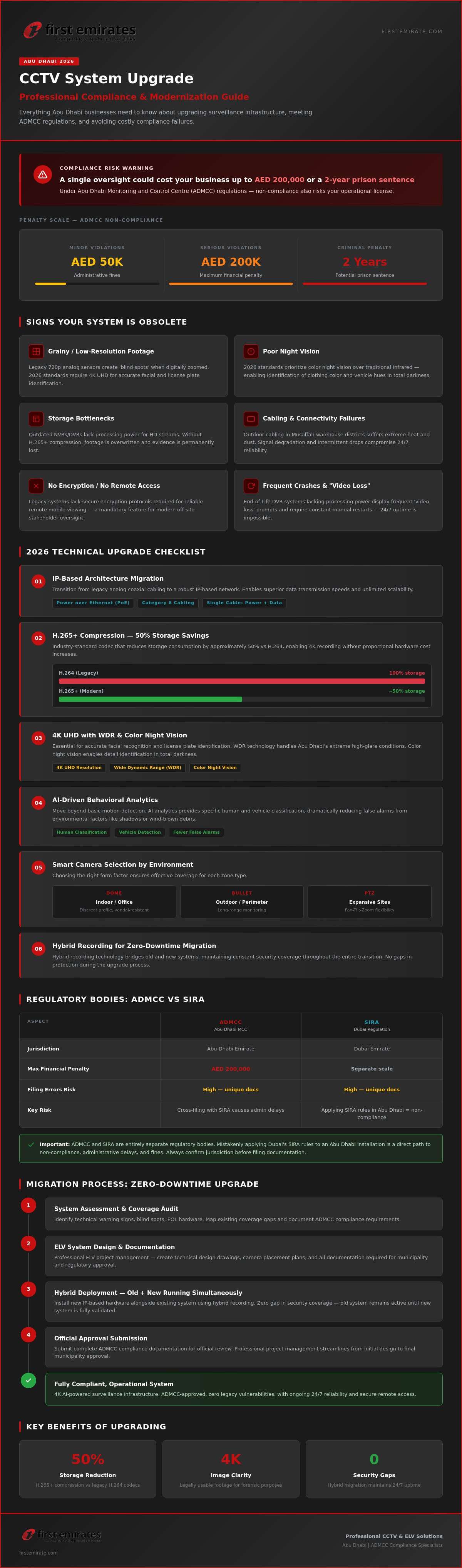
A single compliance oversight in your surveillance strategy could result in fines reaching AED 200,000 or even a two-year prison sentence under Abu Dhabi Monitoring and Control Centre (ADMCC) regulations. For many local enterprises, the necessity of a CCTV system upgrade Abu Dhabi isn't just about clearer images; it's a critical requirement for maintaining operational licenses and ensuring public safety.
It's common to feel frustrated by grainy night vision or the constant struggle with storage limitations for high-definition footage. You likely recognize that your current infrastructure is reaching its technical limits, especially as ADMCC standards for 2026 demand higher precision and better data management. It's also vital to distinguish these requirements from Dubai's SIRA regulations to avoid costly filing errors or administrative delays.
This article provides a professional, step-by-step guide to modernizing your surveillance infrastructure while ensuring full compliance with Abu Dhabi's strict security regulations. We'll examine a technical checklist that covers hardware selection, AI-powered behavioral analytics, and the specific documentation needed to secure official approval without experiencing significant system downtime.
Key Takeaways
- Discover how migrating to IP-based architecture and H.265+ compression improves surveillance clarity while significantly optimizing your data storage efficiency.
- Gain clarity on the specific regulatory differences between ADMCC and SIRA to ensure your business remains fully compliant with Abu Dhabi’s legal requirements.
- Learn to execute a CCTV system upgrade Abu Dhabi using hybrid recording technology to maintain constant security coverage throughout the transition process.
- Identify the technical warning signs and coverage blind spots that indicate your current surveillance hardware is no longer providing adequate protection.
- Understand how professional ELV project management streamlines the path from initial system design to final municipality and regulatory approval.
Recognizing the Signs: Is Your Current CCTV System Obsolete?
Maintaining security integrity requires a proactive approach to hardware assessment. Many businesses realize too late that their Closed-circuit television (CCTV) infrastructure has become a liability rather than an asset. A CCTV system upgrade Abu Dhabi is often necessitated by technical decay that isn't always visible until a critical incident occurs. When legacy sensors fail to provide actionable data, the entire security perimeter is compromised.
Image Quality and Low-Light Performance
Modern surveillance has moved far beyond the grainy 720p footage of the last decade. Upgrading to 4K UHD is now essential for accurate facial recognition and license plate identification. In Abu Dhabi’s high-glare environments, Wide Dynamic Range (WDR) technology is indispensable for balancing extreme light and deep shadows. Additionally, 2026 standards prioritize color night vision over traditional infrared, ensuring that security teams can identify specific details like clothing color or vehicle hues even in total darkness. Relying on low-resolution analog sensors creates 'blind spots' where detail is lost during digital zooming, rendering the footage useless for legal or forensic purposes.
Hardware and Connectivity Failures
Physical infrastructure often bears the brunt of local environmental conditions. In Musaffah warehouse districts, outdoor cabling is frequently subjected to extreme heat and dust, leading to signal degradation and intermittent connectivity. Identifying the 'End-of-Life' (EOL) status for legacy DVR systems is critical; these units often lack the processing power to manage modern high-definition streams, causing frequent system crashes. A system is fundamentally obsolete if it lacks the secure encryption protocols required to support reliable remote mobile viewing for off-site stakeholders.
Regulatory bodies set strict technical specifications that older systems simply cannot meet. Failure to provide high-resolution footage during a mandatory inspection can lead to significant administrative delays or fines ranging from AED 50,000 to AED 200,000. Storage bottlenecks occur when outdated NVRs attempt to process HD streams without modern compression standards, leading to overwritten data and lost evidence. A methodical upgrade ensures your storage capacity matches your resolution requirements without inflating operational costs. If your hardware requires frequent manual restarts or displays 'video loss' prompts, it's a clear indicator that the system's 24/7 reliability has been compromised.
The 2026 Technical Checklist for a Professional Upgrade
A successful CCTV system upgrade Abu Dhabi requires a strategic shift from legacy analog frameworks to a robust IP-based architecture. This transition is the foundation of modern surveillance, enabling superior data transmission speeds and the ability to scale your network without the limitations of traditional coaxial cabling. By utilizing Power over Ethernet (PoE), businesses can consolidate power and data into a single Category 6 cable, which reduces installation labor and material costs significantly. This methodical approach ensures your infrastructure is ready for the high-bandwidth demands of 4K and AI-driven intelligence.
Storage efficiency is a critical component of any professional specification. Implementing H.265+ compression is essential; this industry-standard codec can reduce storage consumption by approximately 50% compared to older codecs like H.264. This allows for higher resolution recording without a proportional increase in hard drive requirements. Beyond simple recording, your upgrade should prioritize AI-driven analytics. Modern systems move beyond basic motion detection to offer specific human and vehicle classification, which minimizes false alarms caused by environmental factors like shadows or wind-blown debris. For businesses seeking these advanced capabilities, investing in professional CCTV surveillance systems provides the technical foundation needed for long-term reliability.
Camera Selection Criteria
Choosing the correct form factor is vital for effective coverage. Dome cameras are generally preferred for indoor office environments due to their discreet profile and vandal resistance, while bullet cameras are more effective for long-range outdoor monitoring in large commercial perimeters. For expansive sites, PTZ (Pan-Tilt-Zoom) cameras provide the flexibility to track moving objects across wide areas. In the Abu Dhabi climate, all outdoor hardware must meet IK10 vandal-proof and IP67 weather-proof ratings to withstand extreme heat, seasonal sandstorms, and potential physical tampering.
Recording and Storage Infrastructure
Compliance with local regulations dictates your storage strategy. Abu Dhabi law typically requires businesses to maintain footage for a period ranging from 31 to 90 days, depending on the specific commercial sector. To prevent data loss, we recommend RAID configurations, which provide data redundancy across multiple hard drives. Additionally, edge storage via high-endurance SD cards serves as a critical failover mechanism. If a network outage occurs, the cameras continue to record locally, automatically syncing the missing data to the primary recorder once the connection is restored. This systematic redundancy is a hallmark of a professional-grade security installation.
Navigating Abu Dhabi’s Security Regulations: SIRA and MCC
Achieving regulatory alignment is a critical phase of any CCTV system upgrade Abu Dhabi. The Abu Dhabi Monitoring and Control Centre (ADMCC), frequently referred to as MCC, is the primary authority responsible for setting the technical standards and operational requirements for surveillance within the emirate. Compliance isn't optional; it's a legal mandate for public and private establishments to maintain public order and safety. While SIRA is the governing body for Dubai, its standards often apply to specific commercial sectors across the UAE, making it essential for businesses with multi-emirate operations to understand both frameworks to avoid administrative penalties.
Engaging an ADMCC-approved integrator is the only viable path to system commissioning. These specialists are authorized to submit technical drawings, equipment lists, and connectivity plans to the authorities on your behalf. Without this professional oversight, even the most advanced hardware may fail to receive the necessary permits for operation. Documentation plays a central role in this process, requiring precise records of camera locations, IP addresses, and storage calculations that prove the system meets the minimum retention periods required by law.
Compliance Checklist for Commercial Properties
Regulatory bodies prioritize specific high-risk zones to ensure comprehensive coverage during an investigation. Mandatory camera placement typically includes all entry and exit points, cash handling counters, and delivery bays. To serve as legal evidence, footage must meet specific frame rates and resolution minimums, often requiring at least 1080p clarity at 15 to 25 frames per second depending on the sector. SIRA compliance is a continuous obligation, not a one-time setup. This means regular testing and documentation are required to ensure the system remains functional and compliant throughout its operational life.
The Audit and Approval Process
Preparing for an official police or municipality inspection requires a methodical review of your entire security infrastructure. Inspectors will verify that the live feed matches the approved site plan and that the storage duration meets the mandated 31 to 90-day window. Common reasons for failing a CCTV audit in Abu Dhabi include obstructed camera views, insufficient lighting in recording zones, or hard drive failures that went unnoticed due to a lack of monitoring. A cornerstone of passing these audits is the 'Security System Logbook.' This document must be kept up to date, detailing all maintenance activities, system faults, and authorized repairs. Maintaining this logbook demonstrates a commitment to technical readiness and provides a clear audit trail for government officials during their site visits.
Planning Your Migration: How to Upgrade Without Downtime
Implementing a CCTV system upgrade Abu Dhabi requires a disciplined approach to avoid security gaps. We begin with a comprehensive site audit of your existing cabling. This stage identifies which components can be integrated into the new architecture and which require immediate replacement. A methodical migration ensures that your facility remains protected throughout the technical transition, preventing the risks associated with a total system blackout.
A hybrid DVR/NVR serves as the technical bridge during this transition. It allows you to maintain your legacy analog cameras while simultaneously adding high-definition IP cameras to the same management interface. This phased replacement strategy focuses on critical perimeter areas first, ensuring that your most vulnerable points receive 4K and AI-driven enhancements immediately. The success of any modern surveillance network depends on the underlying infrastructure. Upgrading your network backbone with professional structured cabling services UAE ensures that your data transmission remains stable even under the high-bandwidth load of multiple HD streams. Final system testing and staff training on the new interface represent the concluding steps of a successful deployment. We verify every camera angle and storage path before the formal handover. To begin this methodical transition, businesses can consult with our team for professional CCTV surveillance systems tailored to local operational requirements.
Hybrid Upgrade Strategies
For businesses managing strict budgets, Video Baluns provide a functional solution by running HD signals over existing coaxial cables. While moving to PoE is the long-term goal for simplified wiring, reusing existing power supplies in the short term can reduce immediate capital expenditure. A cost-benefit analysis often reveals that a phased upgrade offers higher stability than a rushed full-rip-and-replace project. This approach allows for thorough testing at each stage, ensuring that each new component is fully optimized before the next phase begins.
Minimizing Operational Disruptions
Maintaining business continuity is a priority during any technical project. We schedule installation tasks during after-hours windows for retail and office environments to ensure that daily operations remain undisturbed. If a critical zone requires significant downtime for cabling work, temporary mobile surveillance units can be deployed to maintain constant security coverage. Finally, we manage the seamless migration of historical data from old drives to new storage arrays, ensuring that your data retention remains compliant with local laws throughout the switch.
Partnering with First Emirates Computers for Your Upgrade
First Emirates Computers has operated as a dedicated security specialist in the capital for over a decade. This longevity allows us to provide a level of grounded reliability that is essential for complex technical projects. When managing a CCTV system upgrade Abu Dhabi, our team oversees every phase of the ELV project, from initial system design to final municipality approval. We maintain technical proficiency in leading hardware brands, including Hikvision, Dahua, and UNV, ensuring that the selected equipment meets both your operational needs and the technical specifications required by local authorities.
Our approach is built on a capability-first architecture. We don't just sell hardware; we provide integrated solutions that include structured cabling, biometric access control, and home automation. By centralizing these services, we eliminate the friction often found in multi-vendor projects. This systematic oversight ensures that your surveillance infrastructure isn't a standalone silo but a fully integrated part of your building's management system. Our engineers focus on technical readiness, ensuring that every component is optimized for the specific demands of a corporate B2B environment.
Professional Integration Services
Navigating the administrative requirements of the Abu Dhabi Monitoring and Control Centre (ADMCC) can be a complex undertaking for business owners. We handle the full documentation process on your behalf, ensuring that all technical drawings and equipment lists are compliant with current standards. Our custom system designs are tailored specifically to the unique climate of the UAE, accounting for high-glare environments and extreme temperatures that can degrade standard electronics. Whether you require seamless integration with biometric access control for sensitive areas or automated triggers within a home automation framework, our engineers ensure the final installation is both functional and future-proof.
The Value of a Security Maintenance Contract
Long-term technical readiness is achieved through disciplined upkeep rather than reactive repairs. Our Annual Maintenance Contracts (AMC) provide a structured framework for periodic cleaning, sensor calibration, and critical firmware updates. These tasks are vital for extending the longevity of your hardware and preventing the system downtime discussed in previous sections. We offer priority support for businesses located in Musaffah and downtown Abu Dhabi, providing a constant, supportive presence for our long-term partners. Regular maintenance ensures that your security logbook remains current, which is a key requirement for passing government audits. If you're ready to modernize your security, Consult with our CCTV experts today to begin your methodical transition to a compliant, high-definition infrastructure.
Securing Your Operational Future in Abu Dhabi
A methodical approach to your surveillance infrastructure ensures that your business remains both technologically advanced and legally compliant. By transitioning from legacy analog hardware to high-definition IP systems, you eliminate critical blind spots and optimize data storage via H.265+ compression. It's essential to remember that maintaining ADMCC and SIRA standards is a continuous responsibility that requires precise documentation and regular system audits.
Executing a CCTV system upgrade Abu Dhabi doesn't have to disrupt your daily operations. Utilizing hybrid migration strategies allows for a phased replacement of hardware, prioritizing your most vulnerable perimeters first. With over 15 years of local expertise, our team provides SIRA-compliant installations and comprehensive ELV and IT infrastructure support to ensure your project meets every regulatory benchmark.
Secure Your Business with a Professional CCTV Upgrade from First Emirates Computers. Investing in a robust, integrated security system today provides the stability and peace of mind your enterprise needs to thrive in the complex technical landscape of 2026.
Frequently Asked Questions
Do I need to replace all my cameras at once for a CCTV system upgrade?
You don't need to replace all hardware simultaneously; a phased approach is often more practical for many businesses. By utilizing hybrid DVR or NVR units, you can integrate legacy analog cameras with new high-definition IP models. This allows you to prioritize critical zones first while managing your budget effectively. It's a methodical way to ensure continuous security coverage without the logistical strain of a full-site replacement.
What are the legal requirements for CCTV storage in Abu Dhabi?
Legal retention periods in Abu Dhabi typically range from 31 to 90 days of recorded footage. The specific duration depends on your commercial sector and the nature of the facility, such as hotels, banks, or shopping centers. Failure to maintain these records can lead to significant fines. It's vital to calculate your storage capacity based on resolution and frame rate to ensure full compliance with ADMCC standards.
Is wireless camera installation reliable for large warehouses in Musaffah?
Wired installations are the standard for industrial environments like Musaffah warehouses due to their superior stability. Wireless systems often suffer from signal interference caused by metal structures, heavy machinery, and extreme heat. For a reliable CCTV system upgrade Abu Dhabi, we recommend structured cabling. This ensures consistent data transmission and prevents the connectivity drops that can compromise security in large-scale storage facilities.
How long does a typical CCTV system upgrade take for a small office?
A typical upgrade for a small office environment usually takes between one to three business days. This timeline includes the initial site audit, hardware installation, and final system testing. If the existing cabling is in good condition, the process is significantly faster. Our team focuses on minimizing downtime by scheduling work during off-peak hours to ensure your business operations continue without interruption.
Can I view my upgraded CCTV system remotely on my mobile phone?
Remote mobile viewing is a standard feature of modern IP-based surveillance systems. Once the upgrade is complete, you can access live feeds and recorded footage from anywhere via a secure, encrypted application. This capability requires a stable internet connection at the site and proper network configuration. It provides business owners with real-time oversight and the ability to respond to security alerts immediately from their smartphones.
What is the difference between SIRA and MCC in Abu Dhabi?
The Abu Dhabi Monitoring and Control Centre (MCC or ADMCC) is the primary regulatory authority for surveillance within the emirate of Abu Dhabi. In contrast, the Security Industry Regulatory Agency (SIRA) governs security standards specifically for Dubai. While both agencies share similar goals regarding public safety, they maintain different technical specifications and approval processes. Understanding these distinctions is critical for ensuring your local installation meets the correct legal benchmarks.
How often should I perform maintenance on my upgraded security system?
Professional maintenance should be performed at least quarterly or bi-annually to ensure long-term technical readiness. Regular service visits involve cleaning camera lenses, checking cable integrity, and applying firmware updates to protect against cybersecurity threats. An Annual Maintenance Contract (AMC) provides a structured schedule for these tasks. This proactive approach prevents hardware failure and ensures your system remains compliant with government audit requirements throughout its lifecycle.
Will my existing internet connection support a 4K IP camera system?
Supporting a 4K IP camera system depends primarily on your network's upload bandwidth and the use of efficient compression technologies like H.265+. While local recording doesn't rely on the internet, remote viewing of high-definition streams requires a robust connection. If you plan to monitor multiple 4K feeds simultaneously from off-site, you might need to upgrade your ISP plan to handle the increased data load without experiencing significant latency.


