
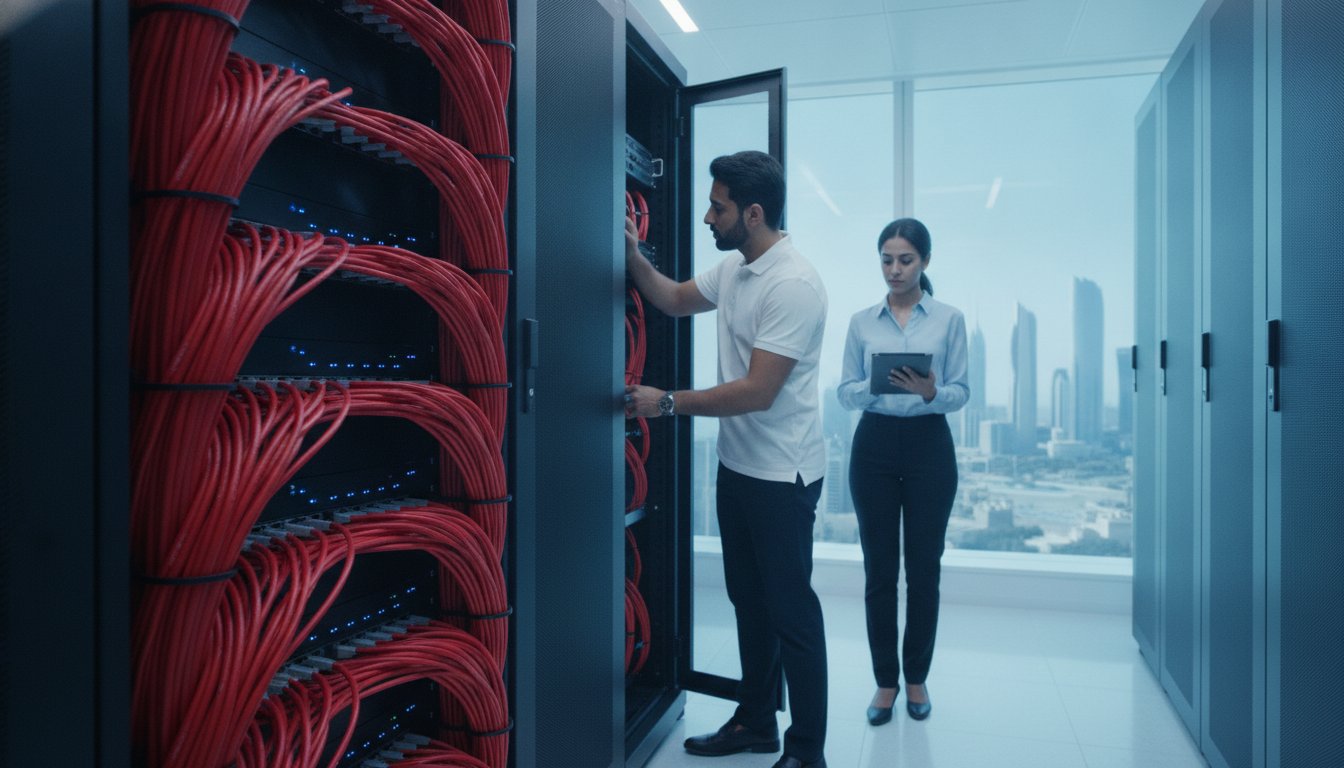
With the UAE reaching a 70.1% AI adoption rate among its working population in early 2026, the demand for robust data infrastructure has never been more critical. Many business owners in the capital face the constant frustration of network downtime or the confusion of meeting strict ADMCC and SIRA regulatory standards. You likely recognize that a reliable network isn't just about speed. It's about building a stable foundation that supports your growth without requiring a complete overhaul every few years.
By investing in professional cat6 cabling services Abu Dhabi, you can establish a future-proofed backbone that adheres to the latest ANSI/TIA-568-E standards. This article outlines how structured cabling provides the technical readiness required for modern industrial and corporate environments. We'll explore the transition from Cat6 to Cat6A, the importance of certified installations for local compliance, and the methodical steps you can take to reduce maintenance costs for the next ten years.
Key Takeaways
- Learn why Cat6 structured cabling serves as the essential nervous system for your business premises, supporting high-speed data transmission up to 10 Gbps.
- Understand the specific performance benchmarks of Cat6, including its 250 MHz bandwidth and the 55-metre distance limitations required to maintain 10GBASE-T connectivity.
- Ensure your infrastructure meets mandatory Abu Dhabi Monitoring and Control Centre (ADMCC) and SIRA standards by selecting professional cat6 cabling services Abu Dhabi.
- Discover a methodical installation lifecycle that moves from initial CAD-based pathway design to final certification for guaranteed long-term reliability.
- Explore how Annual Maintenance Contracts (AMC) protect your physical layer integrity and simplify future network modifications without compromising the original system design.
Understanding Cat6 Structured Cabling in Modern IT Infrastructure
Category 6 (Cat6) is a standardized twisted pair cable for Ethernet designed to support data transfer speeds up to 10 Gbps. Think of structured cabling as the nervous system of your business premises. It carries vital information from the core network to every endpoint, from desktop computers to specialized industrial sensors. While basic wiring might offer temporary connectivity, professional cat6 cabling services Abu Dhabi provide a certified system that guarantees specific performance levels. Adhering to recognized structured cabling standards is what separates a professional installation from a disorganized mess of wires. For most Abu Dhabi SMEs in 2026, Cat6 represents the ideal balance of price and performance. It offers a reliable backbone that handles modern digital demands without the premium cost of higher categories.
Key Components of a Cat6 System
Signal integrity depends heavily on the physical materials used in the installation. Professional cat6 cabling services Abu Dhabi prioritize high-purity copper in both Unshielded Twisted Pair (UTP) and Shielded Twisted Pair (STP) configurations. Cheap, copper-clad aluminum alternatives often fail to meet long-term performance goals and can lead to packet loss. Patch panels and modular jacks act as the critical interface points where signal loss is most likely to occur. Using high-quality components at these junctions ensures that the 250 MHz bandwidth of Cat6 is fully realized. Additionally, standardized racks and enclosures provide the necessary organization for cable management. This infrastructure facilitates proper airflow and simplifies future maintenance tasks by keeping the physical layer logical and accessible.
Beyond Data: Cat6 for ELV and Security Systems
Modern infrastructure does more than just facilitate internet access. Cat6 cabling is a primary driver for integrated ELV projects. It supports high-definition CCTV installation Abu Dhabi by utilizing Power over Ethernet (PoE) technology. This standard allows a single cable to deliver both high-speed data and electrical power to security cameras, biometric access control readers, and building management systems (BMS). This convergence reduces the need for separate electrical runs and simplifies the overall network architecture. Reliability in these systems is paramount, especially when supporting VOIP telephony or unified communication platforms. These services require consistent, low-latency connections to function effectively in a corporate environment, making the physical cabling quality a non-negotiable factor for business continuity.
Performance Standards: Why Cat6 Remains the Abu Dhabi Corporate Standard
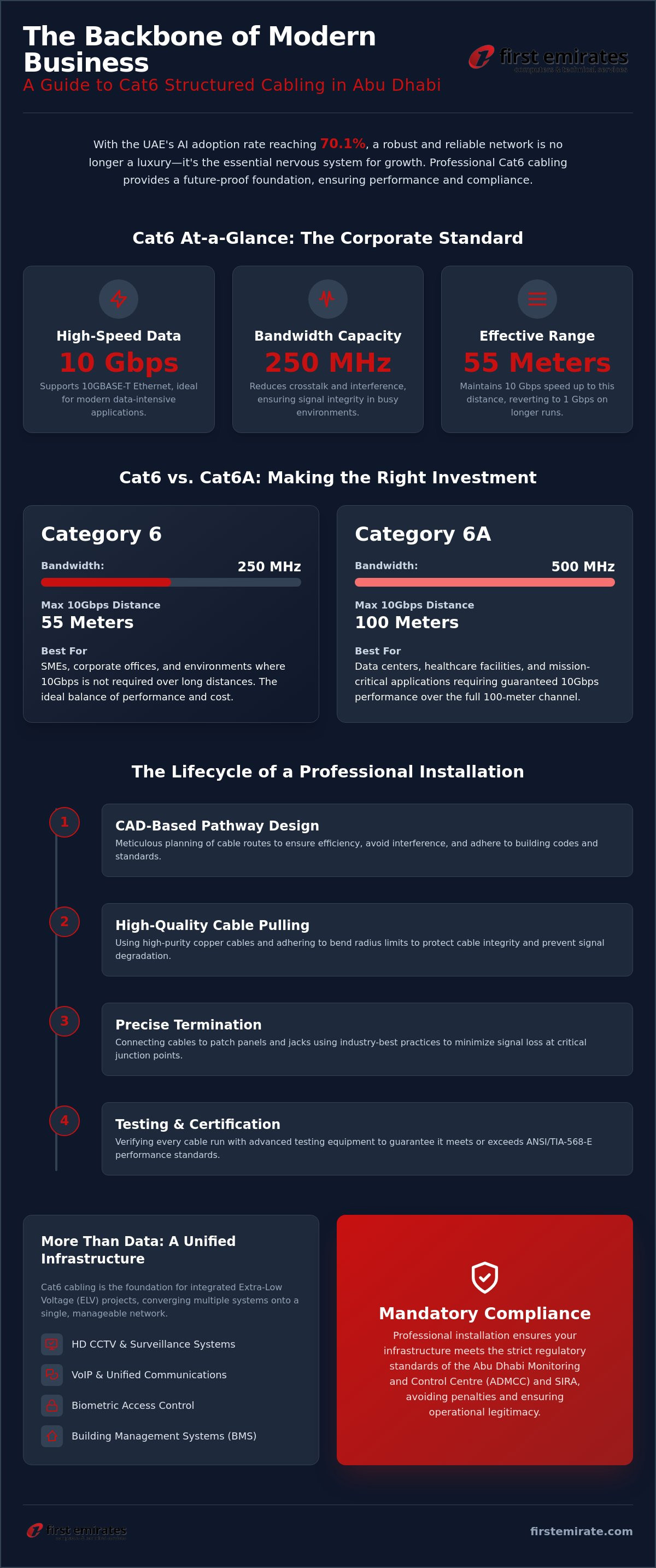
Cat6 cabling remains the primary choice for corporate networks in Abu Dhabi because it offers a significant performance leap over legacy systems. While older Cat5e installations operate at 100 MHz, Category 6 cables are tested to 250 MHz. This increased bandwidth reduces crosstalk and interference, which is vital for maintaining data integrity in busy commercial environments. Professional cat6 cabling services Abu Dhabi ensure that every run adheres to the TIA/EIA-568-E and the International cabling standard ISO/IEC 11801. These standards are critical for ensuring that the physical layer supports 10GBASE-T applications. Engineers must account for the fact that while Cat6 supports 10 Gbps, it's limited to a maximum distance of 55 metres for these high-speed runs. In larger office layouts, exceeding this distance causes the network to auto-negotiate down to 1 Gbps.
Cat6 vs. Cat6A: Making the Right Investment
For many Abu Dhabi businesses, Cat6 provides the most cost-efficient path to a high-performance network. Cat6A is typically reserved for data centers or healthcare facilities that require 10 Gbps over the full 100-metre distance. Cat6 provides a bandwidth of 250 MHz, whereas Cat6A doubles this capacity to 500 MHz. In high-density office environments, managing Alien Crosstalk (AXT) becomes a priority. Shielded Cat6 variants are often deployed to mitigate interference from adjacent cables in tight conduits. If you're planning a new office layout, consulting with a specialist for structured cabling design can help determine which category fits your specific technical requirements.
Power over Ethernet (PoE) Capabilities
Power over Ethernet (PoE) has transformed how ELV systems are deployed. Cat6 handles PoE+ (30W) and PoE++ (up to 60W or 100W) with high efficiency, powering everything from smart LED lighting to advanced biometric readers. When running high-wattage PoE through bundled cables, thermal management is a critical consideration. Heat buildup in large bundles can degrade signal quality over time. Methodical installers use specific spacing and ventilation techniques to ensure stable power delivery, particularly for critical server room cabling solutions where uptime is non-negotiable. This systematic approach ensures that your infrastructure supports both current and future hardware iterations without overheating or signal loss.
Compliance and Environmental Factors for Cabling in the UAE
Cabling projects in the UAE require strict adherence to local regulatory frameworks to ensure both safety and system interoperability. For any infrastructure linked to security, compliance with the Abu Dhabi Monitoring and Control Centre (ADMCC) is mandatory. These regulations dictate specific installation standards for cabling that supports surveillance and monitoring systems. Similarly, the Security Industry Regulatory Agency (SIRA) sets the benchmark for interconnected security systems across the Emirates. Professional cat6 cabling services Abu Dhabi ensure that every component, from the patch panel to the wall outlet, meets these rigorous government requirements. This disciplined approach prevents legal complications and ensures that your facility is ready for official audits.
Fire safety represents another critical compliance pillar. UAE commercial building codes mandate the use of Low Smoke Zero Halogen (LSZH) cable jackets. In the event of a fire, LSZH cables emit limited smoke and no toxic halogen gases, which is essential for protecting occupants in high-rise offices or industrial facilities. Beyond safety, environmental factors like high ambient temperatures must be addressed. In non-chilled environments, such as service corridors or ceiling voids, heat can increase signal attenuation. This phenomenon occurs because electrical resistance in copper increases as the temperature rises, potentially leading to data loss or reduced speeds. Methodical planning accounts for these thermal variables to maintain network performance throughout the year, even during peak summer months.
Local Building Regulations and Standards
When setting up new office fit-outs in Al Maryah Island or Khalifa City, businesses must navigate complex local authority inspections. Passing these inspections requires precise documentation, including as-built drawings and copper certification test results. Partnering with an approved structured cabling services UAE provider ensures that all technical submittals align with municipal expectations. This systematic approach prevents costly rework and ensures your occupancy certificate is processed without delays. It's not just about the installation; it's about providing the verified data that proves the system meets national standards.
Industrial Considerations: Mussafah and Beyond
In industrial zones like Mussafah, the cabling environment is significantly more challenging. Heavy machinery and electrical switchgear often generate Electromagnetic Interference (EMI), which can disrupt data transmission in standard unshielded cables. To counter this, shielded cabling (STP) is deployed to provide a grounded barrier against electrical noise. Additionally, infrastructure must be protected from the pervasive dust and humidity common in warehouse settings. Using IP-rated enclosures and sealed conduits prevents particulate ingress from damaging modular jacks. Strategic cable routing is also employed to maintain physical separation between data lines and high-voltage power cables, further reducing the risk of interference and signal degradation.
Methodical Implementation: The Lifecycle of a Professional Installation
A professional installation follows a deliberate lifecycle designed to eliminate network instability and ensure long-term performance. First Emirates Computers utilizes a systematic three-phase approach that manages every detail from the initial site survey to final system certification. This disciplined process ensures that cat6 cabling services Abu Dhabi provide a scalable infrastructure that meets both current and future bandwidth demands. By following a structured roadmap, technical teams avoid the common pitfalls of haphazard wiring and unorganized cable runs.
Phase 1 begins with a comprehensive site assessment and the creation of a CAD-based pathway design. This architectural blueprint identifies the most efficient routes for cable trays and conduits while maintaining required separation from electrical sources. In Phase 2, the team executes a systematic installation, strictly adhering to international labelling standards at both the patch panel and the wall outlet. This clarity is essential for future troubleshooting and system upgrades. Finally, Phase 3 involves rigorous testing and documentation using industry-standard Fluke or OTDR testers. This final step verifies that every link meets the performance specifications outlined in the original design.
The Importance of Certified Testing
Relying on simple "link-light" testing is insufficient for modern corporate networks. A green light on a switch only indicates basic continuity, not the ability to handle high-speed data without errors. Professional cat6 cabling services Abu Dhabi provide detailed test reports for every single node, measuring parameters like return loss and near-end crosstalk. These reports serve as the foundation for 25-year manufacturer-backed warranties, giving business owners peace of mind that their physical layer is fully compliant. If you're ready to upgrade your facility, you can request a professional site survey from First Emirates Computers to begin the design process.
Professional Patching and Server Room Organization
Server rooms often become unmanageable due to poor initial organization. Utilizing horizontal and vertical cable managers is a standard practice that prevents the development of "cable spaghetti" behind the racks. Systematic color-coding strategies are also employed to separate data, voice, and security traffic, making it easier for IT staff to manage moves, adds, and changes. Beyond organization, proper cable management is vital for optimizing airflow in server room cabling solutions. Obstructed vents lead to equipment overheating, which can significantly shorten the lifespan of expensive hardware components.
Ensuring Long-Term Reliability through Structured Cable Management
Transitioning from a successful installation to daily operations requires a disciplined approach to maintenance. Many organizations view cabling as a one-time expense, but it's more accurate to treat it as a 15-year strategic asset. Professional cat6 cabling services Abu Dhabi don't end when the last cable is labeled. Preserving the physical layer's integrity involves regular oversight through Annual Maintenance Contracts (AMC). These contracts provide a structured framework for auditing patch leads and termination points, preventing the gradual signal degradation that often goes unnoticed until a critical failure occurs. Consistent monitoring ensures that your network remains as reliable in year ten as it was on day one.
Managing "Moves, Adds, and Changes" (MACs) is where many networks begin to lose their original design efficiency. Without a methodical protocol, temporary patches often become permanent fixtures, leading to disorganized racks and unidentified links. A professional MAC process ensures that every new connection is documented, tested, and integrated into the existing CAD-based pathway design. This steady, functional approach maintains the systematic nature of the technical project long after the initial deployment is complete. It prevents the accumulation of "technical debt" that complicates future troubleshooting and increases long-term operational costs.
Developing a Scalability Roadmap
Future-proofing a network requires planning for growth before the need arises. A well-designed infrastructure should account for a 20-30% increase in node density during the initial design phase. This foresight prevents the need for invasive construction work when a department expands or a new floor is commissioned. Utilizing high-capacity backbone fiber optics to link Cat6 distribution points ensures that the core network can handle increased traffic without bottlenecks. This architecture is essential for integrating upcoming technologies like Wi-Fi 7 and a growing grid of IoT sensors, which will place higher demands on local bandwidth and Power over Ethernet (PoE) capacity.
The First Emirates Computers Commitment to Quality
Reliability is built on the foundation of industry-leading components and expert oversight. First Emirates Computers utilizes trusted brands such as Opterna, Belden, and D-Link to ensure that every installation meets global performance benchmarks. Our dedicated AMC teams in Abu Dhabi provide ongoing technical support, ensuring that all integrated ELV and IT hardware assets operate at peak performance. By choosing professional cat6 cabling services Abu Dhabi, you're partnering with a methodical problem-solver committed to being a constant, supportive presence in your technical landscape. This commitment ensures that your network remains a stable, high-performance foundation for your corporate or industrial operations.
Building a Resilient Network Infrastructure for the Next Decade
A professional network backbone is the silent driver of business continuity in the capital. By adhering to international standards and local ADMCC or SIRA regulations, you ensure your premises are safe, compliant, and ready for future technological shifts. Securing professional cat6 cabling services Abu Dhabi ensures that your infrastructure supports high-speed data and critical security systems without compromise. This methodical approach transforms your wiring from a simple utility into a long-term strategic asset that reduces maintenance costs over time.
First Emirates Computers has been a dependable partner in the local market since 2011, bringing over a decade of specialized expertise to every project. As methodical ELV and IT infrastructure specialists, we provide the technical readiness required for complex corporate and industrial environments. We're authorized resellers for industry-leading brands like Opterna, Belden, and D-Link, ensuring that every component in your system meets the highest quality benchmarks. Our team is committed to delivering stability and comprehensive coverage for your physical layer.
If you're planning a new facility or upgrading an existing network, it's essential to work with a seasoned expert. Contact First Emirates Computers for a professional site survey and Cat6 cabling proposal to begin your infrastructure journey. We're here to help you build a stable and high-performance foundation for your business growth.
Frequently Asked Questions
Is Cat6 still the best choice for offices in Abu Dhabi in 2026?
Cat6 remains a highly viable choice for Abu Dhabi offices in 2026, offering a cost-effective balance for standard 1Gbps requirements. While Cat6A is gaining ground for high-density environments, Cat6 still handles the majority of corporate data needs efficiently. It provides the reliable foundation necessary for most SMEs while keeping initial infrastructure costs manageable. Professional cat6 cabling services Abu Dhabi ensure these systems are designed with enough headroom for planned growth.
Can Cat6 cabling support 10Gbps speeds?
Cat6 cabling supports 10Gbps speeds, but it's technically limited to a maximum distance of 55 metres for this specific throughput. Beyond this length, the signal may degrade or auto-negotiate to lower speeds. For organizations requiring 10Gbps over the full 100-metre standard distance, Cat6A is the appropriate technical specification. Methodical planning during the design phase ensures that cable runs stay within these performance-critical distance limitations.
What is the difference between UTP and STP Cat6 cables?
UTP (Unshielded Twisted Pair) is the industry standard for typical office environments where interference is minimal. STP (Shielded Twisted Pair) includes an additional protective layer to block electromagnetic interference (EMI). STP is a necessary requirement for industrial settings or areas with high-voltage electrical lines. Choosing the correct cable type prevents signal loss and ensures the long-term stability of the physical network layer across diverse environments.
How much does professional Cat6 cabling installation cost in the UAE?
Installation costs for cat6 cabling services Abu Dhabi are calculated based on the specific scope of the technical project. Factors such as the number of connection points, the type of containment required, and the complexity of the building's architecture influence the final quote. A comprehensive site survey is the only way to provide an accurate estimate that accounts for all regulatory and performance requirements without hidden expenses.
Why is LSZH cabling required for buildings in Abu Dhabi?
LSZH (Low Smoke Zero Halogen) cabling is a mandatory safety requirement in UAE commercial buildings to mitigate fire risks. In the event of a fire, standard PVC jackets release thick smoke and toxic halogen gases. LSZH materials are engineered to produce minimal smoke and no harmful chemicals, providing a safer environment for occupants. This compliance is essential for passing civil defense inspections and ensuring overall building safety.
What happens if our cabling is not ADMCC or SIRA compliant?
Failing to meet ADMCC or SIRA standards can result in the denial of necessary security permits or occupancy certificates. These regulatory bodies ensure that cabling for surveillance and security systems meets specific reliability and performance benchmarks. Non-compliance often leads to costly rework and project delays. Working with an approved specialist ensures that your infrastructure is documented and installed correctly to pass all official government inspections.
How long does it take to complete a structured cabling project for a standard office?
A standard structured cabling project typically requires one to three weeks for completion, depending on the node density and site conditions. This methodical lifecycle includes the initial CAD-based design, physical installation of conduits and cables, and final certification testing. Larger industrial or multi-floor corporate projects may require a more extended timeline. A clear project roadmap ensures that every phase is executed with precision and minimal disruption to business operations.
Can Cat6 cabling be used for CCTV and Access Control systems?
Cat6 cabling is the primary choice for modern ELV projects, including high-definition CCTV and biometric access control systems. It supports various Power over Ethernet (PoE) standards, allowing a single cable to provide both high-speed data and electrical power to endpoints. This convergence reduces the complexity of the infrastructure and lowers installation costs. It provides a stable and manageable platform for all integrated security and communication technologies within a premises.


