

Can your facility remain competitive when its security, data, and communication systems operate in total isolation? For many operators in industrial zones like Musaffah, the reality of managing ELV infrastructure for warehouses often involves juggling multiple vendors and facing unexpected network downtime. It's a common frustration to realize that aging, fragmented systems are driving up maintenance costs while failing to meet modern safety requirements.
This guide provides a comprehensive roadmap for 2026 to help you transition from disconnected hardware to a unified digital nervous system. You'll discover how a centralized framework ensures compliance with the latest UAE safety standards, including ADMCC 5.0 and the 2024 Civil Defence Law. We'll examine the technical requirements for high-speed structured cabling and the long-term reliability offered by professional Annual Maintenance Contracts. By the end of this integration guide, you'll understand how to build a resilient, future-proof environment that protects your assets and your bottom line.
Key Takeaways
- Understand how a unified ELV infrastructure for warehouses acts as a digital nervous system to streamline security and data management.
- Learn the technical differences between copper and fiber optic cabling to maintain high-speed connectivity across expansive logistics facilities.
- Identify the latest ADMCC and SIRA compliance standards required to secure operational licenses and meet UAE safety regulations.
- Discover how integrated systems reduce overhead costs by replacing aging, disconnected hardware with a centralized management platform.
- Evaluate the benefits of professional maintenance contracts for ensuring the long-term stability and technical readiness of your facility.
Defining ELV Infrastructure for the Modern Logistics Sector
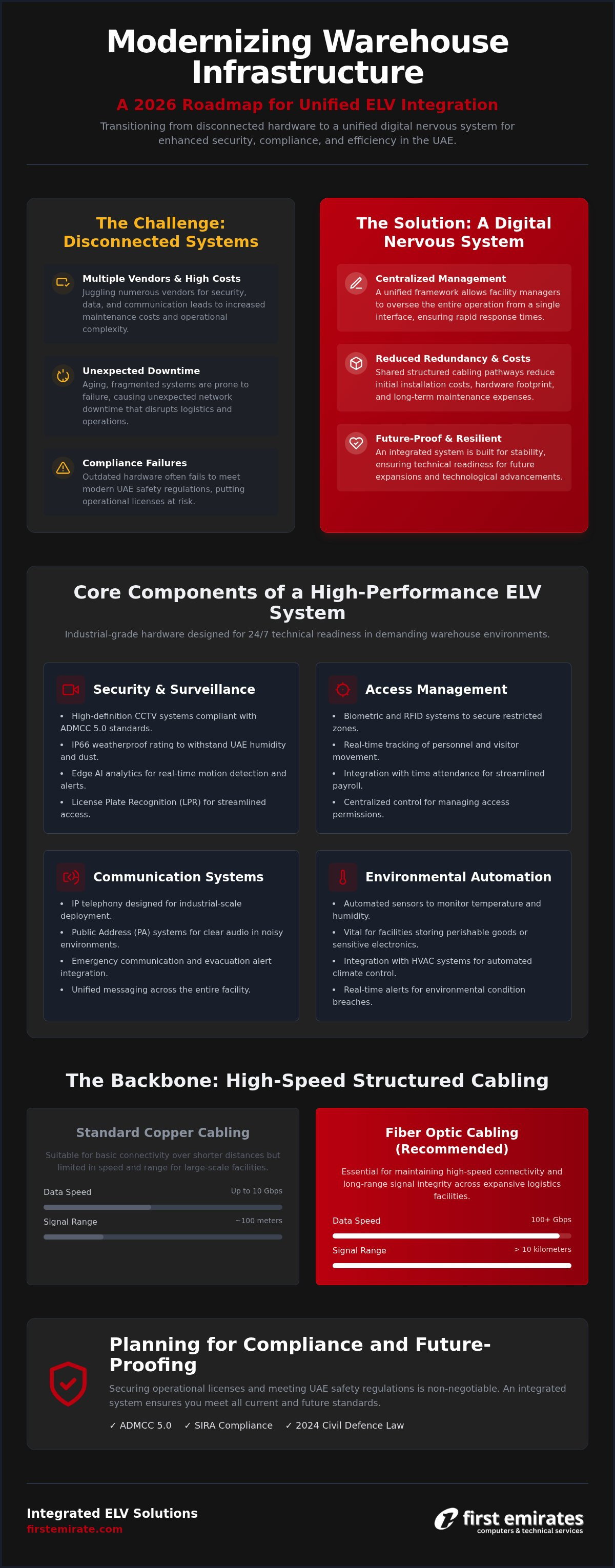
In technical terms, Extra Low Voltage (ELV) refers to systems that operate on a voltage range low enough to carry a minimal risk of electrical shock, typically under 50V AC or 120V DC. In a modern logistics context, however, the definition expands far beyond simple power ratings. ELV infrastructure for warehouses acts as the digital nervous system of the facility, connecting every sensor, camera, and access point into a coherent operational network. It's the silent framework that allows high-tech storage hubs to function with precision.
Unlike residential installations that prioritize basic connectivity and comfort, industrial ELV systems must withstand the rigors of high-volume environments. Warehouses in Abu Dhabi, particularly in industrial zones like Musaffah, face unique challenges such as extreme ambient temperatures and high dust levels. These factors necessitate a methodical approach to design that prioritizes durability and long-range signal integrity. We've seen a decisive shift from standalone security or communication tools toward integrated digital backbones. In this modern setup, data from a CCTV camera can inform inventory movement or trigger automated lighting responses, creating a truly intelligent facility.
The Scope of ELV in Industrial Environments
The modern warehouse relies on a diverse array of interconnected systems to maintain safety and efficiency. A professional ELV project typically encompasses several critical categories that must work in unison:
- Security and Surveillance: High-definition CCTV systems and perimeter protection that comply with ADMCC 5.0 standards for footage retention and clarity.
- Access Management: Biometric access control and RFID systems that secure restricted zones while tracking personnel movement in real-time.
- Communication Systems: IP telephony and public address (PA) systems designed for clear audio delivery across large, noisy floorplates.
- Environmental Automation: Monitoring sensors that track temperature and humidity, which is vital for facilities storing perishable goods or sensitive electronics.
Why Integration Matters for Warehouse ROI
Operating separate systems for security, data, and automation is no longer a viable strategy for large-scale facilities. Integration directly impacts the return on investment by eliminating hardware redundancy. When systems share a unified structured cabling pathway, the initial installation costs and the physical footprint of the equipment are significantly reduced. It's a more efficient way to build.
Centralized management allows facility managers to oversee the entire operation from a single interface. This visibility speeds up response times during security incidents or technical failures. Additionally, a unified framework simplifies long-term maintenance. By bundling these systems under a single Annual Maintenance Contract (AMC), warehouse operators ensure technical readiness while avoiding the high costs of managing multiple disconnected vendors. This steady, functional approach provides the stability needed for complex industrial projects.
Core Components of a High-Performance Warehouse ELV System
A high-performance ELV infrastructure for warehouses requires hardware specifically engineered for industrial scale. Standard office equipment often lacks the durability needed to handle the dust, heat, and vast distances characteristic of Abu Dhabi logistics zones. By selecting components designed for 24/7 technical readiness, operators ensure their facility remains both secure and compliant with local regulations. This methodical approach to hardware selection prevents the high maintenance costs associated with premature equipment failure.
Industrial-Grade CCTV and Surveillance
Warehouse surveillance presents unique challenges, particularly when monitoring loading bays and high-ceiling storage aisles. Cameras must maintain clarity across long distances and in varying light conditions. For outdoor areas, an IP66 weatherproof rating is essential to withstand the UAE's humidity and dust. Modern systems now incorporate Edge AI analytics, allowing for real-time motion detection and automated alerts without overloading the central server. Integrating CCTV installation Abu Dhabi protocols ensures that your system meets the ADMCC 5.0 resolution standards, which typically require a minimum of 1080p for critical areas. Features like License Plate Recognition (LPR) at entry points further streamline the movement of goods while maintaining a strict security log.
Access Control and Time Attendance
Managing the flow of staff, contractors, and visitors in a sprawling industrial site requires a systematic approach. Traditional key-based systems are insufficient for large facilities. Instead, biometric and RFID solutions offer a reliable way to manage entry to restricted zones. These systems provide a digital audit trail, which is vital for both internal security and regulatory compliance. When selecting an access control system company, it's important to choose a partner that understands the integration of time attendance data with your existing management software. This connectivity reduces administrative overhead and ensures that only authorized personnel access sensitive storage areas.
Beyond security, the physical foundation of any robust ELV infrastructure for warehouses relies on structured cabling. For 2026, Cat6A is the recommended standard, supporting 10 Gigabit Ethernet speeds up to 100 meters. This bandwidth is necessary to handle the data load from high-definition cameras and integrated IoT sensors. Finally, Public Address (PA) and intercom systems provide essential floor-wide communication, ensuring that emergency instructions reach every corner of the facility. If you're planning a new facility, consulting with a specialist in ELV projects can help align these components with your operational goals.
Structured Cabling: The Backbone of Warehouse Connectivity
The physical scale of a logistics hub dictates the design of its structured cabling. While a standard office environment might function with basic copper runs, ELV infrastructure for warehouses requires a more robust architecture to handle high-definition data over vast distances. It's the foundation that supports every other system. Without a methodical cabling plan, even the most advanced cameras and access points will suffer from latency and signal degradation.
Copper cabling, such as Cat6A, is excellent for horizontal runs but faces a hard physical limit of 90 meters for effective data transmission. In a warehouse that spans thousands of square meters, this limitation becomes a significant hurdle. Fiber optic cabling serves as the necessary solution for the backbone, connecting the Main Distribution Frame (MDF) to various Intermediate Distribution Frames (IDF) across the floorplate. This hierarchy ensures that data travels efficiently from the furthest corner of the facility back to the central server room.
Industrial zones like Musaffah often feature high levels of Electromagnetic Interference (EMI) from heavy machinery and high-voltage power lines. Unshielded cables can experience signal dropouts or data corruption in these environments. Using shielded twisted pair (STP) cabling or fiber optics, which is inherently immune to EMI, ensures data integrity remains constant regardless of the surrounding industrial activity. This technical readiness is essential for maintaining 24/7 operational uptime.
Fiber Optic Solutions for Large Footprints
Large facilities often have remote gatehouses, loading docks, or perimeter cameras located hundreds of meters from the main office. Relying on copper for these distances leads to packet loss and system instability. Utilizing the structured cabling services UAE specialists provide ensures your facility uses high-bandwidth fiber links. These links maintain a clear signal for security and operational data while future-proofing the network for 10Gbps speeds and beyond. This approach is particularly vital for ELV infrastructure for warehouses where scalability is a primary concern.
Industrial Network Racks and Pathways
Strategic placement of IDF closets is vital to keep horizontal cable runs under the 90-meter threshold. These closets must be protected from the dust and heat common in non-climate-controlled zones. Using NEMA-rated enclosures and organized cable trays prevents physical damage from forklifts or warehouse machinery. Clear, standardized labeling on every port and cable is not just a preference; it's a requirement for efficient troubleshooting. This disciplined organization allows for faster maintenance and reduces the risk of human error during system upgrades.
Planning for Compliance and Future-Proofing in Abu Dhabi
Achieving full compliance for your ELV infrastructure for warehouses involves more than just purchasing high-end hardware. In Abu Dhabi, the regulatory landscape is governed by specific authorities like the Abu Dhabi Monitoring and Control Centre (ADMCC) and the Abu Dhabi Civil Defence Authority (ADCDA). Following the Federal Decree-Law No. (35) of 2024, companies must meet stringent fire safety and emergency planning requirements to secure their operating licenses. Compliance is a multi-step process that requires technical precision and a deep understanding of local law.
Step 1 involves aligning with ADMCC 5.0 standards, which dictate camera resolution and footage retention. Step 2 focuses on scalability. Designing for 2026 means ensuring your network can handle future IoT integration, such as automated inventory sensors or environmental monitors. Step 3 requires selecting partners with local technical readiness, particularly in industrial zones like Musaffah, where on-site support is critical for minimizing downtime. Finally, Step 4 centers on implementing a proactive maintenance strategy to protect your investment from the harsh local climate.
Local Regulations and SIRA Compliance
Mandatory camera coverage is not optional. UAE regulations specify that all entry points, loading bays, and high-value storage aisles must have continuous monitoring. Depending on the warehouse category, you may be required to store recordings for anywhere from 31 to 180 days. For outdoor installations, cameras must have at least an IP66 weatherproof rating to survive intense heat and dust. Utilizing SIRA-approved contractors is essential, as they're authorized to issue the certificates required for trade license renewals. This ensures that your security system isn't just functional but also legally recognized by the authorities.
The Role of Annual Maintenance Contracts (AMC)
The desert climate poses a constant threat to electronic components. Dust accumulation and high temperatures can lead to system degradation or total failure if left unmanaged. Implementing a proactive maintenance strategy through IT AMC services Abu Dhabi providers offer is the most effective way to ensure long-term reliability. A structured AMC includes regular sensor cleaning, firmware updates, and hardware health checks. This disciplined approach prevents small issues from escalating into costly repairs. For businesses seeking a dependable partner for these requirements, First Emirates Computers provides turnkey ELV project management tailored to the Abu Dhabi industrial sector.
Integrated ELV Solutions by First Emirates Computers
First Emirates Computers provides specialized ELV infrastructure for warehouses across Abu Dhabi's industrial landscape. Since 2011, we've operated as turnkey contractors for large-scale logistics hubs, prioritizing technical precision over marketing hyperbole. Our deep roots in Musaffah mean we understand the specific environmental and regulatory hurdles of the region. This local presence isn't just a convenience; it ensures faster response times and a steady hand during critical system deployments.
Our integrated approach covers the full spectrum of technical requirements, from structured cabling and IT hardware sales to biometric access control and CCTV surveillance systems. By consolidating these services under a single ELV project, we remove the burden of managing disconnected vendors. We focus on building a digital nervous system that is both SIRA-compliant and operationally resilient. This unified framework allows for seamless data flow and centralized security management across your entire facility.
Our Methodical Implementation Process
We follow a disciplined workflow to ensure every installation meets our high standards of reliability. Each project starts with a detailed site survey to analyze the specific needs of your logistics environment. Our engineers then develop a system design that accounts for both current operational demands and future scalability. We handle the complex regulatory approval management with ADMCC and SIRA, ensuring your facility adheres to the latest 2026 technical requirements. After approval, our team performs a professional installation and a series of rigorous system tests to confirm total technical readiness.
Long-Term Partnership and Support
Maintaining complex infrastructure in a desert climate requires a proactive strategy. We offer customized Annual Maintenance Contracts (AMC) that provide comprehensive oversight of your warehouse's technical assets. These packages include priority support and regular hardware health checks to prevent unexpected downtime. By choosing a local specialist, you gain a dependable partner committed to the long-term stability of your facility. Contact First Emirates Computers to schedule a comprehensive ELV consultation and discover how we can optimize your warehouse's security and connectivity.
Securing Your Industrial Future with Integrated ELV
Modern logistics demands more than just storage space; it requires a disciplined digital framework. We've explored how a unified ELV infrastructure for warehouses eliminates the risks of fragmented security and prevents costly network downtime. By prioritizing high-grade structured cabling and AI-driven surveillance, you ensure your facility remains fully compliant with Abu Dhabi's evolving safety standards. A systematic approach today prevents the operational bottlenecks of tomorrow.
Stability in a complex technical landscape comes from choosing a partner who understands local industrial realities. First Emirates Computers has operated as an Abu Dhabi-based specialist since 2011, serving as a dependable hand for turnkey projects. As a SIRA-approved security installer, we provide the technical readiness and comprehensive AMC support required to protect your assets against the challenges of the desert climate. We focus on delivering grounded reliability so you can focus on your core business.
Don't leave your facility's connectivity to chance. Request a Professional ELV Infrastructure Consultation for Your Warehouse today to build a resilient foundation for your operations. We're here to help you move forward with a system built for long-term reliability and peace of mind.
Frequently Asked Questions
What are the essential ELV systems for a new warehouse in Abu Dhabi?
Essential systems include SIRA-compliant CCTV, biometric access control, and high-performance structured cabling. Public Address and Voice Alarm (PA/VA) systems are also critical for emergency evacuation and floor-wide communication. A complete ELV infrastructure for warehouses must also incorporate environmental monitoring sensors if you're storing sensitive goods. These components work together to provide a comprehensive security and communication layer that meets both operational needs and Abu Dhabi's strict regulatory standards for industrial facilities.
How does structured cabling differ between an office and a warehouse?
Warehouse cabling requires industrial-grade materials to withstand high temperatures and Electromagnetic Interference (EMI). Unlike office environments, warehouses often exceed the 90-meter limit for copper cabling, necessitating a fiber optic backbone. Network racks must be housed in dust-resistant enclosures, and pathways are typically installed at greater heights. This methodical approach ensures that your ELV infrastructure for warehouses remains stable despite the physical rigors and vast distances of a logistics hub floorplate.
Are SIRA approvals mandatory for all warehouses in the UAE?
SIRA approvals are mandatory for any commercial facility requiring a trade license in Dubai, while Abu Dhabi follows ADMCC regulations. Most warehouses in the UAE must comply with these security standards to ensure public safety and asset protection. These authorities set specific requirements for camera resolution, storage retention, and system maintenance. Failure to meet these standards can result in fines or delays during the license renewal process for your industrial premises.
What is the benefit of integrating access control with CCTV?
Integrating access control with CCTV allows for immediate visual verification of every entry event. When a staff member uses a biometric reader, the system automatically flags the corresponding video footage. This creates a foolproof audit trail and simplifies incident investigations. Centralizing these systems onto a single platform reduces the time spent switching between different software interfaces. It provides a more efficient way to manage large-scale security operations from a central command center.
Can existing warehouse security systems be upgraded to an integrated ELV framework?
Yes, most legacy systems can be transitioned to an integrated ELV framework through IP migration. We often utilize media converters to run modern data over existing coaxial lines or install new structured cabling where necessary. This hybrid approach allows you to upgrade critical areas first while maintaining your current security posture. It's a cost-effective way to modernize your facility's technical readiness without the need for a complete, immediate teardown of your current infrastructure.
How often should warehouse ELV systems undergo maintenance?
Warehouse ELV systems should undergo professional maintenance at least quarterly. The harsh UAE climate leads to rapid dust accumulation on camera lenses and in server cooling fans. Regular inspections under an Annual Maintenance Contract (AMC) include cleaning sensors, checking cable integrity, and applying firmware updates. This disciplined schedule prevents hardware failure and ensures your system is always ready to provide clear evidence or reliable connectivity when it's needed most.
What type of cabling is best for connecting cameras across a large facility?
Fiber optic cabling is the superior choice for connecting cameras across large facilities because it overcomes the distance limitations of copper. It's also immune to the electrical noise generated by heavy warehouse machinery. For local connections under 90 meters, Cat6A is the standard for 2026, providing the bandwidth necessary for high-definition surveillance. Combining a fiber backbone with copper horizontal runs creates a reliable network architecture that supports high-speed data transmission throughout the site.
Does First Emirates Computers provide SIRA-compliant security solutions?
First Emirates Computers is a SIRA-approved security company that specializes in compliant installations. We've provided turnkey ELV projects and security solutions across Abu Dhabi and Dubai since 2011. Our team manages the entire process, from initial system design to securing final regulatory approvals. We ensure that every component of your warehouse's security system meets the exact technical specifications required by local authorities, providing you with a fully certified and legal installation.


