

Would your current surveillance footage stand up to an ADMCC audit, or could a minor technical oversight result in a fine of up to 200,000 AED? You likely recognize that securing a commercial property in the capital requires much more than simply mounting cameras. In a region defined by strict regulatory standards, ensuring your infrastructure meets the Video Surveillance Systems Standards 2017 5.0 is a complex but mandatory task for business license renewal. Professional CCTV installation Abu Dhabi demands a disciplined approach to both hardware selection and legal compliance to avoid the risks of system downtime or non-approval.
This guide provides the technical clarity you need to secure your property with a compliant, high-performance system. We'll help you navigate the differences between IP and Analog hardware while addressing the specific 2026 resolution requirements set by local authorities. You'll learn how to achieve high-definition clarity for evidence and why a local partner for an Annual Maintenance Contract (AMC) is essential for long-term reliability. We'll examine the systematic process of obtaining ADMCC approval, from initial site plans to final technical calculations, ensuring your security investment is both effective and legally sound.
Key Takeaways
- Understand the 2026 ADMCC regulatory requirements to ensure your surveillance system supports business license renewals and avoids substantial legal penalties.
- Evaluate the technical advantages of IP-based digital systems and AI-driven analytics for proactive security monitoring and high-definition evidence.
- Learn how professional CCTV installation Abu Dhabi integrates with structured cabling and ELV backbones to provide a stable, scalable security infrastructure.
- Discover why proactive Annual Maintenance Contracts (AMC) are critical for preventing system downtime and ensuring continuous operational readiness.
- Identify specialized security configurations tailored for industrial environments in Musaffah and residential properties across the emirate.
Navigating Abu Dhabi Security Regulations and Compliance
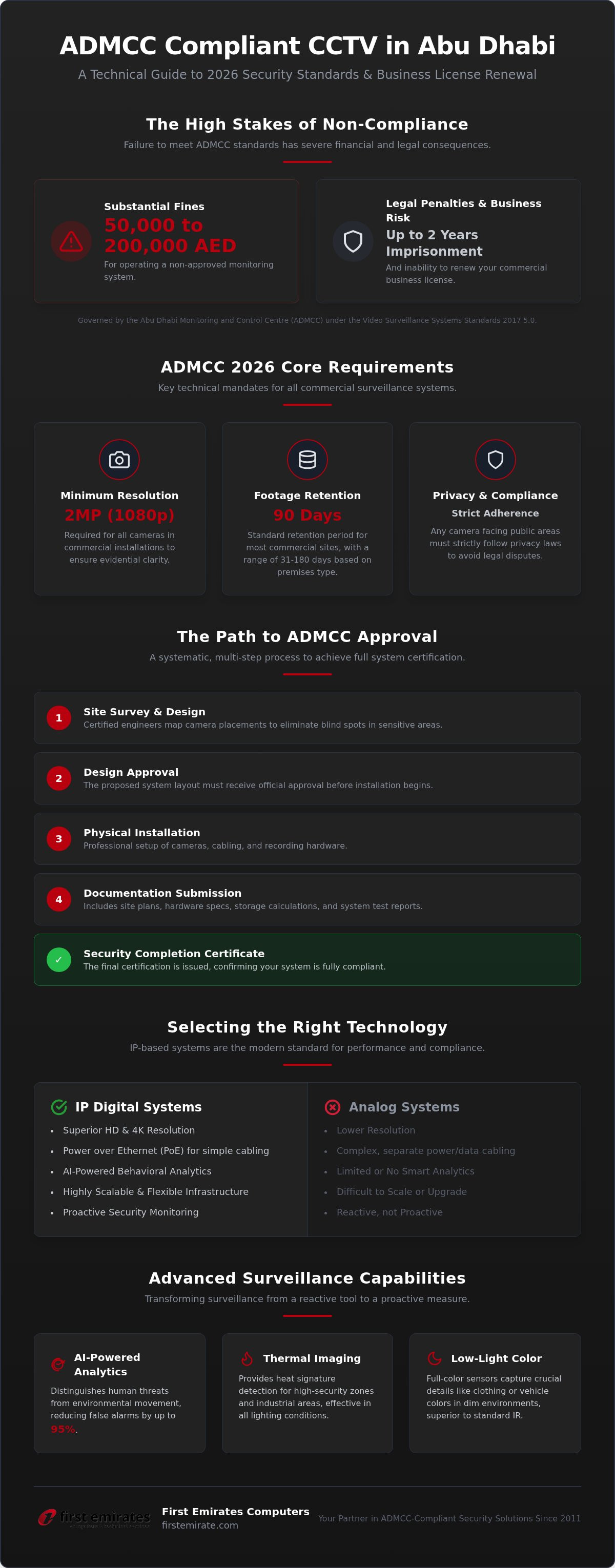
In Abu Dhabi, security is a matter of strict legal adherence rather than optional asset protection. The Abu Dhabi Monitoring and Control Centre (ADMCC) governs every aspect of surveillance within the emirate. For any commercial entity, obtaining or renewing a business license depends entirely on possessing an ADMCC-compliant system. This isn't just about mounting cameras; it's about following the Video Surveillance Systems Standards 2017 5.0. Engaging a police-approved partner for CCTV installation Abu Dhabi ensures that your hardware and storage protocols meet these specific government mandates from the start of the project.
The Municipality Certification and Compliance (MCC) framework acts as the bridge between technical execution and legal operation. If a system fails to meet these standards, the consequences are severe. Operating a monitoring system without the necessary ADMCC approval can lead to fines ranging from 50,000 AED to 200,000 AED. In cases of serious non-compliance, legal penalties can include imprisonment for up to two years. Businesses must treat compliance as a foundational requirement of their physical infrastructure to ensure continuous operation without legal interruptions.
ADMCC vs. SIRA: Understanding the Local Jurisdiction
It's vital to distinguish between the regulatory bodies in the UAE. While SIRA governs Dubai, ADMCC holds the mandate for the entire Abu Dhabi Emirate. The requirements are not interchangeable. For 2026, the ADMCC standards specify a minimum camera resolution of 2 megapixels (1080p) for all commercial installations. Storage duration is equally critical. Depending on the premises type, footage must be retained for 31 to 180 days, with a 90-day retention period being the standard for most commercial sites. Residential villas generally face fewer restrictions regarding internal monitoring, but any camera facing public areas must strictly adhere to privacy laws to avoid legal disputes.
The Certification Process for New Installations
Achieving full compliance follows a logical, multi-step progression. It begins with an initial site survey conducted by certified engineers who map out camera placements to eliminate blind spots in sensitive areas. This design must then receive approval before the physical installation begins. Following the setup, several documents are required for the final security completion certificate:
- Detailed site plans and camera layouts.
- Technical specifications of all hardware used.
- Storage calculations proving the system meets the 90-day retention mandate.
- System testing reports and connectivity verification.
Working with a locally owned integrator like First Emirates provides a distinct advantage. With expertise dating back to 2011, they understand the systematic nature of these approvals and act as a steady hand during the documentation phase. This methodical oversight ensures that your CCTV installation Abu Dhabi is not just technically sound, but fully certified for long-term operation.
Selecting the Right CCTV Technology for 2026
Technology in the security sector evolves rapidly. For a professional CCTV installation Abu Dhabi, IP (Internet Protocol) cameras have effectively replaced analog systems as the industry standard. These digital units provide superior resolution and utilize Power over Ethernet (PoE) to streamline cabling requirements. AI-powered behavioral analytics are a hallmark of the 2026 landscape. These systems can distinguish between human threats and environmental movement, which reduces false alarms by 95% according to industry research. This capability transforms surveillance from a reactive forensic tool into a proactive security measure.
Thermal imaging provides a specialized solution for industrial sectors and high-security zones, allowing for heat signature detection in challenging conditions. For most commercial applications, the decision rests between Infrared (IR) and full-color low-light technology. IR remains reliable for total darkness, but full-color sensors provide the chromatic detail necessary for identifying clothing colors or vehicle shades in dim environments. First Emirates Computers offers methodical guidance on selecting hardware that matches your specific site requirements.
High-Definition Surveillance Standards
Pixel density is the foundation of forensic evidence. While local regulations mandate a minimum 2MP resolution, 4K systems are increasingly common for critical areas where digital zooming is required. Frame rates also play a significant role; a minimum of 20 to 30 frames per second ensures that high-speed movement is captured without blurring. Selecting the correct lens is a technical task that involves calculating the focal length against the desired field of view. A wide-angle lens is appropriate for open parking lots, whereas a telephoto lens is better suited for monitoring narrow corridors or high-value assets.
Smart Integration and Remote Monitoring
Modern systems prioritize accessibility through secure mobile applications, allowing stakeholders to monitor live feeds from any location. Surveillance reaches its peak efficiency when integrated with Biometric Access Control. This integration creates a comprehensive security log where video clips are automatically tagged to specific entry events. Regarding data management, 2026 sees a preference for on-premise NVR storage to manage high-bandwidth 4K data, often supplemented by cloud backups for critical footage. This hybrid approach ensures both speed and redundancy for your security data.
Site-Specific Security: From Musaffah Warehouses to Abu Dhabi Villas
Effective security begins with a site-specific assessment. A one-size-fits-all approach fails to account for the unique environmental and operational challenges of different zones. For instance, a CCTV installation Abu Dhabi project for a retail outlet focuses on theft prevention and footfall analytics. Conversely, industrial plots require robust perimeter protection and high-durability hardware designed to withstand the region's intense heat and dust. Selecting a partner for CCTV installation Abu Dhabi ensures your specific project remains within the legal bounds of privacy while providing comprehensive coverage.
Industrial Requirements for Musaffah Warehouses
Industrial zones like Musaffah present specific challenges for asset protection. Warehouses often house high-value inventory and heavy machinery, making them prime targets for unauthorized access. We prioritize explosion-proof and weather-resistant camera housings to ensure long-term functionality in harsh environments. Strategic placement at loading bays and blind spots between high-shelf racking is essential for total oversight. Integrating these systems with gate barriers and vehicle tracking provides a unified security layer. This methodical approach allows managers to monitor every asset entering or leaving the site with timestamped video evidence.
High-traffic commercial environments, such as corporate offices and retail centers, require a balance between visibility and aesthetics. Cameras in these locations serve a dual purpose: discouraging shoplifting and providing data for operational efficiency. Dome cameras are the preferred choice here due to their discreet profile and vandal-resistant design. Modern AI features allow managers to analyze heat maps of customer movement. This data helps in optimizing floor layouts while maintaining a secure environment for employees and visitors alike. It's a functional application of security technology that supports business growth.
Tailored Solutions for Residential Villas
Residential security in Abu Dhabi is governed by strict privacy regulations. While homeowners seek to protect their property, they must ensure their cameras don't infringe on the privacy of neighbors or the public. We utilize discreet camera designs that complement modern architectural styles without appearing intrusive. Privacy masking is a critical software feature we implement; it blackouts specific areas of the camera's field of view, such as a neighbor's window or swimming pool, to stay compliant with UAE law. These surveillance systems often integrate with Home Automation systems, allowing residents to manage lighting, access, and surveillance from a single, unified interface.
The Installation Process: Infrastructure and Integration
Professional CCTV installation Abu Dhabi relies on a stable physical layer to ensure operational continuity. Without high-quality infrastructure, even the most advanced 4K cameras will suffer from latency or periodic connectivity drops. The foundation of any reliable surveillance system is the Extra Low Voltage (ELV) backbone. This network provides the essential power and data pathways required for continuous, high-definition monitoring. A methodical approach to the physical installation phase prevents the technical failures that often plague poorly planned systems.
The server room setup is equally critical. This central hub houses the NVR (Network Video Recorder) and storage hardware, requiring a controlled environment with proper ventilation and secure access. We prioritize the physical security of the recording equipment to prevent tampering or data loss. Every component, from the professional network switches to the backup power supplies, is integrated into a disciplined architecture designed for 24/7 performance.
Structured Cabling Standards (Cat6 and Fiber)
The performance of an IP-based system is fundamentally limited by its cabling. We utilize high-standard Structured Cabling Services to ensure data integrity across the entire network. For most 2026 installations, Cat6 cabling is the minimum requirement to handle the high bandwidth of 4K streams without signal degradation. In large-scale industrial installations, we implement fiber optic backbones. Fiber allows for reliable data transmission over much longer distances than traditional copper, which is essential for protecting the perimeters of large plots.
Effective cable management is a priority during our installation process. Every cable is systematically labeled and organized within professional racks. This methodical approach simplifies long-term troubleshooting and future system expansions. It ensures that any technical issue can be identified and resolved with minimal downtime, maintaining the integrity of your security coverage.
ELV Project Management and System Integration
A successful surveillance deployment requires coordination during the building's fit-out or renovation phase. Our team manages the ELV project lifecycle from initial design through to final commissioning. This involves coordinating with other building systems to create a unified security environment. We utilize professional-grade network switches with sufficient Power over Ethernet (PoE) budgets to support the entire camera array reliably without overloading the circuit.
The final stage is rigorous testing and commissioning. We verify that every camera provides 100% coverage of its designated area, effectively eliminating blind spots. We also test the NVR's storage performance to confirm it meets the mandatory 90-day retention requirements mentioned in previous sections. This disciplined execution is the hallmark of the First Emirates approach. If you're planning a new facility, you can consult our ELV specialists to design a compliant infrastructure from the ground up.
Ensuring Long-Term Reliability with IT AMC Services
A successful CCTV installation Abu Dhabi isn't a one-time event; it's the start of a long-term infrastructure commitment. Even the highest-quality hardware remains susceptible to the environmental rigors of the UAE. Dust accumulation on lenses, cable wear from extreme heat, and power fluctuations can all compromise system integrity over time. Without a structured maintenance plan, these minor issues often escalate into total system failures at critical moments. Reliability in security is built through consistent, disciplined oversight rather than reactive repairs.
Financial stability depends on operational continuity. The cost of a proactive IT AMC Service is significantly lower than the potential losses from unrecorded security incidents or government fines. When a system fails, the risk isn't just a loss of footage. It's a breach of the ADMCC compliance standards discussed in previous sections. Professional maintenance ensures that your property remains protected and your business license stays in good standing through verified technical readiness.
Scope of a CCTV Annual Maintenance Contract
A professional AMC provides a systematic checklist to keep your security hardware in peak condition. This methodical approach includes several critical service areas:
- Quarterly Physical Inspections: Engineers perform manual lens cleaning and focus adjustments to maintain the high-definition clarity required for forensic evidence.
- Firmware and Security Updates: We manage software updates to patch cybersecurity vulnerabilities, ensuring your system isn't an entry point for network threats.
- Storage Health Checks: We conduct rigorous audits of NVR and hard drive performance to confirm that footage is recording without errors and meeting 90-day retention mandates.
- Cabling and Connectivity Tests: Regular verification of the structured cabling backbone ensures that signal strength remains constant across all camera points.
The First Emirates Support Philosophy
We believe in a capability-first approach to technical support that prioritizes stability. Every client is assigned a dedicated account manager who provides consistent oversight and understands the specific technical history of your CCTV installation Abu Dhabi. This isn't just about fixing what's broken; it's about proactive health monitoring to identify potential hardware failures before they occur. We don't wait for a camera to go offline to take action.
We provide detailed maintenance reports after every scheduled visit. These documents are essential for regulatory compliance audits, proving to local authorities that your system is managed by a licensed specialist. Our emergency response protocols ensure that critical failures are addressed with technical proficiency, providing the peace of mind that a steady, local partner is always available. This commitment to long-term support transforms a simple hardware purchase into a dependable security asset.
Securing Your Operational Future in Abu Dhabi
Effective surveillance is a disciplined integration of regulatory compliance, industrial-grade hardware, and proactive maintenance. As standards for 2026 continue to evolve, the focus shifts from simple camera placement to creating a resilient security infrastructure that supports long-term business continuity. Ensuring your CCTV installation Abu Dhabi project meets ADMCC mandates while utilizing high-definition IP technology is essential for both asset protection and legal approval.
First Emirates Computers has served as a steady, methodical partner for Abu Dhabi and Musaffah clients since 2011. Our locally owned team applies a "capability-first" methodology to every project, utilizing expertise in Hikvision, Dahua, and Panasonic systems. We ensure your surveillance is built on a robust ELV backbone and supported by comprehensive AMCs to prevent system downtime. This systematic approach guarantees that your technical assets remain reliable and fully compliant with local regulations.
Take the first step toward a fully compliant and high-performance security system. Request a Professional Site Survey from First Emirates Computers to ensure your property is protected by a specialist with a SIRA and ADMCC compliant methodology. Establishing a secure environment today provides the peace of mind required for a successful tomorrow.
Frequently Asked Questions
Is it mandatory for all businesses in Abu Dhabi to have CCTV?
Yes, it's a prerequisite for business license issuance and renewal for most commercial properties. The Abu Dhabi Monitoring and Control Centre (ADMCC) enforces these regulations to ensure public safety and asset protection. Failure to comply prevents legal operation within the emirate. Businesses must use an approved integrator to ensure the system meets the technical standards required for the security completion certificate and passes government inspections.
How long must CCTV footage be stored according to Abu Dhabi law?
Commercial sites are typically required to retain footage for a period ranging from 31 to 180 days. For most standard business premises, a 90-day retention period is the legal requirement under the current ADMCC framework. This duration ensures that historical data is available for forensic investigations if needed. We calculate storage requirements based on your camera count and resolution to ensure your NVR hardware remains fully compliant with these mandates.
What is the difference between an ADMCC-approved and a SIRA-approved company?
The primary difference lies in the geographic and regulatory jurisdiction. ADMCC regulates security systems within the Abu Dhabi Emirate, while SIRA governs the security industry in Dubai. Each body has distinct technical standards, documentation processes, and hardware approval lists. For a professional CCTV installation Abu Dhabi, you must partner with a company licensed by ADMCC to ensure your system is legally recognized and approved by local authorities.
Can I view my Abu Dhabi office cameras remotely from another country?
Yes, modern IP-based surveillance systems allow for secure remote monitoring through encrypted mobile applications and web interfaces. As long as your NVR is connected to a stable internet connection with sufficient upload bandwidth, you can access live feeds and recorded footage from anywhere in the world. We configure secure VPNs or proprietary portals to ensure that this remote access doesn't compromise your internal network security or violate local privacy regulations.
How much does a professional CCTV installation cost for a warehouse in Musaffah?
The total investment for a warehouse system depends on several technical factors rather than a fixed price. Key variables include the number of camera points, the total length of structured cabling required, and the specific storage capacity needed to meet 90-day retention laws. Environmental factors in Musaffah, such as the need for explosion-proof or dust-resistant housings, also influence the hardware selection. We recommend a professional site survey to provide a precise technical proposal.
What happens if my CCTV system fails and I don't have an AMC?
System failure without an Annual Maintenance Contract (AMC) often results in significant data gaps and potential legal liabilities. If an incident occurs and footage is unavailable during an ADMCC audit, your business could face substantial fines or license suspension. Beyond legal risks, reactive repairs are usually more expensive and result in longer downtime. A methodical AMC ensures that technical issues are identified and resolved proactively, maintaining continuous operational readiness and compliance.
Are wireless CCTV cameras legal for commercial use in Abu Dhabi?
While wireless cameras exist, they are generally not recommended for commercial CCTV installation Abu Dhabi due to reliability and compliance concerns. ADMCC standards prioritize stable, high-bandwidth connections that are resistant to signal interference. Wireless systems are prone to dropouts and cybersecurity vulnerabilities, making it difficult to guarantee 24/7 recording. We utilize structured cabling for all commercial projects to ensure that power and data transmission remain consistent, meeting the rigorous standards required for government approval.
Can CCTV be integrated with my existing biometric access control system?
Yes, integration between surveillance and biometric access control is a standard practice for high-security environments. This unified approach allows the system to automatically tag video clips to specific entry and exit events, creating a comprehensive audit trail. When an employee uses a biometric reader, the nearest camera can capture a high-definition snapshot of the event. This integration enhances forensic capabilities and simplifies the management of your facility's physical security infrastructure through a single interface.


