

The UAE biometrics market reached a value of USD 257.1 million in 2025, reflecting a significant shift toward high-security infrastructure. As organizations transition away from traditional card-based entry, implementing reliable fingerprint access control systems UAE has become a baseline requirement for protecting physical assets. You've likely noticed that manual attendance tracking is no longer sufficient for modern corporate standards. Errors in time-reporting and the constant risk of unauthorized entry create operational vulnerabilities that demand a more systematic approach to facility management.
We understand that meeting local security standards like SIRA or MCC can feel like a complex hurdle for your technical team. This guide provides a clear roadmap to help you implement a compliant, high-performance biometric system tailored for the UAE's specific regulatory environment. We'll examine how to eliminate system downtime through professional maintenance, ensure accurate time-attendance reporting, and achieve seamless integration with your existing CCTV and ELV systems. By the end of this resource, you'll have the technical clarity needed to secure your premises with confidence and precision.
Key Takeaways
- Understand the technical shift from traditional RFID cards to unforgeable biometric data for more secure identity verification.
- Learn the specific requirements for implementing fingerprint access control systems UAE that comply with SIRA and MCC security standards.
- Identify how to select hardware based on user capacity and environmental factors, such as dust and humidity resistance for industrial zones like Musaffah.
- Explore the integration of biometric readers with central access control panels and wider ELV systems for unified security management.
- Discover why regular calibration and database purging under an Annual Maintenance Contract are vital for long-term system reliability.
Understanding Fingerprint Access Control Systems in the UAE
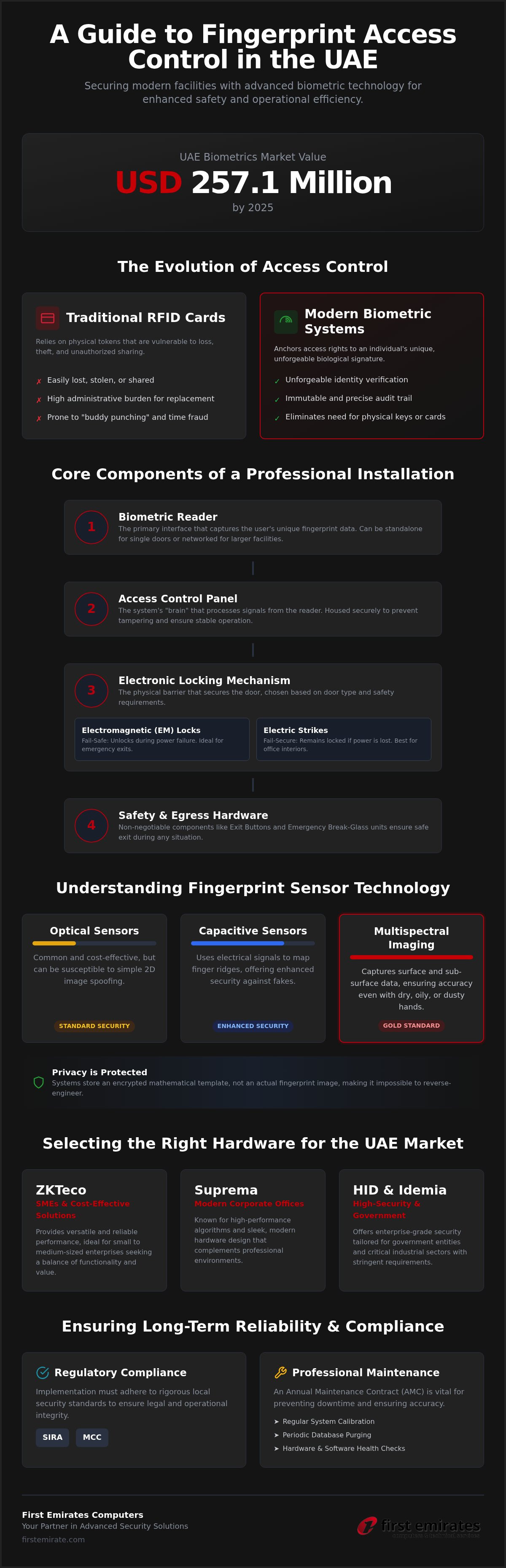
Biometric technology provides a sophisticated layer of identity verification that relies on unique physiological characteristics. In recent years, the adoption of fingerprint access control systems UAE has accelerated as businesses move away from traditional RFID cards toward unforgeable biometric data. This transition is a practical response to the limitations of physical tokens, which are easily lost, stolen, or shared among staff. By anchoring access rights to the individual’s unique biological signature, organizations establish a more reliable and stable security foundation.
Modern access control systems offer three primary advantages for the local business environment. First, they provide an immutable audit trail, allowing management to track entry and exit times with high precision. Second, they enhance operational convenience by removing the need for physical keys or PIN codes. Third, they significantly reduce the administrative burden of replacing lost cards. In Abu Dhabi and Dubai, these systems are the preferred standard because they align with the rigorous technical requirements set by local security authorities.
How Modern Fingerprint Sensors Work
Technical reliability depends on the sensor technology used. Optical sensors are common but can be fooled by simple 2D images. Capacitive sensors offer better security by using electrical signals to map the finger's ridges. Multispectral imaging is the gold standard for high-traffic UAE environments. This technology captures data from both the surface and the sub-surface of the skin, ensuring the reader works even if a user has dry, oily, or dusty hands. To maintain privacy, the system doesn't store actual images; instead, it converts the print into an encrypted mathematical template that's impossible to reverse-engineer.
Top Global Brands for the UAE Market
Selecting the right hardware is a critical step in the integration process when deploying fingerprint access control systems UAE. The market is dominated by several key players that offer varying levels of capability:
- ZKTeco: These provide versatile and cost-effective solutions that are ideal for SMEs looking for reliable performance.
- Suprema: Known for high-performance algorithms and sleek hardware design, they fit well in modern corporate offices.
- HID and Idemia (Morpho): These brands offer enterprise-grade security tailored for government entities and high-security industrial sectors.
Each brand offers distinct features that must be matched to the specific operational needs of your facility. A methodical assessment of your user base and environment will ensure the selected hardware provides long-term stability and ROI.
Core Components of a Professional Biometric Installation
A professional deployment of fingerprint access control systems UAE requires more than just a wall-mounted reader. It's a structured environment where individual hardware pieces work in unison to provide stable security. The biometric reader serves as the primary interface, capturing the unique biological data of the user. Standalone terminals are suitable for single-door setups with limited users. However, network-based terminals are essential for larger facilities, allowing centralized management and real-time data synchronization across multiple entry points.
The access control panel acts as the system's brain, processing signals from the reader to determine if entry should be granted. This panel is typically housed in a secure, central location, separating the decision-making logic from the external reader to prevent tampering. Following international biometric standards ensures that these components maintain high interoperability and data integrity across the entire network.
Physical security is finalized by the electronic locking mechanism. You must choose the right hardware for your specific door type:
- Electromagnetic (EM) Locks: These use powerful magnets to secure the door. They're fail-safe, meaning they unlock during power failures, making them ideal for emergency exits.
- Electric Strikes: These replace the standard strike plate in a door frame. They're often preferred for office interiors because they can be configured as fail-secure, remaining locked if power is lost.
Safety compliance is a non-negotiable part of the installation process. Every system must include exit buttons and emergency break-glass units. These components ensure that occupants can exit the building quickly during a fire or emergency, regardless of the system's operational status.
Network Infrastructure Requirements
Reliability starts with the backbone of the system. Power over Ethernet (PoE) simplifies the process by delivering both power and data through a single cable, which reduces clutter and installation complexity. Server-side software manages the user database and generates detailed audit reports for HR or security teams. For a stable and high-speed connection, these systems must integrate with professional structured cabling services UAE to prevent data packet loss or latency during peak traffic hours.
Physical Installation Best Practices
Precision during the physical setup prevents future maintenance issues. We recommend mounting readers at a height of 1.2 to 1.4 meters for ergonomic access by all staff members. Outdoor or warehouse installations require IP65-rated weatherproofing to withstand the UAE's high humidity and fine dust. All wiring should be concealed within secure conduits to prevent unauthorized access or accidental damage. If you require assistance with a professional biometric installation, our technical team can provide a detailed site survey to ensure your system is built for longevity.
Navigating UAE Security Regulations and System Integration
Compliance with regional standards is a foundational requirement for any security project in the Emirates. In Dubai, the Security Industry Regulatory Agency (SIRA) sets strict hardware and installation specifications. Similarly, the Monitoring and Control Centre (MCC) governs security protocols in Abu Dhabi. When implementing fingerprint access control systems UAE, working with a licensed integrator is mandatory to ensure your facility meets these legal benchmarks. These regulations aren't just bureaucratic hurdles; they're designed to ensure that every system operates reliably during critical events.
Privacy and data handling are equally vital. When Navigating UAE Security Regulations, businesses must adhere to Federal Decree Law No. 45 of 2021. This law classifies biometric data as sensitive, requiring explicit consent from individuals before collection. A professional installation includes setting up secure, encrypted databases that prevent unauthorized access to these biometric templates. Additionally, every system must have a direct link to the building’s fire alarm. This integration ensures a fail-safe release, where all doors automatically unlock when a fire signal is triggered, prioritizing life safety above all else.
Integration with CCTV and ELV Systems
A siloed security system often leads to blind spots in facility management. Linking fingerprint events to CCTV installation Abu Dhabi provides a visual verification layer for every entry attempt. If an unauthorized user attempts access, the system can trigger a camera to record a high-definition clip of the event. This synergy is a core part of modern ELV projects, where access control, surveillance, and structured cabling are managed through a unified dashboard. This centralized approach allows your security team to oversee multiple locations from a single interface, improving response times and operational efficiency.
Regulatory Compliance Checklist
Maintaining legal status requires consistent oversight and documentation. You must ensure your chosen access control system company holds the necessary permits for your specific emirate. Government inspections often require a detailed maintenance log showing that sensors and locks are tested regularly. Standardized reporting for time and attendance audits is also necessary, particularly for businesses that must provide accurate labor data to local authorities. These steps ensure that your fingerprint access control systems UAE remain an asset rather than a liability during official audits.
Selecting a Fingerprint System: A Framework for UAE Businesses
Choosing the right hardware requires a methodical assessment of your organization's specific operational scale. For a small office in a city center, user capacity might only reach fifty people, whereas an industrial site might manage thousands of workers. When evaluating fingerprint access control systems UAE, you should prioritize systems that offer flexible authentication modes. Combining a fingerprint scan with a PIN or an RFID card provides a multi-layered security approach for sensitive areas like server rooms or financial departments. This ensures that even if one credential is compromised, the physical perimeter remains secure.
Scalability is another critical factor for growing enterprises. A well-designed system allows you to manage multiple branches across different emirates from a single central server. This ensures that an employee registered in an Abu Dhabi head office can seamlessly access a warehouse in Sharjah without re-enrolling their biometric data. Planning for this expansion early in the design phase prevents the need for costly hardware replacements as your business footprint grows.
Solutions for Corporate Offices in Abu Dhabi
Corporate environments require high throughput to prevent bottlenecks during morning rush hours. Aesthetic design is also important to maintain the professional look of reception areas. These systems often integrate directly with HR software, automating payroll and attendance reporting by capturing real-time entry and exit data. You can also manage visitor access through temporary credentials, ensuring that guests remain separate from secure employee zones. This creates a polished, efficient entry process that supports both security and productivity.
Industrial and Warehouse Security in Musaffah
The environmental conditions in industrial zones like Musaffah present unique challenges for biometric hardware. High humidity and fine dust can interfere with standard sensors, leading to system failure or slow response times. Ruggedized sensors are essential for industrial sites to prevent false rejections caused by environmental contaminants or worn fingerprints. We recommend terminals with IP65 or higher ratings to ensure moisture and dust resistance. These systems are built to handle large-scale user management for multi-shift operations, providing stable performance in demanding settings. If you're ready to upgrade your facility, you can request a customized biometric system design from our technical specialists to ensure you select the right hardware for your environment.
Professional Maintenance: The Key to System Reliability
Long-term stability for fingerprint access control systems UAE isn't guaranteed by installation alone. It requires a disciplined maintenance schedule to ensure hardware and software remain in peak condition. Biometric sensors are high-precision instruments that interact with physical environments daily. Over time, oils, dust, and environmental debris accumulate on the scanning surface. Regular cleaning and calibration are essential to maintain high recognition accuracy and prevent the frustration of false rejections at entry points. Without this methodical upkeep, even the most advanced hardware will eventually suffer from performance degradation.
Database management is equally vital for system health. As employees join or leave an organization, the user database can become bloated with obsolete biometric templates. Methodically purging old users optimizes system speed and ensures that access rights are strictly aligned with current personnel. Additionally, firmware updates must be applied systematically. These updates protect the hardware against evolving cybersecurity threats and ensure compatibility with modern network protocols. Neglecting these updates leaves your physical security infrastructure vulnerable to digital exploits.
For many organizations, managing these technical tasks internally is impractical. This is where IT AMC services Abu Dhabi provide significant value. A structured maintenance contract ensures that your security infrastructure receives the professional oversight necessary for 24/7 reliability, allowing your team to focus on core business operations while we handle the technical details.
The Benefits of Annual Maintenance Contracts (AMC)
An AMC offers several operational advantages beyond simple repair. It creates a predictable environment where technical issues are managed proactively rather than reactively. Key benefits include:
- Priority response times: Critical system failures are addressed immediately to prevent security gaps or entry delays.
- Scheduled preventive maintenance: Technicians identify wear and tear on locks and readers before they cause a total system failure.
- Compliance assurance: Regular documentation and testing ensure your system remains ready for government inspections or regulatory audits.
The First Emirates Approach to Security Integration
Since 2011, First Emirates Computers has focused on delivering integrated security solutions with a methodical mindset. We don't just sell hardware; we provide a complete lifecycle of support that begins with a detailed site survey. This allows us to understand your specific facility requirements and design a custom system that balances security needs with operational flow. Our technical proficiency ensures that every project is built on a foundation of precision.
Our certified technical teams handle every aspect of the installation, prioritizing structured cabling and clean integration with existing ELV systems. This comprehensive approach ensures that your fingerprint access control systems UAE serve as a dependable asset for your business. We value long-term partnerships and provide the steady hand needed to manage complex technical landscapes with quiet confidence.
Future-Proofing Your Facility's Security Infrastructure
Implementing a robust security perimeter requires more than just high-end hardware; it demands a methodical approach to integration and long-term maintenance. As we've explored, the successful deployment of fingerprint access control systems UAE hinges on selecting components that withstand local environmental challenges and comply with SIRA and MCC standards. A stable system is one that receives regular calibration, timely firmware updates, and professional database management to ensure consistent performance. By prioritizing a structured ELV framework, you transform a simple entry point into a sophisticated data tool for HR and security teams alike.
Since 2011, First Emirates Computers has served as a dependable partner for businesses seeking technical precision and operational continuity. As expert ELV and security integrators, we focus on delivering comprehensive solutions that include professional installation and dedicated Annual Maintenance Contracts. This systematic oversight provides the peace of mind necessary to manage complex corporate or industrial environments with confidence. Secure your premises with First Emirates Computers – Request a site survey today. We look forward to helping you build a more secure and efficient future for your organization.
Frequently Asked Questions
Are fingerprint access control systems legal for businesses in the UAE?
Yes, these systems are fully legal provided they comply with the UAE Federal Data Protection Law. Businesses must obtain explicit consent from employees before collecting biometric data. Additionally, the installation must meet the technical specifications set by SIRA in Dubai or the MCC in Abu Dhabi. Working with a licensed integrator ensures that your data handling and hardware placement remain within the legal framework established by the local government.
Can fingerprint systems work for workers with worn or dirty fingerprints?
Modern systems equipped with multispectral imaging technology are designed specifically for these challenges. While basic optical sensors might fail with dirty or worn prints, multispectral sensors read both surface and sub-surface skin layers. This makes them highly effective for industrial sites where workers handle heavy machinery or materials. Choosing the right sensor technology prevents the operational delays caused by frequent false rejections in demanding physical environments.
What happens to the access control system during a power failure?
Most professional installations include a dedicated power backup or Uninterruptible Power Supply (UPS). This allows the system to remain functional during short outages. For safety compliance, electronic locks are typically configured as fail-safe, meaning they automatically unlock if power is lost and the backup fails. This ensures that occupants can exit the building safely during an emergency without being obstructed by the electronic locking mechanism.
Is it possible to integrate fingerprint access with my existing CCTV system?
Integration is a standard feature in modern ELV projects. By linking your biometric readers to your CCTV network, the system can automatically tag video footage whenever a specific user enters the premises. This creates a powerful visual audit trail that helps security teams verify that the person using the fingerprint actually matches the biometric profile. It provides an extra layer of accountability that traditional standalone systems simply cannot offer.
How many fingerprints can a standard biometric terminal store?
Capacity depends entirely on the hardware specifications of the terminal. Standard office-grade units typically support between 3,000 and 5,000 templates. However, high-capacity fingerprint access control systems UAE used in large industrial zones can store over 50,000 unique templates. It's important to select a terminal that accounts for your current staff numbers while leaving approximately 20 percent overhead for future recruitment and temporary visitor access.
What is the difference between a standalone and a network access control system?
Standalone systems are self-contained units that manage a single door without a central server. They're cost-effective for small shops but difficult to update. Network systems connect all readers to a central management platform. This allows you to add or remove users globally, generate comprehensive attendance reports, and monitor entry events in real time. For businesses with multiple locations, a network-based infrastructure is the only way to maintain consistent security protocols.
Does a fingerprint reader require regular maintenance in the UAE climate?
Regular maintenance is vital due to the UAE's unique environmental factors. Fine dust and high humidity can form a film over the sensor, which significantly reduces scanning speed and accuracy. An Annual Maintenance Contract (AMC) includes scheduled cleaning and sensor calibration to prevent these issues. Methodical upkeep extends the lifespan of your hardware and ensures that the system remains reliable despite the harsh local climate conditions found in coastal areas.
How does biometric access control improve time and attendance tracking?
Biometric systems provide a high level of accuracy by eliminating time-reporting errors and fraudulent practices like buddy punching. Because a fingerprint is unique to the individual, employees cannot log in for one another as they might with traditional cards. The system generates automated, unforgeable reports that track exact entry and exit times. This data flows directly into your HR and payroll software, ensuring that labor costs are calculated with absolute precision.


