

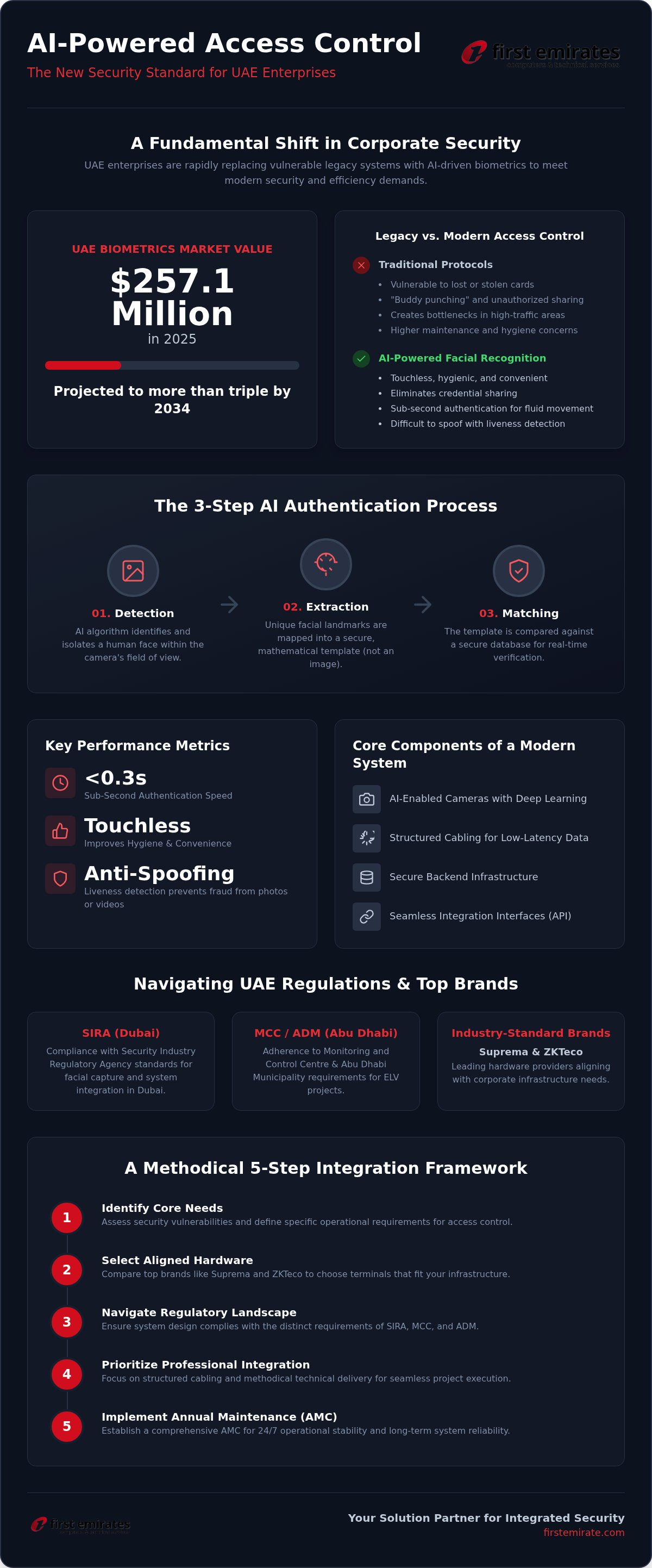
The UAE biometrics market reached a value of USD 257.1 million in 2025, a figure set to more than triple by 2034 as local enterprises replace vulnerable legacy systems. For corporate leaders, implementing facial recognition access control UAE is no longer a futuristic luxury but a necessary infrastructure upgrade to address the risks of lost cards and security bypasses. You likely recognize that traditional protocols are struggling to keep pace with the high-speed requirements of modern corporate environments and the stringent data privacy standards now in place.
It's a common challenge to manage disjointed security layers where your access control fails to integrate with existing CCTV or IT networks. This guide provides a methodical roadmap for deploying AI-powered systems that achieve sub-second authentication while maintaining full compliance with Federal Decree Law No. 45 of 2021. We'll examine the technical requirements for 2026, including the latest SIRA resolution standards for facial capture and the critical role of structured cabling. This systematic approach ensures your infrastructure remains integrated, reliable, and fully aligned with UAE security regulations.
Key Takeaways
- Identify the fundamental mechanisms of AI-driven authentication, including the three-step detection process and the role of liveness detection in preventing spoofing.
- Compare industry-standard biometric brands such as Suprema and ZKTeco to select hardware that aligns with your specific corporate infrastructure needs.
- Navigate the complex regulatory landscape of facial recognition access control UAE by reviewing the distinct requirements set by SIRA in Dubai and MCC/ADM in Abu Dhabi.
- Follow a structured five-step integration framework that prioritizes professional cabling and methodical technical delivery for seamless ELV project execution.
- Recognize the necessity of comprehensive Annual Maintenance Contracts (AMC) to ensure 24/7 operational stability and long-term reliability for your security systems.
The Shift to Facial Recognition Access Control in the UAE
The transition toward facial recognition access control UAE represents a fundamental shift in how corporate and government entities manage physical security. Unlike legacy systems that rely on physical tokens or contact-based biometrics, a modern facial recognition system utilizes AI-driven algorithms to identify individuals based on unique physiological characteristics. This technology has moved from a niche security feature to a central component of integrated ELV projects across the region.
Traditional PINs and proximity cards are increasingly viewed as security liabilities. They're easily lost, stolen, or shared between employees, which compromises the integrity of the restricted area. Fingerprint scanners, once the standard for high-security biometrics, now face scrutiny due to hygiene concerns and higher maintenance requirements. In contrast, AI-powered facial recognition offers a touchless, highly secure alternative that's difficult to spoof. By 2026, adoption rates in the UAE corporate and government sectors have accelerated, driven by the need for faster, more reliable authentication methods that align with national digital transformation goals.
The core benefit of this shift is the achievement of sub-second authentication. In high-traffic environments, modern terminals can verify an identity in less than 0.3 seconds. This speed allows for the fluid movement of personnel, ensuring that security protocols don't become an operational bottleneck. It's a methodical solution for businesses that prioritize both safety and efficiency.
Why Touchless Security is Now the UAE Standard
Operational efficiency is a primary driver for this adoption. In the large office towers of Abu Dhabi and Dubai, traditional card-swipe systems often create significant bottlenecks during morning peak hours. Facial recognition removes the need for physical interaction or searching for badges, which significantly reduces queue times at entry points.
Security integrity is also vastly improved. The technology effectively eliminates "buddy punching" and unauthorized card sharing. Because the credential is the individual's face, it can't be handed off to a colleague or visitor. Additionally, the permanent shift toward contact-free interaction supports long-term health and hygiene protocols within the workplace, making it a preferred choice for modern facility management.
Core Components of a Modern System
A professional implementation requires more than just a standalone camera. It's a systematic technical project that involves several critical layers. First, AI-enabled cameras with deep learning algorithms are necessary to distinguish between a live human and a 2D photograph or video. These units must be supported by robust structured cabling to ensure low-latency data transmission and consistent power delivery.
The backend infrastructure stores secure feature templates rather than raw images, which is essential for data privacy and compliance with local regulations. Finally, these systems must feature seamless integration interfaces. This allows the facial recognition terminal to communicate directly with turnstiles, speed gates, and existing IT networks, creating a unified and responsive security environment.
Technical Mechanism: How AI Ensures Secure Authentication
The effectiveness of facial recognition access control UAE is grounded in a precise, three-stage technical workflow. First, the system performs "Detection," where the AI identifies a human face within the camera's field of view. Next is "Extraction," a process where the software maps unique facial landmarks, such as the distance between eyes or the contour of the jawline, to create a mathematical template. Finally, "Matching" compares this digital signature against a secure database in real time. The reliability of these algorithms is frequently measured by the Face Recognition Vendor Test (FRVT), which evaluates how commercial solutions handle diverse demographics and environmental variables.
Integrating facial recognition access control UAE into your facility also requires a clear understanding of modern processing standards. In 2026, the industry has shifted toward Edge-AI. Rather than sending data to a central server for processing, the terminal handles the heavy computation locally. This reduces authentication latency to under 0.3 seconds and enhances data privacy. For UAE businesses, hardware must also include advanced lighting compensation. Harsh sunlight near glass entrances can wash out images, so professional units utilize Wide Dynamic Range (WDR) sensors to ensure consistent performance regardless of the time of day.
Anti-Spoofing and Liveness Detection Technology
Modern terminals distinguish between a real person and a high-resolution photo or video through multi-layered liveness detection. 3D depth sensing is the preferred standard for high-security areas, as it measures the physical contours of the face to prevent 2D spoofing attempts. IR (Infrared) sensors further bolster this by capturing thermal signatures and performing texture analysis that works even in low-light conditions. Liveness detection serves as the primary barrier against biometric fraud by ensuring the system only authenticates a physical, present human being.
The Role of ELV and Structured Cabling
A common oversight in biometric deployment is neglecting the underlying network infrastructure. High-speed matching requires a robust foundation. Utilizing structured cabling services UAE ensures that data travels across Cat6 or Fiber optics without the bottlenecks that plague older setups. This bandwidth is vital for real-time synchronization between multiple entry points and the central management software.
Professional panels typically require Power over Ethernet (PoE+), which delivers both power and data through a single cable. This methodical approach simplifies installation and improves system uptime by centralizing the power source. For organizations seeking a reliable rollout, our experts provide the technical readiness required for complex integrated ELV projects that stand the test of time.
Comparing Top Biometric Brands for the UAE Market
Selecting the optimal hardware for facial recognition access control UAE involves a systematic evaluation of brand capabilities against your specific operational environment. In 2026, the market is broadly divided between high-precision enterprise systems and versatile, cost-effective solutions for small to medium enterprises (SMEs). A critical factor for any UAE installation is hardware durability. Devices must withstand high ambient temperatures and humidity, particularly for outdoor or semi-outdoor deployments at site entrances. We prioritize brands that offer IP65-rated enclosures and advanced thermal dissipation to ensure long-term stability in the local climate.
Suprema vs. ZKTeco: Technical Benchmarks
Suprema is frequently the choice for organizations requiring high-end precision and advanced encryption standards. Their terminals are known for sleek designs and superior matching algorithms that excel in complex lighting conditions. Conversely, ZKTeco offers a vast product range that provides significant versatility for various installation scales. Their systems are often preferred for their cost-effective integration and broad compatibility with third-party peripherals. For large-scale projects where video surveillance and access control must coexist on a single platform, brands like Hikvision and Dahua provide comprehensive video-integrated ecosystems. These brands allow security teams to manage both visual surveillance and biometric entry from a unified management interface.
Selecting Based on Technical Readiness
Technical readiness is the bridge between purchasing hardware and achieving a functional system. You must evaluate whether your current door controllers and electric locks are compatible with the new biometric terminals or if a complete ELV upgrade is necessary. Modern software platforms now support multi-site management, allowing a central security office in Abu Dhabi to manage access permissions for branches across all seven emirates in real time. Scalability is a mandatory requirement; a system that works for a single door should be capable of expanding to 500+ sites without a total infrastructure overhaul.
Choosing a partner who understands these technical nuances is as important as the hardware itself. For a more detailed breakdown of how to vet providers, refer to our access control system company guide. This methodical selection process ensures that your investment in facial recognition technology provides both security and operational longevity. We focus on delivering solutions that are technically sound and fully supported through comprehensive Annual Maintenance Contracts (AMCs), providing the steady hand required for complex security landscapes.
UAE Regulatory Compliance: SIRA, MCC, and ADM
Regulatory compliance is a non-negotiable pillar of any professional facial recognition access control UAE deployment. In the United Arab Emirates, security standards are governed by emirate-specific authorities, which requires a methodical approach to system design and hardware selection. Federal Decree Law No. 45 of 2021 classifies facial images as sensitive personal data. This classification necessitates explicit consent from individuals and secure, encrypted storage protocols to prevent unauthorized access. Working with a locally licensed integrator ensures that your installation avoids legal complications and meets the rigorous audit requirements of UAE authorities.
Compliance is not a one-time event but a continuous commitment to operational standards. Local regulators require that biometric systems remain functional and integrated with broader security networks. For organizations operating across emirates, understanding the nuance between Dubai and Abu Dhabi regulations is essential for maintaining a unified security posture. Our team provides the technical oversight required to ensure your biometric access control installation adheres to these evolving legal frameworks.
SIRA Compliance for Dubai Businesses
The Security Industry Regulatory Agency (SIRA) sets the benchmark for security installations in Dubai. As of 2026, SIRA has updated its CCTV resolution requirements to ensure facial recognition accuracy. New commercial projects generally require a minimum of 4MP resolution for standard surveillance, while areas designated for facial capture often necessitate 8MP or higher. SIRA-compliant systems must also maintain strict uptime standards and utilize hardware from the agency's approved list. For insights into managing these standards across different regions, you can consult a SIRA approved CCTV company Abu Dhabi to ensure your multi-emirate infrastructure remains consistent and legally sound.
Abu Dhabi Monitoring & Control Centre (MCC) Standards
Abu Dhabi's regulatory landscape is managed by the Monitoring & Control Centre (MCC) and the Abu Dhabi Municipality (ADM). These bodies focus heavily on critical infrastructure and high-security zones within the capital. Commercial buildings in Abu Dhabi must integrate their biometric solutions with centralized monitoring systems to facilitate rapid incident response and data sharing when required. MCC standards require detailed documentation and immutable audit trails for all biometric access logs. This systematic record-keeping is essential for periodic security audits and ensures that your facility adheres to the highest safety protocols in the region. In May 2026, SIRA announced a new AI platform for security consultations, highlighting a broader national trend where AI-driven risk analysis is becoming a standard part of the regulatory approval process.
A Methodical Approach to Face Recognition Integration
Implementing facial recognition access control UAE is a strategic infrastructure investment that requires a lifecycle-oriented approach. It's not merely a hardware installation; it's the integration of AI-driven security into the core of your facility's operational framework. One of the most significant advantages of this technology is its ability to streamline HR automation through Time and Attendance integration. By linking biometric logs directly to payroll and management software, organizations can eliminate manual errors and gain precise data on personnel movement. This systematic integration ensures that your security investment also serves as a high-value tool for administrative efficiency.
The 5-Step Professional Installation Process
Our team follows a disciplined, five-stage framework for every ELV project to ensure technical readiness and long-term stability. This methodical process covers every detail from the initial physical assessment to the final handover:
- Site Survey & Infrastructure Audit: We perform a comprehensive check of existing power sources and structured cabling to ensure the network can handle the data requirements of sub-second biometric matching.
- System Design: Our engineers select the appropriate liveness detection levels and calculate precise camera mounting angles to mitigate the effects of the UAE's intense ambient lighting.
- Implementation: Technicians execute the professional installation of biometric panels and the supporting network infrastructure, adhering to strict industry standards for cabling and hardware placement.
- Configuration: This stage involves the secure setup of the database and initial user enrollment, ensuring that all biometric templates are encrypted in accordance with UAE data privacy laws.
- Testing & Handover: We conduct rigorous stress-testing to verify authentication accuracy and speed, ensuring the system performs reliably under peak traffic conditions before the project is finalized.
Ensuring Long-Term Reliability with AMC
The precision of AI-powered systems depends on consistent hardware calibration and software optimization. In the UAE's unique climate, environmental factors like heat and dust can eventually affect sensor sensitivity and terminal performance. Routine maintenance is essential to prevent system failures or unauthorized lockouts. A steady, proactive approach to system health ensures that the deep learning algorithms continue to function with high accuracy as your database grows.
To support this, we provide dedicated support through Annual Maintenance Contracts (AMC) designed for critical security assets. These contracts include regular firmware updates, hardware cleaning, and priority technical support to ensure your infrastructure remains operational 24/7. You can learn more about our IT AMC services Abu Dhabi for security assets to understand how methodical maintenance protects your technology investment. This commitment to lifecycle support provides the peace of mind that comes from knowing your facility is managed by seasoned technical experts.
Securing Your Corporate Infrastructure for 2026
Implementing a robust facial recognition access control UAE system requires a balance of technical precision and regulatory adherence. By focusing on advanced liveness detection and high-speed Edge-AI processing, businesses can eliminate the vulnerabilities of legacy card systems. Compliance with SIRA and MCC standards remains the essential benchmark for legal and operational success in the region. A systematic five-step integration process, supported by professional structured cabling, ensures that your security infrastructure is both scalable and reliable over the long term.
Since 2011, First Emirates Computers has served as a dependable partner for complex ELV projects. As expert ELV integrators in Abu Dhabi, we specialize in delivering SIRA-compliant solutions that meet the highest technical standards. Our methodical approach provides the stability and technical readiness required to protect your assets and streamline your facility's operations. To ensure your system is professionally designed and maintained, Request a Methodical Security Consultation from First Emirates Computers. We look forward to helping you establish a secure and efficient environment for your organization.
Frequently Asked Questions
Is facial recognition access control legal for private businesses in the UAE?
Facial recognition is legal for private businesses in the UAE, provided they adhere to Federal Decree Law No. 45 of 2021. This law requires companies to obtain explicit, informed consent from individuals before processing their biometric data. Businesses must also ensure that data is stored securely and used only for its intended purpose. Compliance involves maintaining a transparent privacy policy and working with a licensed integrator to ensure all local security regulations are met.
Can facial recognition systems work for employees wearing face masks or glasses?
Modern systems effectively identify employees wearing face masks or glasses by focusing on the periocular region and upper facial features. AI algorithms utilize deep learning to map unique landmarks around the eyes and forehead that remain visible even with facial coverings. During the enrollment phase, the system captures multiple data points to ensure high accuracy. This capability is standard in professional-grade facial recognition access control UAE terminals used in high-traffic office environments.
How fast is the authentication process for face recognition access control?
The authentication process typically takes less than 0.3 seconds for modern Edge-AI terminals. This sub-second response time is achieved by processing biometric data locally on the device rather than sending it to a remote server. High-speed authentication prevents bottlenecks at turnstiles and entry gates, allowing for the fluid movement of large staff volumes. For optimal performance, the underlying structured cabling must support high bandwidth to synchronize logs with the central management software in real time.
Does facial recognition work in low-light or outdoor UAE conditions?
Professional systems work reliably in low-light and harsh outdoor UAE conditions through the use of Infrared (IR) sensors and Wide Dynamic Range (WDR) technology. IR sensors allow the camera to see in total darkness by capturing thermal signatures, while WDR compensates for the intense sunlight and deep shadows common in Abu Dhabi and Dubai. These features ensure consistent identification accuracy regardless of the time of day or the presence of high-contrast backlighting at building entrances.
What happens to the access control system if the internet goes down?
The access control system continues to function normally if the internet connection is lost. Professional terminals utilize local storage and Edge-AI to process authentication requests independently of the central server. All access logs are stored internally on the device's memory and automatically synchronize with the main database once the connection is restored. This decentralized architecture ensures that your facility remains secure and accessible even during network disruptions or IT maintenance periods.
Can face recognition systems be integrated with existing fire alarm systems?
Facial recognition systems integrate seamlessly with existing fire alarm panels through dry contact relays or specialized ELV interfaces. In the event of a fire emergency, the alarm system triggers a signal that automatically releases all electromagnetic locks or opens speed gates for safe egress. This fail-safe mechanism is a mandatory safety requirement in most UAE commercial buildings. It ensures that biometric security measures never compromise the rapid evacuation of personnel during a life-safety event.
How secure is the biometric data stored in these systems?
Biometric data is extremely secure because the system stores mathematical templates rather than actual photographs of faces. These templates are generated using one-way encryption algorithms, meaning a raw image can't be reconstructed from the stored data. Most enterprise-grade systems utilize AES-256 encryption for both data at rest and data in transit. This methodical approach to data protection ensures that even if the database is accessed, the biometric information remains unusable to unauthorized parties.
What is the difference between SIRA-approved and standard access control?
SIRA-approved systems are specifically certified to meet the legal requirements set by the Security Industry Regulatory Agency in Dubai. Unlike standard systems, SIRA-compliant installations must use hardware from an approved list and adhere to strict recording resolution and uptime standards. For many commercial sectors in Dubai, using a SIRA-approved solution is a prerequisite for obtaining or renewing a trade license. These systems undergo rigorous testing to ensure they provide the reliability required for public safety.


