

The best visitor system is not necessarily the one with the longest feature list. It is the one that fits your office’s entry process. When comparing guest access management solutions for offices Abu Dhabi, focus on how visitors move from arrival to approval and onward access, and how staff maintain oversight at each stage.
Inconsistent check-in procedures can make entry harder to manage, while a visitor workflow that stands alone may not align with physical access controls. Start by mapping the visitor journey, then match its requirements to the site’s doors, security systems, and infrastructure.
This guide explains how to define a practical visitor process, compare capabilities against office needs, and consider how guest workflows relate to biometric access control, CCTV, and ELV infrastructure. It also covers installation planning and ongoing maintenance for offices in Abu Dhabi and across the UAE. By documenting daily procedures and site requirements, you can compare options based on fit rather than feature count.
Key Takeaways
- Define the visitor journey and host responsibilities before selecting a system, so entry procedures are consistent and clear.
- Understand how visitor administration and physical access control serve different roles, and where they can support the same security process.
- Compare guest access management solutions for offices Abu Dhabi against your visitor workflow, access points, oversight needs, and site infrastructure.
- Plan installation around door locations, cabling routes, existing systems, and daily office operations.
- Consider how biometric access control, CCTV, ELV infrastructure, and ongoing maintenance fit into a practical office security plan.
Guest Access Management for Abu Dhabi Offices: What Problem Should It Solve?
Guest access management covers the policies, processes, and systems that govern how visitors enter an office, who is responsible for them, and where they may go. Employee access control manages staff permissions; guest access management governs the visitor journey from arrival through departure. The first defines ongoing access rights for employees. The second sets out how the office handles different visitors and applies procedures consistently.
The goal is not simply to open a door. An office needs a controlled entry point, a clear host or staff member responsible for each guest, and a procedure for exceptions such as an unannounced arrival. Access control hardware and infrastructure can support authorised movement through selected doors, but they do not decide who is expected, who approves entry, or what happens when a visit ends. Define those responsibilities in the visitor workflow first.
The visitor workflow is one part of a broader physical security plan. The Physical Security Principles reference offers useful context for considering how people, procedures, and the built environment work together. In an office, that means planning reception alongside door locations, restricted areas, and staff movement through the premises.
Which office visitor scenarios need a managed process?
Separate visitor types before writing procedures. A scheduled meeting has an expected host and purpose. A reception arrival may need staff to identify the right contact. A contractor may need access to a specific work area, while a recurring visitor may use a familiar process without being treated as an employee. For each category, define who approves entry, which areas are relevant, and who remains responsible for the guest.
Visitor volume, operating hours, and the number and location of entry points also shape the process. A single reception desk serving one entrance has different oversight needs from an office with several doors or activity outside reception hours. Base procedures on the actual layout and business operations rather than assuming every guest arrives the same way.
What should a secure guest journey achieve?
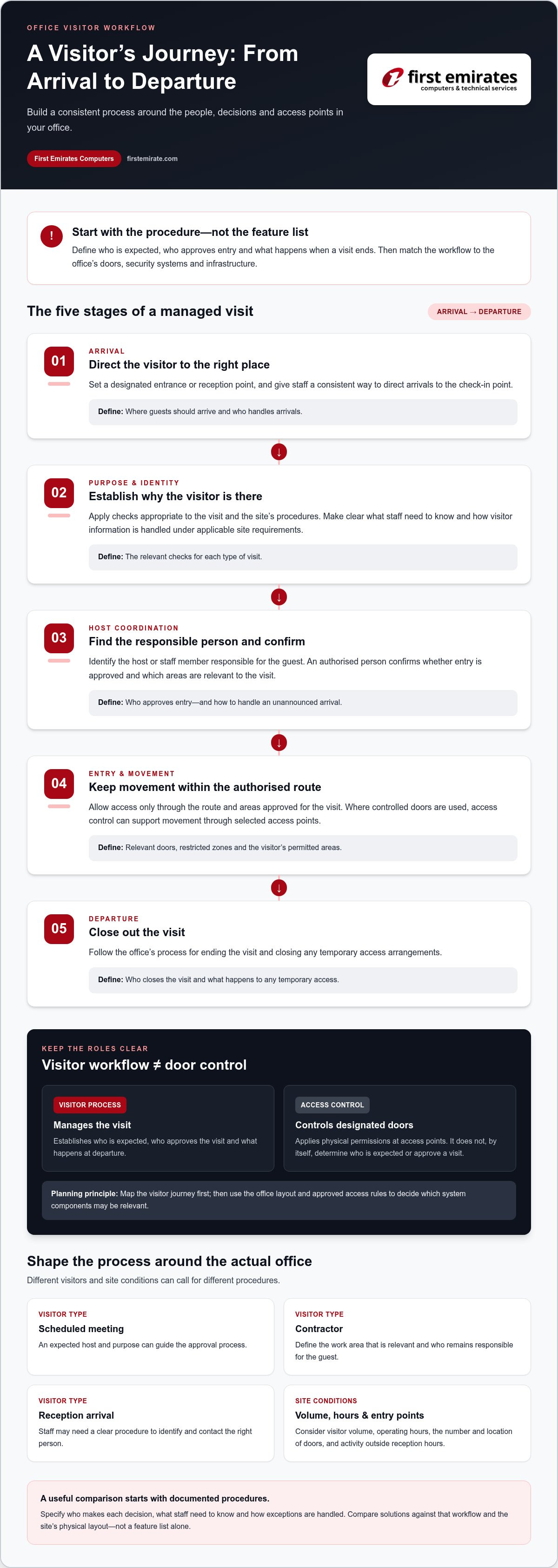
A practical journey gives staff a consistent sequence to follow while allowing for site-specific checks:
- Arrival: Direct the visitor to the designated entrance or reception point.
- Purpose and identity: Apply checks appropriate to the visit and the site’s procedures.
- Host coordination: Identify the person responsible for the guest and confirm whether entry is approved.
- Entry and movement: Allow access only through the route and areas authorised for that visit.
- Departure: Close out the visit according to the office’s process.
Identity checks and any collection or handling of visitor information must follow applicable site requirements. For each stage, specify what staff need to know, who makes the decision, and how exceptions are handled. This gives guest access management solutions for offices Abu Dhabi a practical basis for comparison: the solution should fit the office’s visitor procedures and physical layout, not force the office to build its workflow around a list of features.
How Guest Access Connects with Office Access Control in Abu Dhabi
A visitor process and a door control system address different decisions. The process determines who is expected, who approves the visit, and what should happen at departure. Access control determines whether a door permits movement into a designated area. For example, a receptionist may confirm that a contractor has arrived, while access control helps restrict movement to areas relevant to the work.
The guest process identifies which system components may be relevant; the office layout and approved access rules then shape how those components are planned. This distinction helps offices assess guest access management solutions for offices Abu Dhabi without treating visitor administration software and physical access control as interchangeable.
Where does access control fit into visitor entry?
Map the visitor journey before assigning technology to it. At each stage, identify the person responsible and the decision that needs to be made:
- Arrival: The visitor reaches the designated entrance. Staff need a consistent way to direct arrivals to the right check-in point.
- Visit confirmation: The office establishes the visitor’s purpose and host. This is a visitor administration decision, not a door-control function.
- Entry approval: An authorised person decides whether the guest may proceed and which areas are relevant to the visit.
- Movement: If the office uses controlled doors, access control can support movement through approved access points. Door locations and restricted zones inform the design.
- Departure: Staff follow the office’s process for ending the visit and closing any temporary access arrangements.
Managing a visit means handling its record and workflow; controlling a door means applying physical permissions at an access point. One does not automatically provide the other. First Emirates Computers provides biometric access control for physical access planning. Whether it belongs in a guest-access project depends on the office’s requirements and the role assigned to each door, not on an assumption that visitors should use employee access methods.
When should CCTV and ELV infrastructure be considered?
CCTV may suit a site’s security oversight needs, for example by providing visibility around relevant entrances. It does not identify a visitor’s host, approve a meeting, or replace a defined arrival procedure. Consider its role alongside the office’s security objectives and applicable site requirements.
Door control, CCTV, and supporting ELV infrastructure can be planned as parts of a coordinated project. Structured cabling planning helps account for routes and infrastructure needs, while the site design determines how systems should be arranged. Assess compatibility with existing equipment during project planning rather than assuming it. For a closer look at access control considerations, consult this access control system selection guide.
For an office project, First Emirates Computers can plan biometric access control, CCTV, and relevant ELV infrastructure around site requirements. Explore Abu Dhabi access control and security solutions as part of that planning.
How to Compare Guest Access Management Solutions for Your Office
Start your comparison with operating requirements, not a catalogue of features. For guest access management solutions for offices Abu Dhabi, document what staff need to do, which physical areas are involved, and what infrastructure is already in place. Then match each requirement to a stated system capability and a project deliverable. If a requirement has no clear match, resolve it in the project scope rather than assuming it is covered.
Separate essential requirements from optional capabilities. Essentials are the procedures the office needs to run consistently, such as identifying the responsible host, managing entry at each relevant access point, and assigning oversight. Optional capabilities should affect the decision only when they address a defined operational need. This keeps feature count from becoming a substitute for practical fit.
| Comparison area | What to assess | What to document |
|---|---|---|
| Visitor process | How different visitor categories are handled from arrival to departure. | Required steps, staff responsibilities, and exception procedures. |
| Access points | Which entrances and internal doors are relevant to visitor movement. | Door locations, controlled areas, and access decisions. |
| Oversight | Who manages visitor procedures and who is accountable for system administration. | Named roles, escalation responsibility, and routine oversight tasks. |
| Infrastructure | Existing access control, CCTV, cabling, and related site infrastructure. | Survey findings, cabling needs, and any dependencies in the project scope. |
| Support and scope | Installation, handover, documentation, and ongoing maintenance responsibilities. | Deliverables, ownership after installation, and support arrangements. |
Which requirements belong in an office solution brief?
Record visitor categories, expected arrival patterns, entry points, and operating procedures. Include relevant details about existing access control, CCTV, and network infrastructure, along with the roles responsible for visitor policy and day-to-day system administration. For example, distinguish a meeting guest from a contractor if their approval steps or permitted areas differ. This gives the project team a practical planning basis without presuming that a particular software feature is required.
How should buyers assess support and system continuity?
Compare the installation scope, handover process, system documentation, and responsibility for ongoing maintenance. A clear handover helps the office understand what has been installed and who manages routine administration. Include annual maintenance support in the long-term operating plan, particularly where access control, CCTV, or supporting infrastructure needs continuing attention. The IT AMC services Abu Dhabi guide provides further context on maintenance planning for business systems.
First Emirates Computers plans security and infrastructure projects around site requirements, with biometric access control, CCTV, ELV projects, and structured cabling among its services. A well-defined brief helps align those components with the office’s actual visitor procedures. Explore office access control and security solutions as part of your planning.
Planning an Abu Dhabi Office Guest Access Installation
A reliable installation starts with the visitor workflow and ends with a tested, documented handover. This sequence gives the project team a clear picture of the office’s needs before hardware, cabling, or other infrastructure is specified. Site conditions determine the final scope: door locations, cabling routes, existing systems, and daily office operations all shape the installation plan.
- Define the workflow: Document visitor categories, arrival procedures, approval responsibility, permitted routes, and how a visit is closed.
- Survey the site: Review reception, staff entrances, visitor paths, controlled doors, and the physical layout.
- Scope the infrastructure: Identify relevant existing access control, CCTV, and structured cabling, along with requirements for new infrastructure.
- Plan and install: Agree on work sequencing and coordinate installation around building procedures and office operations.
- Test and hand over: Check the installed system against the agreed scope, orient relevant users, and provide project documentation.
For guest access management solutions for offices Abu Dhabi, this sequence helps distinguish a generic equipment plan from an implementation shaped around how the office functions. Identify requirements affecting privacy, building access, and security, then verify them against current applicable rules for the site before finalising the project scope. Avoid relying on assumptions about which requirements apply.
What should an Abu Dhabi site assessment cover?
Walk the likely visitor route from the building entrance to reception and onward to the meeting or work area. Note staff entrances, controlled doors, operating hours, and points where visitors may need direction or staff approval. Review existing biometric access control, CCTV, and structured cabling where relevant. Coordinate the assessment with building management and the office’s internal security procedures so proposed work fits site access arrangements and operational needs.
A useful survey records constraints as well as requirements. For example, the location of a controlled door may affect the cable route, while the position of reception can influence how staff oversee arrivals. Document existing equipment so project planning accounts for it rather than assuming compatibility. Check any applicable privacy, building, or security requirements for the premises and project conditions.
How should installation and handover be organized?
Plan the work in stages to limit disruption to office activity. Coordinate access to work areas, agree on the intended sequence with relevant office and building contacts, and test each part against operational requirements before handover. User orientation should explain the procedures staff are expected to follow. Handover documentation should record the installed scope and the information needed for responsible system administration.
Continuity also needs a plan. Define who will oversee the system after installation, how maintenance responsibilities will be managed, and what documentation should be retained for future support. First Emirates Computers can plan relevant access control, CCTV, ELV, and structured cabling work around office requirements, with annual maintenance contracts for ongoing system support. Plan your office guest access installation with a site-specific view of workflow, infrastructure, and handover needs.
Guest Access Management Solutions for Offices: First Emirates Computers
Planning guest access means aligning the visitor process with the office’s physical security and infrastructure. First Emirates Computers is an Abu Dhabi-based security and IT infrastructure specialist, providing biometric access control, CCTV, ELV projects, and structured cabling. These services can form part of an office security project when they match the site’s requirements. Scope the relevant components around the building, existing systems, and operational needs rather than assuming every office needs the same arrangement.
For teams assessing guest access management solutions for offices Abu Dhabi, a project-specific approach connects policy decisions to practical site conditions. The visitor process determines what staff need to manage; the office layout and security plan help determine which physical access and infrastructure components are appropriate. Assess any proposed relationship with existing systems during project planning rather than presuming compatibility.
How can access control and infrastructure be planned together?
Begin with the office’s access points and the movement permitted through each area. Consider biometric access control for relevant doors, and include CCTV where it supports the site’s security oversight requirements. These systems have distinct functions, so the plan should describe the intended role of each and how it relates to office procedures. ELV requirements and structured cabling can also be scoped as part of the wider infrastructure work, based on routes, equipment locations, and the existing site setup.
Structured cabling is an important planning consideration where systems need supporting infrastructure. Reviewing pathways and existing cabling alongside the proposed security scope helps define project requirements before installation. For broader infrastructure considerations, the structured cabling companies in Abu Dhabi guide provides related context.
A clear project scope should describe site conditions, relevant system categories, and intended deliverables. This creates a practical basis for coordinating access control with CCTV and ELV requirements, while keeping visitor procedures distinct from the hardware that supports controlled movement.
Why include long-term maintenance in the decision?
Installation is only one stage of a security project. The office should also define who is responsible for system administration, what documentation will be handed over, and how ongoing maintenance will be managed. Clear records of the installed scope and system responsibilities help staff understand what is in place and support continuity as office needs change.
First Emirates Computers offers annual maintenance contracts to support ongoing system reliability. Including maintenance responsibilities in the project plan connects installation with longer-term operation, whether the scope includes access control, CCTV, or related ELV infrastructure. The arrangement should reflect the systems installed and the office’s operational requirements.
For a project planned around your office layout, existing infrastructure, and security needs, discuss an Abu Dhabi office security project with First Emirates Computers.
Set a Clear Direction for Your Office Security Plan
Turn visitor procedures into a practical project brief. Identify the decisions staff must make, the areas visitors may enter, and the site conditions that could shape implementation. This gives your team a clear basis for discussing guest access management solutions for offices Abu Dhabi and keeps the scope focused on operational needs rather than features that do not serve the office.
First Emirates Computers supports office security planning through biometric access control, CCTV, ELV project implementation, and structured cabling. Annual maintenance contracts can also form part of the longer-term support plan. The right scope depends on the office layout, existing infrastructure, and operating requirements, with system responsibilities and handover needs addressed during project planning.
Move forward with a defined brief and a site-specific approach. Discuss your Abu Dhabi office security requirements with First Emirates Computers and take the next step toward a well-planned office security project.
Frequently Asked Questions
What is guest access management for an office?
Guest access management is the office’s organised way of handling visitor entry, approval, and movement. It assigns responsibilities and sets procedures for different visit types. For example, a meeting guest may be directed to a host, while a contractor may need approval for a specific work area. The process is broader than operating a door or recording a name: it establishes how staff handle expected and unexpected arrivals consistently.
Can office guest access management work with an existing access control system?
It may be possible, but the project team needs to assess the existing system, relevant doors, and intended visitor workflow before defining how they relate. A visitor process can determine who approves entry, while physical access control governs movement through controlled doors. For guest access management solutions for offices Abu Dhabi, document system details and site requirements early so compatibility and infrastructure dependencies can be evaluated rather than assumed.
How does biometric access control support office visitor security?
Biometric access control can support physical access decisions at selected doors, based on the office’s security plan. It should not automatically be treated as a visitor registration or approval process. For instance, an office might use biometric controls for staff-only areas while reception staff manage guest approval separately. The appropriate design depends on the access policy, the door’s purpose, and how the office distinguishes employee permissions from visitor procedures.
Can CCTV be used alongside guest access management in an Abu Dhabi office?
Yes, CCTV can be considered as a separate security layer alongside guest procedures when it suits the office’s requirements. For example, cameras may provide oversight of an entrance, while staff remain responsible for confirming a visitor’s purpose and host. CCTV does not replace entry rules or approval decisions. The planned use and handling of footage should be assessed against applicable requirements for the specific premises.
What information should an office prepare before planning guest access installation?
Prepare a site plan or door list, visitor categories, expected arrival patterns, operating procedures, and the staff roles responsible for approvals and administration. Record existing access control, CCTV, and cabling that may affect the project. Also note operational constraints, such as areas that must remain accessible during installation. This information helps the project team define a scope based on actual site conditions.
How can a business manage guest access across multiple office entrances?
Set a consistent visitor policy across entrances, then document differences in staffing, hours, visitor types, or restricted areas. Assign responsibility for each entry point and establish how staff handle arrivals when the usual contact is unavailable. A site plan identifying each entrance and controlled door can clarify where procedures apply. The physical access design should reflect these requirements without assuming every entrance needs identical equipment.
What should an office include in guest access system handover documentation?
Handover records should describe the installed project scope, relevant equipment and door locations, system administration responsibilities, and procedures for routine use. Include available plans or cabling information, testing outcomes, and instructions provided during user orientation. Documenting maintenance responsibilities is also useful, so staff know how ongoing support is organised. Keep the records accessible to the people responsible for office security and facilities administration.


