

What if employees could feel safer without feeling constantly observed? For UAE workplaces, effective physical security isn’t about adding cameras everywhere. A thoughtful plan for workplace physical security systems UAE businesses use starts with site risks, operating hours, and the people moving through each space. It also pairs clear access procedures with surveillance that has a defined purpose.
Choosing measures for an office, warehouse, or mixed-use site can be challenging because each space has different needs. Entry points, visitor access, sensitive rooms, and after-hours activity all affect the plan. The goal is protection that works in the background without disrupting daily operations.
This guide explains how to match CCTV surveillance and biometric access control to workplace risks, consider privacy and staff confidence, and connect systems through ELV implementation and structured cabling. It also covers practical planning, employee procedures, and why annual maintenance matters after installation. Use it to build a clearer plan for protecting people, supporting operations, and keeping systems reliable over time.
Key Takeaways
- Plan security around site layout, operating hours, staff movement, visitors, and sensitive areas rather than adding surveillance without a clear purpose.
- Understand how CCTV, access control, ELV implementation, and structured cabling can work together as a coordinated system.
- Compare workplace physical security systems UAE businesses may use by their purpose, coverage, and impact on daily operations.
- Use a practical implementation process that includes gathering requirements, planning system placement, commissioning, and orienting employees.
- Build ongoing maintenance into the security plan to support dependable system operation over time.
Workplace Physical Security Systems in the UAE: Start with Employee Needs
Workplace security should make it clear who can enter, where visitors should go, and which areas have restricted access. In practice, workplace physical security systems UAE businesses use can combine electronic tools with straightforward procedures to protect people, premises, and controlled areas. CCTV surveillance, access control, and connected infrastructure each have a distinct role. The right mix depends on how the site is used.
More visible surveillance doesn’t automatically make employees feel safer. Cameras without a clear operational purpose may feel intrusive, while gaps in entry procedures can leave staff unsure what to do when an unfamiliar visitor arrives. Start by identifying specific concerns, such as unauthorized entry, visitors moving beyond reception, or access to storage and other sensitive areas. Then choose measures that address those concerns without monitoring more than necessary.
Proportionate workplace security protects people and controlled areas with measures matched to site risks, daily operations, and employee expectations.
Which workplace situations can create security concerns?
Different premises have different movement patterns. An office may need to manage a shared entrance and visitor check-in. A retail workplace may have staff-only storage near customer areas. A warehouse can have several access points and goods-handling zones, while a mixed-use site may need to distinguish between public, employee, and service areas. Building layout and shift patterns affect which entrances are active and when.
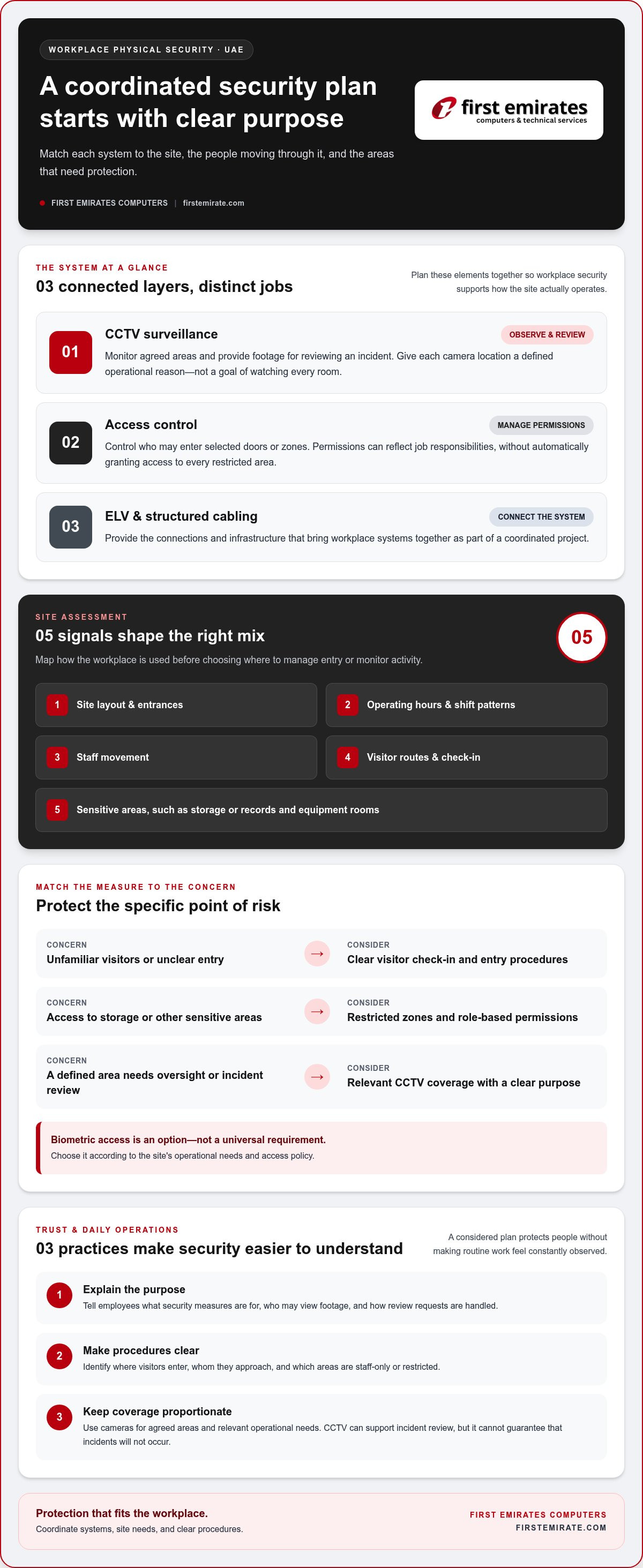
Map reception areas, shared entrances, storage rooms, and spaces used outside standard hours. Consider when staff arrive and leave, how visitors move through the premises, and where access should be limited. This assessment helps identify whether the priority is clearer entry management, oversight of a specific area, or both. Physical security can include CCTV and access control, used alongside appropriate procedures.
How can security measures support employee confidence?
Confidence grows when people know what to expect. A consistent visitor process, clearly identified staff-only areas, and simple instructions for reporting concerns can reduce uncertainty for employees and guests. Explain the purpose of access controls and how staff should follow them, especially when entrances or routines differ between shifts. Practical guidance makes procedures easier to use during a normal workday.
- Set out where visitors should enter and whom they should approach.
- Make restricted areas and entry expectations clear to employees.
- Explain the purpose of security measures in plain language.
CCTV can help monitor agreed areas and provide information for incident review, but cameras alone can’t prevent every incident or guarantee safety. Pair relevant coverage with clear responsibilities and usable procedures to give employees a more dependable framework. For workplace physical security systems UAE sites, the aim is a considered balance: enough visibility and access management to address real risks, without making routine work feel like constant surveillance.
How CCTV, Access Control, and ELV Systems Work Together
CCTV, access control, and the infrastructure connecting them perform different jobs. CCTV can monitor agreed areas and provide footage for reviewing an incident. Access control manages who is permitted to enter selected doors or zones. ELV project implementation and structured cabling provide the connections and infrastructure needed to bring workplace systems together. Planning these elements as one project helps avoid isolated devices that don’t fit the way a site operates.
CCTV helps observe agreed areas and review events, while access control manages permissions at selected entrances and zones. Neither replaces clear workplace procedures. Used together, they can give an organisation a more consistent way to manage entry and understand activity in defined locations.
What should CCTV do in an employee-focused security plan?
Start with the operational reason for each camera location. A view of a shared entrance may help address an access concern, while monitoring a controlled storage area may support a review of activity there. The aim is relevant coverage, not cameras in every room. Consider how employees and visitors use each space, and avoid unnecessary observation of routine work.
Set out who may view footage, for what purposes, and how review requests are handled. Retention periods and viewing procedures should be considered through project-specific policy review, taking workplace needs and applicable requirements into account. Clear internal guidance helps staff understand how footage is managed and reduces uncertainty about surveillance. CCTV can support incident review, but it shouldn’t be treated as a guarantee that incidents won’t occur.
Where can biometric access control fit?
Biometric access control is one option for managing entry to designated areas. Permissions can reflect job responsibilities, allowing employees to enter the spaces needed for their roles without automatically granting access to every controlled zone. For example, a workplace might separate general office access from entry to a restricted records or equipment room. Biometrics aren’t a universal requirement; the choice should reflect the site’s operational needs and access policy. A guide to access control system selection can help businesses compare approaches.
Connected systems also rely on well-planned infrastructure. Structured cabling provides routes for system connections, while ELV implementation coordinates relevant low-voltage components within the wider project. Plan cable routes and equipment locations alongside camera positions and controlled doors. This can support a tidier installation and make system relationships easier to understand. The arrangement depends on the building layout, existing infrastructure, and selected equipment.
For businesses planning workplace physical security systems UAE, First Emirates Computers provides CCTV surveillance, biometric access control, ELV implementation, and structured cabling. See workplace security system options as you consider how these components can fit your site.
Choosing Workplace Physical Security Systems Without Undermining Trust
The right setup depends on what needs managing, what needs observing, and how the site functions throughout the day. CCTV can support monitoring and later review. Access control can manage entry permissions. A combined deployment brings both functions together, but also requires coordinated procedures and system oversight. No single configuration suits every workplace. Before selecting measures, workplace physical security systems UAE businesses use should be assessed against site layout, staff movement, visitor patterns, and sensitive areas.
Which system combination suits different UAE workplaces?
Use this comparison as a starting point, not a fixed specification. Access management focuses on who can enter particular areas; monitoring focuses on visibility in agreed locations. An assessment should account for operating patterns, building layout, and the practical demands of the business.
| Workplace type | Access management considerations | Monitoring considerations | Operational complexity |
|---|---|---|---|
| Office | Shared entrances, staff access, and restricted rooms | Defined entry points or specific operational areas | May increase with multiple departments or access zones |
| Customer-facing site | Distinguishing public areas from staff-only spaces | Selected customer or service areas, based on site needs | Visitor activity and busy periods affect procedures |
| Warehouse | Managing access to storage and work zones | Areas where visibility supports operational review | Layout, goods movement, and shift patterns shape planning |
| Shared premises | Separating permissions between businesses or occupants | Agreed common areas, with responsibilities clearly assigned | Coordination across occupants can add planning needs |
A CCTV-only approach may suit a site where observing defined areas is the main requirement. Access control may be more useful when the priority is restricting entry to selected zones. A combined setup can address both needs, but requires clear decisions about permissions, camera views, footage handling, and system administration. These choices should follow the project requirements rather than rely on a default package.
How can businesses balance monitoring and employee privacy?
Explain to employees what each measure is intended to do, where it operates, and who manages it. Give staff clear guidance on entry procedures and how to raise questions about system operation. Transparency makes security processes predictable, rather than leaving employees to guess why a camera or controlled entrance is in place.
Keep administration disciplined. Limit system access to authorized roles and define the business purposes for viewing footage or changing access permissions. Review those responsibilities when roles or site operations change, so access doesn’t remain broader than necessary.
- Document the purpose of each camera location and controlled entrance.
- Define who can view footage or administer access permissions.
- Review applicable UAE and site-specific requirements for each project.
Requirements can depend on the emirate, site, and type of project. Assess the current rules that apply rather than assuming one workplace’s arrangements automatically suit another. A proportionate design, clear communication, and assigned responsibilities help protect operational needs while supporting employee confidence.
How to Plan and Implement Workplace Physical Security Systems in the UAE
A reliable project starts with how the workplace actually operates, not with a predetermined list of devices. Map the site layout, entrances, visitor routes, restricted spaces, staff routines, operating hours, and employee concerns. Note where visibility may help operational oversight and where access permissions need to be managed. These requirements give the design team a practical basis for planning workplace physical security systems UAE businesses can use consistently.
What should a workplace security assessment establish?
The assessment should record business objectives, movement patterns, relevant environmental conditions, and areas requiring control or monitoring. It should also identify who approves system decisions and who manages permissions, footage access, and day-to-day procedures. A workplace in Abu Dhabi may have different layouts and operating needs from a site in another emirate, so plans should reflect the specific premises rather than assume one arrangement fits all.
- Gather requirements. Walk through the site and document entrances, shared areas, visitor movement, sensitive spaces, shift patterns, and employee concerns. Separate essential operational needs from optional measures.
- Develop the system design. Use the assessment to plan camera locations, controlled doors or zones, and user permissions. Consider how staff and visitors will move through the building and how the system should support those routines.
- Coordinate infrastructure. Plan cable routes, equipment locations, and connections before installation. Coordinating structured cabling with other ELV components helps align the infrastructure with the security design. A structured cabling guide for UAE businesses can provide further context on infrastructure planning.
- Install and configure. Install the planned CCTV and access control components, then configure camera views and permissions according to the agreed requirements. Record key system settings and assign administrative responsibilities.
- Commission and orient staff. Test the system against realistic operating scenarios, address issues, and explain the procedures employees need to follow.
How should commissioning and employee communication work?
Commissioning checks whether the installed system performs as intended in the workplace. Test camera views in the agreed areas, verify that access permissions match assigned roles, and check system connectivity. Walk through scenarios such as an authorized employee entering a restricted zone or a visitor arriving at reception. Document the results and make clear how staff can report a problem.
Before normal use, explain the purpose of the systems, relevant entry procedures, and who is responsible for administration. Requirements can vary by emirate, site, and project, so assess the current requirements for each location rather than treating an Abu Dhabi installation as a template for every UAE workplace.
First Emirates Computers supports workplace planning through CCTV surveillance, biometric access control, ELV implementation, and structured cabling. Plan your workplace security system around your site’s layout and operating needs.
Maintaining Workplace Security Systems with First Emirates Computers
Installation is only the starting point. Camera views, access permissions, and the infrastructure connecting workplace systems need ongoing attention to keep supporting the site’s operations. Planned maintenance can help identify changes in system condition or configuration before they become harder to manage. The appropriate scope and schedule depend on the equipment installed, how the workplace operates, and its environment.
What should ongoing workplace system care cover?
Maintenance should reflect the system design and the responsibilities assigned to workplace administrators. A practical review can consider whether cameras are functioning as intended, access permissions still match employee roles, and connected equipment communicates reliably. It can also cover the condition of relevant cabling and infrastructure, along with operational changes since the last review.
- CCTV: Check that cameras and agreed views remain usable for their intended purpose.
- Access control: Review permissions when staff roles, site zones, or entry procedures change.
- Connectivity: Assess connections between system components and the supporting infrastructure.
- System condition: Record issues and changes that may affect ongoing operation.
For example, a department move may change who needs access to a controlled room, while a revised visitor route may affect how an entrance is monitored. Planned reviews help keep system arrangements aligned with these changes. Maintenance should reflect the specific installation rather than rely on a generic checklist. An IT AMC services guide for Abu Dhabi businesses can also provide context on how ongoing maintenance planning relates to business continuity.
How can an integrated project support business continuity?
When CCTV, biometric access control, ELV components, and structured cabling are planned together, system relationships and responsibilities can be easier to document and oversee. Coordinated planning also helps teams understand which equipment supports each function and where to focus routine checks. It doesn’t remove the need for clear operating procedures, but it can make system ownership more straightforward.
First Emirates Computers provides UAE businesses with CCTV surveillance and biometric access control, alongside ELV project implementation, structured cabling, and annual maintenance contracts. These services can be planned around the needs of each workplace, whether the priority is managing selected entrances, monitoring agreed areas, or maintaining connected infrastructure.
For businesses planning workplace physical security systems UAE, include ongoing support in the project plan from the outset. Define who manages access permissions, who is responsible for system administration, and how maintenance findings will be recorded. These details help connect technical arrangements to everyday operations.
To discuss a workplace security project, share your site requirements with First Emirates Computers, including the spaces, operating patterns, and system needs the project should address.
Make Your Next Security Decision a Practical One
A workplace security plan should remain useful as your team, premises, and daily operations change. Identify what needs attention now, who will oversee the systems, and how you’ll review them over time. This keeps workplace physical security systems UAE businesses invest in aligned with real operational needs rather than treating security as a one-time installation decision.
First Emirates Computers supports workplace projects across the UAE from its Abu Dhabi base, bringing together CCTV surveillance, biometric access control, ELV implementation, structured cabling, and annual maintenance contracts. The right combination depends on your premises and priorities, with ongoing support considered as part of the plan.
Share your site requirements and operational priorities with the team to begin planning. Discuss your workplace security requirements with First Emirates Computers and take a considered next step toward a safer, more confident workplace.
Frequently Asked Questions
How can physical security systems make employees feel safer at work?
They can make daily routines more predictable when staff understand how entry and restricted areas are managed. For example, a clear process for reporting a door that won’t secure gives employees a defined action instead of leaving them uncertain. In workplace physical security systems UAE projects, explain procedures during onboarding and when systems change. Confidence comes from usable measures and clear responsibilities, not simply from adding more visible equipment.
What physical security systems are commonly used in UAE workplaces?
Common electronic measures include CCTV surveillance, access control, and the cabling and ELV infrastructure that connects workplace systems. A business might use access control at an entrance to a staff-only area and CCTV to monitor a defined operational location. The combination depends on the premises and its objectives. For UAE projects, businesses should also consider the requirements that apply to their emirate, site, and type of operation.
Is CCTV enough to secure a workplace?
No. CCTV can support observation and incident review, but it doesn’t manage who can enter a restricted room or tell employees how to respond to an access concern. For example, a camera may record activity near a storage area, while access permissions help control entry to it. Clear procedures and assigned responsibilities remain important. Decide what each measure is meant to address before relying on cameras as the main control.
Can biometric access control be used alongside CCTV?
Yes. Biometric access control and CCTV can serve complementary purposes: biometrics can manage entry permissions at designated doors, while cameras monitor agreed areas. A workplace might use access permissions for a records room and CCTV to review activity at a relevant entrance. Before combining them, define who administers permissions and who may view footage. The design should match the site’s operating routines rather than introduce extra steps employees can’t easily follow.
How should a business balance workplace security with employee privacy?
Explain what each system is used for, which areas it covers, and which roles can access its information. Tie camera placement to documented operational purposes, and avoid monitoring spaces where observation isn’t needed for those purposes. Set internal rules for footage access and review, then communicate them in plain language. Businesses should assess current UAE and site-specific requirements for their project instead of assuming a single rule applies everywhere.
How do businesses plan physical security for different workplace areas?
Assess each area according to its use and movement patterns. A reception may need a clear visitor check-in route, while an equipment room may require restricted entry and a defined process for authorized staff. Note shared doors, delivery routes, shift changes, and areas used by more than one team. This area-by-area record helps decision-makers set priorities and avoid applying the same level of control throughout a building.
How often should workplace security systems be maintained?
There isn’t one schedule that suits every installation. Maintenance timing should reflect the equipment, operating environment, and applicable project requirements. Businesses can also arrange a review after changes such as staff role updates, a reconfigured workspace, or recurring connection issues. Keep a record of checks and identified faults so follow-up is clear. Annual maintenance contracts can support ongoing technical care, with the scope aligned to the system and site.


