

A low per-drop figure can hide a very different installation scope. The structured cabling cost per drop Dubai businesses are quoted depends not only on the cable, but also on what the installer counts as a complete drop and the conditions at the site. It’s difficult to compare proposals when one includes termination and testing while another covers only part of the work.
Look beyond the headline figure. A useful comparison starts with a clear definition of each drop, including components, installation, testing, and exclusions. The route through the building, ceiling access, and whether the space is under fit-out or already occupied also affect planning and labour requirements.
This guide explains what a drop may include, which project factors influence an estimate, and how to compare Dubai installation quotes on consistent terms. It also covers how cable category and performance requirements relate to your current network and future needs. With a defined scope, you can plan structured cabling as part of a coordinated IT and ELV infrastructure project, rather than treating each connection as an isolated line item.
Key Takeaways
- Define each drop by its endpoint, cable route, termination, and testing scope before assessing a quote.
- The structured cabling cost per drop Dubai projects involve depends on design requirements and site conditions.
- Compare proposals against the same scope items, including labour, containment, labels, drawings, and handover.
- Prepare floor plans, outlet locations, equipment-room details, and fit-out timelines to support clearer project planning.
- First Emirates Computers provides structured cabling as part of coordinated IT and ELV infrastructure delivery.
Dubai Structured Cabling Cost per Drop: What's Included?
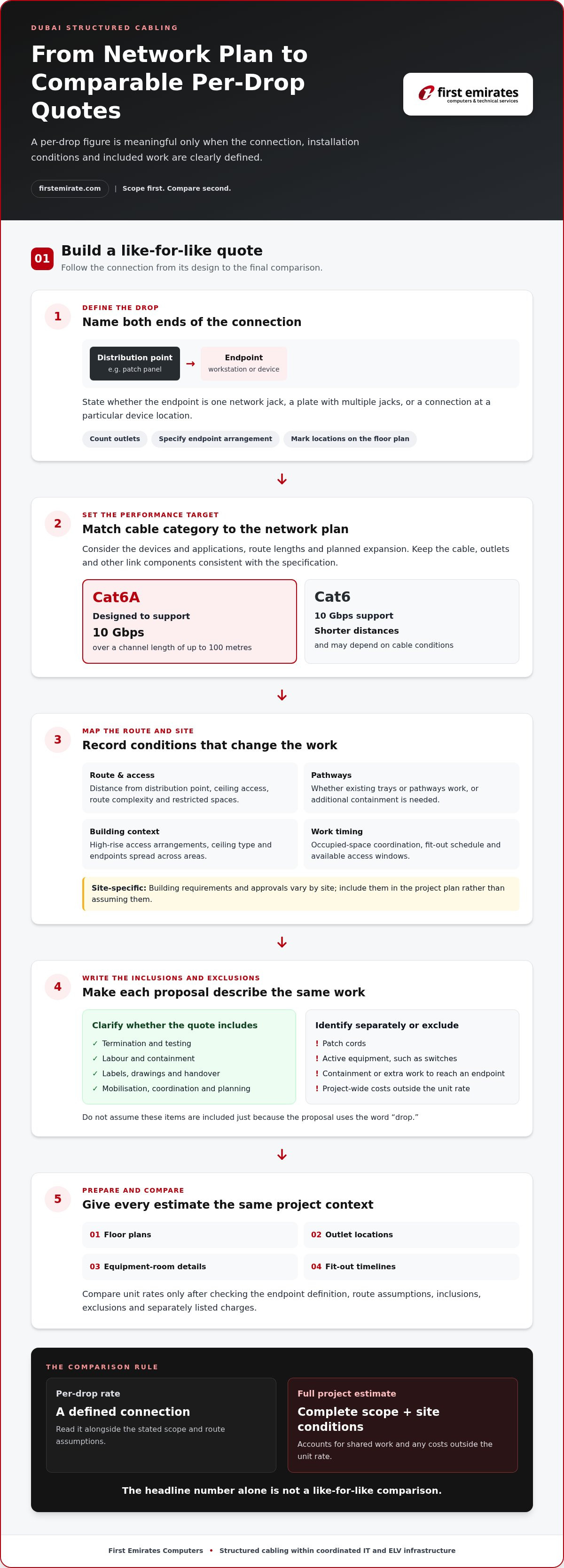
A structured cabling drop is a planned network connection from a distribution point to an endpoint, such as a workstation outlet or device connection. The term describes a connection, but it doesn’t mean every quote covers the same materials or tasks. One proposal may include a terminated outlet and testing; another may price the cable run separately from its endpoint work.
That distinction matters when reviewing the structured cabling cost per drop Dubai suppliers quote. A unit figure is useful for budgeting only when you know what it measures, the assumptions it relies on, and what falls outside the stated scope. Structured cabling comprises connected elements that form an organized infrastructure. The structured cabling overview provides wider context on its components and organization.
What counts as one structured cabling drop?
A typical horizontal connection runs from a patch panel or other distribution point to an outlet serving a workstation or device. The installed cable is one part of that path. Patch cords, which connect equipment at the outlet or patch panel, may be specified separately, as may active network equipment such as switches. Don’t assume these items are included just because a quote uses the word “drop.”
The endpoint also needs a clear definition. It could mean one network jack, an outlet plate with multiple jacks, or a connection at a particular device location. These configurations affect materials and termination work, so the scope should state the number of outlets and the endpoint arrangement at each location. A marked-up floor plan can help match the outlet count to the intended use of each space.
Ask the quote to distinguish installed horizontal cabling from patch cords and active equipment, and to state whether termination and testing are included. It should also identify exclusions, such as containment or additional work needed to reach an endpoint. Clear wording prevents unlike items from being compared as though they were identical.
Why a per-drop figure is not a complete project price
A unit rate rests on assumptions about the route and working conditions. A direct route above an accessible ceiling may require less effort than a longer path through restricted spaces or areas where new containment is needed. Ceiling access, distance from the distribution point, and the complexity of reaching each endpoint can all affect installation work.
Shared project costs may sit outside a per-drop rate. Mobilisation, site coordination, and planning can apply across the installation rather than to one connection. The quote should show whether these costs are included in the unit rate, listed separately, or treated as project-wide items.
A per-drop rate measures a defined connection; the full project estimate accounts for the complete scope, site conditions, and shared work. Read the figure alongside its inclusions, exclusions, route assumptions, and separate charges. That is the basis for a fair comparison, not the unit number alone.
Factors Shaping Structured Cabling Costs in Dubai
The cost of an installed drop reflects more than the cable selected. The design specification sets the materials and performance target, while the building and installation plan determine how much work is needed to connect each endpoint. That’s why the structured cabling cost per drop Dubai project teams see can vary with technical requirements and site conditions, even when the number of connections appears similar.
Cable specification, performance, and future capacity
Choose a cable category to meet the network application and planned performance, rather than upgrading automatically. Cat6A is designed to support 10 Gbps over a channel length of up to 100 metres; Cat6 support for 10 Gbps is limited to shorter distances and can depend on cable conditions. The right choice depends on the network design, route, and capacity needs. Standards such as TIA/EIA-568 and ISO/IEC 11801 should be referenced with their applicable editions verified. Resources from BICSI standards can also inform ICT infrastructure planning.
Specification affects the full scope, not just the cable. A higher-performance design may call for different components or installation practices, while an existing network plan may guide selection. Consider the devices and applications the cabling must support, route lengths, and planned expansion before settling on a category. The specification should be consistent across the cable, outlets, and other components in the link.
Dubai site conditions and installation coordination
Site conditions shape access, routing, and sequencing. In a high-rise, access arrangements and the distance between the equipment room and endpoints can affect planning. Ceiling type may determine how easily routes can be reached, while work in an occupied building may need careful coordination around people and ongoing operations. Fit-out schedules and available access windows also influence when tasks can be completed. Building-specific requirements and approvals vary by site, so include them in the project plan rather than making assumptions.
Containment is another practical consideration. Existing trays or pathways may accommodate the planned route, or the project may need additional containment. A route with several changes in direction, restricted ceiling access, or endpoints spread across separate areas can require more installation effort than a straightforward run. Accurate floor plans and site information help make these assumptions clear.
Endpoint scope also affects the work. A quote should distinguish the number of outlets from the number of jacks at each outlet, and state what is included for termination, testing, labelling, and documentation. These tasks take time and provide useful records for identifying connections and managing the installed system later. Specify them rather than treating them as implied parts of a drop.
- Design: cable category, performance target, and route length.
- Site: ceiling access, containment, endpoint locations, and work sequencing.
- Handover scope: outlet configuration, testing, labels, and project documentation.
The scope of an installed drop depends on both specified materials and site conditions. A clear project plan brings these factors together and makes the proposal easier to assess. First Emirates Computers provides structured cabling and ELV project implementation across the UAE. Discuss your structured cabling project to plan the requirements and installation scope.
How to Compare Dubai Structured Cabling Quotes Like for Like
A fair comparison begins with a shared scope, not the headline unit rate. Compare each proposal against the same endpoint count, cable specification, route assumptions, and installation deliverables. If one quote includes testing and documentation while another leaves them out, their per-drop figures describe different work. Use the checklist below to identify those differences before comparing totals.
The inclusions to check in every per-drop quote
Record the specified cable category, number of endpoints, and outlet arrangement. Note how route length is estimated, including whether the proposal assumes existing pathways or new containment. Then check whether termination, testing, labels, drawings, and handover records are included. These details define what is being priced and make missing scope easier to spot.
| Scope item | What to align across proposals |
|---|---|
| Cable category | Type and performance requirement for the planned application. |
| Endpoints | Number of locations, jacks per outlet, and outlet configuration. |
| Route assumptions | Route length, access conditions, and use of existing or new pathways. |
| Termination | Which ends are terminated and what outlet components are included. |
| Installation labour | Work covered by the rate and any separately stated project labour. |
| Containment | Whether trays, conduit, or other route provisions are part of the scope. |
| Testing and labels | Testing tasks, connection identification, and results records. |
| Drawings and handover | As-installed information and the records provided at completion. |
Check exclusions alongside the table. Patch cords may be separate from installed horizontal cabling, and active equipment such as switches is a different scope from passive cabling. Racks may also be priced independently. Record each exclusion rather than treating an unspecified item as included. Compare identical quantities and assumptions, then review project totals as well as unit rates.
How to assess technical value beyond the unit figure
Technical value depends on whether the proposal meets the same performance requirement and documents the same work. A lower figure may reflect a different cable category, fewer deliverables, or a route assumption that doesn’t match the site. Review how the installation is labelled and recorded, and whether the handover information will help identify connections during later changes. Assess future capacity against the specified design, not a broad claim.
Consider planned moves, additions, or changes when reviewing outlet locations and documentation. A clearly recorded layout can support future planning, but it doesn’t replace a defined capacity requirement. For broader project and provider context, see this guide to structured cabling companies in Abu Dhabi.
The structured cabling cost per drop Dubai proposals show is meaningful only when technical specifications, quantities, assumptions, and handover scope line up. A like-for-like review turns a headline comparison into a practical assessment of what the project will deliver.
What Information Should You Prepare Before Requesting a Dubai Cabling Quote?
A useful cabling brief connects the number and purpose of network points to the building layout and installation plan. For a Dubai site, include floor plans, outlet locations, equipment-room details, known access constraints, and fit-out timelines. Clear information helps define the structured cabling cost per drop Dubai project scope, though a fixed price depends on the site conditions and requirements.
Prepare the brief in sequence. Each step adds detail to align the requested work with the layout and project schedule.
- Define the endpoints. Count the intended network outlets and identify the workstations, devices, or areas each will serve. Mark the number of jacks at each outlet and distinguish planned connections from possible future points.
- Share the plans. Provide current floor plans with outlet locations and equipment-room details. Label relevant rooms and floors so the proposed connections can be understood in context.
- Identify routes and access. Mark known cable pathways, telecom rooms, ceiling access, and restricted areas. Note whether routes are visible, concealed, or dependent on access to shared spaces.
- Document requirements. Record the required cable performance, testing records, labels, drawings, handover format, and target fit-out dates. Include sequencing needs or coordination with other trades.
Map endpoints, pathways, and operational requirements
A plan is most useful when it shows how endpoints relate to the equipment room and likely cable routes. Identify ceiling types or access limitations where known, and flag areas that remain occupied during installation. If the cabling must fit into an active office or a defined fit-out programme, record relevant work windows and milestones. This helps plan the sequence without assuming every route has the same access conditions.
Include the location of racks or patch panels if known, along with details of existing pathways intended for use. In a multi-floor building, mark the floor and room for each endpoint. Include site access and building coordination in project planning, as requirements can differ between buildings and sites.
Set documentation, testing, and handover expectations
State what records you need at completion, such as test results, port labels, and as-built information. Specify the preferred handover format if your team has one. Also identify who will coordinate building access, work windows, and interfaces with other trades. These details make responsibilities and deliverables easier to define in the proposal.
Use the completed brief to request a clearly itemised structured cabling proposal from First Emirates Computers. A project discussion can address the requirements, site information, and installation sequence together. Discuss your structured cabling requirements with the project details prepared.
How First Emirates Computers Delivers Structured Cabling Projects
First Emirates Computers provides structured cabling and ELV project implementation for clients across the UAE. The company has operated since 2011, supporting business infrastructure projects by defining requirements, planning installation, implementing cabling, and documenting handover. For a Dubai site, this process connects the proposed work to the building layout and wider IT environment.
A scoped approach to structured cabling implementation
Project planning starts with the intended endpoints and their use. Outlet plans, equipment-room locations, network requirements, cable routes, access conditions, and fit-out timing help shape the work scope. These details also provide the basis for a clear proposal, since the structured cabling cost per drop Dubai teams consider depends on the specified work and site conditions.
Cabling can be planned as a standalone installation or as part of a broader IT or ELV infrastructure project. Coordinating these requirements helps align outlet locations and cable pathways with other project elements, rather than treating each connection as an isolated task. The installation plan can set out the work sequence, relevant site coordination, and records expected at handover.
Scope definition is essential before a unit rate can represent the work accurately. A per-drop amount cannot account for every route, access constraint, endpoint arrangement, or project-wide coordination item without stated assumptions. First Emirates Computers develops the project scope around the requirements and site information, rather than presenting a fixed figure before those details are established.
Plan the next step for your Dubai project
Before discussing the project, assemble the information that will help make the requirements clear:
- Outlet counts and endpoint locations, with the intended use of each area.
- Floor plans, equipment-room details, and known cable pathways or access constraints.
- Fit-out milestones and relevant building access or coordination arrangements.
- Required testing records, labels, drawings, and handover documentation.
This brief gives the project team a practical starting point for aligning the proposed cabling with the site and its operational needs. If cabling forms part of a wider ELV or IT requirement, include the related infrastructure context so the scope can be planned together. Building access and coordination arrangements are site-specific, so incorporate them into planning rather than making assumptions.
First Emirates Computers serves clients across the UAE with structured cabling and ELV project implementation. Share your Dubai site requirements, drawings, outlet details, and handover expectations to begin a focused project discussion. Discuss your structured cabling project.
Turn Your Cabling Plan into a Clear Project Scope
Use your requirements as a working brief, not just a request for a per-drop figure. A well-defined plan can help align network points with office use, equipment locations, fit-out sequencing, and future changes. That gives the project discussion a practical starting point and connects technical decisions to the way your site will operate.
Use the structured cabling cost per drop Dubai as one part of the evaluation, alongside the complete installation scope and handover requirements. With the key details prepared, you can discuss priorities, identify open site questions, and develop a proposal suited to your project rather than relying on a headline rate alone.
Discuss your structured cabling project with First Emirates Computers and take the next step toward a clearly planned installation. A considered scope gives your team a stronger foundation for infrastructure decisions as your workplace evolves.
Frequently Asked Questions
How much does structured cabling cost per drop in Dubai?
There isn’t one fixed rate for every Dubai installation. The structured cabling cost per drop Dubai projects require depends on the specified cabling, endpoint setup, route, site access, and work included in the proposal. For planning, prepare the outlet count, floor plans, and performance requirements, then assess the itemised estimate against those details. A per-drop figure without its assumptions cannot show the full project cost.
What is included in a structured cabling drop?
A drop generally refers to a network connection between a distribution point and a designated endpoint, but the included work varies by scope. For example, an outlet serving a workstation could have one jack or several, and that configuration affects what the connection comprises. Check whether the stated drop covers cable, outlet components, termination, testing, and patch cords. Switches and other active network devices are usually separate scope items unless specifically included.
Why do structured cabling quotes differ for the same number of drops?
Two proposals can count the same outlets yet describe different installation tasks. One may assume existing pathways and straightforward access, while another may account for a longer route, restricted ceiling access, or new containment. Differences in outlet configuration, cable specification, testing, and project coordination also affect the work being priced. Compare proposals using the same floor plan and endpoint schedule, and note assumptions that could change after site conditions are reviewed.
Does a per-drop quote include testing, labelling, and documentation?
Not necessarily. These deliverables should be stated in the written scope rather than inferred from a per-drop rate. Look for the type of testing, how outlets and ports will be identified, and what records will be handed over. For example, a project team may need test results linked to outlet labels and an updated record of installed connection locations. Defining the format early helps make the handover useful for the people who will manage the network.
Is Cat6 or Cat6A better for a Dubai office cabling project?
Neither category is automatically right for every office. Select the cable to suit the network application, performance target, route, and expected use of the space. A design for standard desk connections may have different requirements from one supporting specialised equipment or planned capacity changes. Document the intended applications and technical requirements before specifying a category, then apply that selection consistently across the project.
Can structured cabling be installed in an occupied office in Dubai?
Yes, installation can be planned for an occupied office, with sequencing coordinated around the site’s operations. For example, the project plan can identify affected rooms, access periods, and dependencies on other fit-out or maintenance work. Share restrictions on entering work areas and note when staff or equipment will be present. These details help the installation team plan routes and activities in context, while building-specific access arrangements remain part of site coordination.
How can I estimate the number of network drops my business needs?
Start by mapping each work area and listing the devices that need wired connections, such as desk locations, printers, and equipment in meeting rooms. Distinguish the number of outlet plates from the number of network jacks required at each location. Add shared devices to the plan and identify areas likely to change function. This inventory creates a reasoned starting count for project planning; the final layout should match your operational and network requirements.


